
Still Not Gone, Still NOT Clean
Posted: January 7, 2011 Filed under: Environment, Environmental Protection, Gulf Oil Spill, New Orleans, toxic waste | Tags: 10 year old poisoned by corexit, Marshes dying from BP Oil, no clean up crews for BP oil mess, Oil in the Gulf, petrochemicals in human blood 25 Comments
THEN.
Well, it’s time for my bimonthly rant about the total lack of concern by any one above the I-10 on the fact we’re still swimming in oil down here. The Cost Guard is still doing the Dosey-Do. Obama doesn’t swim here so he doesn’t care. There was some MSM press coverage.
Hello? Is any body there?
PORT SULPHUR, Louisiana — Federal and Louisiana officials got into a heated argument Friday over the cleanup of oiled marshes during a tour of an area that remains fouled 8½ months after the Deepwater Horizon rig explosion in the Gulf of Mexico.
State and Plaquemines Parish officials took reporters on a boat tour of Barataria Bay, pointing out an area where oil continues to eat away at marshes and protective boom is either absent or has been gobbled up by the oil. The heavily saturated area that reporters saw was 30 feet to 100 feet wide in sections. No cleanup workers were there when reporters toured the area.
The marshes are critical to the Louisiana coast because they protect the shore from hurricanes and serve as a nursery for Gulf sea life.
“This is the biggest cover-up in the history of America,” Plaquemines Parish President Billy Nungesser told reporters, gesturing with his gloved right hand, which was covered in oil.
Nungesser was accompanied by Robert Barham, the secretary of Louisiana’s Department of Wildlife and Fisheries.
As the two were answering questions from reporters, representatives from the U.S. Coast Guard and National Oceanic and Atmospheric Administration interrupted to point out that a plan is being developed to clean up the marshes. They also insisted that the government has not abandoned the Gulf, nor has it lost sight of the fact that BP is a responsible party.
“Clearly there is oil here in the marsh but we are working as a team to find a best way to clean it up,” said Coast Guard Lt. Cmdr. Dan Lauer. “It’s a high priority.”
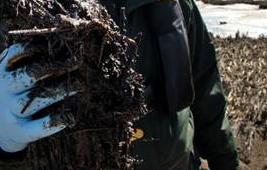
RIGHT NOW.
You could tell it’s a high priority.
There were no clean up crews.
There was oil everywhere.
People down here are getting pretty tired of the excuses.
We’ve heard enough of them since Katrina and Rita.
Saturday Reads: On the Bright Side of the Dark Side
Posted: January 1, 2011 Filed under: Civil Liberties, Environmental Protection, Health care reform, Hillary Clinton: Her Campaign for All of Us, Iraq, U.S. Politics, Women's Rights | Tags: 2011, Airport security, Aldous Huxley, Baby boomers, Brazil, Chris Hedges, Dilma Rousseff, Ellis Island, Jon Huntsman, No Profit Left Behind, Orwell, Rabindranath Tagore, Scott sisters, TSA 11 Comments
Pakistanis watch the New Year fireworks in Karachi on January 1, 2011. (RIZWAN TABASSUM/AFP/Getty Images)
Good evening and a Happy 2011, Sky Dancers.
Here are my Saturday offerings for the New Year. There’s a lot of doom and gloom in the headlines, so I tried to mix in a few stories and thoughts of my own to put things into a more motivating and thoughtful perspective.
From McClatchy: “2011 looks grim for progress on women’s rights in Iraq… BAGHDAD — When Iraqi Prime Minister Nouri al Maliki introduced what he called a national partnership government two weeks ago, he included allies and adversaries, Arabs and Kurds, Shiite Muslims and Sunnis. One group, however, was woefully underrepresented. Only one woman was named to Maliki’s 42-member cabinet, sparking an outcry in a country that once was a beacon for women’s rights in the Arab world and adding to an ongoing struggle over the identity of the new Iraq.“
From further down in the article: “After Maliki announced his lineup, Alaa Talabani, a female lawmaker from the northern Kurdistan region, delivered a rousing condemnation of the selection process to a packed legislative chamber. ‘The Iraqi women feel today, more than any other day, that democracy in Iraq has been slaughtered by discrimination, just as it was slaughtered by sectarianism before,’ Talabani said, her voice quaking with emotion.”
“…slaughtered by discrimination, just as it was slaughtered by sectarianism.” That is a powerful statement.
It reminds me of this Hillary quote: “To expand freedom to more people, we cannot accept that freedom does not belong to all people. We cannot allow oppression defined and justified by religion or tribe to replace that of ideology.” –Secretary of State Hillary Clinton, in Berlin for the 20th anniversary of the wall’s collapse
The words of both Alaa Talabani and Hillary Clinton above make me think of dry drunks and switching addictions. It is as if there is a certain quotient of oppression junkies out there who just go from one form of subjugating others to the next.
Which brings me to my next link. From Chris Hedges’, a few days ago, at truth-out… “2011: A Brave New Dystopia… The two greatest visions of a future dystopia were George Orwell’s ‘1984’ and Aldous Huxley’s ‘Brave New World.’ The debate, between those who watched our descent towards corporate totalitarianism, was who was right. Would we be, as Orwell wrote, dominated by a repressive surveillance and security state that used crude and violent forms of control? Or would we be, as Huxley envisioned, entranced by entertainment and spectacle, captivated by technology and seduced by profligate consumption to embrace our own oppression? It turns out Orwell and Huxley were both right. Huxley saw the first stage of our enslavement. Orwell saw the second.”
My apologies if another frontpager or commenter has already spotlighted Hedges’ piece and I missed it, but I think this is important enough a read to merit a repeat linking.
Speaking of our impending total enslavement, Derek Kravitz at the Washington Post reports that “As frustration grows, airports consider ditching TSA… Some of the nation’s biggest airports are responding to recent public outrage over security screening by weighing whether they should hire private firms such as Covenant to replace the Transportation Security Administration. Sixteen airports, including San Francisco and Kansas City International Airport, have made the switch since 2002. One Orlando airport has approved the change but needs to select a contractor, and several others are seriously considering it. The Metropolitan Washington Airports Authority, which governs Dulles International and Reagan National airports, is studying the option, spokeswoman Tara Hamilton said. For airports, the change isn’t about money. At issue, airport managers and security experts say, is the unwieldy size and bureaucracy of the federal aviation security system. Private firms may be able to do the job more efficiently and with a personal touch, they argue.”
No Profit Left Behind strikes again.
Oh, and it strikes here too — from Alan Johnson at the Columbus-Dispatch — “Kasich emphasizes ‘business’: Governor-elect wants to ‘exploit’ resources, picks EPA, DNR chiefs… Kasich, a former Republican congressman who will take office Jan. 10, emphasized that he doesn’t plan to empower business at ‘the cost of environmental degradation.’ But in the next breath, he said he wants to ‘exploit the wonders of our state.'”
Exploit? Way to thread the business vs. environment needle ever so delicately. Teddy R. has got to be rolling in his grave when he sees today’s Republican party.
Moving along and keeping with the theme from Chris Hedges’ piece, this headline from Raw Story: “Judge warns of ‘Orwellian state’ in warrantless GPS tracking case… Police in Delaware may soon be unable to use global positioning systems (GPS) to keep tabs on a suspect unless they have a court-signed warrant, thanks to a recent ruling by a superior court judge who cited famed author George Orwell in her decision. In striking down evidence obtained through warrantless GPS tracking, Delaware Judge Jan R. Jurden wrote that ‘an Orwellian state is now technologically feasible,’ adding that ‘without adequate judicial preservation of privacy, there is nothing to protect our citizens from being tracked 24/7.’ The ruling goes against a federal appeals court’s decision last summer that allowed warrantless tracking by GPS.”
Sounds like this judge in Delaware just may be looking out for us. So a little silver lining there.
In other uplifting reads… the Gray Lady has a very sentimental editorial today called “A Year Anew.”
From the link:“By now, of course, 2010 feels like a completely familiar, totally used-up year. But why does 2011 still sound like an annum out of science fiction? It’s not as though 2011 is a remoter outpost in the hinterland of the future than, say, 1971 was. Yet here we are in the second decade of the 21st century, living in the very future we tried to imagine when we were young so many years ago. Surely we must have colonies throughout the solar system by now. Surely hunger is no more, and peace is planet-wide. The coming of the new year reminds us, again, that we live, as we always have, somewhere on a sliding scale between utopia and dystopia and that we continuously carry our burdens and opportunities with us. 2011 is merely a new entry in our ancient custom of chronological bookkeeping, an arbitrary starting point for our annual trip around the sun. But it is also so much more. Who can live without fresh intentions, new purposes? Who does not welcome a chance to start over, if only on a new page of the calendar? Life goes on, but it goes on so much better with hope and renewal and recommitment. Last night was a night for banishing regrets. Today is for wondering how to live without new ones, how to do right by ourselves and one another.”
It’s probably nothing more than a neat little moment of synchronicity, but while reading the above, I couldn’t help but picture someone on the NYT editorial board reading Hedges’ column, getting depressed and a little drunk, and then deciding to respond with this editorial.
Next up from today’s Gray Lady, Bob Herbert has an op-ed on the suspension of the Scott sisters’ prison terms — “For Two Sisters, the End of an Ordeal… What is likely to get lost in the story of the Scott sisters finally being freed is just how hideous and how outlandish their experience really was. How can it be possible for individuals with no prior criminal record to be sentenced to two consecutive life terms for a crime in which no one was hurt and $11 was taken? Who had it in for them, and why was that allowed to happen? The Scott sisters may go free, but they will never receive justice.”
Those are good questions, but I doubt we will ever find any answers to them.
I saw a bunch of new year’s stories on Baby Boomers. I’m just going to link to a few of them without excerpting:
“Boomers Hit New Self-Absorption Milestone: Age 65” (NYT)
“Baby Boomers Expected to Drain Medicare” (ABC)
“Baby Boomers helped democratize art” (USA Today)
With so many of the headlines being so hostile toward boomers, like the NYT and ABC ones, I was glad to see that last one from USA Today. I think all the demonization along generational lines is such a waste.
I have a couple more quick links before I wrap this up.
Over in Brazil, some exciting news. President Dilma Rousseff is sworn in! From Newsday: “Brazil’s first female president vows to end poverty.”
Newsweek has an interesting piece — “The Manchurian Candidate: When Barack Obama posted Jon Huntsman to Beijing, it looked like a crafty way to sideline a 2012 rival. Don’t bet on it.”
I hope commenter Pilgrim catches this one! I know she’s a Huntsman fan.
From Raw Story — “Kucinich: GOP’s anti-health reform push may fuel Medicare-for-all drive.”
Here’s hoping against Hope on that one.
And on that note, your historical trivia for January 1st. On this day in 1892… The Ellis Island Immigrant Station in New York opened.
I’d like to close with this verse from Tagore on this New Years…
MIND WITHOUT FEAR
(Gitanjali, Verse 35)
Where the mind is without fear and the head is held high;
Where knowledge is free;
Where the world has not been broken up
into fragments by narrow domestic walls;
Where words come out from the depth of truth;
Where tireless striving stretches its arms towards perfection;
Where the clear stream of reason has not lost its way
into the dreary desert sand of dead habit;
Where the mind is led forward by thee into ever-widening
thought and action-
Into that heaven of freedom, my Father, let my country awake
–Rabindranath Tagore
Hope you are having a peaceful entry into the new year. Drop a note and let us know what you’re reading and thinking about in the comments if you get a chance.
Simple Truths
Posted: July 4, 2010 Filed under: Environmental Protection, Gulf Oil Spill, U.S. Economy, Voter Ignorance | Tags: disincentives, incentives, oil industry subidies, taxes 2 Comments One of the useful things about theories and laws–in the sense of scientific method–is that they provide some very simple insight into the way things are. They are not based on wishful thinking or faith. Hypotheses grow up to be theories only with rigorous testing by many many great minds who consistently recreate similar truths in similar circumstances.
Once the theory becomes established, it can be used for many purposes and insights. In economics, we use these things for predictions and policy insights. We know that a given outcome will–with extremely high probability–recur given the same circumstances. There are laws of demand and supply. There are theories on elasticities of supply and demand given prices or income. We have a fairly good catalog of theories that we teach and we make doctoral students reprove over and over again so they too, can establish that insight and make predictions.
Established theories are basically things that are ‘no brainers’ in any field. One such set of theories in economics deals with taxes and subsidies. You tax something, you see less of that thing because it adds cost and dampens both supply and demand for the taxed thing. You subsidize it, you get more demand and more supply because it lowers the cost. As a matter of theory, when you really subsidize something, you generally end up warping the incentives for production and consumption of that good so badly that not only does that market become pretty dysfunctional, but it tends to spread to other markets because it transfers scarce resources–better put to other uses– from some markets to the subsidized market.
In some cases, we purposely warp a market with taxes for policy purposes. This is the case with so-called sin taxes. There is a reason that cigarettes are taxed to the point that the pricing point of a pack of cigarettes approaches the cost of a CD of music or a ticket to a movie. That’s because the government wants to discourage entry to the market to teen smokers. Prices (after tax) of cigarettes typically rival things teens do. These include going to movies or buying music. It forces the teen who might become a smoker into a choice and hopefully, a good one that includes not smoking. In this case, the disincentive is the policy choice. We often subsidize things too like public transportation or public education. This is because we’d see less of them and less public benefit if they were priced to the market or priced to the cost of producing the good. When you study microeconomics which is the study of individual choices within individual markets, you study externalities.
Generally speaking, a good policy will subsidize a good or service with positive externalities and tax a good or service with bad externalities. We usually call these “spill over” costs or benefits because the cost or the benefit of the activity spills over to the public. If a business can’t realize the benefit in terms of profit, the business won’t provide the service or good. If the business can pass the cost of an activity or service on to the public, it will.
Subsidies should only go to places where there are positive spillovers. Taxes should be applied to places where there are negative spillovers. It is not considered a good idea for taxpayers to subsidize harmful activities in economic theory. We have finally lowered our subsidies to the tobacco industry because it’s good policy. The taxpayer shouldn’t be incentivizing a public health issue that they will have to pay for on both ends. First, in the subsidy to the business, and second to the costs of tremendous health problems created by the users. People who benefit neither from growing tobacco, making cigarettes or smoking, shouldn’t be asked to pay all the spill over costs that come from that activity.
This is why subsidies to Oil Companies baffle many of us.
There’s a really good article today in the NYT on the billions of dollars provided by the U.S. Taxpayer to Oil Companies. My students will be reading this shortly, believe me, because it’s a great example of really bad public policy. Among the things that the article mentions is that the drilling rig, The Deepwater Horizon, “was flying the flag of the Marshall Islands. Registering there allowed the rig’s owner to significantly reduce its American taxes”. Transocean basically shopped corporate ownership to several countries to avoid tax liability. But wait, it gets worse.
At the same time, BP was reaping sizable tax benefits from leasing the rig. According to a letter sent in June to the Senate Finance Committee, the company used a tax break for the oil industry to write off 70 percent of the rent for Deepwater Horizon — a deduction of more than $225,000 a day since the lease began.
With federal officials now considering a new tax on petroleum production to pay for the cleanup, the industry is fighting the measure, warning that it will lead to job losses and higher gasoline prices, as well as an increased dependence on foreign oil.
But an examination of the American tax code indicates that oil production is among the most heavily subsidized businesses, with tax breaks available at virtually every stage of the exploration and extraction process.
According to the most recent study by the Congressional Budget Office, released in 2005, capital investments like oil field leases and drilling equipment are taxed at an effective rate of 9 percent, significantly lower than the overall rate of 25 percent for businesses in general and lower than virtually any other industry.
And for many small and midsize oil companies, the tax on capital investments is so low that it is more than eliminated by var-ious credits. These companies’ returns on those investments are often higher after taxes than before.
“The flow of revenues to oil companies is like the gusher at the bottom of the Gulf of Mexico: heavy and constant,” said Senator Robert Menendez, Democrat of New Jersey, who has worked alongside the Obama administration on a bill that would cut $20 billion in oil industry tax breaks over the next decade. “There is no reason for these corporations to shortchange the American taxpayer.”
Yes, that’s right. President Obama with his green agenda is working on a bill that CUTS $20 billlion in more tax breaks to this industry. But don’t get me started on their ethanol subsidies, it’s the same damned deal. Take food away from being used as food and use it as an additive to fossil fuels. This, too, is bad policy. (To read more on that you may want to check out this link at The Oregonian.)
THIS is what passes as “free market” capitalism these days. Tax payers pay in their tax bills for these horrendous subsidies, then they take it at the pumps too. (In the case of ethanol subsidies, we’ll also take it at the grocery store.) Republicans are much worse. They have no idea that what they are doing is not capitalism. It’s basically encouraging monopolies and monopoly profits as well as distorting resource markets.
Ethanol subsidies, oil drilling incentives, government insurance and loan guarantees for nuclear energy, natural gas subsidies: These proposals tend to have as many or more Republican advocates as Democratic advocates. Even worse, self-described free-market conservatives often rally for energy subsidies and claim it’s not a deviation from their principles.
Today, at the liberal environmentalist website Grist, blogger Dave Roberts takes to task Newt Gingrich. Roberts, with whom I often spar on the Interwebs, has a great (and depressing) argument and analysis of Gingrich’s defense of current energy subsidies and proposal for even more energy subsidies. This is the heart of the argument:
Gingrich and his acolyte defend these subsidies. Why? Says Gingrich, “a low-cost energy regime is essential to our country.”… Fossil-fuel subsidies don’t reduce costs, they shift costs. The burden is moved from energy companies to the public. The result is what we have today: energy that looks cheap because most of its costs are hidden from view.
Even during times of obscene profits (which are pretty much guaranteed by subsidies in a good where the market demand isn’t very sensitive to price changes), we still subsidize these business. Here’s the link to The Grist which basically outs Ginrich as being anything but a capitalist. This is more like the old mercantilism of the past where the king and queen choose a particular company to be blessed with a monopoly and give them some start up funds to go and rape a colony of its natural resources. Think East India Tea Company and the colonies here pre-Revolution. For years, our tax funds have gone to big oil, big finance, and big defense contractors. Lincoln warned of it. Eisenhower warned about it. Teddy Roosevelt and Sherman did something about.
So, here we are again with companies that feed at the public trough while behaving in a way that has nothing to do with public interest. This is no surprise to any economist. We know that the only things corporations are about are maximizing profits and minimizing costs any way they can. They’ll do it by abusing any resource they can, IF we let them get away with it. That’s why there is still slavery, pollution, strip mining, blood diamonds, and for all intents and purposes, wars in places that sit on oceans of oil.
Politicians are all about maximizing their chances of getting re-elected. If they can’t do that, then they maximize their wealth and their after politics career possibilities. This is where we come in. They will continue to do whatever they want to as long as our vote is no longer a check and balance on those behaviors. We have a responsibility to throw the bums out that do this to us.
So, carrots and sticks are important to economic theory and political theory. We know this. The problem is what are going to do about it?
Capturing the Regulator
Posted: February 12, 2010 Filed under: Environmental Protection, Global Financial Crisis, The Bonus Class, U.S. Economy | Tags: corporations, de regulation, externalities, monopolies, Regulation, regulator capture Comments Off on Capturing the Regulator
The original vampire squid: Standard Oil.
We continue to experience fallout from the banking crisis and see that many of the problems were caused by captured regulators. Problems with Fannie Mae were ignored by Barney Frank and the House committee appointed to oversea the mortgage giant’s activities. The NY Fed under Timothy Geithner appears to have been closer to Goldman Sachs and other large banks that its regulatory charter demands. We’ve seen this at the SEC also, as investment banks were able to convince the agency and the senators and congressmen who oversee its activities that deregulating risky activity was a good thing that wouldn’t led to market meltdowns as it had in the past.
We’re still seeing the fall out from continued rent-seeking activity by huge megalocorporations and their captured regulatory agencies and politicians. It’s in more industries than just the financial ones. Since the Reagan years, we’ve seen ongoing defunding of agencies and capture of agencies by the regulated who find ways to buy politicians through lobbyist activities. All of this had led to huge messes in nearly every sector.
Bloomberg.com has further examples of this public-welfare destroying behavior in Regulators Hired by Toyota Helped Halt Investigations. We learn in this piece that many lives were lost because Toyota insiders at the National Highway Traffic Safety headed off “at least four U.S. investigations of unintended acceleration by company vehicles in the last decade, warding off possible recalls, court and government records show.”
Christopher Tinto, vice president of regulatory affairs in Toyota’s Washington office, and Christopher Santucci, who works for Tinto, helped persuade the National Highway Traffic Safety Administration to end probes including those of 2002-2003 Toyota Camrys and Solaras, court documents show. Both men joined Toyota directly from NHTSA, Tinto in 1994 and Santucci in 2003.
While all automakers have employees who handle NHTSA issues, Toyota may be alone among the major companies in employing former agency staffers to do so. Spokesmen for General Motors Co., Ford Motor Co., Chrysler Group LLC and Honda Motor Co. all say their companies have no ex-NHTSA people who deal with the agency on defects.
Possible links between Toyota and NHTSA may fuel mounting criticism of their handling of defects in Toyota and Lexus models tied to 19 deaths between 2004 and 2009. Three congressional committees have scheduled hearings on the recalls.
“Toyota bamboozled NHTSA or NHTSA was bamboozled by itself,” said Joan Claybrook, an auto safety advocate and former NHTSA administrator in the Jimmy Carter administration. “I think there is going to be a lot of heat on NHTSA over this.”
Another corporate whistle-blower is showing how corporate negligence may cost cities and states millions of dollars to replace exploding and cracking PVC pipes. This is from the NY Times. It’s typical corporate behavior. The certification agency here was not ‘informed’ of the changes used to increase production, decrease costs, and of course, feed the bonus class kitty.
JM Eagle was created in 1982, after the bankruptcy of Johns Manville, the first major corporation to seek protection from asbestos claims by filing for bankruptcy. The elder Mr. Wang bought the pipe division out of bankruptcy that year, renamed it JM Manufacturing and added it to his empire. (The company became JM Eagle after acquiring PW Eagle in 2007.)
PVC pipe had been just a small part of Johns Manville’s business, but Mr. Wang made his acquisition at a time when the plastic was fast catching on among cities replacing their older, decaying water systems. For several years, managers stayed on at the company and participated in the development of new standards for plastic pipes.
Mr. Hendrix said in his complaint that after Walter Wang became chief executive in 1990, many of the longtimers resigned or retired, and people who had minimal backgrounds in engineering or failure analysis replaced them.
JM Eagle also put a premium on cutting costs, Mr. Hendrix said, hiring people like him straight out of college. It even maintained a boarding house near Livingston for Taiwanese employees who could not afford suburban New York housing on their modest salaries.
One of his first jobs was to field customer complaints, which he said came in at the rate of at least one a day. He said he was trained to look for ways to attribute leaks and ruptures to the governments and contractors who installed and maintained the pipes.
Only when he was assigned to oversee certain tests did Mr. Hendrix begin to think the complaints stemmed from the company’s own cost-cutting measures. He said he realized JM Eagle had started buying a lower grade of raw materials from Formosa and had speeded up its production lines without reporting the changes to the certification agencies as required.
Republicans continue to label these instances of corporate malfeasance as pending “junk lawsuits” while lives and taxpayer monies indicate they are anything but nuisance. Who is going to pay for these faulty pipe systems? (These are problems economists study and we find the costs of “externalties” usually go to the taxpayer.) Will it be the same folks that are paying for the financial industry meltdown; the U.S. taxpayer? It most certainly will not be the C.E.O. whose short-sightedness and cost reducing behaviors are firmly rooted in bonuses present and past. They cannot be held legally accountable with either their personal network or their freedom because, the corporation is a legal entity all to itself. The worst we can do is watch them go bankrupt and then re-organize to avoid the financial penalties. You can’t put Toyota in Jail. You can see that JM Eagle was a corporation that formed out of the ashes of an earlier corporation that folded to avoid lawsuits from asbestos deaths. They are not unique at all in that behavior. It’s been going on since the courts decided that corporations get limited liability treatment.
One of the stories that I use for my economics class to illustrate these problems is the Radium Dial painting women whose jobs were basically to paint the luminous paint on watch and clock hands back in the 1920s. The original paint contained incredible levels of radioactivity. I saw the documentary about them and the horrible cancers that killed them in a documentary released in the mid 1980s. Many of them died so full of tumors and so full of radio-activity from licking the tips of the brushes or decorating themselves with the radioactive paint–because they were never told of the dangers–that the government has had to go back to their graves and encase them in led boxes because they emit high levels of radioactivity. The company folded to avoid all the costs of clean-up and the survivor lawsuits. The sites of the old factories continue to be problems in places where the factories were located. The most famous was located in Ottawa, Il. Many of our regulatory agencies were formed to avoid situations just like this. There’s a book that you may want to read if this interests you also. Here’s a quote from the link provided above.
It isn’t clear how well known the dangers of radium were in 1917 but no warning was given to the workers. The radium companies denied the dangers of imbibing radium despite the consensus of opinion among most medical experts and government officials that it was dangerous. The dialpainters were such a minority and lacked any financial resources to have any clout in dealing with industry. The battle for recognition of this health hazard to these women went on for many years.
A book titled “Radium Girls: Women and Industrial health reform, 1910-1935” by Claudia Clark was published by The University of North Carolina press, Chapel Hill and London in 1997 (ISBN 0-8078-2331-7 cloth and ISBN 0-8078-4640-6 paperback.) This is an excellent source of information on the subject. It is well documented with many references and an extensive bibliography.
A 1-3/4 hour film titled “Radium City” was made in 1986 about the aftereffects of two radium dial painting companies based in Ottawa, Illinois. The city of Ottawa, IL is about 80 miles southwest of Chicago. The Radium Dial Company (RDC ) moved from the East Coast to Ottawa in 1922. Joseph Kelly was president. The first problems of radiation exposure occurred with the young women who applied the radium paint to the dials. According to the film, RDC went out of business in 1934 after being faced by many lawsuits. Luminous Process Incorporated (LPI) started soon after also headed by Kelly. It operated from 1932 to 1978 when the NRC shut it down. Both factories were demolished, RDC in 1969 and LPI in1984 and much of the material was used as land fill. As a result there are 13 areas today with above normal radiation in Ottawa. The major contaminant is radium-226 and the by-product, radon-222. For more information see the Petitioned Public Health Assessment, Ottawa Radiation Areas, Ottawa, Lasalle County, Illinois
It isn’t known if the radium dials used by Jefferson starting in 1949 were painted by their employees or even done by Jefferson at all. They may have been sent out to be painted. In any case, working conditions were improved by that time but use of the paint was eventually banned.
This is the primary problem with granting corporations their own legal status. Investment bankers used to be mostly be professional partnerships. Recently, they switched to the corporate structure and many are saying that the limited liability (in other words if you screw up they can’t come after your net worth) is one of the reasons they took on so much risk. They no longer have “any skin in the game”.
There is, however, a better solution: expose players in the financial game to greater personal loss if their risk-taking fails. When you worry that a mistake will cause you to lose your second home, your stocks and bonds and your club memberships, then you’re less likely to take the kinds of risks that expose the rest of society to your failures.
A simple mechanism exists to achieve this purpose: the private partnership. Partners face liability that extends to their personal assets. They aren’t protected by the corporate shield that limits losses to what the corporation itself owns (as well as the value of the stocks and bonds the corporation has issued). Unfortunately, the partnership is a legal form of business organization that was largely abandoned by banks over the past quarter-century. Our advice is to bring it back. In other words, don’t nationalize; partnerize.
Even John Gutfreund — the man who kicked off the dramatic change in investment-banking culture and structure when he took Salomon Brothers, a longtime partnership, public in 1981 — confirms our thesis. Michael Lewis wrote in the December issue of Condé Nast Portfolio that Mr. Gutfreund now believes “that the main effect of turning a partnership into a corporation was to transfer financial risk to the shareholders. ‘When things go wrong, it’s their problem,'” said Mr. Gutfreund.
But when the personal wealth of executives is put at risk, as it is in a partnership, their behavior changes. Risk aversion increases. Few partnerships would leverage themselves to the hilt to load up on risky subprime loans.
Not only do these corporations give their management cover for bad decisions, they can raise tons of money in public markets and then use that money to buy political influence and now, after the supreme court decision, to buy ads to further influence elections. These giant corporations whom we give too-big-to-fail status, will in fact place themselves into bankruptcy or collapse to avoid the costs of their externalities. One of the biggest costs is the overproduction of products and services because they don’t reflect the true costs of doing business until it’s usually too late for any one to do something about it. This is exacerbated by neutered or captured regulators. Something that buying the political class achieves.
We need to take a serious look at what many folks are peddling out there as free market capitalism because it’s not free market capitalism. Regulations are there to protect us from bullies just like laws are supposed to do. Third party payers and huge megalocorporations in highly concentrated markets with huge market powers and the ability to influence the market are not what Adam Smith had in mind when he spoke of the invisible hand. Regulation exists to even the playing field when these power players exist,to ensure that markets function under proper conditions, and to hold entities responsible for the costs they create when they make messes.
Since the Reagan years, we’ve gotten one mess after another in one market after another from not realizing and acting on corporate malfeasance. Yes, they create jobs and products but those are by-products of their real purpose which is to maximize profits. They may run ads about loving fuzzy animals, but that is to create an image to help them further their profits. We need major changes in laws that recognize that not all byproducts of economic enterprise by businesses are positive. Most of the good stuff does not come from the huge bully boys. It’s time to evaluate and change the laws surrounding incorporation and to enforce the Sherman Antitrust law again. If we can’t lock them up in jail for doing harmful things to people, then they shouldn’t be granted the same status in the courts as people.
News for those not Interested in Death and Sex Watches
Posted: June 26, 2009 Filed under: Environmental Protection, Health care reform, president teleprompter jesus, Team Obama, The DNC, The Media SUCKS, U.S. Economy | Tags: Climate change, Froomkin, GLBT rights, Greenpeace, Joe Biden, The American Clean Energy and Security Act, Vice President of Gaffes, Waxman-Markey, White House Watch 3 Commentsor When Will Journalists actually Report Real News?
 So for those that don’t want to see the People Magazine section on the front page of every news paper and as the lead in to every TV news item, let’s look at some real news.
Climate Change : The American Clean Energy and Security Act:
Should we be questioning the Climate Change Numbers? Surprise from the WSJ? Not. It’s still an interesting read in light of the Waxman-Markey attempt to push through cap and trade.
The Climate Change Climate Change: The number of skeptics is swelling everywhere.
Among the many reasons President Barack Obama and the Democratic majority are so intent on quickly jamming a cap-and-trade system through Congress is because the global warming tide is again shifting. It turns out Al Gore and the United Nations (with an assist from the media), did a little too vociferous a job smearing anyone who disagreed with them as “deniers.” The backlash has brought the scientific debate roaring back to life in Australia, Europe, Japan and even, if less reported, the U.S.
In April, the Polish Academy of Sciences published a document challenging man-made global warming. In the Czech Republic, where President Vaclav Klaus remains a leading skeptic, today only 11% of the population believes humans play a role. In France, President Nicolas Sarkozy wants to tap Claude Allegre to lead the country’s new ministry of industry and innovation. Twenty years ago Mr. Allegre was among the first to trill about man-made global warming, but the geochemist has since recanted. New Zealand last year elected a new government, which immediately suspended the country’s weeks-old cap-and-trade program.
Greenpeace opposes Waxman-Markey
“Since the Waxman-Markey bill left the Energy and Commerce committee, yet another fleet of industry lobbysists has weakened the bill even more, and further widened the gap between what Waxman-Markey does and what science demands. As a result, Greenpeace opposes this bill in its current form. We are calling upon Congress to vote against this bill unless substantial measures are taken to strengthen it. Despite President Obama’s assurance that he would enact strong, science-based legislation, we are now watching him put his full support behind a bill that chooses politics over science, elevates industry interests over national interest, and shows the significant limitations of what this Congress believes is possible. “As it comes to the floor, the Waxman-Markey bill sets emission reduction targets far lower than science demands, then undermines even those targets with massive offsets. The giveaways and preferences in the bill will actually spur a new generation of nuclear and coal-fired power plants to the detriment of real energy solutions. To support such a bill is to abandon the real leadership that is called for at this pivotal moment in history. We simply no longer have the time for legislation this weak.
I would hate to see this piece of legislation move through the House of Representatives with out media coverage and robust discussion. You’ll remember that I explained cap and trade earlier in case you want a review.

 peej
peej Carissa
 bostonboomer
 dakinikat
 ecocatwoman
 mablue2
 Mama Lopez
 peggysue22
 quixote
 skydancingguestblogger
 Mona (aka Wonk the Vote)



 Sky Dancing
Recent Comments