
Exposing and Dismembering ALEC and its Kleptocracy Agenda
Posted: April 16, 2012 Filed under: American Gun Fetish, Big Pharma, Civil Liberties, Civil Rights, collective bargaining, Corporate Crime, corporate greed, corporate money, corporatism, corruption, Domestic Policy, Economy, education, Environment, New Orleans, We are so F'd | Tags: ALEC 13 Comments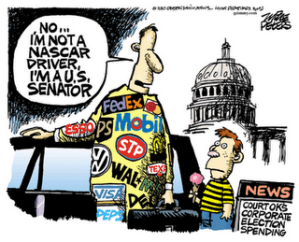 I have a personal interest in seeing ALEC dismembered. My governor Bobby Jindal has adopted and enacted some of its worse cookie cutter laws. There are three progressive interests that are leading actions to defund and defang this supposedly “nonpartisan individual membership organization of state legislators which favors federalism and conservative public policy solutions”. They are the Urban League, Common Cause, and ColorofChange. I would hope that many more groups will join in.
Many of ALEC’s corporate sponsors have quit funding the organization which seeks to remove oversight and regulation of all kinds of industry, privatize public services and goods, and deprive minority communities and women of basic voting rights and civil rights. They seek tort reform that would limit corporate exposure to liability from unsafe products and practices. They like to remove laws providing consumer protection and information. They are not nonpartisan and are responsible for some of the most heinous, radical legislation of the last few years. Woe to those of you whose governors or legislators belong to this organization for you will live in a world with very little protection from big money and big business and your tax dollars will be used to line their coffers.
The American Legislative Exchange Council describes itself as a nonpartisan champion of free markets. But if you spend some time at an ALEC conference (Bloomberg Businessweek did, for an article last year) you will be hard-pressed to find many Democrats. And when the entire conference meets for lunch, you will hear from the podium nothing that would seem out of place in a press release from Eric Cantor’s office. Last year in New Orleans, for example, Bobby Jindal, governor of Louisana, told an ALEC annual meeting, “Defeating the president is crucial to defending our economy,” and “Obama has been a disaster.” I didn’t hear anyone boo. What I did hear was the sound of fevered applause when the conference played a videotaped greeting from Ronald Reagan.
I’m not saying it’s wrong to feverishly applaud Ronald Reagan. I am saying that only in the most thinly defensible, legalistic sense can ALEC call itself “nonpartisan.” And the council doesn’t really support free markets, either. It supports the companies that fund it. This is an important distinction, because the corporations that donate to ALEC aren’t doing so to protect markets. They’re protecting favored tax treatments and pushing regulations that lock in their market positions. As best as we were able to determine in reporting our piece last year, corporations propose bills at the state level and then push them up to ALEC, which has both corporate and legislative members. ALEC pushes the legislative members to the foreground, stamps the bills as “model legislation,” and then the corporations push them back out to other state legislatures. This may not be the case with all ALEC legislation, but it certainly was with the bill we followed.
So ALEC is not what it says it is. That’s not extraordinary: Few advocacy groups are what they say they are. In ALEC’s case, however, the fingers-crossed-behind-its-back description of itself is definitional. If the American Legislative Exchange Council operated with complete openness, it couldn’t operate at all. ALEC has attracted a wide and wealthy range of supporters precisely because it does its real work in a black box. Membership lists are secret. The origins of the model bills are secret. Deliberations and votes on model bills are secret. The model bills themselves are secret. The council has designed its entire structure to disguise industry-backed legislation as grassroots work from state legislators. If this becomes clear to everyone, there’s no reason for corporations to use it. And that is exactly what has been happening.
Minority advocacy groups have been most active in the fight against ALEC. ALEC is responsible for the legislation that requires specific picture ids to vote and they are responsible for the Stand Your Ground Laws. Both of these issues have been front and center in Civil Rights Groups. The Trayvon Martin case is important in two key ways. First, it is bringing to light the institutional racism implicit in the criminal system. Second, it has exposed the role of ALEC in sneaking through legislature in states that most voters do not support or like. The vigilante-empowering Stand Your Ground laws are now seeing daylight.
The tension in corporate boardrooms over the case is the latest example of the pitfalls companies can sometimes face when they donate to political and lobbying groups, even those that seem safely below the radar of public consciousness.
The ALEC controversy is now sparking a broader debate about corporate participation in politics and the polarized state of political discourse. At a minimum, it has strengthened calls for companies to develop clear policies explaining their spending.
“I would caution companies to be very aware of where their money is going,” says Nell Minow, director of GMI Ratings, which provides corporate governance information to investors, corporate auditors and regulatory agencies. “Companies are going to realize they can take a real reputational hit with this kind of affiliation.”
She and others recall the tempest that erupted in 2010 around Target after the company donated to a nonprofit group supporting a Minnesota gubernatorial candidate who was known for opposing gay rights initiatives.
Like Louisiana, many Arizona politicians are in cahoots with ALEC. ALEC likes to use laws to funnel public money into corporate income statements. This isn’t free market promotion, this is more like being given the ability to loot public resources.
Legislators in Arizona continue to advance extremist legislation inspired by the American Legislative Exchange Council (ALEC) and its out-of-state corporate backers, according to a new analysis by People For the American Way Foundation, Common Cause, the Center for Media and Democracy and Progress Now. This report shines a new light on the Arizona Legislature’s unprecedented ties to the secretive organization, which recently drew nationwide fire for its role in implementing radical policies across the country like “Shoot First” laws and voter suppression laws, and anti-worker measures. ALEC’s extreme agenda has recently led companies such as Pepsi, Coca-Cola, McDonalds, Wendy’s, KRAFT and Intuit to withdraw from the organization. The Bill and Melinda Gates Foundation on Monday also withdrew its support from ALEC.
The comprehensive report found that Arizona’s large concentration of ALEC-member legislators, working hand-in-hand with the corporate leaders who make up ALEC’s membership, are continuing to endorse special interest legislation that harms ordinary people by limiting consumers’ rights, privatizing education and dismantling unions.
The report, ALEC in Arizona: The Voice of Corporate Special Interests in the Halls of Arizona’s Legislature, updated for the Fiftieth Legislature, second regular session is available here.
“Recent polling shows that Arizonans are appalled by the out-of-touch and extremist agenda at their State Legislature. This report shows that agenda is no accident,” said John Loredo, a member of Arizona Working Families and a former Arizona House Minority Leader. “Unfortunately, Arizona has one of the highest concentrations of ALEC legislators in the country, and that makes us a petri dish for anti-worker legislation and a host of other bad ideas.”
“ALEC-member legislators are unabashedly continuing to push legislation straight from corporate headquarters to Arizona’s lawbooks,” said Marge Baker, Executive Vice President at People For the American Way Foundation. “Well-heeled special interests are circumventing the democratic system and bypassing Arizona’s citizens, who can’t match the level of access that ALEC provides. As a result, Arizonans are facing an endless assault from laws that serve the interests of the rich and powerful instead of everyday people.”
You can find ALEC’s model bills and reports on its activities in many states at the site ALEC Exposed. ALEC is responsible for the horrible school voucher and privatization plan that Bobby Jindal has ramrodded through our state. It is also responsible for some of the worst climate change denial propaganda. The source of this funding is big oil, big coal, and the Koch Brothers.
$375,858 received from Koch foundations 2005-2010 [Total Koch foundation grants 1997-2010: $708,858]
American Legislative Exchange Council (ALEC) is one-stop shopping for state elected officials interested in perusing the wares of an array of Koch-funded opposition organizations including IER, ACCF, Mercatus and other sources. ALEC has successfully peddled corporate-written legislation to numerous states attacking the Kyoto Protocol, undermining climate science education in schools and numerous other anti-environmental legislation. ALEC has close ties to Koch Industries, which helped bail the organization out of financial troubles with a half-million dollar grant.
ALEC publishes its own materials as well, including a “Climate Change Overview for State Legislators” which downplays the science and risks of global warming and exaggerates the costs of addressing it. The Overview was written by Daniel Simmons, who moved from ALEC to become AEA’s Director of State Affairs. Simmons was at the Mercatus Institute before ALEC and is a graduate of the George Mason University School of Law.
Here’s some of the background information on the laws that ALEC creates with the intended purpose of “starving Public Schools“.
ALEC’s most ambitious and strategic push toward privatizing education came in 2007, through a publication called School Choice and State Constitutions, which proposed a list of programs tailored to each state. That year Georgia passed a version of ALEC’s Special Needs Scholarship Program Act. Most disability organizations strongly oppose special education vouchers—and decades of evidence suggest that such students are better off receiving additional support in public schools. Nonetheless, Louisiana, Oklahoma, Florida, Utah and Indiana have passed versions of their own. Louisiana also passed a version of ALEC’s Parental Choice Scholarship Program Act (renaming it Student Scholarships for Educational Excellence), along with ALEC’s Family Education Tax Credit Program (renamed Tax Deductions for Tuition), which has also been passed by Arizona and Indiana. ALEC’s so-called Great Schools Tax Credit Program Act has been passed by Arizona, Indiana and Oklahoma.
ALEC’s 2010 Report Card on American Education called on members and allies to “Transform the system, don’t tweak it,” likening the group’s current legislative strategy to a game of whack-a-mole: introduce so many pieces of model legislation that there is “no way the person with the mallet [teachers’ unions] can get them all.” ALEC’s agenda includes:
§ Introducing market factors into teaching, through bills like the National Teacher Certification Fairness Act.
§ Privatizing education through vouchers, charters and tax incentives, especially through the Parental Choice Scholarship Program Act and Special Needs Scholarship Program Act, whose many spinoffs encourage the creation of private schools for specific populations: children with autism, children in military families, etc.
§ Increasing student testing and reporting, through more “accountability,” as seen in the Education Accountability Act, Longitudinal Student Growth Act, One-to-One Reading Improvement Act and the Resolution Supporting the Principles of No Child Left Behind.
§ Chipping away at local school districts and school boards, through its 2009 Innovation Schools and School Districts Act and more. Proposals like the Public School Financial Transparency Act and School Board Freedom to Contract Act would allow school districts to outsource auxiliary services.
ALEC is also invested in influencing the educational curriculum. Its 2010 Founding Principles Act would require high school students to take “a semester-long course on the philosophical understandings and the founders’ principles.”
Perhaps the Brookings Institute states the mission most clearly: “Taken seriously, choice is not a system-preserving reform. It is a revolutionary reform that introduces a new system of public education.”
The passage of radical public school defunding in Louisiana is leading to a recall Jindal effort. We’ve already had some of this type of reform in New Orleans and it’s clearly not working well at all unless you count teacher union busting and lowering teacher salaries progress. Here are some of the things we will now be suffering in Louisiana. I personally am opposed to the state funding religious indoctrination hiding under the guise of education. These laws funnel public money into any thing that deems itself a school, it seems.
A vast expansion of charter schools, an overhaul of teacher tenure and establishment of a statewide program to pay private school tuition with public dollars moved within one step of final passage Thursday, as the Louisiana Senate Education Committee endorsed the headliner components of Gov. Bobby Jindal’s education agenda without changes or dissent.
I know this thread wanders around through many topics but the number of right wing bills pressured cooked into law by ALEC and their toadies is just as wandering and perverse. Check out the site and be aware of which politicians supposedly representing the people of your state that are ALEC cronies. The movement to get corporations to defund the organization should be paramount. Ordinary Americans have already lost a lot to their agenda. It’s time to stop them. Put pressure on organizations to join in the effort. Let’s defang this beast together.
Goodbye Flipper?
Posted: April 9, 2012 Filed under: Environment, Environmental Protection, Gulf Oil Spill, just because | Tags: baby dolphin deaths, Cape Cod, dolphins, offshore oil drilling, oil companies, oil spill, Peru, seismic sound waves, sonar 9 Comments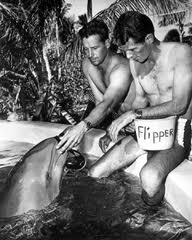
Rick O'Perry, right, and another dolphin trainer with Flipper
Flipper, an Atlantic bottle-nosed dolphin, was one of the biggest television stars from 1964 – 1967. There were actually 4 dolphins who played Flipper on the screen. Most of the series was filmed behind the scenes at the Miami Seaquarium on Virginia Key in Biscayne Bay. The success of the Flipper franchise made dolphins a lovable species around the world. The true story of Flipper, the dolphin and the making of the television series, is told by Ric O’Barry, Flipper’s trainer, in his book Behind The Dolphin Smile. For those of you who were born after the 1960s, you may have seen dolphins in captivity at marine parks or even had the opportunity to swim with dolphins at one of these attractions. (NOTE: I do not support dolphins in captivity)
Due in large part to people’s exposure to Flipper or dolphins in captive environments, there has been increased interest in and concern for dolphins around the world. Since the beginning of this year dolphins worldwide have been stranding themselves and dying in record numbers. The reasons for these deaths are slow in coming. Bear in mind that the numbers listed below are like the tip of an iceberg. Only those dolphins found onshore are listed. Those who died at sea, whose bodies were never discovered and/or recovered are not included in the mortality/stranding counts.
THE GULF STATES – GULF OF MEXICO – February, 2010 – now
When the first report of the explosion and oil leak of the Deepwater-Horizon in the Gulf of Mexico was announced, I knew that we were about to witness one of the greatest environmental disasters in the history of the U.S. It had the potential to outpace the Exxon-Valdez spill off the coast of Alaska – and it did. In case you never saw the official mortality record from the U.S. Fish & Wildlife Service, their last report from April, 2011 lists the statistics on birds, sea turtles and marine mammals impacted.
Of course, those numbers don’t tell the whole story. They don’t include unrecovered animals, nor the impact on breeding or toxins passed on to the offspring of the survivors, nor the poisoned food sources available to the survivors. Please don’t get me wrong. The people living in the area are exposed to the same toxins, but they, at least, may be treated for the illnesses that result from their exposure. And, the people aren’t living in the water, surrounded by the oil and corexit, a toxic substance used to disperse the oil. People also can choose what they will eat, which isn’t the case for the birds, fish, turtles and marine mammals living and swimming in this toxic soup.
Since February of 2010, 693 dolphin deaths have been documented in the Gulf of Mexico. A good compilation of the news coverage can be found at Reef Relief.
An ongoing die-off of dolphins in the Gulf of Mexico has resulted in 693 carcasses washing ashore. Scientists believe many more dolphins likely died but were never recovered. An investigation is underway to determine whether the BP oil spill is to blame. (Press-Register/Ben Raines)
Many of the dolphins in Barataria Bay, LA are sick, according to researchers. The AL.com blog has a full story on what researchers have found through taking both blood and tissue samples.
Thirty-two dolphins caught in August in Louisiana’s heavily oiled Barataria Bay were found to suffer from a range of symptoms including anemia, low body weight, hormone deficiencies, liver disease, and lung problems.
Those symptoms are typical of mammals exposed to oil in laboratory experiments, scientists said.
According to the Gulflive.com blog, of the 30 dolphins who washed ashore since January, 2012, 24 have been calves.
“We are dealing with a very unusual mortality,” said Moby Solangi, director of the Institute for Marine Mammal Studies in Gulfport. “It is mostly calves. Generally when you see a stranding it is a variety of animals — adults, males, females, young.”
The second anniversary is approaching and the legacy of this catastrophe mostly lives on with those people, animals and plants along the Gulf Coast who survived. This story from the one year anniversary has some amazing and heartbreaking photos: http://www.boston.com/bigpicture/2011/04/gulf_oil_spill_one_year_later.html This recent story paints a more current picture of the state of the Gulf Coast.
Laurel didn’t find dead turtles on a recent stroll on her Gulfport shores, which she now calls “death beach.” But walking along she smelled something bad. After poking around in the sand, she found the nauseating source: a dead baby dolphin’s tail, decomposing and buried not more than a few inches in the sand. An out-of-work shrimper came a long and picked it up, and when he realized what it was he started to sob: “This really ruins my day…” Laurel remembers. Tourists looked at it incredulously, Laurel says, their kids screaming, ‘Mommy, it’s a dolphin’s tail!’
The attention of the rest of the country has turned to other news stories, having been lulled into a false sense that everything has returned to normal by all of those commercials, funded by BP and the states’ tourist boards. The bodies of the dead and dying animals tell a different story. But dolphins, in particular, aren’t just dying along the Gulf Coast.
CAPE COD – January – February, 2012
177 dolphins have stranded themselves in Cape Cod. Once again the cause or causes of the high number of dolphins ending up on the beaches of Cape Cod are simply guesses. In mid-February, 11 stranded dolphins were found onshore in Wellfleet.
The remote inlet down Wellfleet’s Herring River is a place where the tides recede fast and far, and that’s left the animals mired in a grayish-brown mud one local calls “Wellfleet mayonnaise.”
News coverage of the incident details the stranding and actions taken to save the dolphins. Sixty dolphins stranded in Cape Cod. The full story tells that only 19 could be rescued.
A single dead dolphin calf was found in Queens, NY.
Kim Durham, the foundation’s rescue program director, tells the Daily News there were “no signs of trauma.” Researchers say an increasing number of common dolphins have been spotted in the Northeast in the winter, which may be attributable to climate change and a steady improvement in environmental cleanliness in the waters off the Rockaway peninsula.
Although no official cause for the strandings has been announced, there are some who think Naval operations in the area could be to blame.
Again, just as in the months of January and February Naval activity is taking place in the Atlantic. Even government Funded IFAW Katie Moore who has denied Naval involvement despite evidence of Naval activity can no longer deny the possibility of sound being the source of these tragic deaths along the Atlantic Coastline, “
And these deaths may not be the only ones which may be attributable to sonar type activities taking place in the oceans.
PERU – February – April 2012
To locate possible oil and/or gas deposits, seismic surveys are conducted with the use of air guns by releasing high pressure air. This passage from the Canadian Centre for Energy Information report was particularly interesting.
Offshore seismic surveys require government approval and must comply with strict environmental regulations, including a pre-survey environmental assessment. Programs are designed to avoid fish spawning seasons and sensitive fishery areas. During the first half-hour of a survey, the energy level of the discharges is gradually increased so that fish and aquatic mammals have an opportunity to move out of the area.
That paragraph is telling. The fish and other marine life are given a full half hour to “leave the area.” Are these people serious? Any of the marine life in area will understand the increasing sound waves are a signal to vamoose? Maybe they should try transmitting in Morse Code, it would make as much sense. Dolphins, like all cetaceans, use echo location to find food, navigate in their habitat and communicate with each other. Needless to say, these high pressure sound waves can do massive damage to marine life, especially dolphins and whales. If you are interested in more detailed information on dolphins and the use and effect of sound, check out this lesson plan: http://www.pac.dfo-mpo.gc.ca/education/documents/porpoise-marsouin/harbourporpoise_lesson4_e.pdf
Of all these recent stranding episodes, the largest die-off is occurring off the coast of Peru. Over 3000 dead dolphins have washed ashore since the incident began. Once again, authorities and researchers are cautious about announcing the cause of the massive numbers of dead dolphins. Some have attributed the deaths to the search for offshore oil deposits in the ocean floor. More information, along with photos and video on this massive die- off can be found at The Watchers and at SF Gate, CNTV and on the blog StrandedNoMore.
For the time being, drilling for oil is a necessary evil. There are many downsides to onshore drilling, but drilling offshore has far greater along with potentially catastrophic problems. This Hub Pages blog entry by Cheryl has a comprehensive discussion of offshore drilling.
It seems evident to me that we, humans, are the culprits in the deaths of these magnificent, highly intelligent animals. Whether through releasing toxins into the environment or sending shockwaves through the ocean, we are killing them. Why? OIL – our endless quest to drill for more and more and more oil. And our tax dollars continue to subsidize this industry, while these oil companies make vast amounts of profit. Then we get to pay again, at artificially inflated prices, when we pump the resultant gasoline into our vehicles. We are complicit, intentionally or not. But Bill McKibben, of 350.org can say it better than I.
Whether or not the bill passes, those subsidies are worth focusing on. After all, we’re talking at least $10 billion in freebies and, depending on what you count, possibly as much as $40 billion annually in freebie cash for an energy industry already making historic profits.
How to Fight Corporate Greed And Actually Make A Difference
Posted: March 13, 2012 Filed under: #Occupy and We are the 99 percent!, corporate greed, corporatism, Environment, Environmental Protection, Environmentalists, globalization, science, social justice 11 CommentsYesterday I posted the rather dismal news about Pennsylvania’s Act 13, a corporate-driven piece of legislation that bows on bended knee to the gas and oil industry at the expense of citizen and community civil rights. All for the love of fracking, natural gas and profits. Did I mention there’s a glut of natural gas on the market right now? The price has dropped like a stone due to oversupply and the incredibly mild winter we’ve had in the States. Prices, however, are much higher elsewhere. Asia and Europe, for instance. And energy companies are pushing for permits to build LNG [liquid natural gas] terminals for that very purpose. According to Forbes magazine:
A thousand cubic feet of natural gas currently costs $14 to $15 in Asia, $8 to $9 in Europe, and $4 in North America, down 9 percent from what it was at the outset of 2011.
That could make corporate CEO’s and investors very grumpy.
It could also make Pennsylvania residents grumpy. It’s bad enough to compromise the environment, jeopardize water supplies and threaten the health of American citizens but then the product is exported elsewhere for increased profits? I can hear heads exploding.
The Forbes article indicates the high investment cost on LGN terminals could easily make this scheme impractical. But the scale of these problems and the power that large corporations wield seem depressingly insurmountable. With energy solutions, the problems are magnified. We need energy to keep on, keeping on. The question is finding a balance between getting the energy we need and what we’re willing to accept as ‘collateral damage.’ It can make your head hurt.
Karma must have led me to an article by Jim Schultz, the executive director of the Democracy Center, an organization that works globally to educate citizens on effective advocacy for environmental and social issues. His article, ‘Three Ways to Beat Corporate Giants’ improved my mood immensely.
Make It Personal
 The example Schultz provides is the Bolivian Water Revolt against Bechtel and the World Bank’s meddling. I’d heard about the 2000 revolt previously, the privatization of the public water supply in Bolivia’s third largest city, Cochabamba. Within weeks of taking over, Bechtel raised water prices by nearly 50%. The poor were literally forced to choose between food or water. Massive protests resulted in the city as rural people joined the pushback. The president, Hugo Banzer, tried repressing the opposition but protests continued unabated. A resulting 4-day workers’ strike brought the strife to an end–Banzer cancelled the Bechtel contract.
However, what I didn’t know [or didn’t remember] was that Bechtel attempted to sue the citizens of Cochabamba for $50 million, though their investment was reportedly less than $1 million. Activists then made the fight personal. Their goal? Make the life of CEO Riley Bechtel and his top management team miserable. They flooded their personal accounts with email. They derided their names and actions at every opportunity in the media. They protested in front of the company’s headquarters and the officer’s private residences. Ultimately, the protest prevailed. Bechtel settled for a token payment of 30 cents.
Add Humor To Your Protests
The plan to replace a coal-fired station is featured, a project in southwest England to be built by a German energy company. Environmentalists and grassroot activists used protests, petitions and civil disobedience—standard fare. But they also added a twist. Since the new station was advertised as ‘clean coal,’ protestors showed up to publicly scrub coal in front of the German company’s office [E. On Energy] and then sent a Santa brigade to deliver the coal to ‘naughty’ executives. This action caught the attention and favor of the public. Ultimately, the protest worked—the energy company withdrew its plans and the UK government pledged not to approve any other coal-fired stations without carbon capture and storage capabilities [a technology yet to be fully developed].
Concentrate On Shareholders
The successful campaign against Occidental Oil Co. and their plans to drill in the Columbian ‘cloud forest,’ focused on the primary investors of the oil field development plan. The region, which is the tribal home to the indigenous U’wa people, the environmental threat to the bio-diversity of the area and the fear of armed violence from the country’s FARC rebels fueled massive protests on Fidelity Investments, a primary shareholder of Occidental. It was through the protests and the exposure of the U’wa people’s way of life—their spiritual connection to the forest, what they stood to lose–that convinced [maybe shamed] the business world to withdraw support and funding for the project. Another win.
In the end, our national and global problems look insurmountable and corporate power certainly appears invincible at first glance. It’s a good refresher to realize that there have been victories and there are citizens, here and abroad, willing to put it on the line and speak out against the rise of corporate greed and bullying. Activists may not win all the battles. But they’ve won some and continue to pushback. For that, I salute them. It’s also a reminder as one Occupy sign shouted out:

And then, I stumbled across this video. It made me laugh and laughing is good for the soul. I’d file this under category #2 in Jim Schultz’s guidebook. Sometimes humor can make a statement of its own.
When Corporations Mutate Into A Super Race
Posted: March 12, 2012 Filed under: corporate money, corporatism, Economy, energy, Environment, Environmental Protection, Environmentalists, fracking, Regulation, toxic waste 12 CommentsWe all remember Mitt Romney’s public and awkward statement that ‘Corporations are people, too.”
But Romney was underplaying the reality of American life in 2012.
Corporations are not mere people. They have morphed into a Super Race, ready to conquer what’s left of our disintegrating democracy. If you think this is liberal hysteria or rank hyperbole, I give you Pennsylvania’s newly passed Act 13. Bad number. But the scope of this foolish and utterly destructive state giveaway is far worse.
Act 13 is a massive gift to the oil and gas companies, which overturn property rights, strips municipal communities of zoning law protection and turn environmental and health compromises into considerations we can no longer afford. It reduces the citizens of Pennsylvania to 3rd world colony status, ripe for exploitation and extraction. Welcome to the New World of Corporate Rule where natural gas extraction is the profitable prize and quality of life is a thing of the past.
And the reaction?
“Now I know what it feels like to live in Nigeria,” said recently retired Pittsburgh City Council President Doug Shields. “You’re basically a resource colony for multi-national corporations to take your natural resources, take them back to wherever they are at, add value to them, and then sell them back to you.”
Yup. This is the neoliberal dream. Steal, add value and then sell back at an exorbitant price tag. The whole world is nothing more than a resource colony so the corporate Super Race can turn a mind-boggling profit. On the backs of the natives. Water safety and/or depletion, health, wildlife? All expendable in this great push for growth and ever-increasing profit. Moral considerations? Please, haven’t you gotten the email? Corporations don’t do morality. They’re too big for that.

Fracking in SW Pennsylvania
Why did this happen in Pennsylvania? Because of the enormous layer of shale deposits known as the Marcellus formation, resting like a slumbering giant beneath the state’s surface. But there’s more! That would be the gargantuan amount of natural gas to be had at a stunning profit—as much as 70-99% some managers of earlier drill wells have boasted.
How could investors resist?
But then, there are the rising concerns of the fracking process itself, the public’s growing awareness of water and air pollution, the niggling problem of toxic wastewater disposal and those bothersome legal suits from citizens with lame health issues.
What to do, what to do?
Act 13 is the perfect response to investor skittishness. It removes all complaint and whining by simply supplanting existing law—the kind that protects the citizen—with corporate friendly law that recognizes the global reality—everyone is for sale and everything can be exploited.
To keep tempers in check, the best PR in the world is dished out, promises of jobs and prosperity, spinning dialogues about energy independence [at any cost] and patriotic flag-waving—how tearing up the earth, polluting our waterways and compromising the public’s health is good for America. After all, in times of crisis, sacrifices need to be made, even when it means overriding the civil rights of people and communities.
That is exactly what Act 13 addresses.
Courts in the Great State of New York upholding community rights to block fracking dreams is simply unacceptable. Act 13 revokes those rights. The Lakota people in South Dakota blocking TransCanada truck transports across Native territory? We can’t have that. Act 13 clearly empowers a corporation to seize property that impacts any stage of the drilling process. And those possible health considerations? Got it covered, boys and girls. Act 13 prohibits physicians from discussing medical impacts from chemical contaminations. The Halliburton Loophole in all its malicious splendor comes back to haunt us.
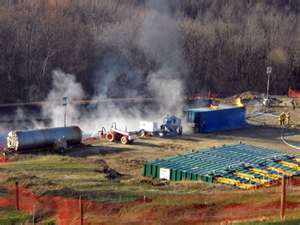
Marcellus Fracking Pit
This is what happens when corporations are declared ‘people.’ This is what happens when legislators sell their souls for 30 pieces of silver. I do not care if Republican Governor Corbett and his Republican dwarves truly believe this is good for Pennsylvania. This is a betrayal of American law and her people on a massive scale. The good citizens of Pennsylvania might look at the situation in Ohio, where Governor Kasich opened the state’s doors for business, any business, and Ohio became the dumping ground for fracking wastewater disposal and deep ground injection wells. We now know those earthquakes were not coincidental events. No wonder Republicans hate science!
Hattip to Alternet on this rant. I’d recommend reading the article ‘Fracking Democracy: Why Pennsylvania’s Act 13 May Be the Nation’s Worst Corporate Giveaway’ by Steven Rosenfeld in its entirety with the first link I provided. It’s a chilling, mind-blowing report.
Act 13 is expected to take effect on April 14th. We better pray [regardless of what state we live in] that the groups now amassing in Pennsylvania are able to halt or at least slow down this corporate monstrosity.
Because if not, we can say ‘adios’ to the shredded remnants of our Republic.
As for Pennsylvania? My heart goes out because I lived and worked in the state for over a dozen years and still have family in the area. The economy has been raked over the coals, so the promise of jobs and money injected into struggling municipalities and rural communities is a huge seduction. But we’ve seen this movie before. It does not end well. Here’s hoping that flesh and blood citizens get a chance to write a far better script for themselves and their future. Here’s hoping the rest of the country wakes up to what can only be called a corporate takeover.
Can We Admit That What We’re Seeing Is More Than . . . ‘Weather?’
Posted: March 5, 2012 Filed under: Capitalism 3.0, Climate Change, Environment, Environmentalists, ethics, globalization, Rick Santorum, Rush Limbaugh | Tags: global warming, tornadoes, weather 16 CommentsThese are some images from my neck of the woods from this past weekend’s round of ‘weather.’

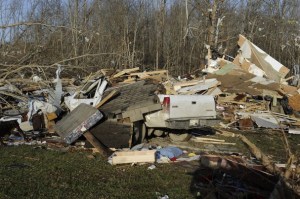
Now granted, I’m not a native of the southeast—South Jersey girl here. But the locals tell me that vertical winds are a hellva lot different than tornado touchdowns, particularly when you’re living in hill country, in the shadow of the Smoky Mountains. Locally, this time we were fortunate—some downed branches and yard mess. The major damage was to the east and south of us. Last year? Not so much. 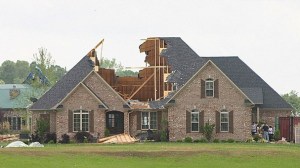
In fact, last year’s April storm front in the southeast produced 280+ tornadoes in 3 days. Historic, the headlines screamed.
If this were merely a local event, we could chalk it up to bad luck and Mother Nature in a cranky mood. But consider that earth-orbiting satellites have been gathering scientific data not previously available, giving us the ‘big picture’, data on a global scale. The following evidence has been accumulated:
- Sea levels are, in fact, rising, the rate of the last decade nearly double that of the last century.
- Global temperatures are on the rise, increasing since the 1970s with the 10 hottest recorded temperatures within the last 12 years.
- The oceans have been warming since 1969, measureable temperatures increasing in the top surfaces [2300 ft] and the acidification of the oceans has increased by 30% since the start of the Industrial Revolution.
- Glaciers are retreating, the Arctic sea ice is shrinking and the ice sheets of Greenland [36-60 cubic miles per year between 2002-2006] and the Antarctic [36 cubic miles per year between 2002-2005] have declined.
According to NASA data, there are certain facts beyond dispute:
The heat-trapping nature of carbon dioxide and other gases was demonstrated in the mid-19th century. Their ability to affect the transfer of infrared energy through the atmosphere is the scientific basis of many JPL-designed instruments, such as AIRS. Increased levels of greenhouse gases must cause the Earth to warm in response.
Ice cores drawn from Greenland, Antarctica, and tropical mountain glaciers show that the Earth’s climate responds to changes in solar output, in the Earth’s orbit, and in greenhouse gas levels. They also show that in the past, large changes in climate have happened very quickly, geologically-speaking: in tens of years, not in millions or even thousands.
We can take the facts and data of NASA, their orbiting satellites and sensors or we can fall back on the word of say . . . a Rick Santorum, who has proven himself such an expert on other subjects. According to Santorum in a speech in Colorado:
[Climate change is] an absolute travesty of scientific research that was motivated by those who, in my opinion, saw this as an opportunity to create a panic and a crisis for government to be able to step in and even more greatly control your life. … I for one never bought the hoax. I for one understand just from science that there are one hundred factors that influence the climate. To suggest that one minor factor of which man’s contribution is a minor factor in the minor factor is the determining ingredient in the sauce that affects the entire global warming and cooling is just absurd on its face. And yet we have politicians running to the ramparts — unfortunately politicians who happen to be running for the Republican nomination for president — who bought into man-made global warming and bought into cap-and-trade.
We can argue the merits of cap and trade but I find it comical that Santorum is running around talking about Satan on one hand—a Santorum absolute–while denying climate change on the other. This is a ‘don’t trust your lying eyes’ moment. And certainly don’t trust science. He continued with:
We were put on this Earth as creatures of God to have dominion over the Earth, to use it wisely and steward it wisely, but for our benefit not for the Earth’s benefit … We are the intelligent beings that know how to manage things and through that course of science and discovery if we can be better stewards of this environment, then we should not let the vagaries of nature destroy what we have helped create.
Huh? I’m not sure what this rambling statement is intended to mean, other than we shouldn’t let nature clue us in that we’re skating on the edge, pushing the health of the planet and its inhabitants to the max. Full steam ahead with those extractions, boys!
Of course, Santorum is not alone in this type of denial. Rush Limbaugh, who has had his fair share of attention in the last few days [not of the good kind], had this to say after declaring climate change a ‘hoax’:
I happen to believe in God. I believe in a loving, brilliant – I know that this – there is no way, I don’t want to sound simpleton here, but there is not – it is not possible that we would be created by a creator in such a way that we would destroy by virtue of our created existence our own planet and environment. It just doesn’t compute and yet that’s what these people are trying to tell us. [Premiere Radio Networks, The Rush Limbaugh Show, 2/2/11
All righty then! God, a loving brilliant God, would not allow us to destroy ourselves. Scrap all that science and data, the fat man speaketh.
Beginning to see a pattern here? We can believe in myth—Satan’s going to getcha and/or a benevolent, personal God-creator, who would never allow Man to be stupid enough to destroy His/Her creation. No problem then. Keep spewing those toxins into the air, don’t worry about contaminating our water supply and . . . heat? What heat?
Despite the relentless war on climate data in particular and science in general, it turns out the public is beginning to catch on to all the corporate-friendly tap dancing. After a dip in public sentiment about Climate Change and the mass investment in misinformation, Americans are using their powers of observation and taking heed to the mounting evidence. According to the Brookings Institute National Survey, Fall 2011, a strong majority [62%] of the American public now believes that global warming is real and poses a threat to global security. Observation to local effects of warming temperatures and world-wide reports of floods, droughts, freakishly warm temperatures, melting ice sheets, ocean acidification and the effects on wildlife and fauna are slowly turning opinion.
We cannot wait for a benevolent God-spirit to save us. We’ll need to do that for ourselves, sooner rather than later. Because we won’t get a second chance. As Naomi Klien recently stated any real shift towards climate sustainability means a shift in the entire free-market ethos that depends on continual growth, massive extraction and profit-making over people.
. . . you can’t do it all with carbon markets and offsetting. You have to really seriously regulate corporations and invest in the public sector. And we need to build public transport systems and light rail and affordable housing along transit lines to lower emissions. The market is not going to step up to this challenge. We must do more: rebuild levees and bridges and the public sphere, because we saw in Katrina what happens when weak infrastructure clashes with heavy weather—it’s catastrophe. These climate deniers aren’t crazy—their worldview is under threat. If you take climate change seriously, you do have to throw out the free-market playbook.
In the end, so many of these pressing issues are related to a flawed economic and political model—the current corporate state. It will be up to us to reimagine a new system or as Peter Barnes suggested in ‘Capitalism 3.0,’ it’s time to upgrade.
Because there’s no place to run or hide. Earth is the only home we have. Reclaiming the commons isn’t optional; it’s a must. And personally? I’m just not into wicked tornadoes.

UPDATE: The Red Cross is now asking for donations for storm ravaged areas in the Southeast. Contact your local offices for information. Or go here.

 peej
peej Carissa
 bostonboomer
 dakinikat
 ecocatwoman
 mablue2
 Mama Lopez
 peggysue22
 quixote
 skydancingguestblogger
 Mona (aka Wonk the Vote)



 Sky Dancing
Recent Comments