
American Entrepreneurship on the Decline … Yet … not for the reasons you’d think
Posted: July 10, 2012 Filed under: 2012 elections, Economic Develpment, Economy | Tags: How Republican Policies kill Small Businesses, Regulation, Small Businesses, taxes 7 Comments One of the great symbols of US spirit has always been its small businesses. It’s one of those myths that seems to carry everywhere including to views of us in other countries. There are two related memes that go along with this mythic American institution that are not borne out by statistics. The first is that small businesses are the source of employment growth in the country. This is not true. Most small businesses that do not fail stay small. The majority of job growth comes from medium to large businesses. Midsize business are far more important. (Data from the BLS.) The second meme is that either too much regulation or uncertainty created by the government is causing depressed job growth. This is simply not true either.
What does this mean? By any reasonable interpretation, it is mid-size companies that are generating the bulk of the jobs in the recovery. From an economic development perspective, it means that job growth is more likely to come from mid-size companies that are adding several workers or perhaps a couple of dozen new employees, rather than the smallest or largest businesses.
And what are these businesses most worried about today? According to a recent survey by the National Federation of Independent Business (here):
“The two principal impediments to current small-business growth are business uncertainty and weak sales… The single most important indicator that would renew small-business owner confidence in business conditions is increased sales in their businesses.”
The economic recovery is a demand issue.
There is also some strange set of lies out there that the increase in taxes proposed by the Obama Administration on those making over $250k is going to kill small business. Not true again! This tax hike would likely impact only about 3.5% of small businesses. The majority of these are partnerships formed by doctors and lawyers. They are not your average mom and pop store. I just heard Haley Barbor repeat this lie on CNN last night.
But to what extent would Obama’s tax plan actually affect small businesses?
In its latest estimate last month, Congress’s nonpartisan Joint Committee on Taxation found that in 2013, just 3.5 percent of small business tax filers would pay a higher rate — about 940,000 individuals, many of whom are lawyers and doctors in partnerships. But those few percent account for 53 percent of all small business income.
GOP aides accept those facts but they say those few small businesses are the ones overseeing growing companies whom the nation is counting on to hire. According to a variety of analyses, the lion’s share of the tax hike would be absorbed by Americans earning well over $1 million.
Late in 2010, when the same debate played out, William Gale, co-director of the nonpartisan Tax Policy Center, called it a “myth” to suggest that ending the tax cut on top marginal rates would hurt small businesses.
“This claim is misleading,” Gale wrote in the Washington Post. “If the objective is to help small businesses, continuing the Bush tax cuts on high-income taxpayers isn’t the way to go — it would miss more than 98 percent of small-business owners and would primarily help people who don’t make most of their money off those businesses.”
There’s a new study covered by The Washington Monthly that shows that entrepreneurship and small business ownership is on the decline. Get ready for this result. It’s primarily Republican policies that are killing small businesses and not over regulation, over taxation or over anything else. Here’s some interesting information about the decline and how some of it is due to other things too.
Data kept by the Small Business Administration, for instance, shows that the share of the working-age population that is self-employed has been declining since 1994. The share fell steadily until 2002, stayed level between 2003 and 2006, then began to drop again. Overall, between 1994 and 2009, the share declined nearly 25 percent.
This drop in the number of self-employed citizens relative to the overall working population is also captured by the Bureau of Labor Statistics, which isolates nonfarm workers. The BLS survey asks workers if they are employed by a private company, a nonprofit organization, or the government, or are self-employed. Self-employed workers are further separated into those who have incorporated their businesses and those who have not.
According to the BLS, the number of Americans who are both self-employed and not incorporated has fallen significantly as a share of the working-age population, from 461 per 10,000 in 1990 to 359 in 2011. This decline—more than 22 percent—reversed a long trend in the opposite direction during the 1970s and ’80s. The BLS data shows a somewhat different picture when it comes to self-employed persons who incorporate their businesses. As a share of the working-age population, their ranks grew 35 percent between 1989 and 2008, before dropping off sharply in 2009. Yet this increase in incorporation may be evidence not so much of rising entrepreneurship as of existing unincorporated one-person firms deciding to change their legal status—to take better advantage of new limited liability laws in many states, for instance, in order to cut their tax bills.
Even if we accept this number without question, however, the total share of the self-employed dropped steadily over the last two decades. In 1994 there were roughly 663 self-employed (incorporated and unincorporated) for every 10,000 working-age Americans; by 2009 this number was down to 606, an 8.5 percent decline.
If anything, there’s good reason to believe that this decline in entrepreneurship is even steeper than government data shows, thanks to what appears to be systematic miscategorization by the government of what counts as a true independent company. Since the 1990s, large companies have increasingly relied on temporary help to do work that formerly was performed by permanent salaried employees. These arrangements enable firms to hire and fire workers with far greater flexibility and free them from having to provide traditional benefits like unemployment insurance, health insurance, retirement plans, and paid vacations. The workers themselves go by many different names: temps, contingent workers, contractors, freelancers. But while some fit the traditional sense of what it means to be an entrepreneur or independent business owner, many, if not most, do not—precisely because they remain entirely dependent on a single power for their employment.
Again, it’s not taxes and it’s not over-regulation responsible for the decline. Here are the two major reasons.
Perhaps the most common complaint among small business entrepreneurs is a shortage of financing. While the rise of the venture capital business might give the impression that financial support for entrepreneurs has never been easier to obtain, the truth is that only a tiny fraction of start-ups have access to venture funds. To get their businesses up and running, the vast majority of entrepreneurs today tend to rely at first, as they always have, on a combination of personal savings and contributions from family and friends. But with family balance sheets ravaged by stagnant wages and skyrocketing costs for health care and higher education, fewer and fewer average families have the savings needed to invest in a small business.
The effects of the radical consolidation in the banking industry that began in the 1980s are equally dramatic. Relatively few bank officers today have the leeway and local knowledge to lend to established local businesses, much less new ventures. This is especially true in bad times, when big institutions come under great pressure both from Wall Street and regulators. In Maryland, for example, Bank of America made 312 SBA-guaranteed loans to local businesses in 2007. In 2010, it made two. Consolidation also concentrates the power of a few financial institutions over small businesses, and radically raises the risk that entire funding systems can collapse all at once. The near breakdown of CIT Group in early 2009—averted only by a last-minute deal with bondholders—would have cut more than a million small businesses off from some of the most important forms of day-to-day business financing.
The single biggest factor driving down entrepreneurship is precisely the radical concentration of power we have seen not only in the banking industry but throughout the U.S. economy over the last thirty years. This revolutionary remaking of almost every economic activity in the nation was set in motion in 1981, when officials in the Reagan administration all but suspended traditional enforcement of America’s antimonopoly laws, a change in policy then adopted by every subsequent administration. Since then, regulators have done almost nothing to stop the great waves of mergers and acquisitions, with the result that control over most major economic activities is now more consolidated than at any time since the Gilded Age.
The effects have been nowhere more dramatic than in those sectors that have always been most congenial to individual proprietorships, like retail, services, farming, and small manufacturing. These were the activities most affected, for instance, by the type of “roll-up” strategies pioneered by financiers like Mitt Romney’s Bain Capital. In the case of the office-supply retailer Staples, Bain’s investment helped propel the company from a one-store operation to a 2,000-store international behemoth. Similar plays resulted in Home Depot capturing a vast proportion of the nation’s hardware business, in Best Buy capturing a vast proportion of America’s electronics business, and in Macy’s capturing a vast proportion of all department store sales. Just one company, Wal-Mart, now controls upward of 50 percent of some lines of grocery and general merchandise business—commerce that a generation ago was divided among tens of thousands of families.
So, next time you think that Republicans are the small business friendly party, think again. It’s clearly the drive towards monopoly, market concentration and policies that benefit the One Percenters that’s killing US small business.
The Rise and Fail of Countries and their Economic Elite
Posted: March 13, 2012 Filed under: #Occupy and We are the 99 percent!, Economic Develpment, income inequality | Tags: Daron Acemoglu, James Robinson, Why Nations Fail 8 Comments
US Economic Performance: Forty Years of economic stagnation for all but the Very Rich.
There’s nothing new about trickle-down economics policies and their failure to deliver growth and jobs. The 1980s saw a lot of empirical testing of Reagan-Bush Policies and new growth models. Basically, the parts of these policies that led to growth were those that put money and spending power into the demand side and not the supply side. The failure of the Bush 2 policies to provide sustained growth of jobs and the real economy–as well as real per capita income–reinforced earlier findings. However, this hasn’t stopped the spread of political memes that falsely assert that providing vast wealth for “job creators” is best for an economy. It’s a popular fairy tale spun by Republican Politicians and it’s unsupported by evidence as well as theory.
Development economists have been studying why some countries are rich and some are poor for some time. There have been a number of factors identified that seem to drive growth. Education of women, good legal and justice systems that protect property rights, and basic economic freedom are some of the factors that have been identified over the years. Daron Acemoglu–a Turkish M.I.T. professor–has written an important book based on his research and the research of his colleague James Robinson called “Why Nations Fail”. Their work explains how nations can basically destroy their economic futures when they let their richest citizens loot their poorest. Evidence comes from both historical and present day economies.
Surely even the most kleptocratic dictator would be in favor of economic development. Economic development means greater income, greater taxes and more stuff to grab, so what’s not to like about it? But actually, it often doesn’t work that way.
In the early 1980s in Takasera, a village in Rukum District in western Nepal, a group of locals decided to begin a development project and bought a Swiss-made water mill which would power machinery such as a press to make oil and a saw mill. The community sent a group of men to Kathmandu who learned how to dismantle the machinery and then put it back together again. The machinery was brought back and successfully put into operation. In 1984, a government official wrote saying that in autonomously undertaking this project the community had “usurped the role of the king” and the mill would have to be shut down. When the locals refused, the police was sent to destroy the mill. The mill was only saved because the villagers were able to ambush and disarm the police.
So why was the Nepalese government opposed to the mill? The answer is that the monarchy and the elite surrounding it, who controlled the government, were afraid of becoming political losers. Economic progress brings social and political change, eroding the political power of elites and rulers, who in response often prefer to sacrifice economic development for political stability.
This is a prime example of politicians blocking technology that would improve the country’s economy to maintain political control. This suboptimal outcome is one of many examples the two economists have found and documented in their study.
But through a series of legendary — and somewhat controversial — academic papers published over the past decade, Acemoglu has persuasively challenged many of the previous theories. (If poverty were primarily the result of geography, say, or an unfortunate history, how can we account for the successes of Botswana, Costa Rica or Thailand?) Now, in their new book, “Why Nations Fail,” Acemoglu and his collaborator, James Robinson, argue that the wealth of a country is most closely correlated with the degree to which the average person shares in the overall growth of its economy. It’s an idea that was first raised by [Adam] Smith but was then largely ignored for centuries as economics became focused on theoretical models of ideal economies rather than the not-at-all-ideal problems of real nations.
Consider Acemoglu’s idea from the perspective of a poor farmer. In parts of modern sub-Saharan Africa, as was true in medieval Europe or the antebellum South, the people who work the fields lack any incentive to improve their yield because any surplus is taken by the wealthy elite. This mind-set changes only when farmers are given strong property rights and discover that they can profit from extra production. In 1978, China began allowing farmers to benefit from any surplus they produced. The decision, most economists agree, helped spark the country’s astounding growth.
According to Acemoglu’s thesis, when a nation’s institutions prevent the poor from profiting from their work, no amount of disease eradication, good economic advice or foreign aid seems to help. I observed this firsthand when I visited a group of Haitian mango farmers a few years ago. Each farmer had no more than one or two mango trees, even though their land lay along a river that could irrigate their fields and support hundreds of trees. So why didn’t they install irrigation pipes? Were they ignorant, indifferent? In fact, they were quite savvy and lived in a region teeming with well-intended foreign-aid programs. But these farmers also knew that nobody in their village had clear title to the land they farmed. If they suddenly grew a few hundred mango trees, it was likely that a well-connected member of the elite would show up and claim their land and its spoils. What was the point?
This is basically the idea that disincentives cut both ways which is an idea lost on Republican Politicians. Why work if the fruit of your labor goes to absentee owners and investors?
Acemoglu, Robinson and their collaborators did not come up with the idea that incentives matter, of course, nor the notion that politics play a role in economic development. Their great contribution has been a series of clever historical studies that persuasively argue that the cheesiest of slogans is actually correct: the true value of a nation is its people. If national institutions give even their poorest and least educated citizens some shot at improving their own lives — through property rights, a reliable judicial system or access to markets — those citizens will do what it takes to make themselves and their country richer. This suggests, among other things, that instead of supporting one-off programs promoting health or agricultural productivity, the international community should focus its aid efforts on deep political and economic change.
Perhaps just as interesting, “Why Nations Fail” also shows the effects of different economic and political systems over the centuries. The sections on ancient Rome and medieval Venice are particularly compelling, because they show how fairly open and prosperous societies can revert to closed and impoverished autocracies. It’s hard to read these sections without thinking about the present-day United States, where economic inequality has grown substantially over the past few decades. Is the 1 percent emerging as a wealth-stripping, poverty-inducing elite?
Well, maybe. Acemoglu and Robinson’s frequent collaborator Simon Johnson, the former chief economist at the International Monetary Fund, told me that financial firms have so thoroughly co-opted the political process that the American economy has become fundamentally unsound. “It’s bad and getting worse,” he told me. Barring some major shift in our political system, he suggested, the United States could be on its way to serious economic failure.
I downloaded their most current working paper which has a lot of political ramifications. (Robinson is a political science professor at Harvard.)It’s on why voters dismantle checks and balances on political and economic elites. You probably want to avoid the model and just look at the bottom line. Essentially, when we remove the checks and balances in our government, we make it easier and cheaper for the richest in the country to bribe the political class. This creates a disconnect between the politics and spending and tax policies. It’s an interesting analysis and way to model the current disconnect between polling of the electorate and policy coming out of legislatures. The most interesting outcome of the model is that this behavior eventually makes every one worse off. The ability of the rich to bribe politicians is central to the outcomes.
Far from seeing China as the clue to spreading prosperity, Acemoglu and Robinson see it as yet another instance of a society rushing into a cul-de-sac. China is not, on their analysis, on course for our own level of prosperity.
Their argument is that the modern level of prosperity rests upon political foundations. Proximately, prosperity is generated by investment and innovation, but these are acts of faith: investors and innovators must have credible reasons to think that, if successful, they will not be plundered by the powerful.
For the polity to provide such reassurance, two conditions have to hold: power has to be centralised and the institutions of power have to be inclusive. Without centralised power, there is disorder, which is anathema to investment.
China most certainly ticks this box – it has centralised power and order in spades. Some African societies don’t; localised power usurps the authority of the state. But China resoundingly fails to tick the box of inclusive institutions. Acemoglu and Robinson quote a summary of the structure of Chinese political power: “The party controls the armed forces; the party controls cadres; and the party controls the news.”
That states need order to prosper is important but no longer controversial. That they need inclusive institutions is, in view of China’s success, wildly controversial. Their argument is that order without inclusive institutions may enable an economy to escape poverty, but will not permit the full ascent to modern prosperity. Their explanation is that if the institutions of power enable the elite to serve its own interest – a structure they term “extractive institutions” – the interests of the elite come to collide with, and prevail over, those of the mass of the population.
So, in order for nations to grow, institutions should focus on inclusion instead of exclusion. This seems like an intuitive suggestion and an unnecessary one for a democracy. However, their work suggests that the rich and political elite will work against this if the right incentives and institutions exist. It’s an interesting way to look at the current situation in the U.S. where politicians–using money from huge donors–work to remove regulations and dismantle organizations that increase inclusion. Notice how public education, community activists, unions, and other institutions aimed at including workers and regular folks into policy making have been demonized recently. I’m definitely up for reading more on this.
Our Future is Calling
Posted: December 29, 2011 Filed under: Economic Develpment, Economy | Tags: aggregate demand problems, infrastructure, Keynesian Economics 9 CommentsThe massive loss of economic value that has occurred so far this century should give us pause when we hear about both austerity agendas and slightly improved conditions. Economist Dean  Baker reminds us that we’re not looking at clear steering ahead even if we slowly mend. Here are some things to consider. The incredible loss of wealth on the kinds of investments made by average Americans and from the collapse of the housing market has severely weakened millions of Americans and decreased their net worth. Statistics like these are likely to keep older workers on the jobs far past their prime. Baker responds to Daily Beast writer Zachary Karabell.
The unemployment rate for the year is likely to average above 9.0 percent. The number of people who are involuntarily underemployed has generally been 8.5 and 9.0 million, close to double the pre-recession level. Millions more have given up looking for work altogether. Real wages have been stagnant or falling for the last 4 years, with little prospect of turning around any time soon as the high rate of unemployment continues to depress wages.
In addition, tens of millions of baby boomers are approaching retirement with almost nothing to support themselves other than their Social Security. According to a recent study by the Pew Research Center, the median older baby boomer (ages 55-64) had just $162,000 in wealth. This is roughly enough to buy the median home. This means that if this household took all of their wealth, they can pay off their mortgage. They would then be completely dependent on their Social Security to support them in retirement. And, half of older baby boomers have less wealth than this.
In short, most of the country is looking at a situation where they are desperate for work or fearful about losing their job. Older workers are looking at a retirement where they are not far above the poverty level, even after spending a life working in middle class jobs. The bad attitudes toward this situation are not the result of “groupthink” as the column asserts, they are the conclusion of people better able to understand the economy than Karabell.
For extra credit in the acting up department Karabell throws in a few broad assertions that are simply wrong. For example he tells us that:
“Overall growth for the next year is shaping up to be 2 percent, give or take. That is pretty lame compared to the heady days of the 1990s or even the mid-2000s. But those seemingly halcyon periods benefited from bubbles, whether the stock market and telecom spending in the 1990s or the housing and debt-inflated growth of the mid-2000s. So while activity now doesn’t look so good by those comparisons, it is actual economic activity undistorted by bubbles. It’s as if the economy of the past 20 years was wearing platform shoes (“Wow, she’s like 6 feet tall”); it looked a lot bigger than it was.”
Actually 2.0 percent annual growth would look bad compared to the 80s, the 70s, the 60s, and the 50s. It is simply a very bad growth rate. Trend productivity growth in the U.S. is between 2.0 and 2.5 percent. Labor force growth is averaging around 0.7 percent. This means that we need growth of around 2.5 -3.0 percent just to keep even with the growth of the labor force. At a 2.0 percent growth rate unemployment will be rising, not falling. This has nothing to with platform shoes, it’s arithmetic.
Furthermore, given the severity of the downturn we should be seeing growth in a 5-8 percent range to get the economy back to its potential level of output. People should be outraged at the thought that the economy might only grow at a 2.0 percent rate.
Lengthened work lives and growth too small to replace jobs lost over the last five years is likely to keep pressure on younger workers. Even younger workers that are well educated and should have decent job skills are not able to find decent, well-paying jobs in this economy. They also have made huge investments in their educations and are carrying high levels of student loan debt. The Atlantic Wire says that we may have a ‘lost generation’ in the making.
During the last decade, the unemployment rate for young people spiked to the highest levels since World War II–only 55 percent of Americans aged 16 to 29 have jobs, a 12 percent drop from the employment rate in 2000. Faced with a grim outlook, many young people aren’t leaving home until their 30s–the number of Americans aged 25 to 34 living with their parents jumped 25 percent during the recession. Last month, The New York Timescalled the collective youth “Generation Limbo,” but after seeing the new census data, Harvard economist Richard Freeman takes it a stage further. “These people will be scarred, and they will be called the ‘lost generation’–in that their careers would not be the same way if we had avoided this economic disaster,” Freeman told The Associated Press. The world has seen a number of lost generations in the past century. Gertrude Stein first coined the term in 1920s in reference to the Europeans who grew up during World War I, but it’s most recently referred to Japanese youth who grew up during that country’s recession in the 1990s. In Japan, the lost youth are referred to as the hikikomori, and the decade of widespread unemployment meant that many of them never had the chance to start careers. In the 10 years of recession in Japan the number of young people working temporary or contract jobs doubled, and the collective hopelessness lead to a sky-rocketing suicide rate.
A country with an economy that relies heavily on household spending cannot thrive and grow under these scenarios. It is well known in macroeconomic research that high, sustained levels of unemployment have a multiplying impact on the rate of economic growth. An economic forecast prepared by Goldman Sachs considers government policy an “impediment to growth”. Fiscal tightening on both the state and national level will make things much worse.
Given the fiscal outlook remains difficult, we believe we’re unlikely to get further stimulus, and that government will continue to be a modest drag on growth. We believe we will see an increase in the rate of fiscal tightening at the federal level over the next couple of years. Fiscal policy was a boost in 2009, roughly neutral in 2010, and in 2011, roughly a 1 percentage point drag. In 2012, the impact depends on upcoming policy decisions. At best from a short-term perspective, if the Obama administration’s package passed, which seems quite unlikely, fiscal drag would be neutralized; at worst, if all temporary stimulus expires, we’d expect a fiscal drag of more than 1 1/2 percentage points of growth in early 2012. The more likely, middle ground outcome: the administration and Congress agree on tax-related proposals and probably extend the one-year payroll tax cut for one more year. There will be a bigger problem in 2013 with the expiration of the Bush tax cuts, as well as any fiscal stimulus measures.
I think it’s rather telling to characterize our government as a drag on economic growth. It’s clear that partisan politics have put elections and ideology ahead of any concern for the future of our country. Nothing we’re talking about here is something that shouldn’t be known by folks who had an introductory university economics courses. We’re unfortunately captured by a group of people in power that have no concern for the good of the country as a whole. 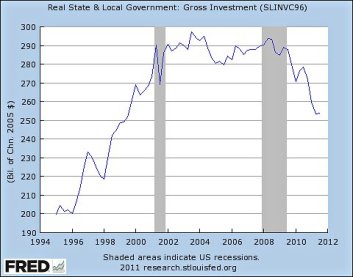
Paul Krugman put up this graph showing the level of Gross Investment by State and Local Governments. This would be the kinds of infrastructure that support modern life as we know it and include things like roads, bridges, new school buildings, sewers, airports, and other things that also drive local business growth. As you can see, there is a serious lack of infrastructure investments by state and local governments this century. Since interest rates are cheap, now is a good time to do these kinds of long term projects that would provide jobs and incentives for local businesses to expand. The majority of our states have balanced budget amendments which disallow deficit spending and in some cases, borrowing. Long term investment is nearly impossible in many states. Krugman argues that the timing is right to invest in roads, bridges, airports, and other important public projects. It’s a perfect time to look at an Infrastructure Bank which had broad bipartisan support during the Bush/Cheney years. President Obama has proposed such an institution.
The proposal, modeled after a bipartisan bill in the Senate, would take $10 billion in start-up money and identify transportation, water or energy projects that lack funding. Eligible projects would need to be worth at least $100 million and provide “a clear public benefit.” The bank would then work with private investors to finance the project through cheap long-term loans or loan guarantees, with the government picking up no more than half the tab — ideally, much less — for any given project.
There is still this insane argument out there that the US is going broke and can’t afford to spend any money. This confuses the institution of government with households and businesses. A government has the ability tax and the national government has the ability to print money and borrow in perpetuity. This country spent far more of its future output during the Great Depression and World War 2 and the results speak for themselves. We’ve had most of this decade’s fiscal policy using taxes to encourage gambling for paper profits, not actual production of goods and services. Europe’s policy makers are stuck in the same mindset. You would think that the experiences between the two world wars would’ve made an impression on them. We’ve spent trillions of dollars propping up the world’s gambling houses without telling them they must lend for productive purposes as a condition of those bailouts. I have no idea how many more years that economists will have to scream that it’s the aggregate demand stupid at policy makers, but I have a feeling we won’t be stopping any time soon.
The Return of the Five Year Plan
Posted: December 1, 2011 Filed under: Economic Develpment, Economy 19 Comments This is going to be a weird post even for me. I read Andy Stern’s WSJ article today called “China’s Superior Economic Model: The free-market fundamentalist economic model is being thrown onto the trash heap of history”. So, these are my thoughts. I come not to bury or to praise either central economic planning or free-market fundamentalism. I come to question the prudence of extremes. Both are fairly played out utopian philosophies. I am forever the practitioner of the pragmatic, data-based, and well thought-out middle path. I am always in search of what works most efficiently and judiciously. Andy, we don’t need more government/public sector enterprises. We need to let the government be the government.
What is weird is that an article with that title by that person could show up at the WSJ. It’s really odd to even hear people discuss industrial plans these days. This harkens back to Mussolini and Fascism, Stalin and single party states with their failed command economies, and maybe a little of post industrial Japan with its kyoka kaisha. I know Andy comes from a union background but that makes it even more bizarre. Industrial plans are as much an artifact of a by gone era as the term laissez faire which took hold out of disgust for monopoly creating monarchs during a period when homogenous commodities from small enterprises were the heart of commerce and the only way to mess a market up good was to disallow every one but the king’s favorite to participate in production.
So, what’s the deal with romanticizing the current Chinese model? Why not look at Sweden or Norway instead?
Secretary of State Hillary Clinton, former Gov. Mitt Romney and President Barack Obama all weighed in with their views—ranging from warnings that China must “end unfair discrimination” (Mrs. Clinton) to complaints that the U.S. has “been played like a fiddle” (Mr. Romney) and that China needs to stop “gaming” the international system (Mr. Obama).
As this was happening, I was part of a U.S.-China dialogue—a trip organized by the China-United States Exchange Foundation and the Center for American Progress—with high-ranking Chinese government officials, both past and present. For me, the tension resulting from the chorus of American criticism paled in significance compared to reading the emerging outline of China’s 12th five-year plan. The aims: a 7% annual economic growth rate; a $640 billion investment in renewable energy; construction of six million homes; and expanding next-generation IT, clean-energy vehicles, biotechnology, high-end manufacturing and environmental protection—all while promoting social equity and rural development.
Some Americans are drawing lessons from this. Last month, the China Daily quoted Orville Schell, who directs the Center on U.S.-China Relations at the Asia Society, as saying: “I think we have come to realize the ability to plan is exactly what is missing in America.” The article also noted that Robert Engle, who won a Nobel Prize in 2003 for economics, has said that while China is making five-year plans for the next generation, Americans are planning only for the next election.
Yes, things are changing and China is making tons of progress. That’s bound to happen when you are that big, have that many people, and you have a long way to grow from a huge 20th century hole to the golden mean. China has done quite well mixing the free market model with its new and improved brand of central planning. However, so has most of Scandinavia and there’s a lot less reliance there on industrial planning and a much bigger appreciation of an open society. There’s also less pollution, less horrible labor practices, and a lot less selective use of resources.
The conservative-preferred, free-market fundamentalist, shareholder-only model—so successful in the 20th century—is being thrown onto the trash heap of history in the 21st century. In an era when countries need to become economic teams, Team USA’s results—a jobless decade, 30 years of flat median wages, a trade deficit, a shrinking middle class and phenomenal gains in wealth but only for the top 1%—are pathetic.
This should motivate leaders to rethink, rather than double down on an empirically failing free-market extremism. As painful and humbling as it may be, America needs to do what a once-dominant business or sports team would do when the tide turns: study the ingredients of its competitors’ success.
While we debate, Team China rolls on. Our delegation witnessed China’s people-oriented development in Chongqing, a city of 32 million in Western China, which is led by an aggressive and popular Communist Party leader—Bo Xilai. A skyline of cranes are building roughly 1.5 million square feet of usable floor space daily—including, our delegation was told, 700,000 units of public housing annually.
Meanwhile, the Chinese government can boast that it has established in Western China an economic zone for cloud computing and automotive and aerospace production resulting in 12.5% annual growth and 49% growth in annual tax revenue, with wages rising more than 10% a year.
To me, the problem isn’t that we’re bad at planning, it’s that we’ve had a concerted political and corporate effort to go back to a kleptocracy where the monarchs in charge set up the perfect conditions for a few big players to capture markets. We say that we’re all about free market fundamentalism but we’re not for that any more than what our government is doing now is some kind of central planning that’s “collectivism” gone amok which is the equally ridiculous libertarian narrative. Government does have a role in commerce and markets. It should be not be efficient central planning or being so hands off as to create the situation where entire markets collapse from frictions. It also shouldn’t be using its legal and power status to promote the interests of one group of market participants over another.
Stern offers this view.
America needs to embrace a plan for growth and innovation, with a streamlined government as a partner with the private sector.
Uhhh, no. The government needs to ensure that markets can operate efficiently and nothing gets illegally exploited. This isn’t exactly akin to partnering with the private sector. As a Katrina Carpetbagger victim, I can tell you that government partnering with the private sector usually means companies of Jeb Bush get contracts for pumps with the Army Corps of Engineers that are so faulty that the entire ground shakes throughout the city when switched on. They make plenty of noise and release a lot of energy, but those pumps took around 3 years worth of refitting to be made to pump water out of the canal and into the lake. Then there was Halliburton that took up blocks worth of parking in the French Quarter and fed tons of federal workers while preventing access to parking for people that wanted to access struggling restaurants and local businesses. Don’t even get me started on the number of debris collection trucks that came from Virginia, Maryland and Texas to haul things when New Orleans companies weren’t even considered.
We know what makes markets functional. They need to be translucent with minimized information asymmetry. They need to have minimal moral hazard opportunities like insider trading. It’s best when there isn’t any market concentration or powerful blocs. Some products and services are most appropriately and efficiently provided by government; not outsourced to profit mongers for monopoly rent extraction and nothing else. We know that taxes reduce incentives, subsidies increase incentives, and that things like patents that serve as barriers to entry to a market reduce quantities available to the market, increase prices, and provide market power. We don’t even use all of this knowledge right now. That’s because there is too much corporate money and corporate access to the political system. It’s not for the lack of efficient government planning.
Yes, the government can create a legal environment, regulatory framework, and infrastructure to support economic growth. But what do we have? Laws that extol corporate personhood and free speech that create the environment where senior executives can do immense harm and never be held to legal account. We have lax and captured regulators that are more likely to let a bad drug get through to help a drugmaker than worry about the potential damage to newborns, the elderly, or any number of the weakest members of society. Then, we have enormous pressure to change laws so the damaged can’t recover any recompense for the damages. We have lawmakers that create laws to transfer enormous wealth, income and resources to business that donate money to them. We now learn they own stock in companies and pass laws that protect bad market practices as long as they positively impact stockholder bottom lines. Don’t even get me started on how the government can’t even fund the rebuilding and improvement of basic infrastructure unless there is direct political benefit to the politician or one of his/her donors. We get bridges to no where and major interstate bridges in Minneapolis that collapse into the river with people and cars because no one funds refits and maintenance.
We’re going to embrace government/private sector cooperation given this experience? I would hope not. The focus on China right now reminds me of the obsession with Japan in the 80s and the USSR in the post ww2 period. Any country that manages to start developing itself out of a hole is going to have a meteoric rise. That’s just simple math. Most of the best of our technology booms in the last century came from happenstance and an open environment with a bunch of government grants that funded labrats in universities and hospitals, in NASA type government agencies, and in highly regulated government monopolies like Bell Labs. What was wrong with that model? What’s wrong with the models of Norway and Sweden? I don’t think that China has any kind of special insight to offer us. After all, we can point to on time trains in Italy, Sputnik, and early German rocket science as great 2oth century advances and notice that the government and economic systems that supported these advances didn’t turn out to be long lasting. Japan’s corporate/government coziness has brought us and them Fukishima. China may have some nifty infrastructure but I sure wouldn’t want to be a Tibetan right now or a young person working in an Apple manufacturing plant or a citizen with asthma or a Chinese coalminer. We may not need rampant 18th century freemarket fundamentalism or 19th century capitalism, but let’s not get all excited about this revamped 20th century central planning and corporate/government enterprises either.
It’s best to look at the fundamentals of the individual market then decide if circumstances say cage the beast or set it free or find a middle path that incorporates a combination of both. The government’s role is not to partner with private enterprise. It’s not to create a central plan. It’s to ensure that no one player in the market gets an unfair advantage or creates undue damage to any other and it’s to provide public goods as necessary.
Today’s Successful Economies
Posted: September 30, 2011 Filed under: Economic Develpment, Economy, U.S. Economy, We are so F'd | Tags: globalization, Jeffrey Sachs, neoconfederates on the rise, US global standings 6 Comments
Swedes are happier and more globally competitive than the US. Is this the real secret of blondes having more fun?
I wrote a blog post a while back about heaven having fjords. I’m very much interested in economics from a development standpoint so it’s always worthwhile checking out the top performers in the world for lessons. It is also quite apparent when you do that Libertarian and Republican memes fail and fail badly. It’s probably why we never hear these things in corporate media.
Societies are better when the pull together instead of pull apart. The best performing countries in economics are the same countries that have a high commitment to public education and society at large. The high performers–in economics, in health, and in education–are the Scandavian countries with their highly progressive tax rates, intense regulation of commerce and harmful activities and emphasis on making sure the rising tide rises all the boats rather than sinking a huge number of them to the benefit of the mega yachts. These are also countries with parliamentary systems which makes them highly democratic. They’ve been winning consistently with the advent of the global economy. The US has lost its position as leader of the developed nations and is moving way down into the losing positions below still developing nations. We could learn some lessons from Scandinavia.
Here’s Jeffrey Sachs at Project Syndicate with some things to think about in that vein. He has written a new book called The Price of Civilization which basically outlines the missteps that we’ve taken that were primarily started as a result of the election of Ronald Reagan. For some reason, many Americans don’t want to pay for some very simple modern facilities like roads, electric grids, airports, and railways. They prefer to buy junk from China they probably don’t need in search of happiness in the form of hoarding and consuming.
Rather than respond to globalization with more government spending on education, infrastructure, and technology, Ronald Reagan won the presidency in 1980 by pledging to slash government spending and cut taxes.
For 30 years, the US has been going in the wrong direction, cutting the role of government in the domestic economy rather than promoting the investments needed to modernize the economy and workforce. The rich have benefited in the short run, by getting massive tax breaks. The poor have suffered from job losses and cuts in government services. Economic inequality has reached a high not seen since the Great Depression.
These adverse trends have been exacerbated by domestic politics. The rich have used their wealth to strengthen their grip on power. They pay for the expensive campaigns of presidents and congressmen, so presidents and congressmen help the rich – often at the expense of the rest of society. The same syndrome – in which the rich have gained control of the political system (or strengthened their control of it) – now afflicts many other countries.
Sweden–as an example other than Norway who can use their oil to leverage their improvements–has been called an economic miracle. After feeling the global recession, they are now growing GDP at rates that are twice to three times the averages of most industrial countries. They are growing 5 times fasting than the US. So, look at their numbers there on the CIA Factbook and marvel where under the poverty rate comes the label: not applicable. Sweden blends capitalism with a social democracy in a way that makes the swedes the 6th most prosperous country on the planet. They are above the US who is number 10. They are behind Norway, Denmark, Finland, Australia and New Zealand. They are number 23 in GDP per capita The US is number 11. They are also highly globally competitive ranking #3 in Global Competitiveness Index after Finland and Switzerland. The US is number 1o.
The Swedes are number 9 on the human development index. We are number 4. Norway is number 1. Sweden has high marginal tax rates (sometimes over 70%), very powerful unions, immigrants, and generous vacations and work weeks. Under Republican fairy tales, Sweden and Norway should be worse off than Haiti. Rather than looking at countries that are achieving great things and leaving us in the dust, we are grasping at a rigid ideology that is designed to tank us.
I haven’t read the Sachs book but I’m definitely putting it on my reading list. You may recall that this is also something Fareed Zakaria examines in his TV show, in books, and at TIME magazine. Here’s a good summary from a recent Time article.
The following rankings come from various lists, but they all tell the same story. According to the Organisation for Economic Co-operation and Development (OECD), our 15-year-olds rank 17th in the world in science and 25th in math. We rank 12th among developed countries in college graduation (down from No. 1 for decades). We come in 79th in elementary-school enrollment. Our infrastructure is ranked 23rd in the world, well behind that of every other major advanced economy. American health numbers are stunning for a rich country: based on studies by the OECD and the World Health Organization, we’re 27th in life expectancy, 18th in diabetes and first in obesity. Only a few decades ago, the U.S. stood tall in such rankings. No more. There are some areas in which we are still clearly No. 1, but they’re not ones we usually brag about. We have the most guns. We have the most crime among rich countries. And, of course, we have by far the largest amount of debt in the world.
We’re in the process of watching the Cat Food Commission Redux set our priorities for our future and its basically an agenda meant to downsize the American Dream for every one except the Mega Wealthy. I hope that the Cheddar Revolution and the Occupy Wall Street movement turn into an American Spring Movement. We have to regain the positive momentum towards modernity before the powers that be force us all back into a pre-civil war paradigm of laws, economic servitude, and society.
Meanwhile, as I write about these healthy economies, 90% of US citizens say our economy stinks and they are pretty unhappy about it. Its time to look at some best practices of other countries and dump the ideologues that keeping making the wrong decisions for us.

 peej
peej Carissa
 bostonboomer
 dakinikat
 ecocatwoman
 mablue2
 Mama Lopez
 peggysue22
 quixote
 skydancingguestblogger
 Mona (aka Wonk the Vote)



 Sky Dancing
Recent Comments