
Republicans Vote to End Medicare, and Other DC Follies
Posted: April 15, 2011 Filed under: Barack Obama, Democratic Politics, Domestic Policy, Federal Budget, Federal Budget and Budget deficit, Hillary Clinton, House of Representatives, income inequality, legislation, Media, Medicare, Psychopaths in charge, Surreality, the villagers, U.S. Economy, U.S. Politics, We are so F'd | Tags: Barak Obama, medicare, Nancy Pelosi, Paul Ryan 23 Comments
What a disgrace these House Republicans are! This afternoon, 235 of them voted to destroy Medicare and Medicaid when they voted for Representative Paul Ryan’s budget bill. The bill passed the House with all Democrats and only four Republicans voting against it.
The bill will most likely die in the Senate, but Democrats should make sure those House Republicans’ constituents know what they voted for. Of course Democrats will do no such thing, because, first they are wimps with no idea how to win, and second, their President is already signaling that he will compromise with Ryan in the bargaining over raising the debt ceiling.
Obama said that it is critical for the world economy that Congress vote to increase the $14.3 trillion debt ceiling, but said that he would have to reach an accord with Republicans, who have called for a vote to be conditional on passage of fiscal reform.
“I think it’s absolutely right that it’s not going to happen without some spending cuts,” Obama said during an interview with The Associated Press.
Before the vote on the Ryan bill, there was a vote on an even more draconian bill proposed by far right Republicans. It turned into a bit of a free-for-all on the House floor. From Brian Beutler at TPM:
What was supposed to be a routine vote in the House — to knock down an amendment authored by conservative Republicans — turned into pandemonium on the House floor Friday, as Democrats tried to jam the plan through, and hang it around the GOP’s necks.
The vote was on the Republican Study Committee’s alternative budget — a radical plan that annihilates the social contract in America by putting the GOP budget on steroids. Deeper tax cuts for the wealthy, more severe entitlement rollbacks.
Normally something like that would fail by a large bipartisan margin in either the House or the Senate….But today that formula didn’t hold. In an attempt to highlight deep divides in the Republican caucus. Dems switched their votes — from “no” to “present.”
Panic ensued. In the House, legislation passes by a simple majority of members voting. The Dems took themselves out of the equation, leaving Republicans to decide whether the House should adopt the more-conservative RSC budget instead of the one authored by Budget Committee Chairman Paul Ryan. As Dems flipped to present, Republicans realized that a majority of their members had indeed gone on the record in support of the RSC plan — and if the vote closed, it would pass. That would be a slap in the face to Ryan, and a politically toxic outcome for the Republican party.
So they started flipping their votes from “yes” to “no.”
In the end, the plan went down by a small margin, 119-136. A full 172 Democrats voted “present.”
It’s nice to see a little bit of partisan spirit from the Democrats anyway. Too bad they had to use Obama’s old standby–voting “present,” but still maybe a good sign. It’s pretty clear that many in the House are unhappy with Obama and his kowtowing to Republicans. Maybe they will stand up to Obama next. Where there’s life, there’s hope.
Of the Ryan Budget bill, House Minority Leader Nancy Pelosi said
“This Republican plan ends Medicare as we know it and dramatically reduces benefits for seniors,” Rep. Nancy Pelosi (D-Calif.), the House minority leader, said in a floor speech. She said it would force the average senior citizen to pay twice as much for half the benefits while giving “tens of billions of dollars” in tax breaks to big oil companies.
The GOP plan “reduces Medicaid to our seniors and nursing homes . . . while it gives tax breaks to companies that send jobs overseas,” Pelosi said. “That’s just not fair.”
Pelosi was also very unhappy with President Obama’s “compromise” budget for 2011. Besides being angry about the cuts to programs that help the most vulnerable Americans, Pelosi was extremely unhappy that she and her Democratic House colleagues were completely cut out of the negotiations on the 2011 budget. In fact, Patricia Murphy at The Daily Beast says that many Democrats are “disgusted” with Obama. She writes that
…a number of Democrats are past protesting the president, discussing among themselves ways to recruit a primary challenger in 2012.
“I have been very disappointed in the administration to the point where I’m embarrassed that I endorsed him,” one senior Democratic lawmaker said. “It’s so bad that some of us are thinking, is there some way we can replace him? How do you get rid of this guy?” The member, who would discuss the strategy only on the condition of anonymity, called the discontent with Obama among the caucus “widespread,” adding: “Nobody is saying [they want him out] publicly, but a lot of people wish it could be so. Never say never.”
House Republicans, who got much of what they wanted in their negotiations with the White House, are whining because Obama said some mean things about them in his deficit speech on Tuesday. They were shocked that the president’s speech was “partisan.” Give me a break! Why do we have political parties if they aren’t supposed to be “partisan?”
The three Republican congressmen saw it as a rare ray of sunshine in Washington’s stormy budget battle: an invitation from the White House to hear President Obama lay out his ideas for taming the national debt.
They expected a peace offering, a gesture of goodwill aimed at smoothing a path toward compromise. But soon after taking their seats at George Washington University on Wednesday, they found themselves under fire for plotting “a fundamentally different America” from the one most Americans know and love.
“What came to my mind was: Why did he invite us?” Rep. Dave Camp (R-Mich.) said in an interview Thursday. “It’s just a wasted opportunity.”
The situation was all the more perplexing because Obama has to work with these guys: Camp is chairman of the House Ways and Means Committee, responsible for trade, taxes and urgent legislation to raise the legal limit on government borrowing. Rep. Jeb Hensarling (Tex.) chairs the House Republican Conference. And Rep. Paul Ryan (R-Wis.) is House Budget Committee chairman and the author of the spending blueprint Obama lacerated as “deeply pessimistic” during his 44-minute address.
Give me a break! Why do we have political parties if they aren’t supposed to be “partisan?” I’d like to see a hell of a lot more partisanship on the Democratic side. Of course Republicans are never accused of “partisanship,” but it is simply assumed that they will be rabidly “partisan” and the press eats it up when they are. But don’t worry guys, Obama is just mouthing the appropriate words before he surrenders and gives you most of what you want again.
Whatever Obama thinks he’s doing, it doesn’t seem to be working for the majority of Americans. Today Gallup reported that the president’s job approval rating is only 41%. The biggest drop in support for Obama is among Independents, only 35% of whom approve of his performance.
The latest buzzword in DC is “serious.” Republicans and columnists rave about how “serious” Ryan’s budget bill is. Democrats claim Obama’s plan is the truly “serious” one. But as Dakinikat keeps explaining, neither of these plans is going to do much to pull the country out of the doldrums, because neither has even a nodding acquaintance with economic reality. For anyone to call any of these politicians and pundits “serious” is nothing but a sick joke.
Today was just another pointless day in the lives of the least serious people in the least serious city on earth.
We Interrupt your Regularly Scheduled Programming for a Bit of Deprogramming
Posted: April 12, 2011 Filed under: Catfood Commission, Domestic Policy, Economic Develpment, financial institutions, income inequality | Tags: helping the world's poor, Income Inequality, tax havens 9 Comments
Uncle Barrack sez: Time to feed the Corporate Kitty
It’s time for my regular rant on how bad income inequality is for an economy. I know that John Boenher wants to transfer all the resources in the country to so-called job creators and that CEO Hacks are trying to turn the public school system into a drone production unit, but as usual, I’m going to interrupt the messaging with empirical evidence. I’m just one of those people that doesn’t believe any one unless they back it up with honest numbers. This time, I’m going to direct you to a study by the International Monetary Fund (IMF). Just in case you don’t already know, the IMF is not exactly a bastion of comrades-in-arms. They’ve been soundly criticized by developing nations for exporting American-style capitalism wherever they go to provide help to struggling nations. So, with that in mind, here’s a briefing on the study titled “Warning! Inequality May be Hazardous to your Health”.
Their introduction is so meaty that I’m going to leave it nearly wholesale for you before I return to editing more things for a development journal. Finding ways to raise every one’s boat is my thing, just in case you never noticed.
Many of us have been struck by the huge increase in income inequality in the United States in the past thirty years. The rich have gotten much richer, while just about everyone else has had very modest income growth.
Some dismiss inequality and focus instead on overall growth—arguing, in effect, that a rising tide lifts all boats. But assume we have a thousand boats representing all the households in the United States, with boat length proportional to family income. In the late 1970s, the average boat was a 12 foot canoe and the biggest yacht was 250 feet long. Thirty years later, the average boat is a slightly roomier 15 footer, while the biggest yacht, at over 1100 feet, would dwarf the Titanic! When a handful of yachts become ocean liners while the rest remain lowly canoes, something is seriously amiss.
In fact, inequality matters. And it matters in all corners of the globe. You need look no further than the role it might have played in the historic transformation underway in the Middle East.
The increase in U.S. income inequality in recent decades is strikingly similar to the increase in the 1920s. In both cases there was a boom in the financial sector, poor people borrowed a lot, and it all ended in huge financial crises. Did the recent financial crisis result somehow from the increase in inequality?
Some time ago, we became interested in long periods of high growth (“growth spells”) and what keeps them going. The initial thought was that sometimes crises happen when a “growth spell” comes to an end, as perhaps occurred with Japan in the 1990s.
We approached the problem as a medical researcher might think of life expectancy, looking at age, weight, gender, smoking habits, etc. We do something similar, looking for what might bring long “growth spells” to an end by focusing on factors like political institutions, health and education, macroeconomic instability, debt, trade openness, and so on.
Somewhat to our surprise, income inequality stood out in our analysis as a key driver of the duration of “growth spells”.
We found that high “growth spells” were much more likely to end in countries with less equal income distributions. The effect is large. For example, we estimate that closing, say, half the inequality gap between Latin America and emerging Asia would more than double the expected duration of a “growth spell”. Inequality seemed to make a big difference almost no matter what other variables were in the model or exactly how we defined a “growth spell”. Inequality is of course not the only thing that matters but, from our analysis, it clearly belongs in the “pantheon” of well-established growth factors such as the quality of political institutions or trade openness.
While income distribution within a given country is pretty stable most of the time, it sometimes moves a lot. In addition to the United States in recent decades, we’ve also seen changes in China and many other countries. Brazil reduced inequality significantly from the early 1990s through a focused set of transfer programs that have become a model for many around the world. A reduction of the magnitude achieved by Brazil could—albeit with uncertainty about the precise effect—increase the expected length of a typical “growth spell” by about 50 percent.
The upshot? It is a big mistake to separate analyses of growth and income distribution. A rising tide is still critical to lifting all boats. The implication of our analysis is that helping to raise the lowest boats may actually help to keep the tide rising!
That basically says that no one’s boat will really rise as much as it could unless all boats rise. Intuitively, this makes sense because if you think about it, businesses need customers. Poor customers just don’t buy as much unless you provide them with good incomes. Unless you want make government the primary customer in an economy or you’re deluded into thinking business investment will ever be the major agent in GDP, you realize that household consumers are the true center of any market economy. Denying them incomes denies every one of incomes. Just providing monies to the top 1 or 2 percent who are now likely to take their spending and investment any where on the planet is just delusional. Actually, if you want some really good reading on that, I suggest you pick up the book Tax Havens: How Globalization Really Works (Cornell Studies in Money).
In Tax Havens, Ronen Palan, Richard Murphy, and Christian Chavagneux provide an up-to-date evaluation of the role and function of tax havens in the global financial system-their history, inner workings, impact, extent, and enforcement. They make clear that while, individually, tax havens may appear insignificant, together they have a major impact on the global economy. Holding up to $13 trillion of personal wealth—the equivalent of the annual U.S. Gross National Product—and serving as the legal home of two million corporate entities and half of all international lending banks, tax havens also skew the distribution of globalization’s costs and benefits to the detriment of developing economies.
The first comprehensive account of these entities, this book challenges much of the conventional wisdom about tax havens. The authors reveal that, rather than operating at the margins of the world economy, tax havens are integral to it. More than simple conduits for tax avoidance and evasion, tax havens actually belong to the broad world of finance, to the business of managing the monetary resources of individuals, organizations, and countries. They have become among the most powerful instruments of globalization, one of the principal causes of global financial instability, and one of the large political issues of our times.
There’s not really much difference between the Gadhaffi family and the Koch brothers when it comes to where the money goes from exploiting national resources. It’s also really no surprise that when you observe the countries that have the highest per capita incomes in the world that you find the world’s tax havens in the top tiers. (Norway and the US are the only countries in the top ten that aren’t tax havens.) Giving money to the richest folks in your country–the behavior of so-called banana republics–is detrimental to the economic health of that country in many ways. It’s just another way that financial institutions and financial innovation has gutted the productive capability of many a country.
The original IMF study–released on April 8, 2011–is here. I would like to point to the policy implications and suggestions section which makes going to the original study imperative. Think about this when you listen to US banana republic President Obama speak tomorrow on the marvels of the catfood commission’s report. Notice there are other studies cited in the policy suggestions.
There is nonetheless surely policy scope to improve income distribution without undermining incentives—perhaps even improving them—and thereby contribute to lengthening the duration of growth spells.
- Better targeting of subsidies can be a win-win proposition, as with the reallocation of fiscal resources towards subsidies of goods that are consumed mainly by the poor,which can free up capacity to finance public infrastructure investment while better protecting the poor (Coady et al., 2010).
- Active labor market policies to foster job-richer recoveries (ILO, 2011) may help to make recoveries more sustainable, especially as rising unemployment appears to be associated with deteriorations in the income distribution (Heathcote, Perri, and Violante, 2010).
- Equality of opportunity can make for both more equal and more efficient outcomes (World Bank, 2005). For example, effective investments in health and education—human capital—may be able to square the circle of promoting durable growth and equity while avoiding shorter-run disincentive effects (Gupta et al., 1999). Such investments could strengthen the labor force‘s capacity to cope with new technologies (which may have contributed to more inequality in a number of cases), and thereby not only reduce inequality but also help sustain growth. They could also help countries address possible adverse distributional consequences of globalization and reinforce its growth benefits.
- Some countries have managed through pro-poor policies to markedly reduce income inequality. Brazil, for example, after its market-oriented reforms of 1994 implemented active propoor distributional policies, notably, social assistance spending, that were critical to substantial reductions in poverty (Ravallion, 2009).
- Well-designed progressive taxation and adequate bargaining power for labor can also be important in promoting equity, though with due attention to the need to avoid dual labor markets that perpetuate divisions between insiders and outsiders.
Yes, I bolded the sections that are in absolute contradiction with current US political groupthink. I guess Obama just really isn’t that into development policy or research in economics. Read them and weep for what could be. Meanwhile, turn on the TV and go right back to the villagers promoting the idea that trickle up economics makes all of us better off, if you dare.
Budget Standoff Basics
Posted: April 7, 2011 Filed under: Domestic Policy, Economy, U.S. Economy, U.S. Politics, We are so F'd, Women's Rights | Tags: Toxic Republicans 14 Comments
Pirates of the Rich and Crazy
Is it just me or does John Boehner seem like he’s in over his head?
I thought I’d dig up some references for you on exactly what a shutdown of the Federal Government means and what’s at issue here. ProPublica has a great FAQ up with some basic facts on what will be impacted, what won’t be effected, and what’s at stake. Here’s a short summary from them of the Status Fail.
The GOP and the Obama administration are currently locked in a standoff over a difference of $7 billion to $30 billion—a miniscule amount of the total $3.5 trillion budget. (OMB Watch, an open government group, has a thorough account [1] of the budget battles that led up to this point.)
The Washington Post’s Ezra Klein has a simple summary [2] of the GOP’s budget proposal, put forward by House Budget Committee Chairman Paul Ryan on Tuesday: It lowers corporate taxes and taxes on the wealthy, extends the Bush tax cuts permanently, calls for repeal of both the health care law and Dodd-Frank financial reform law, and freezes discretionary spending at 2008 levels.
The Obama administration has offered to cut $33 billion from current spending levels but hasn’t given many specifics about what those cuts would entail
The biggest issue that appears to be happening is that Boehner keeps changing the bar and is being forced to say no deal on certain cuts demanded by folks like their religionist base on items like Planned Parenthood Funding. Steven Benen asks if Boehner is actually willing shut down the government over the minuscule funding for Planned Parenthood. This is definitely not Barbara Bush’s Republicans around the beltway these days. Also included in the hostage negotiations is the Clean Air Act. Republicans want to stop the government from monitoring air pollution. Hell, this isn’t even Richard Nixon’s Republicans.
Republicans want to cut off Planned Parenthood and gut the Clean Air Act, but instead of pursuing legislation to achieve their goals, they’re insisting that this be part of the budget. Democrats can’t go along with this nonsense, and John Boehner is too weak a Speaker to tell his caucus to act like grown-ups, so the entire process is unraveling.
This has led to talk about the GOP shutting down the government over abortion, but even that’s not quite right — Planned Parenthood is already prohibited from using public funds to terminate pregnancies, and has been for many years. What we’re talking about here is Republicans shutting down the government over access to contraception and family planning services.
For all of those folks that thought the Republicans weren’t ready to go crazy over their crazy, extremist religious views, this should wake them out of their stupor. These folks are trying to shut down access to birth control by screaming abortion. This kind of mean and stupid should hurt. You can also check out WT for a long list of what kind of things will be shut down or go unpaid because the xtian Taliban hate Planned Parenthood. They must hate soliders because that’s one of the groups of people that won’t be able to get paychecks either.
IRS tax audits would be halted in their tracks, this weekend’s National Cherry Blossom Festival Parade in Washington canceled, and national parks and the Smithsonian shuttered if Congress can’t reach agreement on annual spending and the government shuts down at midnight Friday.
The military, federal law enforcement and other key officials would still be at work, earning pay – except their paychecks would be halted until the government funding stream is turned back on.
The Federal Government’s personnel bureau has posted information about which Federal employees will be furloughed. There’s an old study up on what happened the last time the Republicans shut down the government under Newt Gingrich that appears to be the blueprint for Federal Response. The ProPublica site contains a series of links to a lot of information on these topics in particular. They cite a NYT article for this information.
The New York Times has a handy list laying out how various government services might be affected [16]. Some things that would continue mostly unaffected are military operations, the Federal Reserve, the postal service, and Medicare and Social Security payments. An accompanying story also outlines some potential scenarios [17] in more detail:
The National Zoo would close, but the lions and tigers would get fed; Yellowstone and other national parks would shut down. The Internal Revenue Service could stop issuing refund checks. Customs and Border Patrol agents training officials in Afghanistan might have to come home. And thousands of government-issued BlackBerrys would go silent.… In any shutdown, the government does not completely cease functioning, of course. Activities that are essential to national security, like military operations, can continue. Air traffic control and other public safety functions are exempt from shutdowns. Federal prisons still operate; law enforcement and criminal investigations can continue.
The Hill has just quoted Harry Reid as saying he doesn’t think a shutdown will be averted. Again, the issues don’t seem to be the level of spending, it’s appeals to climate deniers and members of the xtian Taliban that seem to be at issue here.
Reid blamed a partisan dispute over Planned Parenthood and other hot-button ideological issues for the stalemate, while Republicans said they had offered reasonable spending cuts and Democrats were to blame for the impasse.
…
“The two main issues holding this matter up are the choice of women, reproductive rights, and clean air,” Reid said. “These matters have no place in a budget bill.”
Reid said the president and Democratic leaders would not give any more ground in the talks.
“We have given everything that we can give,” he said
Frankly, this has gotten worse than even I imaged it could be. Clearly, people that are voting Republican have brought such extremists to the House that it’s unlikely negotiations of any kind will be successful unless Boehner cracks a whip. At the moment, all he appears to be doing is dithering, drinking, and crying.
Fighting Back … Ballroom Days are Over
Posted: April 5, 2011 Filed under: Civil Liberties, Civil Rights, collective bargaining, Corporate Crime, Democratic Politics, Domestic Policy, Economic Develpment, Economy, education | Tags: civil disobedience, democratic solutions, demonstrations, protesting 31 Comments
May take a week, and it may take longer.
They got the guns, but we got the numbers.
Gonna win yeah, we’re taking over.
Come on!
Yeah!
Your ballroom days are over, baby.
Night is drawing near.
Shadows of the evening
Crawl across the years.
Jim Morrison, from “Five to One”
I’ve spent the last six months watching this country’s policy makers throw all common sense and empirical evidence on the US economy to the wind. My jaw just drops when I consider what the Republicans have proposed under the flag of austerity and how the Democrats entertain them.
BostonBoomer and I spend a lot of time on the phone with each other. We’ve been each other’s support system having much in common as older, divorced women gone back to school and social justice activists feeling exiled in some kind of shared virtual gulag. We remember the protests and actions that we took at a younger age to demonstrate against war and the treatment of minorities and women. BB was active in antiwar protests. I was an avid women’s rights activist in the 70s and 80s, having found out that just getting good grades and hard work weren’t going to be enough for me to break into white male dominated bastions. It’s maddening when you think of all the time you spend on your education and doing the right thing and find out that what really gets you ahead is your ability to fit certain biological characteristics and social status. All those things I tried to change back then are being undone. All over the country, privileged, wealthy people and corporations are using political donations and power to seek advantage like never before. This is not healthy for our country or our future. We need to end their Ballroom Days.
It’s heartened both of us to see union workers in the US and many citizens in the MENA region stand up to authority and demand their right to participate in policy decisions that impact their lives. All over the world, the immense transfer of wealth and national assets to a small elite–the uberwealthy few representing mostly inheritance dynasties–has occurred with the help of political lap dogs seeking donations and parochial interests. It seems we may have reached a tipping point. Some yearning-to-be-free democracy contagion has created a new call for activism to protect the interests of the many against the pillaging of the few. It’s brought people to the streets all over the world and created scapegoats for rapacious states. From whistle blowing of war crimes by Bradley Manning to shouting for no more political or economic prisoners in Northern African nations, we see ordinary, educated, middle class people taking to the streets and shouting enough! We’ve fed the cheats long enough!
It’s about time.
Allison Kilkenny at The Nation has a new article up called “The Resistance Has Begun” that lists recent political demonstrations and unrest. Her article was inspired by a post by Chris Hedges–This is What Resistance Looks Like–on the increasing number of political protests occurring around the country. Hedges writes on the importance of the protests. Are we looking at renewed activism from the people who’ve been hurt by the power class-enabling policies of the last 30 years?
Chris Hedges has this to say.
The phrase consent of the governed has been turned into a cruel joke. There is no way to vote against the interests of Goldman Sachs. Civil disobedience is the only tool we have left.
We will not halt the laying off of teachers and other public employees, the slashing of unemployment benefits, the closing of public libraries, the reduction of student loans, the foreclosures, the gutting of public education and early childhood programs or the dismantling of basic social services such as heating assistance for the elderly until we start to carry out sustained acts of civil disobedience against the financial institutions responsible for our debacle. The banks and Wall Street, which have erected the corporate state to serve their interests at our expense, caused the financial crisis. The bankers and their lobbyists crafted tax havens that account for up to $1 trillion in tax revenue lost every decade. They rewrote tax laws so the nation’s most profitable corporations, including Bank of America, could avoid paying any federal taxes. They engaged in massive fraud and deception that wiped out an estimated $40 trillion in global wealth. The banks are the ones that should be made to pay for the financial collapse. Not us. And for this reason at 11 a.m. April 15 I will join protesters in Union Square in New York City in front of the Bank of America.
“The political process no longer works,” Kevin Zeese, the director of Prosperity Agenda and one of the organizers of the April 15 event, told me. “The economy is controlled by a handful of economic elites. The necessities of most Americans are no longer being met. The only way to change this is to shift the power to a culture of resistance. This will be the first in a series of events we will organize to help give people control of their economic and political life.”
I’ve written recently about the Social Contract of 20th century America and how that contract has been broken by politicians seeking to empower the monopolies and oligopolies that fill their political accounts with booty. Things have gotten so blatantly amoral that the very same folks that destroyed the Gulf ecosystem and took 11 lives and many livelihoods through careless management decisions rewarded themselves with bonuses and ‘best safety’ records with no concept that people might find that appalling. This was a repeat performance of the situation where executives of investment and commercial banks took huge bonuses right on the back of their bad management decisions that brought near US economic collapse and massive bail outs with federal funds. Also, BP is right back applying for drilling rights having really not made things right on either the human or the environment accounts for their last cost-cutting, profit gouging adventure in ignoring safety for the sake of quick profits.
When the social costs of doing business exceed the benefits of doing that business for every one but a few, the society needs to take a hard look at why it tolerates such behavior. Forcing other people to bear the costs of your business or your consumption is wrong and that’s exactly what most business subsidies and lax regulations do. When businesses can push their costs off on society or consumers of certain goods can push their costs off on society, that market becomes distorted and dysfunctional. The market price does not reflect true costs. It will overproduce harmful goods and drain resources that would be better placed elsewhere. The only way to push these costs back to the producers and consumers of costly activities and end the dysfunction is through legal prosecution or tough regulation. The idea that’s been propagated that regulation serves no purpose in a market system is part and parcel of the problem.
Opaque, vague markets do no one any good. They serve as breeders of Ponzi schemes like that of Bernie Madoff. Markets that don’t force the true cost of doing business back on the producer are no good either. They take precious scarce resources and allocate them to activities that are not worthwhile because prices and costs are understated. There are mounds and mounds of microeconomic studies that show how insidious markets can be when they are distorted by things like information asymmetries or supply-enabling protection. All of these activities set up winners and losers. In most cases, ordinary people are the losers. It takes money and power to access the special treatment offered by politicians and their laws. You only get those huge passes and benefits if your get to call yourself a corporation in this country. You can collect a lot of money for being inefficient for some reason. Businesses in this country are considered to be ‘individuals’ for freedom of speech issues but they go unprosecuted for murder every day. Just talk to grieving families of those 11 workers who died on the Deep Water Horizon in the name of increased production and lower costs. Only a sociopath could murder 11 people with safety shortcuts then provide incentives for good safety records to the instigators of the bad decisions. The only offset that we have to the kind of power and access achieved by lobbyists and corporate interests is civil disobedience and protests. Protest we must!
Kilkenny’s article lists a number of protests that are brewing around the country. These include examples in New York State, New Hampshire, Wisconsin, Ohio, Indiana and other average cities with average US citizens. Is this a Middle Class Awakening going viral? Here’s some more from Chris Hedges on how concentration of power and money in monopoly banks has warped our policy agendas and priorities. Our incomes from hard work are being skimmed by paper shuffling fees paid as bonuses to agents with no productive purpose but market distortion.
The 10 major banks, which control 60 percent of the economy, determine how our legislative bills are written, how our courts rule, how we frame our public debates on the airwaves, who is elected to office and how we are governed. The phrase consent of the governed has been turned by our two major political parties into a cruel joke. There is no way to vote against the interests of Goldman Sachs. And the faster these banks and huge corporations are broken up and regulated, the sooner we will become free.
Bank of America is one of the worst. It did not pay any federal taxes last year or the year before. It is currently one of the most aggressive banks in seizing homes, at times using private security teams that carry out brutal home invasions to toss families into the street. The bank refuses to lend small business people and consumers the billions in government money it was handed. It has returned with a vengeance to the flagrant criminal activity and speculation that created the meltdown, behavior made possible because the government refuses to institute effective sanctions or control from regulators, legislators or the courts. Bank of America, like most of the banks that peddled garbage to small shareholders, routinely hid its massive losses through a creative accounting device it called “repurchase agreements.” It used these “repos” during the financial collapse to temporarily erase losses from the books by transferring toxic debt to dummy firms before public filings had to be made. It is called fraud. And Bank of America is very good at it.
There is nothing free market about government-installed and enabled monopolies. We achieve nothing as a society by buying into the delusion that all government does is destroy the business environment when all evidence points to their enabling of the worst business practices. There is nothing remotely efficient about markets that can use public resources on the cheap to underprice goods and services, hence making them more marketable than they should be. There is no efficiency in letting producers of products and services pass the costs of their bad management decisions on to middle class and working people. You cannot blame government workers for the current economic failings. You can however, blame Bank of America, Republican Governors who hand out tax cuts indiscriminately, and federal subsidies of inefficient businesses. Huge corporations and rich people gobble up tons of public resources via subsidies, tax breaks, and use of infrastructure. Many governors have literally given away their states treasury and resources courting businesses that cost them more than they bring to that state in jobs or revenues. The big lie is that corporations are overtaxed and receive no benefits from state, local or federal government. We can’t afford to enable that big lie. We must protest it.
Ordinary Americans cannot band together to hire lobbyists to help repair our broken Social Contract. The only thing we have are our feet, our voices, and our votes. Paul Ryan’s budget Anthem is just the latest in a line of assaults on reason and common sense. It is the very definition of pennywise and pound foolish and it’s insulting. It hypes unnecessary tax cuts and increases in pentagon spending while removing funding for public health, public education, and public information programs. It continues the effort to redistribute the incomes and the resources of the country to the very few at the cost of the very many. The only way to stop this is to protest. Protest frequently. Protest openly. Protest now. Public Policy should not be based on badly written dystopian fiction novels.
It is not illegal immigrants that have broken the American Dream. It’s not bands of stereotyped Muslim Bedouins hiding out in caves a world apart from Main Street that’s threatening the livelihoods of American workers. It’s not poor Cuba’s last vestiges of Marxism or crazy-like-a-fox Hugo Chavez. It’s time to stop falling for their straw men enemies. What has taken the American Dream away from so many is the greed and power lust of a few people that have completely usurped the nation’s policy makers. It’s time to remind them that they may have the guns, but we have the numbers.
Just In: Judge in Wisconsin blocks Walker’s Union Busting Bill
Posted: March 18, 2011 Filed under: collective bargaining, Domestic Policy | Tags: collective bargainning, union, Wisconsin, Wisconsin 14 13 Comments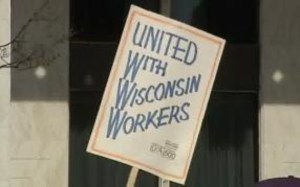 A Wisconsin Judge in Dane County has issued a restraining order to block enforcement of the Republican effort to end the collective bargaining rights of the state’s public workers. The judge has ruled that the way the law was pushed through possibly violated the state’s open meetings laws. She has stopped the enactment of the law until she reviews the merits of the case in terms of the process that was used to pass it.
Judge Maryann Sumi issued the order to temporarily block the law as Dane County District Attorney Ismael Ozanne had requested as part of his lawsuit.She said the order will stop publication until further order of the court. Sumi said that while the order blocks the law’s publication, she said she has no authority to prevent the Legislature from voting on the bill again.The state Department of Justice asked for a stay of the order, but the judge denied the request.The judge said she wasn’t weighing the merits of the law in issuing the order.”What I want to make clear is I make no judgments on merit of legislation,” she said.She said that instead, she was interpreting the state’s open meetings law.
This action prevents the state’s Secretary of State from recording the law.
Sumi’s order will prevent Secretary of State Doug La Follette from publishing the law until she can rule on the merits of the case. Dane County Ismael Ozanne is seeking to block the law because he says a legislative committee violated the state’s open meetings law.
Sumi said Ozanne was likely to succeed on the merits.
“It seems to me the public policy behind effective enforcement of the open meeting law is so strong that it does outweigh the interest, at least at this time, which may exist in favor of sustaining the validity of the (law),” she said.
The judge’s finding – at least for now – is a setback to Republican Gov. Scott Walker and a victory for opponents, who have spent weeks in the Capitol to protest the bill.
Asst. Atty. Gen Steven Means, who was part of the state’s legal team, said after the ruling that “we disagree with it.”
“And the reason they have appellate courts is because circuit court judges make errors and they have in this case.”
Means said the state would “entertain an appeal.”
“If the Legislature decides to go back and re-act on these provisions, they have the right to do that. And we will see what happens,” he said.
Means said he had no idea what the Legislature might do.

 peej
peej Carissa
 bostonboomer
 dakinikat
 ecocatwoman
 mablue2
 Mama Lopez
 peggysue22
 quixote
 skydancingguestblogger
 Mona (aka Wonk the Vote)



 Sky Dancing
Recent Comments