
William Black Goes Ballistic
Posted: February 1, 2012 Filed under: 2012 elections, Bailout Blues, Banksters, corruption, Crime, Democratic Politics, double-speak, financial institutions, investment banking, The Great Recession, U.S. Economy, We are so F'd | Tags: 2012 presidential election, Barack Obama, Financial Crisis, George W. Bush, U.S. Economy 6 CommentsI’ve been reading William Black’s essays and posts, watching his video interviews and You Tube presentations, ever since I saw him on Bill  Moyers Journal speaking frankly, no holds barred, about how the financial industry had brought the country to its knees and gotten away with it. He spoke frankly again during his Congressional testimony last year when he came right out and called the mortgage debacle that nearly finished the US economy . . . fraud. Yes he used the ‘f’ word! This was unlike other ‘experts’ who insisted there was no inkling of trouble on the horizon, that the financial meltdown was ‘an act of the economic gods,’ a huge surprise, the product of overly optimistic financial predictions.
No, Black said. It was fraud. It was criminal. In case you missed that testimony, you can watch below. It’s worth a second go-around.
Too bad Black’s comments were basically ignored, caught up in the razzle-dazzle of excuses, half-truths and political posturing that’s become all too familiar to anyone paying attention. Business as usual is still the acceptable mantra. In case, you’ve forgotten [time flies when we’re having so much fun], William Black headed Poppy Bush’s forensic audit team during the S&L scandal, which ultimately led to 1000 elite felony convictions.
Black’s investigative team wasn’t kidding around.
William Black came out yesterday morning with his own take on President Obama’s SOTU announcement of a Task Force [The Let’s Try It Again Task Force], quoting POTUS:
And tonight, I am asking my Attorney General to create a special unit of federal prosecutors and leading state attorneys general to expand our investigations into the abusive lending and packaging of risky mortgages that led to the housing crisis. This new unit will hold accountable those who broke the law, speed assistance to homeowners, and help turn the page on an era of recklessness that hurt so many Americans.
Black suggests we look at the wording, the avoidance of using the ‘f’ or ‘c’ word. That would be fraud and criminal. His response to this and Eric Holder’s follow up memorandum:
The working group will not “investigate … abusive lending” and it will not “hold accountable those who broke the law … [by defrauding] homeowners.” It will not “speed assistance to homeowners.” It will not “turn the page on an era of recklessness” – and fraud, not “recklessness” is what prosecutors should prosecute. The name of the working group makes its crippling limitations clear: the Residential Mortgage-Backed Securities Working Group. Attorney General Holder’s memorandum about the working group makes clear that the name is not misleading. The working group will deal only with mortgage-backed securities (MBS) – not the fraudulent mortgage origination that drove the crisis (the only exception is federally insured mortgages).
Clearly, he’s not impressed. No, instead he’s disgusted and enraged. In fact, the essay nearly jumps off the page with genuine anger. He goes on to say:
The working group is a symbolic political gesture designed to neutralize criticism of the administration’s continuing failure to hold accountable the elite frauds that drove the crisis. Neither the Bush nor the Obama administration has convicted a single elite fraud that drove the crisis. This is a national disgrace and represents the triumph of crony capitalism. Remember that the FBI warned in September 2004 that there was an “epidemic” of mortgage fraud and predicted that it would cause a financial “crisis.” There are no valid excuses for the Bush and Obama administrations’ failures. The media have begun to pummel the Obama administration for its failure to prosecute. The administration could not answer this criticism with substance because it has nothing substantive to offer in prosecuting elite mortgage origination frauds. The ugly truth is that we are three full years into his presidency and Holder could not find a single indictment to bring that Obama could brag about in his SOTU address. Who doubts that Holder and Obama would have done so if they had anything in the prosecutorial pipeline? Why do Holder and Obama have nothing in the pipeline?
One of the other things that deeply disturbs Black is President Obama’s willingness to play politics in this matter, float the gambit of the Task Force /Working Group and the reputation of Eric Schneiderman to create the appearance of a genuine hands-on effort. But this move is not genuine as far as Black is concerned and contradicts the very essence of President Obama’s SOTU address, conjuring up the Seal Team that took out Osama Bin Laden—a team effort, concentrating on the mission.
This is no more than vulgar propaganda, Black claims.
He also refers to a disclosure made by Scot Paltrow for Rueters 10 days ago, revealing that US Attorney General Eric Holder and Lanny Breuer, heading the DOJs criminal division [also a co-chair of the ‘Let’s Try It Again Task Force], had been partners at Covington and Burling, a well-established and well-heeled law firm that represented many of the largest banks, providing cover for their clients through key arguments on the MERS debacle.
Conflict of interest anyone?
The state Attorney Generals? They were lobbyied, leaned on, even offered [as was the case of AG Kamala Harris, CA] $8 billion to assist damaged California homeowners in a bid to agree to the original deal, which would have offered the big banks immunity from liability. All so the President could announce ‘a deal’ in his State of the Union address, even though homeowners would be left out to dry and bank executives, who led deliberate “accounting control frauds,” could continue their conduct with absolute impunity.
This is ugly, made all the uglier in that it was sanctioned through and by the White House. Black suggests that Eric Schneiderman recognized the leverage he had, agreed to join the Task Force as a co-chair with the stipulation that the original deal be modified, specifically concerning civil liability in mortgage origination fraud.
This might explain Jamie Dimon’s whine last Friday, pouting and claiming bankers are the objects of unfair discrimination. Really? Here’s the average American’s response:
Of course, you would think that this mess would be a window of opportunity for Republicans in an election year. What an incredible club to use on President Obama to win the WH, maybe the House and the Senate by gargantuan majorities.
No fear there because for every compromised Democrat there is an equally compromised Republican. Both the Democrats and Republicans rely heavily on campaign contributions from the financial sector. Neither side is willing to cut their bankers [crooked or not] off at the knees.
What to do? What better reason to support any and all actions to get money out of the political arena. Until we do? The world belongs to the highest bidder.
Greedy Bastards
Posted: January 26, 2012 Filed under: Banksters, commercial banking, Corporate Crime, corruption, financial institutions, Global Financial Crisis, investment banking, lobbyists, U.S. Economy, U.S. Politics | Tags: Dylan Ratigan, extractionism vs capitalism, Greedy Bastards 15 CommentsNo, I am not making an editorial comment.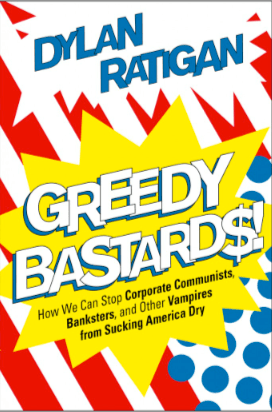
But after nonstop blathering served up by the GOP, only to be followed by President Obama’s Teddy Roosevelt impersonation [although I have to admit—the State of the Union was a surprisingly good speech], I thought a moment of palate cleansing might be in order. In this case Dylan Ratigan offers up the sorbet.
Ratigan is someone willing to call out the shysters, the casino players and shakedown artists, including their political handmaidens for what they truly are, and ‘Greedy Bastards’ is the title of his newly released book. The author’s name may ring a bell because Dylan Ratigan has a public platform on MSNBC, an hour-long show Monday through Friday. The program airs at 4:00 pm, EST, in my neck of the woods.
Ratigan’s slant focuses on the collision of worlds, that of finance and politics, how the incestuous relationship is literally squeezing the life out of the United States. His take is not an indictment of capitalism. Rather it is an indictment of what is posing as capitalism, a system he refers to as ‘extractionism.’
Ratigan is not a newcomer or a pundit simply reading a script. He worked the financial beat with Bloomberg News, serving as Global Managing Editor to Corporate Finance until 2003. He’s also the former anchor and co-creator of CNBC’s Fast Money. He has launched and anchored a number of financially-related broadcasts over the years but decided to leave Fast Money after the 2008 financial meltdown. Ratigan has publicly stated that he was personally disgusted by the Wall Street banking sector’s shakedown of the American public. The Dylan Ratigan Show was launched to provide discussion and analysis of the financial/government intersection, a system that has acquiesced to the wanton theft of the Nation’s wealth and resources by . . . Greedy Bastards, of course.
Though the show has been on air for three years, Ratigan has admitted that his voice was finally heard after an infamous meltdown last August. It was an on-air rant that would have made Patty Chayefesky proud, a Howard Beale moment.
That woke people up! It also led to Ratigan’s Get the Money Out [of politics] Movement, working towards a Constitutional Amendment to remove the corrosive element of money in the political sphere. And then, there’s the book.
One thing I liked about Ratigan’s approach is that instead of pointing out one segment of the population for public pillorying, his title basically refers to a state of mind and the all too frequent way of doing business and politics in the 21st century.
For instance, in the case of capitalism, Ratigan uses the example of venture capital, a subject that has come up in reference to Romney’s connection to Bain & Company, specifically Bain Capital. From Chapter 1:
If I start a venture capital firm that lends out money to drug researchers trying to find new cures for disease, and I get rich doing it, then I made my money by investing in the productive future of the country. I used my money in a way that facilitated scientific innovation and a cure. I’m what the director of the Havas Media Lab Umair Haque a ‘capitalist who makes.’ But instead, if I take the same money and use it to lobby for changes in government regulation—changes that help me trick a union into investing its retirement savings in flawed investments so that I can collect the commissions—then I may move as many dollars into my bank account as someone who funded cures for diseases, but I haven’t made anything. I’m a ‘capitalist who takes,’ exploiting my power to influence the government for my own private gain, no matter the harm to anyone else. I’m a greedy bastard.
The latter example, taking money from others without providing anything of value is, according to Ratigan, the opposite of capitalism. An extractionist system loses increasing value over time until there’s nothing left. Call it the vampire or vulture model. A system based on the extractionist principle, provides no incentive for people to make good deals, where both sides benefit. Instead, it rewards those who take and give nothing in return.
Sound familiar?
Ratigan covers the areas that have pushed the extractionist model to the max: banking, education, healthcare, energy, trade negotiations and the unholy alliance of government and big money fueling the feeding frenzy of the Nation’s resources and our future. But unlike many gloom and doom tomes, Ratigan offers solutions and brings an optimism to the subject, namely that we have the ideas, the people and yes, even the money to solve what at times seems insolvable. He concludes in a rather convincing way that what is needed is a realignment between investment and the needs of capable, innovative people. If loans and investments offered the highest returns when they provided the highest value as opposed to simply taking the highest risk, then prevailing attitudes and business practices would shift and win/win deals would be created.
 Sound like pie in the sky? I don’t think so. Yes, it’s a matter of will, public pressure to exact the necessary changes but this realignment idea is possible by citing the goals first, and then targeting the resources to get there. Ratigan refers to this as hotspotting—zeroing in on the problem, determining what methodology provides the best results, and then aiming resources to match those needs.
Though some critics have dismissed this idea, it is very attuned to what Bill Clinton recently suggested in his Esquire interview about highlighting the successes and needs across the country, and then linking them, matching them up. Just another turn on the realignment idea:
. . . the two best things you could do are the infrastructure bank and a simple SBA-like loan guarantee for all building retrofits, where the contractor or the energy-service company guarantees the savings. So that allows the bank to loan money to let a school or a college or a hospital or a museum or a commercial building or factories for lease unencumbered by debt to loan it on terms that are longer, so you can pay it back only from your utility savings. You could create a million jobs doing that because of the home models that are out there now.
There are these two guys on Long Island who started a little home-repair deal. They got thirty-five employees now, and they’re — they can go in, tell you how much they’ll save you. There’s an operation in Nebraska that’s in and out in a day, and they’re averaging more than 20 percent savings, and conservative Republican Nebraska is the only state in the country that has 100 percent publicly owned power.
And,
You’ve got Orlando with those one hundred computer-simulation companies. They got into computer simulation because you have the Disney and Universal theme parks, and Electronic Arts’ video-games division. And the Pentagon and NASA desperately need simulation, for different reasons. So there you’ve got the University of Central Florida, the biggest unknown university in America, fifty-six thousand students, changing curriculum, at least once a year, if not more often, to make sure they’re meeting whatever their needs are, and they’re recruiting more and more professors to do this kind of research that will lead to technology transfers to the companies. You’ve got Pittsburgh actually becoming a real hotbed of nanotechnology research. You’ve got San Diego, where there are more Nobel-prize-winning scientists living than any other city in America. You’ve got the University of California San Diego and other schools there training people to do genomic work. Qualcomm is headquartered there, and there are now seven hundred other telecom companies there, and you’ve got a big private foundation investing in this as well as the government, and nobody knows who’s a Republican or who’s a Democrat, they’re just building this networking.
We have fabulously innovative, creative people working on all kinds of things. Our true wealth is in our people; our true value is . . . us.
Ratigan is now on a 30-million jobs tour showcasing business enterprises that are, in fact, answering a need, offering value to their communities, providing jobs and in the best capitalist tradition—making a profit.
The endnote is that the country hasn’t lost its edge. We’ve lost the path that works, the one that values quality and integrity. Greedy Bastards will always exist, those hoping to make a quick buck [or trillions of bucks] off the backs of others. They have no shame. The goal is to make them and their thievery the exception, not the rule.
Btw, Ratigan’s book is highly readable, written for the layperson. No economic degrees required. If you’ve been following the financial blowout and/or Ratigan’s show, this will be a fast review. If you’re just starting to pay attention, consider the book a primer—what the country underwent and where we need to go. The sooner, the better. Ratigan encourages us to reclaim our voice, demanding that our people and country come first.
It’s a worthy message. Read the book. Get the word out.
Is This the Conversation We’ve Been Waiting For . . . Or Not?
Posted: January 14, 2012 Filed under: #Occupy and We are the 99 percent!, 2012 primaries, Banksters, Congress, Corporate Crime, corporate money, Economy, income inequality, Regulation, Republican Tax Fetishists | Tags: crony capitalism, Financial Crisis, Mitt Romney, Newt Gingrich, U.S. Economy 22 CommentsThe recent brouhaha over Newt Gingrich and Mitt Romney locking horns over Romney’s involvement [I created 100,000 jobs] at Bain Capital  has raised speculation that a conversation about capitalism, the way it’s been practiced these last 30-40 years, is about to commence, a conversation that is way overdue.
The irony is that the issue has been brought to the fore by Republican candidates, none of whom questioned the blowback of leveraged buyouts [LBO] and private equity firms in the past or even whispered the traitorous phrases–crony capitalism, vulture capitalism–in public. In fact, the centerpiece of GOP economic theory is free market fundamentalism—set the market free, unfetter business from governmental regulation and Heaven’s Gate will open.
Not quite.
There’s the 2008 meltdown to contend with, the abuses of Wall Street and a clear example that Greenspan’s ‘self-regulating’ market theory was a cruel and greedy joke. Following the meltdown, Greenspan himself glumly admitted his worldview was incorrect.
In addition, we have plenty of evidence that the so-called Trickle-Down philosophy has not ‘raised all ships’ as heralded by the true believers but rather led to huge income disparities, flat wages and the death-rattle of the middle-class.
Yes, there is the question of globalization. Like it or not, we have grown interconnected. But when decisions are made purely on profit, the quicker the better, then transferring manufacturing abroad, exploiting cheap foreign labor, taking advantage of lax worker safety rules and nonexistent environmental regulations begins to make a twisted sort of sense. So, too with trade agreements made deliberately lopsided and unfair because these ‘deals’ have no national loyalty. Profit is king; all else is subservient.
The long-term damage is massive. We don’t have to speculate about this. The evidence is everywhere in our unemployment numbers [which are far worse than reported] and the slide into poverty for alarming numbers of Americans. Add in the housing crisis, still escalating health care costs, the Gulf oil spill, endless wars, the battles over extracting oil, coal and natural gas while refusing to work on rational and workable alternative energy policies, and . . .
Well, it’s enough to make your head explode.
But suddenly, the door has flown open for a conversation on what it means to be a shareholder capitalist. The unquestioned virtue of profit over all else has begun to raise its ugly head.
For instance, what value [if any] is created for a society when money is valued above all else, valued over the welfare of fellow citizens–the sick, the disabled, even our children. What value is maintained when corners are cut, laws rewritten, ridiculous tax policies hyped as necessary for growth and future job creation? But the mythical jobs, positions offering a living wage, never come. What does it mean when massive profits stream only to the top tier of the population, the so-called job creators, while everyone and everything else is left to flounder?
I call it a no-value deal–a lie, a theft–the magnitude of which hollows out a society, sucks it dry.
For too long Newt Gingrich [for all his caterwauling now] and his like-minded buddies have called it the free enterprise system. Free for whom? Certainly not for the families who have lost their homes, seen their jobs exported and have no reasonable expectation that their own children will ever see better times. Not with the continuation of what Dylan Ratigan has termed Extractionism, a system that takes money from others without offering anything of value, anything that actually promotes growth or improves society. This is a system that merely fills the coffers of the Extractionists, while they play a heady game of King of the Mountain and continue to spread the folklore that this is what freedom and liberty look like.
 But let’s be fair. Mitt Romney is not the devil incarnate, nor is Bain Capital the worst of the worst. Much of what Newt Gingrich’s SuperPac is selling to the electorate conveniently let’s Wall Street and multinational corporations off the hook. The ads fail to mention the cushy collusion of legislators who push laws and tax breaks to keep the circle spinning. And Washington Democrats who may be dancing the happy dance now are just as guilty of supporting the status quo, going along to get along, eagerly taking campaign donations from their own smiling Extractionists.
Is this the conversation Republicans are offering?
Sorry, no.
Rush Limbaugh has been apoplectic on the issue. According to Limbaugh, Gingrich has ‘Gone Perot.’
So you might say that Newt now has adopted the Perot stance, because he just said it: ‘I’m gonna make sure that Romney doesn’t come out of New Hampshire with any momentum whatsoever.’ And he’s using language that the left uses, and he’s attempting to make hay with this. You know, he’s trying to dredge up and have long-lasting negatives attach to Romney [this is what’s so unsettling about this] in the same way the left would say it. You could, after all these bites, say, “I’m Barack Obama, and I approve this message.
Rudy Giuliani also weighed in.
What the hell are you doing, Newt?” Giuliani said this morning on “Fox and Friends.” “The stuff you’re saying is one of the reasons we’re in this trouble now.
This whole ignorant populist view of the economy that was proven to be incorrect with the Soviet Union with Chinese communism.
Oh yes, the ‘ignorant populist’ view that has beamed a light on business as usual. Which btw, is not working, except for a tiny fraction of the American public. If anything, Uncle Newt has pulled back the curtain and revealed an unsettling truth.
This might not be the full-throated conversation Americans need to engage in. Still it’s a beginning from a most unexpected quarter, whose raison d’etre is as caught up in short-term results as are its economic principles. Almost Occupy Wall St. in nature, the conversation is now in the open. This is a conversation that defies Mitt Romney’s suggestion that sensitive subjects are better left to the privacy of ‘quiet rooms.’
This is the conversation of the moment. The first word, the opening sentence. It has just begun.
Update: Under the Big Sky of Montana
Posted: January 6, 2012 Filed under: corporate money, court rulings, SCOTUS 14 CommentsWord is out that American Tradition Partnership will, in fact, appeal Montana’s Supreme Court decision last Friday on the question of  upholding the state’s 100-year ban on direct corporate funding in state elections. The Montana decision was the first shot across the bow to the contentious SCOTUS Citizen United v. Federal Election Commission ruling in 2010, whereby money was equated to free speech and the virtual floodgates opened to corporate funds, influencing [corrupting] our electoral processes [see GOP primaries/clown show for a clear example of the corrosive nature of this decision].
John Bonifaz, the director of Free Speech for People, stated that he sees the appeal as a win/win situation.
“We believe there’s a win-win situation here,” said John Bonifaz, the co-founder and director of Free Speech for People. If the high court refuses to address the decision, he said, it could give a green light to other states to limit corporations’ political spending.
“If they take it up, there will be a new opportunity to push forward all the arguments as to why the court got it wrong,” he said. And if they reaffirm their prior decision, “that will only fuel the efforts further to allow a constitutional amendment,” he said, noting that he would expect the court to make a decision by late June or early July.
Judge Nelson, who wrote a principled dissent in the Montana case [mentioned in an earlier post on Sky Dancing] has indicated that he expects SCOTUS to take the case up and reverse Montana’s decision on the merits. He reiterated his position that Citizens United is the Law of the Land. However, Judge Nelson made clear in his original dissent that he found the theory of corporate personhood highly offensive and false.
Frankly, we need more judges like this, those with the courage to express their extreme distaste for a ruling, while standing on the firm conviction that the Rule of Law has meaning and purpose. This is what a principled stand is all about, frequently neither easy nor comfortable. We have watched a cascade of politicians giving lip service to ‘following the law,’ while doing just the opposite. Or the appalling examples down in Florida, the rocket dockets where judges merely rubberstamped decisions for mortgage servicers in fraudulent home foreclosure cases.
This is a case to keep an eye on. Either way it goes, I think John Bonifaz is correct—it’ a moment where an odious decision is being forced into the spotlight for reexamination. It’s an inflection point where the rights of people push hard against the ridiculous and destructive notion that corporations, artificial entities, are equal to human beings, afforded with the same natural rights while not being bound [as Judge Nelson clearly stated] “to the same code of conduct, decency and morality.”
One of my favorite Occupy Wall St. signs shouted out this same sentiment.

So keep those lips puckered for a cowboy. I may be forced to buy myself a cowboy hat! You rock, Montana!
Let’s Hear It for the Little Guy . . . Oh Hell, Let’s Hear It for Montana
Posted: January 3, 2012 Filed under: corporate money, corruption, court rulings, SCOTUS 8 CommentsWhile awaiting the results of the Iowa Ugly Contest, we can rejoice in an example of American common sense and respect for the electoral process.
From the land of the Ponderosa Pine, from the state where the official flower is bitterroot [oh, how appropriate], we have the first challenge to SCOTUS’s reprehensible 2010 decision in Citizens United. From the Daily Agenda:
The Montana Court vigorously upheld the state’s right to regulate how corporations can raise and spend money after a secretive Colorado corporation, Western Tradition Partnership, and a Montana sportsman’s group and local businessman sued to overturn a 1912 state law banning direct corporate spending on electoral campaigns.
What does this mean? A first shot across the bow to one of the most contentious Supreme Court decisions in the last decade, a decision that has flooded elections with corporate money and influence and threatens to undermine the very nature and foundation of our democratic electoral processes.
There are national movements afoot, calls for Constitutional Amendments to remove the corrosive effects of corporate money and influence through Dylan Ratigan’s political action group. Bernie Sanders and his pragmatic Yankee constituents in Vermont are working to the same end. I reported before the holiday that Tammy Baldwin, House Rep from WI, introduced a resolution calling for aggressive investigation and prosecution of TBTF banks involved in the housing debacle. At last look, Baldwin had attracted 70 cosponsors to the proposed legislation. There’s a ‘fight ‘em on the beaches’ spirit rising on the wind. It’s a good sign.
And now Montana has entered the fray, where the State Supreme Court overturned a lower court’s decision to allow direct spending in state electoral campaigns.
This case wended its way through the judicial process and the decision to uphold the 100-year old state ban was ultimately supported in a 5-4 decision last Friday. John Bonifaz spokesman for Free Speech For People, a group pushing to overturn the Citizens United decision, said in a statement:
With this ruling, the Montana Supreme Court now sets up the first test case for the U.S. Supreme Court to revisit its Citizens United decision, a decision which poses a direct and serious threat to our democracy.
 Not to get too heady about this decision [we are talking about bucking a ruling by SCOTUS, always considered The Rule of the Land], the dissenting opinion by Montana Judge Nelson, the main points picked up by Alternet, made my heart soar for its principled stand. Yes, it sounds like a contradiction because I think Citizens is an odious and destructive ruling. But so does Nelson, which he explains below. Btw, I would suggest reading the full post over at Alternet because it gives a good summary of the historical background in Montana, the reason the state ban on direct corporate funds was originally imposed and the smarmy games the lawyers [representing Western Tradition Partnership] have been playing in Montana.
But here are few of Judge Nelson’s statements pertaining to his dissent:
Nelson closed by slamming the legal theory of corporate personhood—that corporations, because they are run and owned by people, should have the same constitutional freedoms as individuals under the Bill of Rights. Corporatist judges, such as the Roberts Court, believe that corporations and people are indistinguishable under the law. In contrast, constitutional conservatives know very well that the framers of the U.S. Constitution distrusted large economic enterprises and drafted a document to protect individual businessmen, farmers and tradespeople from economic exploitation.
“While I recognize that this doctrine is firmly entrenched in law,” Nelson began, “I find the concept entirely offensive. Corporations are artificial creatures of law. As such, they should enjoy only those powers—not constitutional rights, but legislatively-conferred powers—that are concomitant with their legitimate function, that being limited liability investment vehicles for business. Corporations are not persons. Human beings are persons, and it is an affront to the inviolable dignity of our species that courts have created a legal fiction which forces people—human beings—to share fundamental natural rights with soulless creations of government. Worse still, while corporations and human beings share many of the same rights under the law, they clearly are not bound equally to the same codes of good conduct, decency, and morality, and they are not held equally accountable for their sins. Indeed, it is truly ironic that the death penalty and hell are reserved only to natural persons.”
As Nelson said, ending his dissent, “the [U.S.] Supreme Court has spoken. It has interpreted the protections of the First Amendment vis-a-vis corporate political speech. Agree with its decision or not, Montana’s judiciary and elected officers are bound to accept and enforce the [U.S.] Supreme Court’s ruling…”
This is what it means to stand on principle, even when you vehemently disagree. It’s not a matter of stretching out and letting the 18-wheeler  have its way. This is an honorable dissent, one to be proud of because it’s firmly entrenched in the American tradition.
So while Michelle Bachmann awaits a miracle and we’re inundated with the results of today’s Ugly Contest think about Judge Nelson’s stand and words.
I don’t know about you but I’m ready to kiss a cowboy!

 peej
peej Carissa
 bostonboomer
 dakinikat
 ecocatwoman
 mablue2
 Mama Lopez
 peggysue22
 quixote
 skydancingguestblogger
 Mona (aka Wonk the Vote)



 Sky Dancing
Recent Comments