
What The Irish Can Teach Us
Posted: March 18, 2012 Filed under: Barbara Ehrenreich, Charles Murray, corporatism, Economy, financial institutions, free market ideology, hunger, income inequality, The Great Hunger, U.S. Economy, unemployment, voodoo economics, worker rights 12 CommentsNow that we’ve all been Irish for a day–donning the green, marching or watching parades and downing those pints at the local bar, we might ask ourselves [whether we’re from Irish American backgrounds or not]: Is there anything more the Irish can teach us?
Running across an essay by Barbara Ehrenreich on American poverty, specifically the lingering, depressing notion of the ‘culture of poverty’ and

Dublin's Famine Memorial
having listened to Charles Murray on Book TV discuss his recent book, “Coming Apart: The State of White America, 1960-2012,” I think the answer is a resounding ‘yes.’
As Ehrenreich reminds us, the idea that poor people are inherently different than the affluent and in fact, need to be changed, corrected, put right has been an enduring theme of the conservative right. The inequality between the poor and the rich is not a matter of jobs or opportunity, education or money, so the theory goes. It’s about the poor being substantially flawed. They lack core values: ambition, get-up-and-go, faith, and the ability to plan for the future. The poor are impulsive, promiscuous, prone to addiction and crime and, as Ehrenreich points out, theorists all contend that the poor ‘certainly cannot be trusted with money.’
Charles Murray’s presentation picks up on the ‘culture of poverty’ theory and runs with it like a champion of reason and rightness. The American Project, Murray contends, the continuation of a civil society is threatened because the working class and upper-middle class are of a different kind altogether. The unraveling of America has nothing to do with the inequality of income but the inequality of culture.
Murray uses two ‘symbolic’ communities to illustrate his thesis: Belmont and Fishtown though both communities actually exist—Belmont, an affluent neighborhood outside Boston and Fishtown, a working class neighborhood of Philadelphia. Murray goes on to compare the two communities in four main areas: marriage, industriousness, honesty, and religiosity. And surprise, surprise. Fishtown gets a failing grade on all scores.
What does this have to do with the Irish? I suggest a quick trip back in time, say to the mid-19th century during what became known as the Great Hunger.
Ireland was heavily populated with subsistence/tenant farmers, generally in debt to their English landlords. Most have heard of the ‘great potato blight’ of 1845-1849 when over 1 million Irish died of starvation. What many may not know is that the the affluent English landlords were exporting an abundance of grain, meat and dairy for profit as the Irish poor starved. And the conservative government response? Their policy was one of laissez faire, leave well enough alone. As the Assistant Secretary of Ireland reportedly said at the time: to give the people something for nothing, ‘would have the country on us for an indefinite time.’ The fear of dependency was greater than watching the population starve. Free market policies and workhouses became popular. But still people died. In droves. The fields of once blighted potatoes became graveyards.
How were the Irish viewed by ‘polite’ English society? The Irish were considered brutish, lazy, devious, promiscuous, prone to crime and heavy drinking. Worse yet—they were Catholic.
The point is that this warped view on poverty is not new. Nor are the political responses. Even when a population was starving to death en masse, the response in Ireland was an ideological one: people had to work to be fed, even when they were too weak and sick to stand upright.
The Irish know this. They remembered it well and passed the bleak stories down to their descendants. The impoverished Irish immigrants, those who came to America [if they survived the ocean crossing], found the same weary stereotypes waiting on another shore. Anyone with Irish American grandparents or other family oldsters have likely heard the tales of blatant bigotry while growing up—the ‘no dogs or Irish’ signs in shop windows.
 Still I found it amazing that Murray could say the main problem threatening the Nation today is not income inequality but cultural inequality. Minx wrote a very effective piece last week on the growing poverty in the US. Cited in her post was a statement by Tavis Smiley, who is pushing to have the issue of exploding poverty included in the 2012 election:
Women are much more likely to be poor than men, and more than a million children have fallen into poverty, and more than 500,000 have fallen into extreme poverty” — that is, living on less than $2 a day — “since 2010.” Recent census data shows that the number of children who live in extreme poverty has doubled from 1996 to 2011, from 1.4 million to 2.8 million.
And yet, as Minx pointed out a number of states: Kansas, Utah and Nebraska have initiated policies to cut food stamps to needy children.
Well here’s a factoid that turns the whole cultural argument on its head: the fastest growing segment of the newly poor are in suburban neighborhoods.

Warrensville Heights, Cleveland suburb, photo:dustin franz,NYT
Some of this is due to changing demographics but the larger percentage has to do with long-term unemployment, stagnate wages, off-shoring, the housing debacle, etc., etc. Here’s a chilling study from the same link:
Mark Rank, a social welfare professor at Washington University in St. Louis, has written extensively about shifts in U.S. poverty since the 1960s, and finds that Americans today are more likely to face poverty than in the past. According to Rank’s data, 24 percent of people who were in their 20s in the 1970s were likely to experience poverty at some point in their lives. That number rose to 31 percent in the 1980s and 37 percent in the 1990s. Today a majority of Americans-51.4 percent, according to the Urban Institute-will experience poverty by the time they’re 65.
Are we to believe that this sudden shift to poverty or expectation of poverty is all about lost moral/cultural compasses? Charles Murray would say, ‘yes.’ He suggests that the upper-middle class reach out, reintegrate and reeducate the working classes in the four pillars of civil society: marriage, industriousness, honesty and religiosity. Note that Murray’s study just happens to begin at the soon-to-be turbulent 1960s. Ahhh, if only we could go back to those Father Knows Best days.
In contrast, Barbara Ehrenreich pointedly says:
. . . a new discovery of poverty is long overdue. This time, we’ll have to take account not only of stereotypical Skid Row residents and Appalachians, but of foreclosed-upon suburbanites, laid-off tech workers, and America’s ever-growing army of the “working poor.” And if we look closely enough, we’ll have to conclude that poverty is not, after all, a cultural aberration or a character flaw. Poverty is a shortage of money.
My suggestion? Find yourself an Irish grandmother, the older the better. She’ll give you an earful. Generational memory is a powerful thing!
How to Fight Corporate Greed And Actually Make A Difference
Posted: March 13, 2012 Filed under: #Occupy and We are the 99 percent!, corporate greed, corporatism, Environment, Environmental Protection, Environmentalists, globalization, science, social justice 11 CommentsYesterday I posted the rather dismal news about Pennsylvania’s Act 13, a corporate-driven piece of legislation that bows on bended knee to the gas and oil industry at the expense of citizen and community civil rights. All for the love of fracking, natural gas and profits. Did I mention there’s a glut of natural gas on the market right now? The price has dropped like a stone due to oversupply and the incredibly mild winter we’ve had in the States. Prices, however, are much higher elsewhere. Asia and Europe, for instance. And energy companies are pushing for permits to build LNG [liquid natural gas] terminals for that very purpose. According to Forbes magazine:
A thousand cubic feet of natural gas currently costs $14 to $15 in Asia, $8 to $9 in Europe, and $4 in North America, down 9 percent from what it was at the outset of 2011.
That could make corporate CEO’s and investors very grumpy.
It could also make Pennsylvania residents grumpy. It’s bad enough to compromise the environment, jeopardize water supplies and threaten the health of American citizens but then the product is exported elsewhere for increased profits? I can hear heads exploding.
The Forbes article indicates the high investment cost on LGN terminals could easily make this scheme impractical. But the scale of these problems and the power that large corporations wield seem depressingly insurmountable. With energy solutions, the problems are magnified. We need energy to keep on, keeping on. The question is finding a balance between getting the energy we need and what we’re willing to accept as ‘collateral damage.’ It can make your head hurt.
Karma must have led me to an article by Jim Schultz, the executive director of the Democracy Center, an organization that works globally to educate citizens on effective advocacy for environmental and social issues. His article, ‘Three Ways to Beat Corporate Giants’ improved my mood immensely.
Make It Personal
 The example Schultz provides is the Bolivian Water Revolt against Bechtel and the World Bank’s meddling. I’d heard about the 2000 revolt previously, the privatization of the public water supply in Bolivia’s third largest city, Cochabamba. Within weeks of taking over, Bechtel raised water prices by nearly 50%. The poor were literally forced to choose between food or water. Massive protests resulted in the city as rural people joined the pushback. The president, Hugo Banzer, tried repressing the opposition but protests continued unabated. A resulting 4-day workers’ strike brought the strife to an end–Banzer cancelled the Bechtel contract.
However, what I didn’t know [or didn’t remember] was that Bechtel attempted to sue the citizens of Cochabamba for $50 million, though their investment was reportedly less than $1 million. Activists then made the fight personal. Their goal? Make the life of CEO Riley Bechtel and his top management team miserable. They flooded their personal accounts with email. They derided their names and actions at every opportunity in the media. They protested in front of the company’s headquarters and the officer’s private residences. Ultimately, the protest prevailed. Bechtel settled for a token payment of 30 cents.
Add Humor To Your Protests
The plan to replace a coal-fired station is featured, a project in southwest England to be built by a German energy company. Environmentalists and grassroot activists used protests, petitions and civil disobedience—standard fare. But they also added a twist. Since the new station was advertised as ‘clean coal,’ protestors showed up to publicly scrub coal in front of the German company’s office [E. On Energy] and then sent a Santa brigade to deliver the coal to ‘naughty’ executives. This action caught the attention and favor of the public. Ultimately, the protest worked—the energy company withdrew its plans and the UK government pledged not to approve any other coal-fired stations without carbon capture and storage capabilities [a technology yet to be fully developed].
Concentrate On Shareholders
The successful campaign against Occidental Oil Co. and their plans to drill in the Columbian ‘cloud forest,’ focused on the primary investors of the oil field development plan. The region, which is the tribal home to the indigenous U’wa people, the environmental threat to the bio-diversity of the area and the fear of armed violence from the country’s FARC rebels fueled massive protests on Fidelity Investments, a primary shareholder of Occidental. It was through the protests and the exposure of the U’wa people’s way of life—their spiritual connection to the forest, what they stood to lose–that convinced [maybe shamed] the business world to withdraw support and funding for the project. Another win.
In the end, our national and global problems look insurmountable and corporate power certainly appears invincible at first glance. It’s a good refresher to realize that there have been victories and there are citizens, here and abroad, willing to put it on the line and speak out against the rise of corporate greed and bullying. Activists may not win all the battles. But they’ve won some and continue to pushback. For that, I salute them. It’s also a reminder as one Occupy sign shouted out:

And then, I stumbled across this video. It made me laugh and laughing is good for the soul. I’d file this under category #2 in Jim Schultz’s guidebook. Sometimes humor can make a statement of its own.
When Corporations Mutate Into A Super Race
Posted: March 12, 2012 Filed under: corporate money, corporatism, Economy, energy, Environment, Environmental Protection, Environmentalists, fracking, Regulation, toxic waste 12 CommentsWe all remember Mitt Romney’s public and awkward statement that ‘Corporations are people, too.”
But Romney was underplaying the reality of American life in 2012.
Corporations are not mere people. They have morphed into a Super Race, ready to conquer what’s left of our disintegrating democracy. If you think this is liberal hysteria or rank hyperbole, I give you Pennsylvania’s newly passed Act 13. Bad number. But the scope of this foolish and utterly destructive state giveaway is far worse.
Act 13 is a massive gift to the oil and gas companies, which overturn property rights, strips municipal communities of zoning law protection and turn environmental and health compromises into considerations we can no longer afford. It reduces the citizens of Pennsylvania to 3rd world colony status, ripe for exploitation and extraction. Welcome to the New World of Corporate Rule where natural gas extraction is the profitable prize and quality of life is a thing of the past.
And the reaction?
“Now I know what it feels like to live in Nigeria,” said recently retired Pittsburgh City Council President Doug Shields. “You’re basically a resource colony for multi-national corporations to take your natural resources, take them back to wherever they are at, add value to them, and then sell them back to you.”
Yup. This is the neoliberal dream. Steal, add value and then sell back at an exorbitant price tag. The whole world is nothing more than a resource colony so the corporate Super Race can turn a mind-boggling profit. On the backs of the natives. Water safety and/or depletion, health, wildlife? All expendable in this great push for growth and ever-increasing profit. Moral considerations? Please, haven’t you gotten the email? Corporations don’t do morality. They’re too big for that.

Fracking in SW Pennsylvania
Why did this happen in Pennsylvania? Because of the enormous layer of shale deposits known as the Marcellus formation, resting like a slumbering giant beneath the state’s surface. But there’s more! That would be the gargantuan amount of natural gas to be had at a stunning profit—as much as 70-99% some managers of earlier drill wells have boasted.
How could investors resist?
But then, there are the rising concerns of the fracking process itself, the public’s growing awareness of water and air pollution, the niggling problem of toxic wastewater disposal and those bothersome legal suits from citizens with lame health issues.
What to do, what to do?
Act 13 is the perfect response to investor skittishness. It removes all complaint and whining by simply supplanting existing law—the kind that protects the citizen—with corporate friendly law that recognizes the global reality—everyone is for sale and everything can be exploited.
To keep tempers in check, the best PR in the world is dished out, promises of jobs and prosperity, spinning dialogues about energy independence [at any cost] and patriotic flag-waving—how tearing up the earth, polluting our waterways and compromising the public’s health is good for America. After all, in times of crisis, sacrifices need to be made, even when it means overriding the civil rights of people and communities.
That is exactly what Act 13 addresses.
Courts in the Great State of New York upholding community rights to block fracking dreams is simply unacceptable. Act 13 revokes those rights. The Lakota people in South Dakota blocking TransCanada truck transports across Native territory? We can’t have that. Act 13 clearly empowers a corporation to seize property that impacts any stage of the drilling process. And those possible health considerations? Got it covered, boys and girls. Act 13 prohibits physicians from discussing medical impacts from chemical contaminations. The Halliburton Loophole in all its malicious splendor comes back to haunt us.
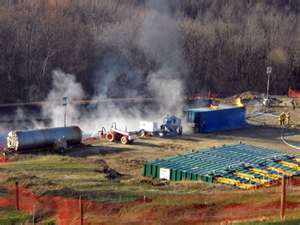
Marcellus Fracking Pit
This is what happens when corporations are declared ‘people.’ This is what happens when legislators sell their souls for 30 pieces of silver. I do not care if Republican Governor Corbett and his Republican dwarves truly believe this is good for Pennsylvania. This is a betrayal of American law and her people on a massive scale. The good citizens of Pennsylvania might look at the situation in Ohio, where Governor Kasich opened the state’s doors for business, any business, and Ohio became the dumping ground for fracking wastewater disposal and deep ground injection wells. We now know those earthquakes were not coincidental events. No wonder Republicans hate science!
Hattip to Alternet on this rant. I’d recommend reading the article ‘Fracking Democracy: Why Pennsylvania’s Act 13 May Be the Nation’s Worst Corporate Giveaway’ by Steven Rosenfeld in its entirety with the first link I provided. It’s a chilling, mind-blowing report.
Act 13 is expected to take effect on April 14th. We better pray [regardless of what state we live in] that the groups now amassing in Pennsylvania are able to halt or at least slow down this corporate monstrosity.
Because if not, we can say ‘adios’ to the shredded remnants of our Republic.
As for Pennsylvania? My heart goes out because I lived and worked in the state for over a dozen years and still have family in the area. The economy has been raked over the coals, so the promise of jobs and money injected into struggling municipalities and rural communities is a huge seduction. But we’ve seen this movie before. It does not end well. Here’s hoping that flesh and blood citizens get a chance to write a far better script for themselves and their future. Here’s hoping the rest of the country wakes up to what can only be called a corporate takeover.

 peej
peej Carissa
 bostonboomer
 dakinikat
 ecocatwoman
 mablue2
 Mama Lopez
 peggysue22
 quixote
 skydancingguestblogger
 Mona (aka Wonk the Vote)



 Sky Dancing
Recent Comments