
Late Saturday Night Drifts
Posted: January 23, 2011 Filed under: Big Pharma, Health care reform, Team Obama | Tags: Big Pharma, medicine, oligiopolies, Public Health 12 Comments Some where in another world (Minneapolis to be precise), I did work for a managed pharmacy benefits plan that was owned by United Health Care but was sold off to SmithKline Beecham (now GlaxoSmithKline). This was during the “Hillarycare” debates. I know a lot about this because one of our VPs was on her panel and one of the hearings was held there. I honestly thought that the DOJ would call the merger thing off because it was an appalling example of a vertical monopoly. That didn’t happen.
During the mid nineties, Big Pharma wanted their hands on the ability to call the plan formularies for defined benefit plans and stack them with their drugs. All of them were scrambling to buy managed drug plans from Insurance Companies at the time. Managed pharmacy benefit plans basically meant a windfall for any drug listed on the formulary. Big Pharma had a plan and I was privy to the business deal which was to just tweak some chemical formula enough to call something a new drug, get it subject to a new patent, stick it on a formulary, and watch the profits roll in.
Don’t even get me started on how erectile dysfunction drugs made their way to formularies. The race for profits is frequently a race to a place with nonexistent ethics. So, based on the short amount of time I witnessed that situation, I took my fees and ran to New Orleans. I couldn’t say much then because I was at a level where I was silenced by the merger negotiations and the SEC.
So, why do I mention that now? Because, this doesn’t surprise me at all. Drug development is a business model and any one who thinks otherwise is sadly mistaken and most likely sadly at the bottom of the food chain and uninformed. Important drugs are not discovered because there is basically no money in it and there will never be any corporate money invested in it.
Public Health is part and parcel of the Public Interest. The parable of Erectile Dysfunction Drugs may have a different ending if this policy actually sees the light of day. Fortunately, it’s not completely up to the whims of creationists who hate science. This move recognizes that the profit motive doesn’t always drive the correct priorities for society. It only drives the correct money flows for something in high demand at particular time. Rich people with a flaccid penis and a fear of wrinkles are driving the market. So, what about Public Health?
The Obama administration has become so concerned about the slowing pace of new drugs coming out of the pharmaceutical industry that officials have decided to start a billion-dollar government drug development center to help create medicines.
The new effort comes as many large drug makers, unable to find enough new drugs, are paring back research. Promising discoveries in illnesses like depression and Parkinson’s that once would have led to clinical trials are instead going unexplored because companies have neither the will nor the resources to undertake the effort.
The initial financing of the government’s new drug center is relatively small compared with the $45.8 billion that the industry estimates it invested in research in 2009. The cost of bringing a single drug to market can exceed $1 billion, according to some estimates, and drug companies have typically spent twice as much on marketing as on research, a business model that is increasingly suspect.
The National Institutes of Health has traditionally focused on basic research, such as describing the structure of proteins, leaving industry to create drugs using those compounds. But the drug industry’s research productivity has been declining for 15 years, “and it certainly doesn’t show any signs of turning upward,” said Dr. Francis S. Collins, director of the institutes.
There’s another idea worth considering. There are many drugs that are in the public domain. There are many folks on medicare and medicaid plans. There are also veterans. Why not have the government offer to help start up small firms around the country that will produce those drugs at a minimal cost and reasonable profit with big time orders from all these government plans? The idea is just to save money on drugs going to those covered by public health programs and create manufacturing jobs in places that need them. Many old drugs are just as effective as their minimally tweaked but patented counterparts that are advertised and marketed into a high profit set up per the nifty Big Pharma Business model. Why pay for maximum profits to a market filled with a few greedy oligopolies when you can promote some nice little business all over Main Streets of American instead and Public Health instead and stir up a few jobs in the process?
Let the competition for government contracts really begin!
So, it’s an Open Thread, but that’s an article and a policy worth some discussion.
Wikileaks on Big Pharma
Posted: December 21, 2010 Filed under: Big Pharma, Wikileaks | Tags: Big PHarma deals death, BOA, Nigeria, PFizer, Wikileaks 53 Comments Wikileaks has been the source of a lot of important whistle blower information which is why there seems to be a crusade against the organization’s most visible representative, Julian Assange. Wikileaks was founded in 2006 as a place where–among others–Chinese dissidents would be allowed to get important information to the public. Wikileaks’ stated purpose is to give assistance to all peoples that seek to “reveal unethical behaviour in their governments and corporations”.
Its first released documents dealt with government plots to assassinate people. It also has exposed bizarre documents from the Church of Scientology. During the financial crisis, Wikileaks released a report about a serious nuclear accident in Iran, problems at banks like the Kaupthing Bank of Iceland and Barclay’s, and a toxic dumping incident in the Ivory Coast. They have dumped data on corrupt governments and corrupt corporations so there is absolutely no shock that the powers that be all over the world are trying anything they can to discredit Wikileaks and every one associated with it. Wikileaks is bigger than one man and his foibles.
I’ve been finding more and more horrible things about Big Pharma and their experimentation on poor and helpless people in developing nations. This cover up trail–as with some others associated with horrible drug testing practices–leads to Wikileaks. Wikileaks has acted as our pharma watch dogs and released documents that provide more information on an ongoing story that exposed fatal drug tests on Nigerian children. Here is a summary of the situation from Democracy Now. You can watch Amy Goodman’s story in video at the same link. WAPO actually did a lot of the original investigative journalism back at the time this came to light in the late 1990s.
Diplomatic cables released by WikiLeaks show the pharmaceutical giant Pfizer hired investigators to find evidence of corruption against the Nigerian attorney general to pressure him to drop a $6 billion lawsuit over fraudulent drug tests on Nigerian children. Researchers did not obtain signed consent forms, and medical personnel said Pfizer did not tell parents their children were getting the experimental drug. Eleven children died, and others suffered disabling injuries including deafness, muteness, paralysis, brain damage, loss of sight, slurred speech. We speak to Washington Post reporter Joe Stephens, who helped break the story in 2000, and Musikilu Mojeed, a Nigerian journalist who has worked on this story for the NEXT newspaper in Lagos.
The story is 14 years old, but the Wikileaks information is new. In 1995, Pfzier was trying to get a new antibiotic–Trovan— to market. You may know this drug as Zithromax. It was supposed to be a big drug breakthrough and they wanted to test the drug on children. This is a complex and difficult undertaking in the US so they headed to Nigeria for their Clinical Trials. This is Amy Goodman’s explanation from a transcript of the show.
AMY GOODMAN: In 1996, Pfizer’s researchers selected 200 children at an epidemic hospital in Nigeria for an experimental drug trial. About a hundred of the kids were given an untested oral version of the antibiotic Trovan. Researchers did not obtain signed consent forms, and medical personnel said Pfizer did not tell their parents their children were getting the experimental drug. Eleven children died. Others suffered disabling injuries including deafness, muteness, paralysis, brain damage, loss of sight, slurred speech.
The details of the case were first exposed in 2000 in an investigative series in the Washington Post. In 2007, Nigerian officials brought criminal and civil charges against Pfizer in a multi-billion-dollar lawsuit.
Wikileaks has exposed an important link between Pfizer and the Nigerian law suit.
JUAN GONZALEZ: A State Department cable from 2009 details a meeting between Pfizer’s country manager, Enrico Liggeri, and U.S. officials in Abuja. The cable reads, “According to Liggeri, Pfizer had hired investigators to uncover corruption links to Federal Attorney General Michael Aondoakaa to expose him and put pressure on him to drop the federal cases.” A few months later, Nigeria settled with Pfizer for just $75 million.
Nigerian journalists consider Assange and Wikileaks to be heroes for exposing this connection. Here’s something just written by PMNews Nigeria outlining the importance of this information. You see an article there written by a Nigerian lawyer that explains the importance of the Wikileaks. The author has disabled the option to quote his work so I’ll respect this and just give you the link.
Additional information on Pfizer has come to light through the documents released by WikiLeaks. A lot of this information is being reported by Democracy Now–an advertising free media outlet–that has followed this story extensively. Pfizer extensively lobbied against a New Zealand Free trade agreement because New Zealand has drug buying rules similar to Canada. Big Pharma just hates it when countries negotiate prices.
In other WikiLeaks news, newly released cables have shed more light on the pharmaceutical giant Pfizer. Last week on Democracy Now! we reported how Pfizer hired investigators to find evidence of corruption against the Nigerian attorney general to pressure him to drop legal action over fatal drug tests on Nigerian children. Now Pfizer’s actions in New Zealand have been exposed by WikiLeaks. Newly released cables show the pharmaceutical company lobbied against New Zealand getting a free trade agreement with the United States because it objected to New Zealand’s restrictive drug buying rules. In addition, cables show drug companies tried to get rid of New Zealand’s former health minister.
Democracy NOW also reports that the Big Pharma has become the biggest defrauder of the Federal Government. They are bigger than even the military industrial complex with its giants like GE.
A new study by the watchdog group Public Citizen has found that the pharmaceutical drug industry has become the biggest defrauder of the federal government, surpassing the defense industry. Public Citizen found that the drug industry paid out nearly $20 billion in penalties over the past two decades for violations of the False Claim Act. More than half of the industry’s fines were paid by just four companies: GlaxoSmithKline, Pfizer, Eli Lilly and Schering-Plough.
If you read the show’s transcript, you’ll see further evidence and concerns about clinical trials happening on poor people in poor countries. The person I will quote is guest “Dr. Sidney Wolfe, the Director of Public Citizen’s Health Research Group and co-author of the new report, Rapidly Increasing Criminal and Civil Monetary Penalties Against the Pharmaceutical Industry: 1991 to 2010.”
I’d just like to add something to what James Steele said, which is, we call this industry the human experimentation corporations. The biggest human experimentation corporation is right here in the United States. It’s called Quintiles. They do experiments for drug companies as quickly as they possibly can all over the world. We found an ad from Quintiles that sells to the drug industry: “We help you recruit drug-naive subjects in many developing countries.” So this industry, in terms of exporting human experiments—and it really is a business—in terms of criminal violations—off-label marketing, illegal—in terms of False Claims Act, is really at the forefront. They parade themselves—and they do some good things; they do develop some good drugs. Is it really necessary for them to engage in criminal behavior, in civil violations and in very unethical human experimentations around the world? We think the answer is no.
A top lawyer at the FDA has recently said, “The only way we’re going to stop this industry from violating these laws, endangering people, is to start putting people in jail.” No one has ever gone to jail from one of these drug companies for these criminal violations. The size of the penalties is miniscule compared with the profits. Two companies, as mentioned—Glaxo and Pfizer alone—have paid $7 billion or $8 billion in the last 20 years. In one year, those two companies make about $15 billion or $16 billion in profits. So, until they are adequately assessed penalties that compare with the amount of money they’ve made off of these various drugs, until people are put in jail, if appropriate, this industry is going to keep running away.
And one other thing that was alluded to by James Steele is, this industry directly finances the FDA through cash payments. This year, between $700 million and $800 million in cash goes directly from the drug industry to the FDA. It pays for about two-thirds of all the review of drugs. So, in addition to the lobbying, the $200 million that James Steele talked about, there are direct cash payments, under a 1992 law that the Congress unwisely passed. So we have lots of problems with this industry. It does a lot of good things, but it is increasingly a menace in this country and abroad. As part of globalization, we’ve globalized human experimentation, and it’s a pretty nasty business.
There are several things that are becoming abundantly clear to me as I continue my search for Big Pharma’s role in the deathes of many people–babies and children included–through reckless experimentation and profit-seeking. The first is the importance of Wikileaks and the realization that the sideshow going on right now over Assange’s behavior in Sweden detracts from the essential role that Wikleaks plays in releasing important information. The second is how the majority of real data that I find comes from either sources not aligned with advertising interests or over seas media.
Democracy NOW and public interest groups like WikiLeaks rely on small donations and are not held hostage by government bullies and corporate revenues. Without media and free press outlets like Wikileaks and Democracy NOW and these investigative reports done by Public Interest Groups, we would NEVER get this information. We should be actively funding their ventures and supporting their right to expose the corruption and immoral behaviors of all governments and huge corporations.
The rich and powerful are banding together to prevent this information from coming to the surface. JUST a few minutes ago, this came to my attention: Apple Explains Why They Banned The Wikileaks App. MasterCard, Bank of America, and Pay Pal have moved to stop the flow of money to Wikileaks. BOA is said to be one of the next data drops from Wikileaks so I hardly find that move surprising. As corporate and western European/American government interests move to strangle this outlet of free speech, we’re beginning to see more people–people with questionable intellect and morals–distracted by the Assange Rape Accusation Side Show. Isn’t a little bit odd that all this is taking place in light of more and more whistle blowing documents showing up in places where there is only accountability to free speech and not to the profit motive and geopolitical power?
Against this backdrop, Julian Assange, the 39-year-old globetrotting Australian who is the driving force behind WikiLeaks, is battling extradition from England to Sweden for questioning about rape allegations. He was released on bail in London on Thursday.
Speaking Saturday outside a supporter’s mansion in eastern England, Assange called the case in Sweden a “travesty.” He also claimed he and others working for WikiLeaks face significant risks.
“There is a threat to my life. There is a threat to my staff. There are significant risks facing us,” he said, without offering details of the purported threats.
In an interview with CNBC on Friday, Assange said his organization plans to soon release information about banks, and he told Forbes magazine last month that the data would show “unethical practices.”
Assange told Computerworld magazine in 2009 that his organization had a trove of files on Bank of America. “At the moment, for example, we are sitting on 5GB from Bank of America, one of the executive’s hard drives. Now how do we present that? It’s a difficult problem,” he was quoted as telling the magazine.
Stay tuned. There will be more. The more you dig into stuff, the more twisted it gets. My guess is that Karl Rove is over on a mission there in Sweden to stop something that must either endanger Cheney, Bush, or himself. Why is Karl Rove helping to persecute Julian Assange? But, my friends, that is another story.
update: The BBC News has a Transcript of The Assange interview on its site.
Prescribing Death for Profits
Posted: December 19, 2010 Filed under: Big Pharma, Corporate Crime | Tags: Big Pharma, Celebrix, clinical trials in India, drug trials killing poor people in poor countries, FDA, Ketek 63 Comments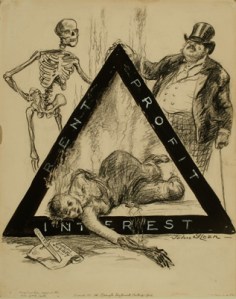
The Triangle Shirtwaist Factory Fire, for The Call by John Sloan
An article in this month’s Vanity Fair called “Deadly Medicine” made me realize how much of the movement of various parts of corporate business functions were not only to chase the lowest wage, but to also chase the least amount of regulation. The result of this movement has been the death of many poor people in many poor countries. Yet, we hear very little of this news in this country. You can only image how much this has to do with the huge connections between Corporate Big Media and its Corporate Advertisers. I’ve had to rely on many a foreign source and watch dog blog to sniff out some of the information in this post.
You may have read a link I put in down thread to a fire in a Bangladeshi factory that killed many young women that sounded hauntingly familiar to the Triangle Shirtwaist Factory tragedy in this country in 1911. I know a lot about the Bangladeshi economy because that is where my major professor was born. Much of the country’s growth has come from the textile business. It employs young women in situations similar to what workers endured in 18th and 19 century America. We have the laws and the Ladies Garment Workers’ Union to watch for these kinds of abuses. The young women of Bangladesh have neither. This fire happened five days ago. Many of the fire exits were locked as was the case with the Triangle Shirtwaist Fire. The workers were subject to appalling conditions. At least 27 died and around 100 were seriously injured. Workers jumped to their death to avoid the flames. Bangladesh has another cottage industry that kills too. It serves as a guinea pig country for Big Pharma and the results of this relationship are frequently tragic.
Similar sad stories unfolds in parts of the old USSR, South America, and Asia as a result of the greed of Big Pharma. This industry looks for countries where it can avoid and cripple FDA regulation of their industry. I was appalled that I had not read much of this until I picked up the Vanity Fare article. After Googling the topic, I found that the media coverage at the time was limited mostly to foreign outlets. It figures. Let me give you a taste of what I’m going to write about in several installments because there is so much to tell you and it will make you weep.
Many of these clinical trials have gone to places where people give their consent with a finger print or a poorly scribbled “X”. Surely, this is questionable ‘consent’. Some of the victims of these experiments are not even capable of granting consent. My first case study for you is the example of 49 babies who died in India while undergoing experimental drug trials. In some instances, pediatricians were actually paid up to $350 a head to come up with subjects for the trials. As I share the investigative reporting on this subject, one of the things to keep in mind is that there are now companies that broker clinical trial sites and victims for Big Pharma. It’s a growth industry. These brokers act as agents who procure countries with dysfunctional laws and judicial systems and poor, desperate people for drug experimentation. There is evidently big money in prescribing death to people in the poorest nations of the word.
In August, 2008, The Sunday Times reported this story.
Forty-nine babies have died in drug tests at one of India’s top hospitals, raising concerns that ethical standards are being compromised as the country becomes the world’s leading destination for clinical trials.
The deaths occurred over a period of 30 months at the Delhi-based All India Institute of Medical Sciences (AIIMS), an elite medical college and public hospital renowned for providing low-cost treatment to the poor. The victims were among the 4,142 infants who were used in a total of 42 clinical trials — one of the final stages of developing a new drug — at AIIMS since January 2006, many for Western companies. Of the children used in the trials, 2,728 were aged under a year old.
The mortality rate among the babies, many of whom were seriously ill before they became part of the clinical trials, was 1.2 per cent — significantly below the 4 per cent for all patients treated at the hospital. However the age of those selected for testing has shocked many in India and there are fears that the increasingly lucrative drug-testing industry may be cutting corners because of a shortfall of staff trained in medical ethics and best practice.
Manish Tiwari, a spokesperson for the Congress party, which heads India’s coalition Government, said: “The practice of using infants like guinea-pigs for drug testing must end.”
In 2006, a science Reporter for the Times asked this salient question in a headline: ‘Poor, sick, desperate. What more could Big Pharma ask in Indian drug trials?’ The article outlines steps taken by the big drugmakers to move risky trials over seans to avoid lawsuits like those resulting from products like Vioxx –a Merck product–and from Paraxel made by TeGenero. The rush to find the most vulnerable countries and people has gone largely unnoticed in this country.
And so Big Pharma has begun outsourcing its trials to India, a move that, according to bioethicists, could create a “new imperialism”. India has huge numbers of sick people glad to test drugs in return for minimal, if any, recompense. The patients rarely mind — to them, experimental healthcare is better than none at all — and they rarely complain. India also has a homegrown supply of highly educated, English-speaking doctors, who cost a fraction of their Western counterparts.
AstraZeneca has opened a drug-testing facility in Bangalore; Pfizer has done the same in Bombay. At the moment one in a hundred global clinical trials is conducted in India, but Oxygen Healthcare, a British consultancy, estimates that in five years’ time that figure will have risen to one in ten.
This makes financial sense but others are clearly worried that poor, illiterate patients are being exploited. There is certainly doubt over whether they are giving informed consent. The Indian Journal of Medical Ethics reports that patients are often unable to distinguish between trials that might benefit them and those that won’t. Another study pointed out that, of the country’s 14,000 general hospitals, fewer than 200 are equipped to carry out drug trials adequately.
Indian patients are often used to test medicines that, once marketed, they will not be able to afford.
The editors of the American Journal of Bioethics say in their blog that “pharma trials in India should be the focus of a huge amount of attention in the world of research ethics”. Even more forthright was a recent opinion piece in The Scientist. “If Gandhi were alive today, he would lead protesters to the doors of a clinical research trials facility, where the oppression of the Indian poor dwarfs that of the 1930s.” This is a reference to Gandhi’s march against the British salt tax, which made it illegal to obtain salt from anyone other than the British Government, even though it could be collected along the coast. Gandhi and his supporters marched 240 miles from western India to coastal Gujarat, gathering the mineral on the way. The march ended in a bloody confrontation at a salt factory.
The Indian Government now stands accused of colluding in this new oppression. In 2004 it stipulated that drugs tested in India should first be proved safe in their country of origin; in 2005 the law was revoked.
Believe me, I’ve been Googling up a storm on these trials in India and other places for reports in US Newspapers. I have yet to really find one. I have found one blog called PharmaGossip that discusses some of these issue and the Vanity Fare article in particular. It simply shares the article that begins with this short introduction giving you a flavor the extent and the tragedy of cases found by its authors.
Prescription drugs kill some 200,000 Americans every year. Will that number go up, now that most clinical trials are conducted overseas—on sick Russians, homeless Poles, and slum-dwelling Chinese—in places where regulation is virtually nonexistent, the F.D.A. doesn’t reach, and “mistakes” can end up in pauper’s graves? The authors investigate the globalization of the pharmaceutical industry, and the U.S. Government’s failure to rein in a lethal profit machine.
The article includes examples–including the one from India above–from hamlets all over the world with exotic-sounding names. All of these countries have citizens that have died so that Big Pharma can bring wrinkle creams, erectile dysfunction drugs, and tiny twists on existing drugs to the U.S. Market. Many of these drugs are not as efficacious and have deleterious side effects compared to existing, older drugs.
If you go to the home page on PharmaGossip you’ll see more news on AstraZeneca which is one of the companies that comes up in many of these horror stories. Here’s a link to another blog called Corporate Crime Daily that tells the story of Seroquel from 2009. The article is called: AstraZeneca: Tales of a Deadly Drug Pusher. Seroquel is an anti-psychotic drug. Because the drug came to market and caused damages to U.S. citizens and wound up in court, you can find coverage by the NYT. AstraZeneca was also found guilty of defrauding Medicare in 2008. The reason I’m adding this is that when it hits our citizens and our courts, it becomes a media issue. When the trials kill Indian babies and poor Poles, the US press is mum.
The number and type of clinical trials held in Western Europe, Canada, or the United States have been reduced significantly because their judicial systems are a way to check unethical and deadly business behaviors. [Restated to avoid confusion. Yes some trials are held here but they are fewer and some types are not done here much any more.] ** As long as the FDA will approve drugs based on experimentation in vulnerable countries, we will have the blood of many on our hands. Here are some numbers from the Vanity Fare article.
Many of today’s trials still take place in developed countries, such as Britain, Italy, and Japan. But thousands are taking place in countries with large concentrations of poor, often illiterate people, who in some cases sign consent forms with a thumbprint, or scratch an “X.” Bangladesh has been home to 76 clinical trials. There have been clinical trials in Malawi (61), the Russian Federation (1,513), Romania (876), Thailand (786), Ukraine (589), Kazakhstan (15), Peru (494), Iran (292), Turkey (716), and Uganda (132). Throw a dart at a world map and you are unlikely to hit a spot that has escaped the attention of those who scout out locations for the pharmaceutical industry.The two destinations that one day will eclipse all the others, including Europe and the United States, are China (with 1,861 trials) and India (with 1,457). A few years ago, India was home to more American drug trials than China was, thanks in part to its large English-speaking population. But that has changed. English is now mandatory in China’s elementary schools, and, owing to its population edge, China now has more people who speak English than India does.

 peej
peej Carissa
 bostonboomer
 dakinikat
 ecocatwoman
 mablue2
 Mama Lopez
 peggysue22
 quixote
 skydancingguestblogger
 Mona (aka Wonk the Vote)



 Sky Dancing
Recent Comments