
A Deadly Unwind
Posted: May 23, 2009 Filed under: Bailout Blues, Global Financial Crisis, Main Stream Media, U.S. Economy | Tags: automobile dealers, bailouts, Chrysler bankruptcy, liquidation Comments Off on A Deadly Unwind My dad was a small town Ford dealer (Council Bluffs, IA). Dad was fortunate enough to have a very rich mentor that put him into the dealer development program when I wasn’t even walking and so we moved to what I still believe is the middle of no where and put down roots. I don’t know if you’ve got much experience in a small town, but the local car dealers are actually pretty big businesses for them. My dad headed up blood drives and the United Way. He belonged to the Chamber of Commerce. When Dad was younger he volunteered for everything. As he got older, he wrote a lot of checks. He helped my Mom establish a Victorian house museum that still is world-renown. He always bought tons of tickets to the college world series to hand out to every one who walked in the door. He sponsored little league teams and bought advertising in the local newspapers and TV stations. His 50-100 employees were with dad for as long as I can remember. Not only the mechanics and the office folks stayed with Dad, but also the car salesmen. They were my family too. When dad retired in the 1980s after surviving those horrible energy crisis years, I came to look back on how central the car business is to small town America. Actually, Dad also sold a lot of trucks because we lived in farm country.
I’m thinking more and more about this as well as having a lot of discussions with Dad on the unwinding of the great 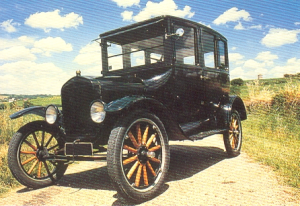 American car companies. In a way, it feels like the unwinding of small America cities and a way of living. Chrysler and GM are dumping dealers all over the country. Most of the surviving dealerships are not going to look like the way dealerships developed when cars and the car industry were the most American of all business. I’m sure it’s going to be much more efficient and I am certain that each of the US automakers over franchised, but still, there is something about a small town car dealership that is not going to be replaceable. In many towns, it is one of the biggest employers and also a huge source of charitable donations.
It is odd that the first two articles that grabbed me this morning as I drunk my coffee were two contrasting views on the wind down of Chrysler. The first one was all about the finance and the bankruptcy and is on Salon. It’s called “Who is Screwing with the bankruptcy laws”. The second was on the front page of the business section of the NY Times. It goes to directly to the heart of the dealer closings and is entitled “Chrysler Francisees Make Case Against Closure”. Both show exactly how ugly the Chrysler bankruptcy has become.
A Credit Derivatives Primer
Posted: May 12, 2009 Filed under: Bailout Blues, Global Financial Crisis, U.S. Economy 2 Comments While it’s short on mathiness, it’s long on financespeak. Another one of those speechie things I have given to people confused by what’s been going on in the financial markets. Don’t worry, I’ll quit posting academic things later this week! Meanwhile, don’t fall asleep!
Credit derivatives are a relatively recent financial innovation. They were first introduced in 1992 but not broadly traded until 1999 when documentation was standardized. The market for these securities is huge. Since 2000, it has increased from $900 billion to more than $45.5 trillion. This is roughly twice the size of the entire United States Equity Markets. Hedge funds are very active in this market and there is much concentration of the volume trade. Four large broker-dealers are responsible for the majority of transactions. JP Morgan Chase, Citibank and Bank of America have been the largest players. Most credit derivatives are credit default swaps (CDS). These are contractual agreements that transfer the default risk of one or more reference entities from one party to the other. It is designed to shift credit risk from one party to another. It is basically a bet on the health of a company or another set of assets like mortgages.
These instruments serve a role similar to insurance and appear to inject moral hazard into the banking community by leading to lax lending practices as witnessed by the current crises triggered by mortgage markets. Many traditional bank assets have been packaged and sold recently. This appears to be a side effect of the changing role of banks after GLBA. Credit derivatives were developed as an attempt to manage credit risk.
There is also risk stemming from problems in the market itself. Some of the biggest concerns come from the size of the notional outstanding. It is believed that the total size of credit default swap universe is about 10 times bigger than the underlying pool of cash bonds. This underlying mismatch has proved to be a problem as the market has recently become thin and less liquid. Deliverables have become an issue. This is probably one of the reasons that the government has proposed to buy “troubled assets” as part of the financial crisis rescue.
There is a clear and present danger, since the hedge funds have taken similarly losing positions and they may play a role in further destabilizing the market as they unwind these assets. This is one reason that the Fed is taking some of these assets onto their balance sheet as a strategy of their quantitative easing policy. They’d prefer to slowly unwind this market.
From My Ivory Tower
Posted: May 11, 2009 Filed under: Bailout Blues, Equity Markets, Global Financial Crisis, U.S. Economy | Tags: fiduciary responsibility, Financial Crisis, lend and hold mod 1 Comment(Note: I’m knee deep in end of the semester stuff so I thought I’d share with you my standard academic speech on the current financial meltdown.  Don’t fall asleep now!)
While the underlying causes of the current mortgage and housing crisis cannot be perfectly elucidated at the moment, there appear to both micro and macroeconomic factors at work. The macroeconomic factors can be traced to a prolonged period of excess global liquidity. The was induced by relatively low interest rates set by the Federal Reserve Bank and other central banks following the US recession in 2001 and the events of 9/11/2001. This excess liquidity went into the demand for residential investment and triggered large increases in housing prices.
The roots of microeconomic crisis can be found in industry practices by financial intermediaries including the ‘originate and distribute’ lending model. Other factors included poor regulation of Fannie Mae and Freddie Mac, major players in the residential housing markets, and the loosening of underwriting standards for loans and leverage requirements for investment banks. This encouraged banks to provide house loans to folks ill-suited for them that were securitized to meet an increasing demand. The inherent risk in these loans was mispriced. The loan origination process was especially weak as many mortgage originators were more concerned with producing volume to ensure bonuses than soundness. Agents securitizing these mortgages did not audit individual loans for soundness. Additionally, rating agency models seemed completely unable to discover underlying default risk. Prudent auditing practices were missing at all levels of the lending process.
As the demand for houses increased, prices of those homes increased which increased the number of construction companies building homes and speculation in the housing market. Many of the people that bought homes did so at inflated house prices. Given the lax lending standards, these folks did not necessarily have down payments or the credit history and income to pay for these loans as the economy slowed and interest rates began to rise. Many did not even care about the terms of the loans since they were not planning on holding them very long. Regulators missed the build-up of vulnerabilities as much of the risk was perceived to be transferred to other, unregulated securities markets. Home buying and financing became a speculative activity with many buyers that were unaware of the risk and unprepared to handle the consequences of a downturn.
At the time of the failure of Fannie and Freddie, they were leveraged at a level of 150 and poorly capitalized to handle loan losses. Since many of the loans originated at this time were packaged and sold on the secondary market, an increasing default rate brought down the value of these bonds as well as other types of derivatives created from mortgage related assets. Since it is difficult now to value these assets and there appears to be no bottom set in the market, banks are now reluctant to lend to each other in the interbank markets and prefer to maintain high liquidity to cover potential losses and deposit withdrawals. At the moment, we’re seeing governments injecting capital into banks as well as the end of investment bank as a standalone entity. While this situation should be temporary, banking laws should be changed to prevent any future occurrence.
Regulations are likely to change as the crisis winds down. Both Fannie and Freddie require a complete overhaul, something that was tried in 2000 by the Clinton Administration and then by Congress in 2003 and 2005. It is unseemly in a market economy that extraordinary profits be privatized while losses resulting from bad management and accounting practices should be turned over to the taxpayer.
Additional Regulation over the derivatives market is also likely to result. These markets have largely been ignored until the meltdown. The government should ensure that sound underwriting practices are not undermined to achieve ‘affordable’ housing—especially not by the GSEs and other organizations that carry implicit taxpayer guarantees. Encouraging old fashioned “lend and hold” banking would help this. Affordable Housing initiatives most likely require target funds and programs that ensure transparency in the origination process and place borrowers in appropriate loans. Additionally, secondary markets must be more transparent, more standardized, and more accountable. It is possible that a revision of the mark to market accounting practices will be narrowed to asset classifications that are rich with asset valuation information only. It is also possible that certain short-selling practices may see restrictions.
Past crises have also show that regulation in the U.S. is reactionary. One example is the reaction to the bank runs during the Great Depression. A further example is the thrift crises in the 1980s. Sophistication of the markets, increased options for saving and investing, and borrowing went farther than the Fed’s ability to monitor and manage bank performance. As these crises occur, regulators respond and frequently must wait until laws catch up. The current crisis is no different.
One of the most significant studies of systemic banking crises has just been produced by the IMF this fall. Laeven and Valencia (2008) identified 124 systemic banking crises over the period of 1970 to 2007. Their study evaluates crisis resolution policies put in place to contain the crisis as well as the challenge of long-run system stabilization. They have found that nonperforming loans tend to be high during the onset of a banking crisis. During a Crisis in Chile in 1986, non-performing loans peaked at 36% of total loans. These were the result of unsound banking practices such as a high level of connected loans. The authors found that the percentage of non-performing loans ran as high as 75% of the total loans in one country and averaged about 25% across country. They also found that banking crises were frequently preceded by credit booms. This was also the case in Chile where the average annual growth of private credit to GDP prior to its crisis was as high as 34.1 percent.
In the case of Turkey in 2000, the trigger of the crisis was the collapse of the interbank loan market. It especially failed in loans from large to small banks. Any bank that depended heavily on overnight funding failed. Authors pointed out that Turkey widely exhibited problems in macroeconomic factors. At the time, inflation was growing at 80 percent per annum in the 1990s. The government also ran high fiscal deficits. There was large public debt, high current account deficits and a generally weak financial system. Because of these macro vulnerabilities, the banks had exposure through holdings of government securities. There were also the micro risks of maturity and exchange rate mismatches coming from market risk. It is possible that these factors are present in the current global financial crisis. This could extend the period of crisis beyond normal expectations.
Zombie Negotiations
Posted: May 4, 2009 Filed under: Bailout Blues, Equity Markets, Global Financial Crisis, U.S. Economy | Tags: bank failures, Bank Stress Tests, zombie banks 3 CommentsI’m at the end of my semester which is the time when students that should’ve showed up in my office months ago suddenly feel they can negotiate a different result than the one listed in my syllabus and on my grade sheet. I’ve noticed this pattern in all my years of teaching. I get about a handful of them right after the first test that say, sheesh, I don’t think I get this what can I do? I get more than a handful the week before finals, when their grades are pretty much a given, saying, sheesh, I don’t think I can get this, what can you do for me?
There’s an implicit contract between me and my students and a good deal of it is stated in the syllabus which all of them get at the beginning of the semester. Over the years, it’s grown to being a pamphlet of sorts. Much of this has to do with either accreditation or legal requirements (like what to do if you’re disabled and need help with things). A lot of it is me trying to be absolutely, positively clear that we agree on the expectations we have in this class. I spend the entire first day going over all of these things and they all nod in agreement, don’t ask many questions, and hope they can leave early.
Why do I feel like the Fed is waving a syllabus in front of a few recalcitrant banks over the results of the so-called stress test? Are they asking why didn’t you come to us sooner when you had a problem? How much of a softie is the Fed going to be when a few of them want to renegotiate what it means to get an A,B,C, D, or F?
The Hedge Fund Empire Strikes Back
Posted: May 1, 2009 Filed under: Bailout Blues, Equity Markets, Global Financial Crisis, Uncategorized | Tags: bond holders, Chrylser bankruptcy, Chrysler bailout, hedge funds 2 Comments The role of hedge funds in the bankruptcy of Chrysler and GM will probably be discussed and studied for some time. It’s not often this POTUS singles out a Financial Institution for scorn since they’ve all been major donors to his campaign but POTUS made an exception when announcing the Chrysler bankruptcy. Evidently, POTUS was not amused that a few of them would not bend to his will on the deal.
The most interesting thing is that the spoilers are now responding. They are not only responding, they are making it clear that the group the cut the deal were TARP fund babies and they were not. They are actively referring themselves as the No-Tarp Gang just to make that perfectly clear.
Also, interesting is the tone of the coverage concerning the bankruptcy. A Motor Trend blog has a headline screaming Chrysler Bankruptcy “Cruel” Result of Hedge Fund Greediness. Motor Trend obviously has more interest in the Car Makers than the Deal Makers and there in lies the rub. The government-brokered deal, led by four of the biggest Tarp Babies, puts interests that are usually at the back of the line in corporate bankruptcy at the front. Basically the union employees could potentially lose it all in the bankruptcy court.
This deal, turns the entire idea of the safety and primacy of bonds in a bankruptcy deal upside down which could argueably further destabilize financial markets. So, before you accuse me of being anti-union here, which I’m not, let me talk about that. Bonds are usually first in line in any bankruptcy. It’s why they are considered less risky and yield less than their riskier cousins, the equities. Folks that buy corporate bonds play an important role in the market. They provide corporations with huge, long term sources of cash at better terms than any one of them could get from a bank.
If a deal can be cut that undercuts the nature of bonds, what would this mean to other bond holders in other deals that are likely in the bankruptcy pipe? (This would include GM and other industries.) Could this deal actually destabilize the primacy of bonds in the bankruptcy hierarchy? Is that what the fuss is about? Are they being greedy? Are they looking out for their investors? Are they posturing? I don’t think we quite know yet. But, the Hedge Funds spoke up as reported in today’s WAPO.
President Obama’s harsh attack on hedge funds he blamed for forcing Chrysler into bankruptcy yesterday sparked cries of protest from the secretive financial firms that hold about $1 billion of the automaker’s debt.
Hedge funds and investment managers were irate at Obama’s description of them as “speculators” who were “refusing to sacrifice like everyone else” and who wanted “to hold out for the prospect of an unjustified taxpayer-funded bailout.”
“Some of the characterizations that were used today to refer to us as speculators or to say we’re looking for a bailout is really unfair,” said one executive who spoke on condition of anonymity because of the sensitivity of the matter. “What we’re looking for is a reasonable payout on the value of the debt . . . more in line with what unions and Fiat were getting.”
George Schultze, the managing member of the hedge fund Schultze Asset Management, a Chrysler bondholder, said, “We are simply seeking to enforce our bargained-for rights under well-settled law.”
“Hopefully, the bankruptcy process will help refocus on this issue rather than on pointing fingers at lenders,” he said.
I supposed that I don’t have to tell you that hedge funds are not charitable organizations but many of them actually invest for charitable organizations, along with unions and state and government workers. Their clientele can be anything from a small group of rich investors, to you and me, actually. We’ve heard a lot about them recently but most people, I’d speculate, don’t know a lot about what they are and what they do. Hedge funds came onto the scene in the 1950s and what mostly defines them is their regulation regime.
Here’s an easy definition from a website at the University of Iowa.
“Hedge fund” is a general, non-legal term that was originally used to describe a type of private and unregistered investment pool that employed sophisticated hedging and arbitrage techniques to trade in the corporate equity markets. Hedge funds have traditionally been limited to sophisticated, wealthy investors. Over time, the activities of hedge funds broadened into other financial instruments and activities. Today, the term “hedge fund” refers not so much to hedging techniques, which hedge funds may or may not employ, as it does to their status as private and unregistered investment pools.
Hedge funds are similar to mutual funds in that they both are pooled investment vehicles that accept investors’ money and generally invest it on a collective basis. However, they are regulated in significantly different ways. Up until 2005, hedge funds in the United States often relied on Section 4(2) and Rule 506 of Regulation D of the Securities Act of 1933 to avoid having to register their securities with the Securities and Exchange Commission of the United States (SEC). Further, to avoid regulation regarding mutual funds (a type of “investment company”), hedge funds relied on Sections 3(c)(1) and 3(c)(7) of the Investment Company Act of 1940. In short, hedge funds escaped most U.S. regulation directed at other investment vehicles such as mutual funds.
European nations regulate hedge funds by either regulating the type of investor who can invest in a hedge fund or by regulating the minimum subscription level required to invest in a hedge fund. In the years to come, experts are predicting the rise of an alternative regulatory framework that will be tiered yet flexible.

 peej
peej Carissa
 bostonboomer
 dakinikat
 ecocatwoman
 mablue2
 Mama Lopez
 peggysue22
 quixote
 skydancingguestblogger
 Mona (aka Wonk the Vote)



 Sky Dancing
Recent Comments