
Friday: Exit World Stage Right
Posted: June 2, 2017 Filed under: Afternoon Reads 45 Comments Merry Meet
Sky Dancers!
It’s no longer morning in America or any place else for that matter. We’re watching our country abdicate its global, humanitarian and moral leadership positions like Greenland sheds ice mass. Why is this country suffering due to the angst of small groups of white, backwater American voters and a cabal of Billionaire thugs? It amazes me that the concerns, well-being and health of so much is being determined by so few. You would think we were back in the days of fiefdoms.
Kremlin Caligula’s decisions to pull out of the Paris Accord placing the US along sides Syria and Nicaragua will go down as one of the worst policy decision this country has ever seen. It may be as bad as the Iraq Invasion and will at least be equal to Hoover’s economic policies that sent the US economy tailspinning into the Great Depression. Putin must be delirious with joy.
As promised, Trump stepped to the podium in the Rose Garden on Thursday afternoon, announcing that the United States would leave the Paris accord. The decision will have serious, irreversible repercussions for the United States and the world.
The president’s justifications for leaving the agreement are also just plain wrong.
First, contrary to the president’s assertions, America’s hands are not tied and its sovereignty is not compromised by the Paris climate pact. The Paris agreement is an accord, not a treaty, which means it’s voluntary. The genius (and reality) of the Paris agreement is that it requires no particular policies at all — nor are the emissions targets that countries committed to legally binding. Trump admitted as much in the Rose Garden, referring to the accord’s “nonbinding” nature. If the president genuinely thinks America’s targets are too onerous, he can simply adjust them (although we believe it would be shortsighted for the administration to do so). There is no need to exit the Paris accord in search of a “better deal.” Given the voluntary nature of the agreement, pulling out of the Paris deal in a fit of pique is an empty gesture, unless that gesture is meant to be a slap in the face to every single U.S. ally and partner in the world.
The second big lie is that the Paris agreement will be a job killer. In fact, it will help the United States capture more 21st-century jobs. That is why dozens of U.S. corporate leaders, including many on the president’s own advisory council, urged him not to quit the agreement. As a letter sent to the White House by ExxonMobil put it, the agreement represents an “effective framework for addressing the risk of climate change,” and the United States is “well positioned to compete” under the terms of the deal.
Action on climate and economic growth go hand in hand, and are mutually reinforcing. That is why twice as much money was invested worldwide in renewables last year as in fossil fuels, and why China is pouring in billions to try to win this market of the future. A bipartisan group of retired admirals and generals on the CNA Military Advisory Board is about to release a report that will also spell out the importance of competitiveness in advanced energy technologies — not just to the economy, but also to the country’s standing in the world. Pulling out of climate will result in a loss of U.S. jobs and knock the United States off its perch as a global leader in innovation in a quickly changing global economic climate.
The rationale for ditching America’s commitment to the Paris accord just doesn’t hold up. Moreover, Trump’s decision to withdraw from the Paris Agreement comes with several serious and lasting consequences for the United States and the world:
The Trump administration is hastening catastrophic effects of climate change. Scientists and economists now state with confidence that the failure to act to arrest and mitigate global climate change will have devastating global consequences, including for young Americans alive today and for their children and grandchildren. Donald Trump himself may well live to see more climate-related catastrophes hit the homeland. His children and grandchildren certainly will.
Americans all over this country are already seeing the changes — storms are more severe, big floods come more often, and in the most extreme case, Arctic waters are melting and opening up sea lanes for the first time in recorded history. Trump saw the damage from Hurricane Sandy firsthand, a preview of what climate change has in store for future generations.
Heading off the worst effects of climate change requires global action: Action by one country alone, no matter how powerful, cannot address the threat. But our country, one of the world’s two largest carbon emitters, does have significant power to improve not just our own climate, but the world’s — and Trump’s decision takes us in the wrong direction. That’s especially tragic in light of the signature achievement of the Paris Agreement, which was to get every country on board; now China and India have made the same commitments the United States and other highly developed countries have. It binds us all together through a political agreement — but the strength of that agreement depends on all of us meeting our nationally determined responsibilities.
 Probably the most significant foreign policy thing about the abandonment of this treaty along side abandoning trade agreements in Asia is that China will undoubtedly fill the leadership void. Look for fireworks and parades in Beijing. We’ve managed to undo World Order in a very short period of time.
Ceding U.S. leadership to the Chinese on this issue is likely to have political and economic costs. China, like Russia, sees value in any division between the United States and Europe — as a rising power it would rather negotiate with us separately rather than collectively. Europeans grateful to China for its continued partnership on climate will be less concerned to take account of U.S. interests with respect to, say, China’s harmful industrial policy, human rights violations, or economic and military coercion expansionism in Asia. European deals with China for the production of infrastructure and equipment related to renewable energy will surely follow. Pulling out of Paris will weaken our geopolitical standing – and complicate our efforts to work with our partners and allies to manage a rising China. Other nations that see themselves as bearing the brunt of climate change, including those of strategic importance to the United States — such as Vietnam, the Philippines, or much of Africa — will now see China as part of the solution to their problem.
Pulling out of Paris will likely result in creating jobs in China that could have been created here in the United States. It will give Chinese and other countries’ companies a leg up in the growing and competitive green economy, putting U.S. companies at a serious disadvantage. The industry and the jobs of the future are in renewables — why would we cede any of that ground to Chinese, Indian, and European companies? The United States will be relegated from a global leader, economically and otherwise, to a member of a lonely camp of pariah countries that haven’t signed this global pact, together with only Syria and Nicaragua. America First? Hardly.
Withdrawing from Paris will damage U.S. standing in the world. Pulling out of Paris will call into question the word of the United States and weaken our ability to call on other countries to work with us on other global threats, such as global terrorism and global pandemics. International agreements are not irrevocable; indeed this one, which the United States had a heavy hand in creating, was crafted carefully as a series of nationally determined, voluntary commitments precisely in order to gain worldwide support, and with the understanding that countries can adjust their commitments as needed. Walking away from that agreement sends a clear — and foolhardy — message to all other countries around the world: Don’t trust the United States.
And why should they, if we so evidently signal that U.S. foreign policy is utterly politicized, and that agreements signed with one administration will not be honored by the next. It is firmly in the U.S. interest to have others’ trust — and for us to be able to demand in return — the durability of agreements, even when governments change. As a chief architect and moral leader of the post-World War II order, our own behavior with respect to agreements and international law sets the example. If the most powerful country in the world has suddenly decided that signing and living up to an agreement no longer matters, why should it matter to other states?
 We are becoming a medieval castle on a solitary hill. We’re shunning modernity and science for appointments to courts that will instill Grand Inquisitors and the religion that brought you the Dark Ages and the Black Plague. We might as well burn cow pies in the fireplace and return our lighting system to whale oil. That is what trying to rescue the moribund coal industry at the cost of the future of alternative energies will be to our economy. I can’t even believe what it could do to our planet. The only good thing is that the big important states like California with economies that are as large as most of the world’s countries are unlikely to stop progress.
We’re beginning to see more examples of what motivates President Swiss Cheese for Brains. The first motivation appears to be removing any sign of President Obama’s policies and successes and rebranding them with slight of hand with the t-Rump name. The majority of us are not fooled. What are the possible reasons for this tragic decision?
The most revealing moment of President Trump’s announcement that he is withdrawing from the Paris climate deal came in an off-hand response of a White House official after Trump’s speech. Asked whether Trump thinks climate change is real, the official said: “Can we stay on topic?”
Why this matters: To the Trump administration, the Paris climate deal has nothing to do with climate change. It’s an economic issue. To Trump, withdrawing from the accord represents a triumph of populist America over greedy globalism.
Unlike other policy goals (healthcare and tax reform) Trump isn’t even acknowledging climate change is a problem. That makes his overtures about being open to renegotiate and re-enter the Paris deal suspect. Speaking after Trump, administration officials didn’t offer any specific ways in which Trump would do that, with one official beginning but not finishing the following sentence before switching topics: “You’ll see actions in the coming weeks…”
 There’s speculation that the young, new French Prime Minister’s taunts of Kremlin Caligula over the weekend which included direct discussion of the herky jerky handshake may have offset the voices of Ivanka and America’s CEOs. Donald Trump is ‘trolling the world’ and those of us who didn’t fall for his argle bargle.
Trump’s move won’t have much impact on emissions in the short term, and probably not even in the long term. His claims that the Paris agreement would force businesses to lay off workers and consumers to pay higher energy prices were transparently bogus, because a nonbinding agreement wouldn’t force anything. But Trump’s move to abandon it will have a huge impact on the global community’s view of America, and of a president who would rather troll the free world than lead it.
Of course, trolling the world is the essence of Trump’s America First political brand, and Thursday’s announcement reinforced his persona as an unapologetic rebel who won’t let foreigners try to tell America what to do, even when major corporations, his secretary of state, and his daughter Ivanka want him to do it. He was also leaning into his political identity as Barack Obama’s photographic negative, dismantling Obama’s progressive legacy, kicking sand in the wimpy cosmopolitan faces of Obama’s froufrou citizen-of-the-world pals.
But it’s important to recall what Obama did and didn’t do when he led the community of nations to a deal in Paris. He didn’t let the world dictate U.S. energy policy, because Paris is only a mechanism for announcing national commitments to cut emissions, not for enforcing those commitments. He didn’t commit America to unrealistically ambitious emissions goals, either, just a 27 percent reduction from 2005 levels by 2025, not that drastic considering that the U.S. led the world in emissions before Obama and led the world in emissions reductions under Obama. Our electricity sector has already achieved that 27 percent goal, thanks to the continuing decline of coal power, and while our transportation sector has a long way to go, Obama’s strict fuel-efficiency standards and the expansion of electric vehicles has it heading in the right direction. The real triumph of Paris wasn’t America’s promises; it was the serious commitments from China, India and other developing nations that had previously insisted on their right to burn unlimited carbon until their economies caught up to the developed world.
Similarly, it’s important not to exaggerate the substantive impact of Trump’s decision to bail on Paris, which will officially remove the United States from the agreement in late 2020 at the earliest. It’s a signal that the U.S. government no longer cares about the climate, but that’s been abundantly clear ever since Trump won the election and appointed an energetic fossil-fuel advocate named Scott Pruitt to run the Environmental Protection Agency. Leaving Paris won’t reverse the rapid decline of coal or the boom of cleaner energy in America, because the economics of coal have fallen apart while the cost of wind and solar have plummeted, and it won’t stop that same trend in China, India and the rest of the world. By the same token, if Trump had announced he was staying in the Paris deal, that wouldn’t have meant that Trump was abandoning his efforts to gut Obama’s climate regulations (like the Clean Power Plan for the electricity sector) and other climate policies (like those fuel efficiency standards for cars and trucks). Really, it would have been pretty weird for Trump to remain in the deal while trying to undermine everything the U.S. was doing to live up to its commitments.
 If Russia has invested in the T-Rump Family Crime Syndicate to destabilize the US and its influence in the world, then that’s been an investment with an incredible return. T-Rump shows that ignorance and lies rule the White House.
“We’re getting out, but we will start to negotiate, and we will see if we can make a deal that’s fair.”
Each country set its own commitments under the Paris Accord, so Trump’s comment is puzzling. He could unilaterally change the commitments offered by President Barack Obama, which is technically allowed under the Accord. But there is no appetite to renegotiate the entire agreement, as made clear by various statements from world leaders after his announcement.
“China will be allowed to build hundreds of additional coal plants. So, we can’t build the plants, but they can, according to this agreement. India will be allowed to double its coal production by 2020.”
This is false. The agreement is nonbinding and each nation sets its own targets. There is nothing in the agreement that stops the United States from building coal plants or gives the permission to China or India to build coal plants. In fact, market forces, primarily reduced costs for natural gas, have forced the closure of coal plants. China announced this year that it would cancel plans to build more than 100 coal-fired plants.
Gary Cohn, chairman of Trump’s National Economic Council, recently told reporters that “coal doesn’t even make that much sense anymore as a feedstock. Natural gas, which we have become an abundant producer, which we’re going to become a major exporter of, is such a cleaner fuel.”
“Compliance with the terms of the Paris accord and the onerous energy restrictions it has placed on the United States could cost America as much as 2.7 million lost jobs by 2025, according to the National Economic Research Associates. This includes 440,000 fewer manufacturing jobs — not what we need.”
Trump cited a slew of statistics from a study that was funded by the U.S. Chamber of Commerce and the American Council for Capital Formation, foes of the Paris Accord. So the figures must be viewed with a jaundiced eye. Moreover, the study assumed a scenario that no policy analyst expects — that the United States takes drastic steps to meet the Obama pledge of a 26 to 28 percent reduction in emissions by 2025.
Moreover, the study did not consider possible benefits from reducing climate change. A footnote says: The study “does not take into account potential benefits from avoided emissions. … The model does not take into consideration yet-to-be developed technologies that might influence the long-term cost.”
 There are many more examples at the WAPO link that fact check the Presidential Whoppers. MIT officials went out of their way to discuss how President Swiss Cheese for Brains misquoted their research.
“We certainly do not support the withdrawal of the U.S. from the Paris agreement,” said Erwan Monier, a lead researcher at the MIT Joint Program on the Science and Policy of Global Change, and one of the study’s authors.
“If we don’t do anything, we might shoot over 5 degrees or more and that would be catastrophic,” said John Reilly, the co-director of the program, adding that MIT’s scientists had had no contact with the White House and were not offered a chance to explain their work.
US cities and state officials went out of their way to say that their municipalities would continue with their climate change initiatives. Govern Jerry Brown of California was one of the most outspoken critics of the announcement. World leaders reacted. Again, even the CEOS of companies like Exxon Mobile expressed dismay. Elon Musk quit his position as an industry advisor to the feckless grifting Troll who is robbing our country of dignity and treasure.
Thirty states and scores of companies said Thursday that they would press ahead with their climate policies and pursue lower greenhouse gas emissions, breaking sharply with President Trump’s decision to exit the historic Paris climate accord.
In a pointed rebuttal to Trump’s announcement in the Rose Garden of the White House, New York Gov. Andrew M. Cuomo (D) unveiled a plan Thursday to invest $1.65 billion in renewable energy and energy efficiency, the largest procurement of renewable energy by an American state.
Meanwhile, more than two dozen big companies — including Apple, Morgan Stanley and Royal Dutch Shell — urged Trump not to exit the Paris agreement on Thursday.
President Trump framed his renunciation of the Paris climate accord as a historic moment in defense of American workers and the economy. But the actions of state capitols and corporate board rooms offered a counterpoint to the rationale behind Trump’s move.
Across the nation and the economy, renewable energy technologies have taken root and have gathered momentum of their own while creating thousands of new jobs, state and corporate officials said. And the pressures on executives of companies to address the issue have grown greater as major financial firms for the first time press the issue.
The Trump administration’s decision to exit the landmark climate agreement will damage America’s international standing on climate issues and make it nearly impossible for the world to reach internationally agreed goals of limiting global warming, officials said.
Elon Musk, chief executive of Tesla, and Robert Iger, chief executive of Disney, both resigned from the president’s advisory council after the announcement. Lloyd Blankfein, chief executive of Goldman Sachs, tweeted that Trump’s decision “is a setback for the environment and for the U.S.’s leadership position in the world.”
But the action comes well after many corporate board rooms and state capitols had adopted climate change as a given, officials and executives said.
On Thursday, Cuomo unveiled his plan for investing $1.5 billion in renewable energy and energy efficiency. In an interview, he said he would spend an additional $150 million to give solar energy a boost on the rooftops of schools and other public buildings with the best commercial solar panels there is to produce solar energy.
 Plus, what would a T-Rump policy decision be without a YUGE math error! This time it’s like in the multi-trillion dollar range. t-Rump’s analysis only looked at the costs and not the offsetting benefits.
President Donald Trump announced Thursday that the United States would abandon the Paris climate agreement, but his justification for withdrawing was rooted in a false economic claim.
Trump claimed that U.S. commitments under the Paris accord would cost the country’s GDP $3 trillion, but the report he took that estimate from “does not take into account potential benefits from avoided emissions.”
In other words: The study did not account for any benefits of participating in a global plan to avoid the worst effects of climate change. It is a report on climate mitigation that ignores climate change. The report also does not consider the economic benefits to renewable energy industries, nor does it consider the health costs that are associated with fossil fuel pollution.
The best thing to say about Trump’s chaotic decisions, announcements, and executive orders is that most of them will be tied up in court, are so vague as to be unenforceable or as in this case, it will take years to actually happen. Trump is likely to be out of the White House before anything substantive can be undone on this decision.
According to Axios, who on Wednesday first reported that the Trump administration was considering pulling out of the agreement, a “small team” is working out the details of how exactly to initiate leaving the deal and whether they plan on leaving only the Paris Agreement or the entire UNFCCC treaty:
Details on how the withdrawal will be executed are being worked out by a small team including EPA Administrator Scott Pruitt. They’re deciding on whether to initiate a full, formal withdrawal — which could take 3 years — or exit the underlying United Nations climate change treaty, which would be faster but more extreme.
The latter, more extreme option could theoretically bring the United States out of the Agreement (and the entire United Nations Climate Program in general) in only a year’s time, but where the ultimate authority to pull out of that treaty lies is a legally complicated issue. An increasingly relevant October 2016 note from the Center for Climate and Energy Solutions (titled “Could a Future President Reverse U.S. Approval of the Paris Agreement?”) touches on this issue:
There is some question whether the president may withdraw from the UNFCCC without Senate approval as a matter of U.S. constitutional law. Unlike the Paris Agreement, which President Obama accepted under his executive authority, the UNFCCC was ratified by President George H.W. Bush after receiving the Senate’s consent […].
Consequently, there is a plausible argument that the president may not withdraw from the UNFCCC without the Senate’s consent, for the same reason that the president may not unilaterally rescind a law enacted by Congress: Namely, termination of a law requires action by the same institutional actors that adopted the law—in this case, the president acting in conjunction with two-thirds of the Senate. In practice, however, it is very unlikely that the legality of a decision by the president to withdraw from the UNFCCC could be successfully challenged.
Doremus concurs with this assessment, but both she and the above note reference a failed attempt from senators to block Jimmy Carter’s withdrawal of the United States from a mutual defense treaty with Taiwan in 1979. In that case, Goldwater v. Carter, the Supreme Court refused to hear arguments over the legality for Carter to make that move — necessitated by the decision to open diplomatic relations with the People’s Republic of China — primarily due to the political nature of the case.
In response to this decision, a 1980 piece in the Yale Journal of International Lawargued that “both the Executive and the Congress have been left with no legal precedent to guide and inform them as to the most intelligent way to terminate future treaties.” This lack of legal clarity remains essentially unchanged to this day.
Ann Carlson, Professor of Environmental Law at UCLA, told us via e-mail that if the United States stays in the UNFCCC treaty while pulling out of the Paris Agreement, they would still be bound by the obligations under the treaty:
If Trump doesn’t withdraw the U.S. from the 1992 UNFCCC, we remain a party to it and would still have to meet our obligations under the treaty, including providing data about our greenhouse gas emissions.
A simpler option, Carlson told us, would involve the Trump administration simply ignoring the obligations of the treaty without making any formal notice. She told us:
There are no real ramifications for doing so.
So, let’s not celebrate our return to the Dark Ages that includes the weekly pillorying of the candidacy of Hillary Clinton.
“She clearly feels and many of us feel that the election was stolen from her. It’s undisputed how close the margin was in the three states that made the difference,” said Terry Shumaker, a longtime Clinton friend and former U.S. ambassador to Trinidad. “Am I angry? Yes. Do I assume she is? Yes.”
One former Clinton adviser who has been in touch with her since Election Day was blunt in their assessment of Clinton’s recent venting about the circumstances surrounding her defeat.
This person was deeply bothered by Clinton’s assertion on Wednesday in which she said “I take responsibility for every decision I make — but that’s not why I lost,” and said it reflected the fact that Clinton remains “focused on her legacy.”
“I think this time around, the confluence of the Russia hacking and that they tried to sway the election Trump’s way… and the Comey thing gave her back-up to say, ‘Hey, this wasn’t my fault,'” the ex-adviser said. “She doesn’t want to be the person that lost Donald Trump. It’s one thing to lose to Barack Obama. It’s entirely a different thing to lose to Donald Trump.”
I’m just sick and tired of everything these days. Bring on the leeches and blood draining! No doctors us!
What’s on your reading and blogging list today?
Tuesday Reads
Posted: May 30, 2017 Filed under: Afternoon Reads, U.S. Politics 39 Comments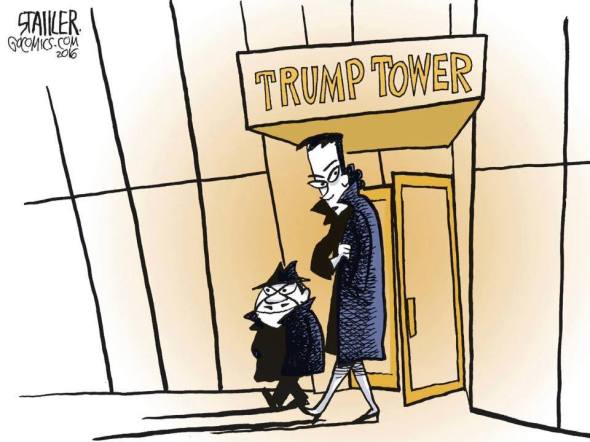
Good Morning!!
There was a big, damaging leak in the Trump/Russia case this morning. You’ve probably already seen it or heard about it.
Russian government officials discussed having potentially “derogatory” information about then-presidential candidate Donald Trump and some of his top aides in conversations intercepted by US intelligence during the 2016 election, according to two former intelligence officials and a congressional source.
One source described the information as financial in nature and said the discussion centered on whether the Russians had leverage over Trump’s inner circle. The source said the intercepted communications suggested to US intelligence that Russians believed “they had the ability to influence the administration through the derogatory information.”
The “sources” said this talk could itself have been disinformation, but it sure sounds credible considering what we know about Trump’s troubled financial history.
The contents of the conversations made clear to US officials that Russia was considering ways to influence the election — even if their claims turned out to be false.
None of the sources would say which specific Trump aides were discussed. One of the officials said the intelligence report masked the American names but it was clear the conversations revolved around the Trump campaign team. Another source would not give more specifics, citing the classified nature of the information.
“The Russians could be overstating their belief to influence,” said one of the sources.
As CNN first reported, the US intercepted discussions of Russian officials bragging about cultivating relationships with Trump campaign aides during the campaign, including Trump’s first national security adviser, Michael Flynn, to influence Trump. Following CNN’s report, The New York Times said Trump’s campaign chairman Paul Manafort was also discussed.
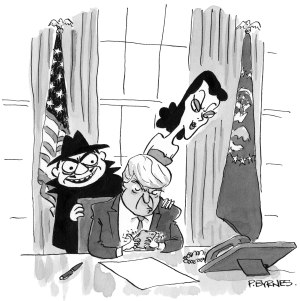
Yesterday John Schindler posted a new piece at The Observer suggesting that people at NSA are determined to get the goods on Trump: NSA in Unprecedented Hunt for KremlinGate Evidence. (Previously, Schindler had written that NSA Director has stated internally that there is evidence of coordination between Trump associates and Russia). From yesterday’s story:
…now that the Justice Department has appointed Robert Mueller special counsel charged with running the Russia investigation, NSA is apparently pulling out all the stops to track down any additional evidence which might be relevant to the expanded inquiry into KremlinGate.
Specifically, last week NSA is believed to have sent out an unprecedented order to the Directorate of Operations, the agency’s largest unit. The DO, as insiders term it, manages all of NSA’s SIGINT assets worldwide, making it the most important spy operation on earth. The email sent to every person assigned to the DO came from the Office of General Counsel, the NSA’s in-house lawyers, and it was something seldom seen at the agency—a preservation order.
advertisementSuch an order would have charged every DO official, from junior analysts to senior managers, with finding any references to individuals involved in KremlinGate, especially high-ranking Americans—and preserving those records for Federal investigators. This would include intercepted phone calls and any transcripts of them, emails, online chats, faxes—anything the agency might have picked up last year.
At the request of NSA officials, I will not name the specific individuals that DO personnel have been told to be on the lookout for in SIGINT intercepts, but one could fairly surmise that the list includes virtually all key members of Team Trump.
Read more at the Observer link. Schindler tweeted this morning that more leaks will be coming. More tweets from this morning:
Two other spy types on Twitter say it looks like Russian hackers are planning to help Trump out.
https://twitter.com/th3j35t3r/status/869548894925062144
Early this morning, Trump responded with one of his idiotic tweets.
Trump also tweeted out a Fox News story that claims Kushner wasn’t the one who suggested a secure back channel with Russia.
A December meeting between Jared Kushner, President Donald Trump’s son-in-law and one of the senior advisers in the Trump administration, and Russian ambassador Sergei Kislyak at Trump Tower focused on Syria, a source familiar with the matter told Fox News Monday.
During the meeting the Russians broached the idea of using a secure line between the Trump administration and Russia, not Kushner, a source familiar with the matter told Fox News. That follows a recent report from The Washington Post alleging that Kushner wanted to develop a secure, private line with Russia.
The idea of a permanent back channel was never discussed, according to the source. Instead, only a one-off for a call about Syria was raised in the conversation.
In addition, the source told Fox News the December meeting focused on Russia’s contention that the Obama administration’s policy on Syria was deeply flawed.
In tweeting the story approvingly, Trump seems to be confirming that the meeting took place and that it focused on civilians interfering with the foreign policy of a sitting president, Barack Obama.
I guess those plans for controlling Trump’s self-destructive tweets isn’t working.
More Russia news breaking from ABC News, as I write this: Russia investigation expands to include Donald Trump’s personal attorney.
One of President Donald Trump’s closest confidants, his personal lawyer Michael Cohen, has now become a focus of the expanding Congressional investigation into Russian efforts to influence the 2016 campaign.
Cohen confirmed to ABC News that House and Senate investigators have asked him “to provide information and testimony” about any contacts he had with people connected to the Russian government, but he said he has turned down the invitation.
“I declined the invitation to participate as the request was poorly phrased, overly broad and not capable of being answered,” Cohen told ABC News in an email Tuesday.
After Cohen rejected the Congressional requests for cooperation, the Senate Select Intelligence Committee voted unanimously on Thursday to grant the chairman, Sen. Richard Burr of North Carolina, and ranking Democrat, Sen. Mark Warner of Virginia, blanket authority to issue subpoenas as they deem necessary.
The rest of the story mostly recaps what we already know about Cohen and other Trump associates who are being investigated.
The long-predicted White House reorganization may have begun.
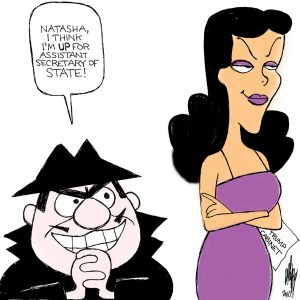
The Washington Post: Dubke resigns as White House communications director.
Mike Dubke has resigned as White House communications director in the first of what could be a series of changes to President Trump’s senior staff amid the growing Russia scandal.
Dubke, who served in the post for three months, tendered his resignation May 18. He offered to stay on to help manage communications in Washington during Trump’s foreign trip, and the president accepted.
Dubke’s last day on the job has not been determined. But it could be as early as Tuesday, when he was expected to meet with his staff at the White House, said a senior administration official, who required anonymity to discuss a personnel move that has not yet been formally announced….
Dubke, 47, who has worked closely with White House press secretary Sean Spicer, served as a behind-the-scenes player helping manage communications strategy and responses to crises such as the firing of James B. Comey as FBI director, as well as rollout plans for policy and other initiatives.
The communications operation — and Dubke and Spicer specifically — have come under sharp criticism from Trump and many senior officials in the West Wing, who believe the president has been poorly served by his staff, in particular in the aftermath of the Comey firing.
Will Spicer be next? From Politico:
Spicer, the press secretary, is expected to take on a reduced public role, though he is conducting the briefing later on Tuesday. Dubke, who was only on the job for a little over three months, had generally been seen as a Spicer ally in the White House.
Trump has also been in talks with former campaign aides Corey Lewandowski and David Bossie about taking on more formal roles, possibly in a crisis management function. Trump met with Lewandowski and Bossie in the White House on Monday, and the discussion centered on what role they could play, said one person briefed on the matter.
Trump is also said to have become more frustrated with Kushner, a top adviser who has become the subject of damaging reports alleging that he tried to set up secret communications with the Russians during the transition and failed to disclose multiple meetings with Russian officials.
However, it’s not clear that Trump would remove a family member, and Kushner’s lawyer said he is willing to cooperate with the various investigations into the matter.
More insider stuff at the link.
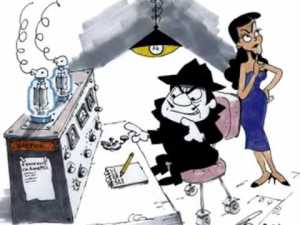
One more interesting article on a Trump favorite from Vanity Fair: How Stephen Miller Rode White Rage from Duke’s Campus to Trump’s West Wing. It seems that as a writer for the Duke student newspaper, Miller got involved in the Duke Lacrosse rape allegations.
A columnist for The Chronicle, the Duke student newspaper, Miller defended the lacrosse players in print, despite nearly universal condemnation of them by others on campus and in the media. His outspoken support for the players—even before the indictments were handed up—got him plenty of national media attention, which he enthusiastically embraced. As he expounded nightly on CNN and on The O’Reilly Factor, among other television shows, it became apparent that the sordid allegations surrounding the case gave Miller the perfect opportunity to hone the right-wing political views he had espoused since adolescence. His passion for American exceptionalism and racial superiority eventually led him to jobs in Washington, D.C., first as a spokesperson for two right-wing members of Congress, Michele Bachmann and John Shadegg, and then as a policy adviser and communications director for conservative Alabama senator Jeff Sessions, now the U.S. attorney general. Sessions, with Miller at his side, almost single-handedly killed the 2013 bipartisan immigration-reform bill that would have created a path to citizenship for 11 million undocumented immigrants.
Now, at 31, the still-single Miller is President Trump’s youngest senior policy adviser, with his own office in the West Wing and a seat at the table during crucial decisions. His most visible act in that job so far was helping his friend Steve Bannon, for the moment Trump’s chief strategist, to craft and roll out the Trump administration’s first try at instituting a travel ban on the citizens of seven predominantly Muslim countries.
Check out the rest at Vanity Fair.
I’m getting the feeling that this may turn out to be another big news day. Who knows what shoes are about to drop? I plan to keep my eyes and ears open.
Please post your thoughts and links in the comment thread below.
Memorial Day Reads
Posted: May 29, 2017 Filed under: Afternoon Reads | Tags: Baltimore, Memorial Day, New Orleans, removal of confederate statues, Richmond 33 Comments Good Afternoon Sky Dancers!!
Today used to be known as Decoration Day. It originally commemorated Civil War dead but now–as Memorial Day–it honors all who have fallen in service to our country as members of our armed forces. It became a federal holiday in 1971. I think I write on this each year, but much to my chagrin, the state of Mississippi just recognized the federal holiday recently. It was a highly controversial move.
On May 5, 1868, General John A. Logan, leader of an organization for Northern Civil War veterans, called for a nationwide day of remembrance later that month. “The 30th of May, 1868, is designated for the purpose of strewing with flowers, or otherwise decorating the graves of comrades who died in defense of their country during the late rebellion, and whose bodies now lie in almost every city, village and hamlet churchyard in the land,” he proclaimed.
The date of Decoration Day, as he called it, was chosen because it wasn’t the anniversary of any particular battle.
On the first Decoration Day, General James Garfield made a speech at Arlington National Cemetery, and 5,000 participants decorated the graves of the 20,000 Union and Confederate soldiers buried there.
Many Northern states held similar commemorative events and reprised the tradition in subsequent years; by 1890 each one had made Decoration Day an official state holiday. Southern states, on the other hand, continued to honor their dead on separate days until after World War I.
There are states in the South that still celebrate the Confederate version of Memorial Day.
In Georgia the day has been called “State Holiday” since 2015, when Confederate Memorial Day and Robert E. Lee’s birthday were struck from the state calendar. The state holiday list says the official holiday is April 26 but will be observed this year on Monday, April 24.
New Orleans opened the still deep and contentious wounds of the Confederacy by deciding what to do with some of our Confederate symbols this month. Mayor Mitch Landrieu and the city tore down four of the most visible monuments built by Lost Causers years after the surrender of the South. He commemorated the occasion with this speech. This is an interview from NPR he gave shortly after the speech.
(SOUNDBITE OF ARCHIVED RECORDING)
MITCH LANDRIEU: These statues are not just stone and metal. They’re not just innocent remembrances of a benign history. These monuments celebrate a fictional sanitized Confederacy, ignoring the death, ignoring the enslavement, ignoring the terror that it actually stood for.
CORNISH: New Orleans Mayor Mitch Landrieu spoke last Friday after the city took down the last of four Confederate monuments. General Robert E. Lee was the final one to go. It was an address about the decision, about the history of slavery in the city. It was an address about race. A week later, people are still talking about it, dissecting sections of the speech.
(SOUNDBITE OF ARCHIVED RECORDING)
LANDRIEU: This is not about a naive quest to solve all of our problems at once. This is, however, about showing the whole world that we as a city, that we as a people are able to acknowledge, to understand, to reconcile and, more importantly, choose a better future for ourselves, making straight what has been crooked and making right what was wrong.
He was interviewed by Chuck Todd for MTP.
I’d like to continue quoting the interview from NPR.
CORNISH: I want to quote a letter to the editors of the Times-Picayune, a writer, a citizen named Charles Foy of Madisonville. He says you single-handedly managed to turn innocuous city landmarks into battlegrounds and that these monuments have stood in place for many years. He goes on to say, I can guarantee you that very few people, black or white, gave them a second thought. This is not an uncommon opinion.
LANDRIEU: Well, it’s a silly opinion. I mean that’s the argument that says it all. Mayor, we don’t know anybody that cares about these monuments. That’s because we live a block away and a world apart. And you know, this story that we told was not just about the monuments. You know, the context is that New Orleans got destroyed after Katrina. We’ve been rebuilding our whole city. And as we built back all of our schools and all of our health clinics and all of our hospitals and all of our businesses, we began to think about our public spaces and whether those public spaces really represented who we were as a people. And those monuments stuck out on public spaces like a sore thumb.
And so I asked the people of New Orleans just to think about that, and that speech was really to the people of New Orleans. It wasn’t a speech to the rest of the nation. So it’s quite a surprise that the speech has gotten so much attention across the country. But this is – the issue of race is a complicated issue for the country that we have to walk through. You can’t go around it. You can’t go over it. You can’t go under it. You have to go right through it, and it’s painful.
CORNISH: Is there a particular moment when you started to think about actually taking the monuments down?
LANDRIEU: Yeah, there was a specific moment. (Laughter) I was having breakfast with Wynton Marsalis about three years ago, and he and I were thinking about what the 300th anniversary of the city would look like, which is, by the way, next year.
And I was trying to prepare the city about how to develop itself and get ready for the future. And he said, you ought to think about those monuments. And I said, you’re crazy. I’ve walked by those monuments every day. And he said, no, I want you to really think about it. And I told him I would.
 The removal of the statues came at odd times with the jobbers wearing masks and bullet proof vests. There was heavy police presence due to a huge contingent of protesters that settled in for awhile. It was the usual suspects.
It seems like many generations after the Civil War we still have white people trying to make a last stand on a wound that does not heal for any one. Just as I cannot understand supporting “heritage” of a group of enslavers, I cannot fully understand the struggles of those descended from slaves. Even though I descended from old slave-owing families, all of my family fought on the Union side and was solidly against slavery so the narrative with which I grew up did not include a celebration of the confederacy.
Supporters and opponents of removing New Orleans’ Confederate monuments met Sunday afternoon (May 7) at Lee Circle, in a tense and angry confrontation that included some scuffles during a day of demonstrations.
Police quickly broke up a couple of fights, and the dueling protests appeared mostly peaceful. But heated words, slurs and profanities were exchanged, as demonstrators on opposite sides held Confederate flags and protest signs.
A march led by Take ‘Em Down NOLA, which supports the removal of the Confederate monuments, brought hundreds of people from Congo Square to Lee Circle, where they came face-to-face with groups of monument supporters who had been there since the morning. Police said more than 700 people were involved in the demonstrations.
Those advocating the removal of the statues chanted slogans like “Go home racists,” and “Hey hey, ho ho, white supremacy’s got to go.”
On the other side, a monument supporter shouted over a megaphone: “We built this country. If you don’t like it, there are plenty of other non-white countries you can go to!”
I’ve actually seen friendships end and family feuds heat up over the removal of the statues. I’m a preservationist and historian at heart and have been more active and focused on preserving, restoring, and showing our civil rights sites. I’m still waiting for the statue to appear of little Ruby Bridges and the promised memorial at the site where Homer Plessey sat down in a white part of a train. Both of these are within blocks of my home. I also was probably one of the few people fuming when this same mayor and city council voted to destroy the Woolworth’s building with its historical lunch counter. I’m still waiting for the statues in memorial of the victims of lynchings too. But, right now, that’s no one’s focus.
The Smithsonian Magazine had a piece on Richmond’s dealings with Confederate History. The city’s monuments became a place of protest when they added a statue of Arthur Ashe in the 90s. Their struggle has been different.
In the past couple of weeks, how we remember and commemorate the Civil War has undergone seismic shifts. The city of New Orleans is in the process of removing four monuments that celebrate Confederate leaders and an 1874 attempt by white supremacists to topple Louisiana’s biracial Reconstruction government. In Charlottesville, Virginia, a court injunction temporarily halted the city’s plans to sell its Robert E. Lee monument while alt-right leader Richard Spencer led a torchlight protest this past weekend reminiscent of Klan rallies of the past. White supremacist support for the Lee statue will likely strengthen and broaden the call to remove this and other Confederate monuments throughout the city. Curiously, however, the former capital of the Confederacy, Richmond, Virginia, has not seen a similar outcry. Why?
The city boasts some of the most significant sites of Confederate commemoration. Its famed Monument Avenue is studded with massive statues of Generals Robert E. Lee, Stonewall Jackson and J.E.B. Stuart along with the president of the confederacy, Jefferson Davis. Thousands of Confederate soldiers and officers, and Davis himself, are buried in the city’s Hollywood Cemetery—a sacred space for white Southerners grappling with defeat. Veterans’ reunions, battlefields, monument dedications, parades and the opening of the Confederate Museum in 1896 helped solidify the city itself as a shrine to Confederate memory by the beginning of the 20th century. If ever a city was ripe for calls to remove Confederate monuments, it is Richmond.
But beyond scattered acts of vandalism, locals have remained largely quiet. Part of the reason why is that over the years, the city has recognized changing perceptions of the Confederacy—and officials have addressed concerns that public spaces devoted to the city’s past do not sufficiently reflect Richmond’s diversity.
In the past few decades, Richmond has dedicated new monuments that have greatly expanded its commemorative landscape. A statue of homegrown tennis star Arthur Ashe joined Monument Avenue in 1996—arguably one of its most high-profile and controversial additions. While some Richmonders welcomed the statue, others argued that it would “disrupt the theme of the avenue,” and both its supporters and detractors mocked the statue itself.
In 2003, the city dedicated a monument of Abraham Lincoln and his son to mark the president’s April 1865 visit following the abandonment of Richmond by the Confederate government. The dedication helped re-interpret Lincoln’s visit as a symbol of slavery’s end as opposed to the entrance of a conquering tyrant. While in Richmond just 11 days before his assassination, Lincoln famously corrected newly freed slaves who knelt at his feet: “Don’t kneel to me,” Lincoln responded. “That is not right. You must kneel to God only, and thank Him for the liberty you will afterward enjoy.” Four years after the Lincoln statue was erected, the city installed the Richmond Slavery Reconciliation Statue, a 15-foot bronze sculpture depicting two enslaved individuals embracing not far from the center of Richmond’s former slave market.
 So, now the city of Baltimore and its mayor Catherine Pugh will try to find a path for a city with a history of racial divides and strife. Maryland wasn’t even a Confederate state yet still has signs of the Lost Cause.
New Orleans recently took down its Confederate monuments. Baltimore Mayor Catherine Pugh says she is considering doing the same thing in the city.
“The city does want to remove these,” Pugh told The Baltimore Sun. “We will take a closer look at how we go about following in the footsteps of New Orleans.”
Before former Mayor Stephanie Rawlings-Blake left office last year, she added signs in front of four Confederate monuments in Baltimore. The signs said, in part, that the monuments were “part of a propaganda campaign of national pro-Confederate organizations to perpetuate the beliefs of white supremacy, falsify history and support segregation and racial intimidation.”
But Rawlings-Blake stopped short of removing the monuments. She cited costs and logistical concerns, and left the decision to Pugh, who took office in December.
 The City Commission has recommended the removal of two specific monuments.
University of Maryland law professor Larry S. Gibson, a commission member, proposed the plan to remove the Roger B. Taney Monument on Mount Vernon Place and the Robert E. Lee and Thomas J. “Stonewall” Jackson Monument in the Wyman Park Dell.
Gibson said Taney’s statute should be dismantled because his authorship of the Dred Scott Supreme Court decision was “pure racism.” The decision held that African-Americans could not be American citizens.
“In my view, he deserves a place in infamy,” Gibson said of the fifth chief justice of the United States.
Gibson also argued that Baltimore has a disproportionate number of monuments to the Confederacy on its public property. He said that more than twice as many Marylanders fought for the Union as the Confederacy during the Civil War, but the city has only one public monument to the Union.
“Three monuments to the Confederacy is out of proportion,” Gibson said. “Probably a majority of Baltimoreans think there should be none to the Confederacy.”
The commissioners recommended that the statute of Lee and Jackson be offered to the U.S. Park Service to place in Chancellorsville, Va. The two Confederate generals last met in person shortly before the Battle of Chancellorsville in 1863.
The commission voted to keep the Confederate Soldiers and Sailors Monument on Mount Royal Avenue and the Confederate Women’s Monument on West University Parkway, but to add context. Members said they needed to meet again to decide exactly what context they wanted to add.
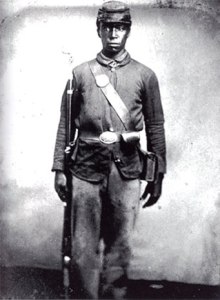 So, there’s the past. Axios has the numbers we should know for Memorial Day Present.
Good Monday morning, and wishing a peaceful, restful Memorial Day to you and yours. Pausing to remember a part of the beating heart of America that too often eludes us — the fallen, and the serving:
There were very few civil war veterans alive when I was born. The last few of them died when I was still in diapers. Even as a child I was confused by the number of white people that just seemed to regale the entire Confederacy, its treason, its stain of enslaving human beings, and the entire mess created necessitating the civil rights movements that were chronicled daily on my black and white TV. As a woman now on the verge of getting her first Social Security check, the fact we still seem to be fighting this war perplexes me to no end. But then, we now have a President that probably would have happily palled around with Jeff Davis and then entered the South as a Carpetbagger with equal ease.
 This is President Lincoln’s last address and it was on the reconstruction. I thought I’d share parts of it with you.
I have been shown a letter on this subject, supposed to be an able one, in which the writer expresses regret that my mind has not seemed to be definitely fixed on the question whether the seceding States, so called, are in the Union or out of it. It would perhaps, add astonishment to his regret, were he to learn that since I have found professed Union men endeavoring to make that question, I have purposely forborne any public expression upon it. As appears to me that question has not been, nor yet is, a practically material one, and that any discussion of it, while it thus remains practically immaterial, could have no effect other than the mischievous one of dividing our friends. As yet, whatever it may hereafter become, that question is bad, as the basis of a controversy, and good for nothing at all–a merely pernicious abstraction.
We all agree that the seceded States, so called, are out of their proper relation with the Union; and that the sole object of the government, civil and military, in regard to those States is to again get them into that proper practical relation. I believe it is not only possible, but in fact, easier to do this, without deciding, or even considering, whether these States have ever been out of the Union, than with it. Finding themselves safely at home, it would be utterly immaterial whether they had ever been abroad. Let us all join in doing the acts necessary to restoring the proper practical relations between these States and the Union; and each forever after, innocently indulge his own opinion whether, in doing the acts, he brought the States from without, into the Union, or only gave them proper assistance, they never having been out of it.
The amount of constituency, so to speak, on which the new Louisiana government rests, would be more satisfactory to all, if it contained fifty, thirty, or even twenty thousand, instead of only about twelve thousand, as it does. It is also unsatisfactory to some that the elective franchise is not given to the colored man. I would myself prefer that it were now conferred on the very intelligent, and on those who serve our cause as soldiers. Still the question is not whether the Louisiana government, as it stands, is quite all that is desirable. The question is, “Will it be wiser to take it as it is, and help to improve it; or to reject, and disperse it?” “Can Louisiana be brought into proper practical relation with the Union sooner by sustaining, or by discarding her new State government?”
Some twelve thousand voters in the heretofore slave-state of Louisiana have sworn allegiance to the Union, assumed to be the rightful political power of the State, held elections, organized a State government, adopted a free-state constitution, giving the benefit of public schools equally to black and white, and empowering the Legislature to confer the elective franchise upon the colored man. Their Legislature has already voted to ratify the constitutional amendment recently passed by Congress, abolishing slavery throughout the nation. These twelve thousand persons are thus fully committed to the Union, and to perpetual freedom in the state–committed to the very things, and nearly all the things the nation wants–and they ask the nations recognition and it’s assistance to make good their committal. Now, if we reject, and spurn them, we do our utmost to disorganize and disperse them. We in effect say to the white men “You are worthless, or worse–we will neither help you, nor be helped by you.” To the blacks we say “This cup of liberty which these, your old masters, hold to your lips, we will dash from you, and leave you to the chances of gathering the spilled and scattered contents in some vague and undefined when, where, and how.” If this course, discouraging and paralyzing both white and black, has any tendency to bring Louisiana into proper practical relations with the Union, I have, so far, been unable to perceive it. If, on the contrary, we recognize, and sustain the new government of Louisiana the converse of all this is made true. We encourage the hearts, and nerve the arms of the twelve thousand to adhere to their work, and argue for it, and proselyte for it, and fight for it, and feed it, and grow it, and ripen it to a complete success. The colored man too, in seeing all united for him, is inspired with vigilance, and energy, and daring, to the same end. Grant that he desires the elective franchise, will he not attain it sooner by saving the already advanced steps toward it, than by running backward over them? Concede that the new government of Louisiana is only to what it should be as the egg is to the fowl, we shall sooner have the fowl by hatching the egg than by smashing it? Again, if we reject Louisiana, we also reject one vote in favor of the proposed amendment to the national Constitution. To meet this proposition, it has been argued that no more than three fourths of those States which have not attempted secession are necessary to validly ratify the amendment. I do not commit myself against this, further than to say that such a ratification would be questionable, and sure to be persistently questioned; while a ratification by three-fourths of all the States would be unquestioned and unquestionable.
I repeat the question, “Can Louisiana be brought into proper practical relation with the Union sooner by sustaining or by discarding her new State Government?
What has been said of Louisiana will apply generally to other States. And yet so great peculiarities pertain to each state, and such important and sudden changes occur in the same state; and withal, so new and unprecedented is the whole case, that no exclusive, and inflexible plan can be safely prescribed as to details and colatterals [sic]. Such exclusive, and inflexible plan, would surely become a new entanglement. Important principles may, and must, be inflexible.
 This brings me to one of the removed monuments. The vile one was undoubtedly the Liberty Place Monument. It celebrates the bloody undoing of what Lincoln said of Louisiana and her government.
The Battle of Liberty Place Monument is a 35-foot stone obelisk that was erected in 1891 in the middle of Canal Street in honor of the “Battle of Liberty Place,” an 1874 insurrection of the Crescent City White League, a group of all white, mostly Confederate veterans, who battled against the racially integrated New Orleans Metropolitan Police and state militia.
The monument was meant to honor the members of the White League who died during the battle. In 1932, the City of New Orleans added a plaque to the monument, explicitly outlining its white supremacist sympathies, which explained that the battle was fought for the “overthrow of carpetbag government, ousting the usurpers” and that “the national election of November 1876 recognized white supremacy in the South and gave us our state.”
This was a monument to the White League. It was an attempt to overthrow the government of Louisiana and many police officers were killed.Take time to think about that inscription on its base. You may also find the link to a video interview of descendant of one of those participating in that riot. Listen to him say that the civil war was about states rights and never about slavery and that there was election fraud like today. It’s the one up there next to the photo of the inscription. This narrative is the narrative of the Lost Cause. It is the narrative of men like David Duke.
On Sept. 14, 1874, the White League stormed the New Orleans police station in an attempted coup d’état to remove the governor of New Orleans, Republican William Kellogg, and replace him with John McEnery, who had been his unsuccessful Democratic challenger in the 1872 election. The White League defeated the city’s integrated police department, and took control of the city for a couple of days before President Ulysses S. Grant sent down federal troops to reclaim the city. The White League quickly surrendered the city upon the arrival of federal troops, and the Battle of Liberty Place monument exists to remember the 100 White League members who died in the battle. That is to say, it exists to celebrate those who died in a failed coup with the explicit purpose of returning Louisiana to a white dominated society.
The White League, formed in 1874, was one of the last white terrorist groups that sprang up during Reconstruction. The Ku Klux Klan started in 1865 upon the completion of the war. The White League was founded by Christopher Columbus Nash, a former Confederate soldier who was a prisoner of war during the Civil War. On April 13, 1873, Nash led a white militia in the Colfax Massacre that killed approximately 150 freed blacks. The massacre erupted following white fury at the election of Kellogg to the governorship in 1872. This battle is one of the single biggest massacres of Reconstruction. Soon thereafter Nash formed the White League.
“Having solely in view the maintenance of our hereditary civilization and Christianity menaced by a stupid Africanization, we appeal to men of our race, of whatever language or nationality, to unite with us against that supreme danger,” read the platform of the White League.
Despite their clear racist and terroristic foundations, they represented a more palatable form of terror than the KKK. The White League was more mainstream than the KKK. This brand of terror had become normalized over the previous decade. The White League openly collaborated with the KKK, Southern Democratic politicians, and white business owners who facilitated the Redeemers movement to terrorize freed blacks and Union sympathizers to swing elections in favor of the Democratic Party.
President Grant was so alarmed by the threat to democracy that the White League posed that he wrote about them in his 1874 State of the Union Address: “White Leagues and other societies were formed; large quantities of arms and ammunition were imported and distributed to these organizations; military drills, with menacing demonstrations, were held, and with all these murders enough were committed to spread terror among those whose political action was to be suppressed, if possible, by these intolerant and criminal proceedings.”
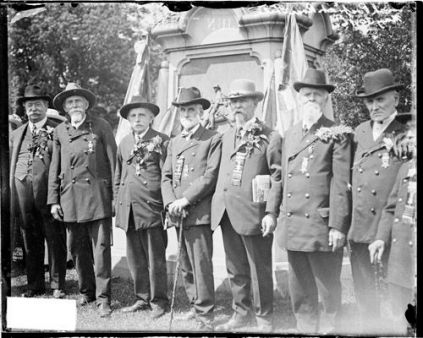 What gets me thinking when I read about all of these deaths is that the morality of our Commander-in-Chief and his/her level headed, informed life-and-death decisions create the basis of what constitutes how we sacrifice our public servants and protectors. Lincoln and Grant knew what it was like to send men to certain death and you can see that gravity in their actions, speeches and lives. You can feel it when you read about their mistakes and their weaknesses. You can see it in Lincoln’s depression and in Grant’s heaving drinking. As Americans, we have always tried to use the lives of our armed forces fully knowing that we’re creating Gold Star Families and fresh graves in Arlington.
Who will be sacrificed by this administration and for what cause will we memorialize them?
Friday Reads: Living under a Mean Spirit
Posted: May 26, 2017 Filed under: Afternoon Reads | Tags: Assault, corruption, Rudeness 43 Comments Good Afternoon!
We live in a country where Mean Spiritedness is now rewarded, held up, elected, and on display. We’ve all known coarse, crude, uncouth people. Never have so many of them held public office. They are full of pride about what they consider their Christianity, their whiteness. their lack of manners, and their obvious failure to learn anything about the world, culture, and science around them.
One of our major parties is now not only one of greed but of meanness and stupidity. Kremlin Caligula represents that ethos in spades. I’ve always voted independently no matter which party had its name on my voter registration. I cannot imagine ever voting for another Republican in my lifetime because any cog in that wheel is a cog in a wheel that rolls over our humanity.
I’ve chosen to decorate my post today with Hopi Kachina Clowns or Koshare . The Koshare depict unacceptable behavior and teach values in the lore of Pueblo culture. We could use a few good Koshare wandering around the halls of Congress and the grounds of the White House.
 A rich white man who body slammed a Jewish Journalist for asking him a question is now head to the House of Representatives and was placed there by the mean spirits of Montana. He won a mostly narrow victory given the unbearable redness of Montana, but it was a victory nonetheless. This is horrifying. The usual suspects in the right wing press and in congress are blaming the victim and presenting the bully as some kind of hero. I am appalled. The following words are from from Brian Beutler writing for The Republic.
Republican Greg Gianforte defeated Democrat Rob Quist in a special election Thursday for Montana’s lone congressional seat, a six-point victory that should horrify you because he won with the full support of the GOP after body-slamming and punching an American reporter—and many of our political institutions, especially the media, are too paralyzed to impose a meaningful consequence on him or his enablers.
Gianforte, a true coward, didn’t admit any wrongdoing until his victory speech, at which point the risks of playacting decency pertained to his criminal case—the police have charged him with assault—rather than the election. “When you make a mistake, you have to own up to it,” Gianforte said. “That’s the Montana way.” I suspect some Montanans would object to the notion that you only apologize once it’s politically safe to do so.
For it was already beyond dispute on Wednesday night, thanks to audio of the attackand a witness account from a Fox News reporter, that Gianforte had attacked the Guardian’s Ben Jacobs. That’s when the process of public accountability began. In a healthier political culture, the condemnation would have been nearly unanimous, and the context of the incident would not have been a matter of controversy. What we witnessed instead was a political media—confronted with a one-sided assault on its most basic freedom—rendered by its own constructs largely incapable of identifying the threat with any precision.
Before he became president of the United States, Donald Trump toured the country encouraging violence against protesters and whipping up animosity toward the press. Earlier this month, Trump’s Health and Human Services secretary, Tom Price, sicced police on a reporter who was trying to ask him a question in the West Virginia state capitol on account of the fact that he didn’t recognize the reporter as an attendee of a press conference, then praised the police for their diligence. Last week, the FCC’s security detail manhandled a tech reporter at the National Press Club.
Republicans know in theory how to get their hackles up over political violence directed at reporters, because in January 2010, when an aide to Massachusetts Attorney General Martha Coakley pushed a conservative reporter (then helped him up, and apologized for his behavior) Republicans tried to end his career in public service.
Their tacit acceptance of a culture of antagonism and violence directed at the press suggests at least that the party’s values have changed.
 The win wasn’t as imposing as it could’ve been. This is the one bit of goodness. It also may have been mostly locked in by early and mail in voting. However, the state of Montana is sending a man who just was charged with assault and the assault was on a reporter doing his job. This is not how it’s supposed to work in a democracy. This is from Matt Yglesias writing for Vox.
Greg Gianforte’s 7 percentage point win in the Montana special election keeps a seat in Republican hands but fundamentally represents bad news for the GOP. The basic issue, as David Wasserman breaks down for the Cook Political Report, is that for prognostication purposes you don’t only want to know who wins or loses a special election — you want to know the margin.
Montana is considerably redder than the average congressional district. According to Wasserman’s calculations, in an election where Democrats got 50 percent of the two-party vote nationwide, you’d expect them to get just 39 percent in Montana. Quist scored 44 percent, and with the Libertarian pulling in 6 percent, his share of the two-party vote is more like 46.Things aren’t as simple as saying that Rob Quist outperformed the 39 percent benchmark and therefore Democrats are on track to win — geography means Republicans can hold their majority with less than 50 percent of the vote. But the GOP underperformed badly in Montana, after a similar underperformance in the special election for Kansas’s Fourth Congressional District.
There are 120 Republican-held House seats that are more GOP-friendly than Montana’s at-large district. If Republicans are winning in places like Montana by just 7 percentage points, then they are in extreme peril of losing their House majority in November 2018.
Republican leaders have taken their party on a risky course, and they ought to strongly consider turning the ship around.
 The Guardian–home of the assaulted Reporter Ben Jacobs–calls the new Congressman a ‘fresh liability’ for the equally mean spirited Paul Ryan. I can’t imagine them doing anything given what kids of crooks they’ve got wandering the White House. They only care about delivering tax cuts and ending everything but the military.
As it is, the party will now have to decide whether to embrace, accommodate or ostracise a man who made himself the personification of Trump’s media-baiting, violence-inciting campaign rhetoric. The legal saga will put a dark cloud over him and his movements on Capitol Hill are likely to receive outsized and negative coverage. In short, he is a liability adding to Ryan’s already considerable burden.
“This is going to be another of those moral tests for the Republican party,” said Charlie Sykes, a conservative author and commentator. “It should be an easy one for them to say there is no place for violence against reporters.”
In normal politics, Skyes added, the incident would have been universally condemned. But, since the ascent of Trump, the compass has moved. “It’s hard to overstate the cynicism we’ve seen from Republicans in Washington who will stop at nothing when votes are involved. How far down the road are Republicanswilling to go?”
On Thursday, Ryan said that what occurred was “wrong and should not happen”and Gianforte should apologise. But he stopped short of calling for Gianforte to quit the race. The questions will keep coming, however, when Gianforte takes his seat in the House.
 Meanwhile, Kremlin Caligula displayed bad form when pushing his way to the front of the NATO summit. He shoved the Prime Minister of Montenegro to get to the head of the pack like a grade school bully.
Video of the incident spread on social networks in multiple languages.
“It seems Donald Trump did not want that anyone overshadows his presence at the summit,” said the Montenegro newspaper Vijesti.
Other Balkan websites ran headlines such as “America First” and “Where do you think you are going?”
Markovic himself, however, shrugged off the slight.
“It didn’t really register. I just saw reactions about it on social networks. It is simply a harmless situation,” he told reporters after the summit.
Instead of being insulted, he took the opportunity to thank Trump for supporting Montenegro’s membership in NATO. The small former Yugoslav republic is slated to become NATO’s 29th member next month.
His speech elicited laughs, eyerolls, and mumbles. WAPO labels Trump’s behavior a national embarrassment. The uncouth idiot from Queens has done us no favors with our friends while spilling beyond top secret information to international Thugs and Bullies.
After Trump called NATO obsolete (then proceeded to walk that back), Europe was looking for public support of Article 5, which affirms that NATO members will come to the mutual defense of any member that is under attack. But alas, Trump could not even bring himself to utter explicitly that the U.S. supports Article 5 in his remarks at Brussels, which every single U.S. president has done since Harry Truman in 1949. If NATO allies were nervous about the United States’ commitment to Europe’s security before, they must be fuming now. The NATO summit comes as reports surface that British police are withholding intelligence from the United States after leaks to U.S. media about the Manchester bombing investigation, and weeks after Trump revealed highly classified information to the Russiansabout operations against the Islamic State. For all of Trump’s fire and fury about the United States getting the raw end of the deal from NATO, from an optics standpoint, it is the United States that is looking like the irresponsible partner.
Perhaps in Trump’s eyes, the Saudis threw a much better shindig — spending $68 million to host Trump. Well, really, it was a $110 billion dollar fete, considering the price tag for the historic weapons deal that the United States signed with Saudi Arabia. Trump appeared to be much more friendly and relaxed among Saudi Arabian and other Gulf leaders than with our European allies. Obviously, Trump was bedazzled by the kingdom’s hospitality, but none of the Saudi opulence and money can whitewash Saudi Arabia’s terrible record of fueling Wahhabi terrorism, carrying out record numbers of public beheadings, contributing to famine in Yemen, and withholding many basic rights for Saudi women and girls. Days after one of the worst terrorist attacks in British history, Trump is visibly more comfortable praising autocrats and extremist governments who help to fuel violence and conflict. That should be a slap in the face to our liberal allies in Europe.

President Donald Trump‘s first trip to a NATO summit Thursday did not sit well with former ambassadors to the alliance.
“I do think Trump’s visit to NATO was the least effective of any American president since 1949,” Nicholas Burns, who served as ambassador to the 28-member defense alliance under President George W. Bush, tweeted Friday. NATO came into existence in 1949.
In Brussels, Trump admonished members of the alliance for not paying their “fair share” for defense. The president failed to publicly endorse “Article 5,” the NATO mutual assistance clause that he was widely expected to back publicly for the first time.
Donald Rumsfeld thought the entire speech was just terrific which speaks volumes to any one with extensive knowledge of his history and your basic war criminal. Former Speaker John Boehner called him a “disaster”. But it was today’s Hillary Clinton who gave good shade to President Swiss Cheese for Brains in ways that only she could do. She gave her Alma Mater Wellesley’s commencement Address. You may watch the full address below.
She was talking to the graduates about their future. But she was focused just as much on her own past, and the hardest, fullest case against Trump she’s made since last November.
“In the years to come, there will be trolls galore, online and in person,” she said, urging the graduates not to let themselves get beaten down. “They may even call you ‘a nasty woman.'”
Back when she was getting her diploma in 1969, Clinton said, “we were furious about the past presidential election of a man whose presidency would eventually end in disgrace with his impeachment for obstruction of justice,” pausing to soak up the cheers and applause from a crowd who knew exactly what she was talking about, and approved.
Just in case anyone missed the point, she leaned in a little further, reminding students and attendees of the private women’s liberal arts school in Massachusetts that Richard Nixon had gone down “after firing the person running the investigation into him at the Department of Justice.”
“But here’s what I want you to know. We got through that tumultuous time, and once again we began to thrive as our society changed laws and opened the circle of opportunity and rights wider and wider for more Americans,” Clinton said.
Clinton has been struggling non-stop over the last six months with her loss, but she’s also been struggling with her public role. People close to her, many of whom share her insistence that a race she ran well was stolen out from under her by Russian involvement and by a surprise October letter from that same now-fired FBI director, are frustrated that she hasn’t been more in demand for a central role in the Trump resistance.
My most favorite headline today comes from The Dallas News: ‘Trump’s budget shows his top priority is refusing to deal with reality’ written by Kevin Williamson.
President Donald Trump has produced a very silly budget proposal. Thankfully, presidential budget proposals have all the effect of a mouse passing gas in a hurricane — Congress, not the president, actually appropriates funds and writes the tax code.Presidential budget proposals are not received as actual fiscal blueprints but as statements of priorities, and so we must conclude that Trump’s top priority is refusing to deal with reality.
Here’s the situation: About 80 percent of federal spending is consumed by five things: 1. National defense; 2. Social Security; 3. Medicare; 4. Medicaid and other related health-care benefits; 5. Interest on the debt. Trump wants to increase spending on defense by about 10 percent while shielding Social Security and Medicare from cuts. Short of a default, he doesn’t have any choice but to pay the interest on the debt. So that leaves things pretty tight.
On top of that, he wants to pass what he boasts is one of the largest tax cuts in history. And balance the budget. Naturally, the White House budget monkeys are messing with the numbers a little bit. It’s the return of the Naïve Supply-Sider.
 Williamson does a great job explaining what us economists have found out and think about that. This is good because I get very tired of having to give and write that explanation many times a year. Let me also tell you that this guy writes for The National Review so Republicans don’t have to get their prunes from me or any other person that generally votes democratic.
The problem with this simplistic analysis is that it credits 100 percent of economic growth to tax cuts, when in fact economic growth is the result of many factors. The U.S. economy has experienced periods of strong growth with much higher tax rates, as it did in the 1950s and 1960s. The meaningful comparison is not between what tax revenue was before the tax cuts and what it was after the tax cuts, but between what it was after the tax cuts and what it would have been without the cuts. Which, unfortunately, is a counterfactual.
Economists who have looked at the issue have found evidence of growth effects and sometimes evidence of very strong growth effects. What they have not found is evidence of growth effects amounting to 100 percent of forgone revenue, i.e. the holy grail of “self-financing tax cuts.” The Trump budget proposal includes tax cuts that not only are self-financing but doubly self-financing. These tax cuts would, if we are to take him at his word (and that is impossible to do) not only pay for themselves but generate enough new revenue to balance the budget 10 years down the road.
You can bet that free lunch will turn out to be expensive.
 My big problem is the use of that word ‘free lunch’. The folks that really need food won’t get it. The ‘free lunch’ will go to the rest of the Caligulas resident in our country. So, there’s the greed and the stupidity and the mean rolled up in one huge gesture. Meanwhile, the FBI is now very out front that it’s going after Jared Kushner. I’ll give this last bit to Charles Pierce of Esquire infamy.
In their infinite wisdom, enough of the American people got together and decided to put a manifestly unqualified and manifestly unfit New York real estate sub-tycoon in charge of the executive branch of the national government. He has proceeded to do business there in the same shadowy fashion in which he’s done business everywhere else. He’s kept everything within the family, even if the family members are no more qualified to do the work than he is. Either he never knew that you can’t run a democratic republic that way, or he didn’t care. Either everything is a surprise to this crowd, or they think that the institutions of government are just another great, fertile field of grift to be plundered.
In any case, at the end of the day, it’s all going to be about money. Jared Kushner is just the most recent clue in a completely bogus treasure map.
So, follow the money and send in the clowns. The oldies are still the goodies.
What’s on your reading and blogging list today?
Tuesday Reads: Another Overwhelming News Day
Posted: May 23, 2017 Filed under: Afternoon Reads, U.S. Politics 29 Comments
The Morning News, William Merritt Chase
Good Afternoon!!
I’m having another one of those days where I just can’t get going on a post. The news is just so overwhelming.
As has been happening almost daily for the past couple of weeks, The Washington Post broke a huge new story on the Trump Russia investigation: Trump asked intelligence chiefs to push back against FBI collusion probe after Comey revealed its existence.
Trump made separate appeals to the director of national intelligence, Daniel Coats, and to Adm. Michael S. Rogers, the director of the National Security Agency, urging them to publicly deny the existence of any evidence of collusion during the 2016 election.
Coats and Rogers refused to comply with the requests, which they both deemed to be inappropriate, according to two current and two former officials, who spoke on the condition of anonymity to discuss private communications with the president….
Trump’s conversation with Rogers was documented contemporaneously in an internal memo written by a senior NSA official, according to the officials. It is unclear if a similar memo was prepared by the Office of the Director of National Intelligence to document Trump’s conversation with Coats. Officials said such memos could be made available to both the special counsel now overseeing the Russia investigation and congressional investigators, who might explore whether Trump sought to impede the FBI’s work.
Coats is refusing to comment on the story, but he isn’t denying it.

End of the Story, Marcus Stone
Of course that breaking news story was quickly pushed to the media back burner after the terror attack in Manchester, England.
NBC News: Manchester Arena Suicide Bombing: Victims Include 8-Year-Old Girl, Young Student.
The first victims identified in the suicide bombing after an Ariana Grande concert in Britain were an 8-year-old remembered as a “beautiful little girl” and an 18-year-old college student who had previously met her pop idol.
They were among the 22 killed Monday night at the Manchester Arena in the deadliest terror attack in Britain since 2005. Another 59 people were also injured as the suspect detonated a bomb near one of the venue’s exits, sending the mostly younger concertgoers fleeing in panic, authorities said.
Grande’s fans are predominantly teens and young girls, and many had gone to the venue with their parents for a night of carefree fun that in a flash turned into a scene of carnage. Hours after the bloodshed, desperate parents said they were still trying unsuccessfully to reconnect with children.
The Washington Post: Manchester bombing suspect identified, U.S. officials say; Islamic State claims responsibility.
The Islamic State claimed Tuesday that one of its “soldiers” carried out an apparent suicide blast in Manchester that killed at least 22 people, including teenagers and others streaming out of a pop concert.
U.S. officials, speaking on the condition of anonymity, identified the assailant as Salman Abedi. They did not provide information about his age or nationality, and British officials declined to comment on the suspect’s identity.
Islamic State’s claim came as British investigators intensified their search for possible accomplices and police teams fanned out across the northern city after the worst terrorist strike in Britain in more than a decade.
The Islamic State did not give any details about the attacker or how the blast was carried out late Monday. Its statement was posted on the online messaging service Telegram and later noted by the SITE Intelligence Group, which monitors militant websites.
The Islamic State often quickly proclaims links to attacks, but some previous claims have not been proven.

Morning News, Lillian Westcott Hale
This morning DNI Dan Coats testified before the Senate Armed Services Committee and discussed the attack. NBC News:
The bloody mayhem in Manchester could be a taste of the ISIS terror to come.
That was the dire warning from Director of National Intelligence Dan Coats on Tuesday in his appearance before the Senate Armed Services Committee and a report by the agency.
“They claim responsibility for virtually every attack,” Coats told the panel after ISIS declared it was behind the suicide bombing at an Ariana Grande concert in Manchester, England, that left 22 dead and dozens more injured. “We have not verified yet the connection.”
The attack came straight from the ISIS playbook that Coats warned lawmakers about.
“We anticipate that ISIS will be in transition over the coming year, shifting toward more traditional terrorist operations rather than conventional military engagement in Iraq and Syria,” Coats warned. “ISIS will continue to lead, enable and inspire terrorist attacks, both unilaterally and with the assistance of its formal branches and networks.”
Why? Because ISIS is losing on the battlefield and it has lost much of the territory it held in Iraq and Syria.
There also was a hearing this morning in the House Intelligence Committee on the Trump-Russia connection. I watched some of it. It’s hard to believe, but Republicans are still trying to absolve Trump and are more concerned about leaks to the media than the fact that Russia interfered in U.S. elections.
Some headlines coming out of the testimony of former CIA Director John Brennan:
NPR: Former CIA Director Tells Lawmakers About ‘Very Aggressive’ Russian Election Meddling.
Former CIA Director John Brennan told the House Intelligence Committee Tuesday that Russia “brazenly interfered in the 2016 election process,” despite U.S. efforts to warn them off. Brennan testified in an open session of the committee, one of a handful of congressional committee now investigating Russian meddling in the 2016 election.
Brennan said he told his Russian counterpart, the head of Russia’s FSB, last August that if Russia pursued its efforts to interfere, “it would destroy any near-term prospect for improvement in relations” between the two countries. He said Russia denied any attempts to interfere.
In his opening statement, Brennan also recounted how he had briefed congressional leaders in August of last year, including House Speaker Paul Ryan, R-Wisc., Senate Majority Leader Mitch McConnell, R-Ky., and the chairs and ranking members of the House and Senate Intelligence Committees about the “full details” of what he knew of Russia’s interference in the 2016 election. Brennan said he became convinced last summer that Russia was trying to interfere in the campaign, saying “they were very aggressive.”
So both Ryan and McConnell knew how serious this was back in August 2016, and they did nothing in response but continue enabling/supporting Trump.
Brennan said he is “aware of information and intelligence that revealed contacts and interactions between Russian officials and U.S. persons involved in the Trump campaign.” Brennan said that concerned him, “because of known Russian efforts to suborn such individuals,” and that it raised questions about whether or not the Russians “were able to gain the cooperation of those individuals.” Brennan added he didn’t know if “collusion existed” between the Russians and those he identified as involved in the Trump campaign.
While Brennan would not specifically identify any individuals associated with the Trump campaign who had contacts with Russian officials and would not opine as to whether there was any collusion or collaboration, he did tell lawmakers why he was concerned about the contacts occurring against the general background of Russian efforts to meddle in the election. Brennan said he’s studied Russian intelligence activities over the years, and how they’ve been able to get people to betray their country. “Frequently, individuals on a treasonous path do not even realize they’re on that path until it gets to be too late,” he said.

Woman reading the newspaper, Carl Vilhelm Holsoe
Business Insider: Former CIA director: I was concerned about ‘interactions’ between Russians and the Trump campaign.
Former CIA Director John Brennan, in testimony Tuesday before the House Intelligence Committee, said that he was concerned by some of the “interactions” between Russian officials and members of the Trump campaign that took place during the election last year.
Brennan’s testimony on Russian interference in the election came two months after he was originally scheduled to testify in an open hearing that was unexpectedly canceled by the committee’s chairman, Rep. Devin Nunes. He told the committee that he warned his Russian counterpart, FSB chief Alexander Bortnikov, in an August 2016 phone call against interfering in the presidential election.
“It should be clear to everyone that Russia brazenly interfered in our 2016 presidential election process,” Brennan said in his opening statement, “and that they undertook these activities despite our strong protests and explicit warning that they do not do so.”
Republican Rep. Tom Rooney asked Brennan if he ever found “any direct evidence of collusion between the Trump campaign and Putin in Moscow” while he was the CIA director.
Brennan replied that “there was intelligence that the Russian intelligence services were actively involved in this effort … to try to get individuals to act on their behalf either wittingly or unwittingly.” He added that he was “was worried by the contacts that the Russians were having with US persons” and “had unresolved questions” by the time he left office about whether” the Russians had succeeded in getting Americans to do their bidding.
More articles of interest about Brennan’s testimony:
USA Today: Ex-CIA director John Brennan: ‘Unresolved questions’ about Trump campaign ties to Russia.
CNN: Ex-CIA chief John Brennan: Russians contacted Trump campaign.
Think Progress: Trey Gowdy’s effort to throw cold water on Trump-Russia collusion backfires spectacularly.
Another big story this morning was the release of Trump’s ridiculous proposed budget. I’ll let you check that out at the links below:
The Washington Post: Trump proposes dramatic changes to federal government, slashing safety net programs that affect up to a fifth of Americans.
BBC News: Trump’s $4.1tr budget takes hatchet to safety net
The Washington Post: Larry Summers: Trump’s budget is simply ludicrous,
FiveThirtyEight: Trump’s Budget Is Built On A Fantasy.
NBC News: Trump’s Own Voters Would Be Among Hardest Hit By His Budget.
Business Insider: Trump’s budget only works ‘if you believe in tooth fairies.’
So . . .what stories are you following today?

 peej
peej Carissa
 bostonboomer
 dakinikat
 ecocatwoman
 mablue2
 Mama Lopez
 peggysue22
 quixote
 skydancingguestblogger
 Mona (aka Wonk the Vote)



 Sky Dancing
Recent Comments