
Voodoo Economics on Steroids
Posted: August 16, 2011 Filed under: 2012 presidential campaign, Surreality, The Media SUCKS, We are so F'd 26 CommentsI’ve been ranting about how there is a confederacy of dunces between journalists who refuse to fact check their guests and themselves and people with absolutely no knowledge of economics making absurd comments on the economy. Here’s a premier example from Media Matters. Rush Limbaugh–the usual big, fat liar–has been saying on air that Obama inherited an unemployment rate of 5.7. Hannity has now gone on Fox claiming the rate was 5.6. Fact checking these idiots and liars shows the unemployment rate in January 2009 was 7.2 percent. That’s the real inherited rate that the horrible Dubya economy left the intellectually and morally adrift Obama administration.
How are we supposed to get any significant and correct economic policy when so many people listen to media punditry that can’t even get the basic facts straight?
There’s this continual meme dancing around the media now that says nothing can be done about the current economic situation and that we just have to live with it. That’s unbelievably false. There’s even a fear among mainstream Democrats of using the word “stimulus”. Stimulus is an act committed by Reagan in the 1980s, Nixon in the 1970s, and Eisenhower in the 1950s and yes, Democratic presidents before, in between and after them. Much of this is Obama’s fault who pushed through an inadequately sized, tax cut heavy stimulus after the Great Recession when much more bold action was required. From what I now know, administration economists Larry Summers, Christine Romer, and Jared Bernstein warned him. He took the politically expedient cave-in path. Also, he completely took his eye off the economy to chase down his vanity Health Care Reform which spawned the Tea Party nonsense and a series of law suits. He spent his first two years when something could be done doing something that was unsupported by the public and led to his current issues with the House of Representatives. Now, even the White House says there are no options. This is simply not true.
Economists all over the world are calling for the same policy prescription and it’s the same BIG option. Here’s the latest from former French Minister of Finance and now Madam President of the IMF, Christine Lagarde writing in the FT.
So there are no easy answers. But that does not mean there are no options. For the advanced economies, there is an unmistakable need to restore fiscal sustainability through credible consolidation plans. At the same time we know that slamming on the brakes too quickly will hurt the recovery and worsen job prospects. So fiscal adjustment must resolve the conundrum of being neither too fast nor too slow.
Shaping a Goldilocks fiscal consolidation is all about timing. What is needed is a dual focus on medium-term consolidation and short-term support for growth and jobs. That may sound contradictory, but the two are mutually reinforcing. Decisions on future consolidation, tackling the issues that will bring sustained fiscal improvement, create space in the near term for policies that support growth and jobs.
By the same token, support for growth in the near term is vital to the credibility of any agreement on consolidation. After all, who will believe that commitments to cuts are going to survive a lengthy stagnation with prolonged high unemployment and social dissatisfaction?
Will the markets buy such an approach? In some countries, they seem to be pushing for sharp fiscal adjustments. And some policymakers have decided that is the road to follow. But in many countries a short-term focus would be wrong. We should remember that markets can be of two minds: while they dislike high public debt – and may applaud sharp fiscal consolidation – as we saw last week they dislike low or negative growth even more.
Many resources in this country were spent bailing out investment banks, commercial banks, and other financial institutions whose policies and actions brought this country and Europe into a terrible recession from which recovery has been extremely lacking. No one is discussing the fact that solid economic growth is one way to return sovereign debt to sustainable levels. Instead, emphasis is being placed on policies that will continue to shrink economies, cause joblessness, bankrupt productive businesses that lack customers, and remove programs meant to sustain economies in recession. Insanity continues because ignorance rules supreme.
There’s a really good discussion of inter-macroeconomist tit-for-tat going on at Brad DeLong’s blog right now where obvious Republican shill Greg Mankiw is trying to walk back earlier assertions on stimulus. You can wade through the back and forth if you want, but I’d like to call attention to DeLong’s conclusions.
The U.S. government right now can borrow at a nominal rate of 2.24%/year for ten years in an environment where expected ten-year inflation is around 2.5%/year. The short-term nominal interest rates the Fed usually targets are zero, turning its preferred policy tool–open-market operations–into relatively ineffective swaps of one zero-yield government asset for another. Asset prices tell us that our current macroeconomic distress is that the private sector is desperately hungry not for liquidity (which could be provided for the Federal Reserve) or savings vehicles of substantial duration (which could be provided by inducing businesses to invest) but rather for safe assets, which right now can most easily be provided by having credit-worthy governments spend and borrow.
An open-minded and nuanced look at the current situation strongly leads to the conclusion that conventional fiscal policy is, in situations like today, the demand management tool of first resort.
Exactly. The bond market continues to see yields drop and prices rise despite S&P downgrades and bond vigilante politics. Here is one of our biggest problems via Jeffrey Goldberg at Bloomberg.
I thought about this man when I heard, at the end of 2008, that GM was shuttering the Janesville plant, and I thought about him again as I read a compelling and disturbing new book about the U.S. unemployment crisis called “Pinched,” by Don Peck. (Peck is a colleague of mine at the Atlantic magazine, but I’m not involved in his coverage of the economy.)
Peck explains, with coolness and concision, the brutal new realities faced by Americans without college degrees. And he delivers a dystopian vision of a country in which the American dream will soon be dead to the majority of its citizens.
He describes an already entrenched two-tiered U.S. economy. The upper tier is populated by people without elaborate toolboxes but with advanced degrees and superior analytical, creative and interpersonal skills. These people congregate in places like Washington, Boston and San Francisco. They feel few, if any, effects of the recession.
The lower tier is made up of people in places like Phoenix and Las Vegas and Tampa, Florida, who are educationally and even dispositionally ill-equipped for a globalized economy. The recession was a body blow to these people, of course, but they are also suffering because of some longer-term and more systematic problems, such as our neglect of our national infrastructure (think of the jobs that would have been created if we had taken care of our bridges, highways and airports over the past 30 years), our long journey away from manufacturing, and the painful consequences of increased automation and globalization.
As much as I hate referring to John Edwards, I will lift one of his political themes. There are two Americas. The vast majority of people live in the second America that never reaches the lying eyes or mouths of Rush Limbaugh, Sean Hannity, or any other Washington Journalist or Politician. This is the America that yells disapproval in polls and is ignored because only money counts in politics these days. Here’s some disturbing evidence of that. Congressional Asshole Paul Ryan is no long holding free, in-person town halls. He’s only holding appearances in pay-for-view, friendly environments like local Rotary Clubs. That’s one helluva obvious way of ignoring the voters and pandering to your donors. That’s a prime way to stay in the frame of mind that everything you think and do is hunky dory when it is actually hurting the very people you are elected to represent. He’s thinking of running for president now. The voters in Wisconsin should throw him into one of their rivers instead.
Right now, there’s a bus some where in Iowa with a President that’s talking about what a hopeless situation he’s found himself in because every one else won’t do his homework. There’s a few other buses in places where there’s elected officials saying gay families aren’t real families, monetary policy is treason, and that all the answers to our problems lie in the gold standard and confederate ideas of state’s rights. As of right now, we can either elect people whose ideas are firmly planted in 19th century ignorance or a person that refuses to fight for anything. That’s Second America’s Hobson’s choice.
I realize that I’ve just inadvertently written yet, another rant. Economists all over the world are talking until they are blue in the face. The only ones that understand what’s really necessary are those majority of folks that live in Second America. Unfortunately, our elected officials and media pundits all appear blissfully ignorant and dwell in that small little gated corner of First America where only the upper 2% of the population can afford to live.
When Obama Said, “Be the Change,” Did He Mean, “Do It Yourself?”
Posted: August 15, 2011 Filed under: 2012 presidential campaign, jobs, The Great Recession, U.S. Economy, U.S. Politics | Tags: Barack Obama, bus tour, Illinois, Iowa, Martha's Vineyard, Minnesota, road trip, speeches 13 Comments
This morning, President Obama set out on a three-day “bus tour” of five tiny towns in three Midwestern states before he returns to his comfort zone among the wealthy elites on Martha’s Vineyard for a ten-day vacation.
According to the National Journal, each of the towns on the tour is in an area that is doing very well economically.
The best part about these towns? They’re doing darn well in the face of the country’s worst economic decline since the Great Depression.
Where the country faces an unemployment rate stubbornly stuck in the 9-point range, the four counties Obama will visit top out at 7.7 percent in Henry County, Ill. The lowest, in Winnishiek County, Iowa, is a mere 5.9 percent.
Part of the reason the town mayors all said they escaped the perils of the recession is that none relied heavily on hard-hit industries like construction. Most have diverse industries, split between a small amount of manufacturing and typical Midwestern agriculture. So when Obama goes to “discuss ways to grow the economy, strengthen the middle class and accelerate hiring in communities and towns across the nation,” he’ll be talking to success stories. As cameras flood in, they won’t find closed-down plants or houses with foreclosure signs; they’ll find picturesque small farms, and, in Alpha, Ill., an 8-acre corn maze.
However, a difficult issue for the Obama is that the towns he will visit are
overwhelmingly white; so white that 2010 census figures suggest Obama will be the only black person in Atkinson, Ill., when he visits on Wednesday. That image may be neutral among, say, white, working-class voters, with whom Obama has struggled in recent elections. It won’t look as good to the African-American community, which has been particularly hard hit by the recession.
African-American unemployment hovers at 16.2 percent, the highest for any ethnic group and double the rate of unemployment for whites. While Obama spends the beginning of the week in three cities with white populations over 93 percent, the Congressional Black Caucus will be hosting job fairs, seminars and job readiness workshops in struggling cities over the August recess, hoping to connect unemployed African-Americans with employers in Detroit, Miami, Atlanta, and Los Angeles. The bus tour may not sit well with the CBC, either: Obama will not be attending any of the Congressional Black Caucus events.
That’s pretty troubling, although not surprising. You’d think if the taxpayers are covering the expenses, the President could at least talk to some people who are suffering the worst consequences of the Great Recession.
Jay Leno got off a couple of middling-funny cracks about the trip and the U.S. economy last night.
Leno: President Obama is off on his three-state bus tour this week. I believe the three states are Confusion, Delusion and Desperation.
Leno: More fallout from that Standard & Poor’s credit downgrading of the U.S.. Today England, France and Germany unfriended us on Facebook.
Leno: Treasury Secretary Tim Geithner will stay on with President Obama and not join the private sector. Thanks to his economic policies there are no private sector jobs.
Okay, I thought you could use a little comic relief. Now back to Obama’s road trip.
The head of the RNC Reince Priebus followed Obama to his first stop, Cannon Falls, MN, where he made his own failed attempt at humor, referring to the President’s trip as “Obama’s Debt-End Tour.” Frankly, I don’t get it. But Mitt Romney had a better one, the “Magical Misery Tour.”
None of the articles I’ve read say whether the President will actually ride on a bus from place to place, but I did learn that the Secret Service recently purchased two buses that will be used on the trip. The White House insists this is not a campaign swing, but an “official trip,” so we taxpayers will be picking up the tab.
The Incredible Shrinking President
Posted: August 14, 2011 Filed under: 2012 presidential campaign, A My Pet Goat Moment, Barack Obama, Democratic Politics, Media, U.S. Economy, U.S. Politics, unemployment, voodoo economics | Tags: Barack Obama, failure, media criticism, speeches 41 Comments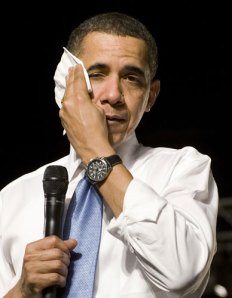
Flop sweat
President Obama has enjoyed largely positive media coverage since 2004, when he gave his first nationally televised speech at the Democratic National Convention in Boston. But since his very public humiliation at the hands of Republicans in the debt ceiling fight, the tide has suddenly turned. I think we may have finally reached a real tipping point.
Just one week ago, Dakinikat wrote a post about the Villagers finally beginning to express buyer’s remorse after Obama’s recent display of weakness and cluelessness. This week, the President has again been hammered in the national and international media, and yet he and his handlers still don’t get it, as Dakinikat’s post from late last night demonstrated.
According to the shocking New York Times article Dakinikat quoted in her post last night, Obama and his top advisers have, in a cold and calculating way, determined that advocating for policies that would create jobs would not be conducive to Mr. Obama’s reelection. Even the ideas they hesitate to push are weak and unoriginal–and as Dak pointed out, would have little to no impact on unemployment or the economy anyway. According to the NYT,
Mr. Obama plans to spend time this weekend considering his options, advisers said. The White House expects to unveil new job-creation proposals in early September.
The ailing economy, barely growing at the same pace as the population, has swept all other political issues to the sidelines. Twenty-five million Americans could not find full-time jobs last month. Millions of families cannot afford to live in their homes. And the contentious debate over raising the federal debt ceiling — which Mr. Obama achieved only after striking a compromise with Republicans that included a plan for at least $2.1 trillion in spending cuts over 10 years — has further shaken economic confidence….
So far, most signs point to a continuation of the nonconfrontational approach — better to do something than nothing — that has defined this administration. Mr. Obama and his aides are skeptical that voters will reward bold proposals if those ideas do not pass Congress. It is their judgment that moderate voters want tangible results rather than speeches.
Perhaps so, but so far we have gotten nothing but speeches–and repeated capitulations–from Mr. Obama. More:
Mr. Plouffe and Mr. Daley share the view that a focus on deficit reduction is an economic and political imperative, according to people who have spoken with them. Voters believe that paying down the debt will help the economy, and the White House agrees, although it wants to avoid cutting too much spending while the economy remains weak.
As part of this appeal to centrist voters, the president intends to continue his push for a so-called grand bargain on deficit reduction — a deal with Republicans to make even larger spending cuts, including to the social safety net, in exchange for some revenue increases — despite the strong opposition of Congressional Democrats who want to use the issue to draw contrasts with Republicans.
Have Plouffe and Daley paid any attention to the media reactions to their boss in the past week? I want to share some of my favorite recent critiques of Obama. Admittedly some of them come from right wing sources, but I detect a distinct change in the wingers’ reactions to Obama too. Instead of claiming he’s a socialist, they are mocking him for being incompetent and ineffectual.
It’s too damned late on so many fronts …
Posted: August 13, 2011 Filed under: 2012 presidential campaign | Tags: stupid White House policy advisor tricks 29 Comments I really try not to do late, wonky economic posts on any night, let alone a Saturday night. It’s probably because I’m deep in the midst of writing a monetary policy paper that I’m even remotely in the mode of doing stuff like this right now, but really, it seems like this discussion is coming late on all fronts. It’s late for the jobless. It’s late for the businesses who don’t have customers. It’s late for economists who can’t figure out why everything they’ve learned over the last 70 years is being suddenly ignored. I personally can’t believe the NYT is reporting that there’s a debate in the White House on the necessity of doing something other than seeking bipartisan surrender. Their internal polling must be worse than we think.
As the economy worsens, President Obama and his senior aides are considering whether to adopt a more combative approach on economic issues, seeking to highlight substantive differences with Republicans in Congress and on the campaign trail rather than continuing to pursue elusive compromises, advisers to the president say.
Mr. Obama’s senior adviser, David Plouffe, and his chief of staff, William M. Daley, want him to maintain a pragmatic strategy of appealing to independent voters by advocating ideas that can pass Congress, even if they may not have much economic impact. These include free trade agreements and improved patent protections for inventors.
But others, including Gene Sperling, Mr. Obama’s chief economic adviser, say public anger over the debt ceiling debate has weakened Republicans and created an opening for bigger ideas like tax incentives for businesses that hire more workers, according to Congressional Democrats who share that view. Democrats are also pushing the White House to help homeowners facing foreclosure.
I simply highlighted the ideas that are wrong, wrong, wrong and now we know where they are coming from. How much domestic economic boost can you get from free trade agreements, improved patent protections for inventors, and yet MORE tax incentives for businesses to hire more workers when they have very few customers? The answer is little to none. I’ll be generous and say a smidgin. If Daley, Plouffe or Sperling were economists we wouldn’t even be seeing these STUPID ideas.
Why on earth would any Democratic President want to compromise with the absolutely wrong voices in the GOP that are basically supporting economic policy that’s custom made to tank the US economy during his re-election cycle? These idiots have to believe the aforementioned crap. That’s the only excuse that I can come up with.
The boasts of Congressional Republicans about their cost-cutting victories are ringing hollow to some well-known economists, financial analysts and corporate leaders, including some Republicans, who are expressing increasing alarm over Washington’s new austerity and antitax orthodoxy.
Their critiques have grown sharper since last week, when President Obama signed his deficit reduction deal with Republicans and, a few days later, when Standard & Poor’s downgraded the credit rating of the United States.
But even before that, macroeconomists and private sector forecasters were warning that the direction in which the new House Republican majority had pushed the White House and Congress this year — for immediate spending cuts, no further stimulus measures and no tax increases, ever — was wrong for addressing the nation’s two main ills, a weak economy now and projections of unsustainably high federal debt in coming years.
Instead, these critics say, Washington should be focusing on stimulating the economy in the near term to induce people to spend money and create jobs, while settling on a long-term plan for spending cuts and tax increases to take effect only after the economy recovers.
The absolute lack of a knowledgeable voice on fiscal policy these days in policy circles that matter absolutely boggles my mind. We can argue the fine points of whether focused tax cuts or spending initiatives are required to jump start aggregate demand and create customers with jobs but really, that’s about the extent of the controversy between economists, financiers, and people that know what they’re doing.
“I think the U.S. has every chance of having a good year next year, but the politicians are doing their damnedest to prevent it from happening — the Republicans are — and the Democrats to my eternal bafflement have not stood their ground,” Ian C. Shepherdson, chief United States economist for High Frequency Economics, a research firm, said in an interview.
Yup, exactly so.
Journalistic standards and modern political norms place some restrictions on what a reporter can and will say in a news article. It’s what too often leads to unhelpful he-said-she-said reporting (“Eric Cantor today said two plus two equals five; Democrats and mathematicians disagreed”).
Yup, people can say bat-shit crazy, impossibly false things and it still gets reported as just some one’s opinion. Further more, FOX news will drag on at least five republican politicians that will insist that 2+2=5 and there’s a liberal media bias and that’s the only reason there could be any different answer. It’s enough to make a financial economist drink. Okay, I keep writing rants these days. I’m going to take a late bath with a late nightcap. Hopefully, you’re all in the middle of some sweet dreams.
Late Night Open Thread: Rick Parry …. “A New Hope”
Posted: August 13, 2011 Filed under: 2012 presidential campaign, Republican presidential politics, U.S. Politics | Tags: cheap cornography, Rich Perry, Rick Parry, Stephen Colbert, Super PACs 14 CommentsIt’s not a typo. Comedian Stephen Colbert wants America to vote for Rick Parry – that’s right, Parry with an “A.”
In the first released ad by his “super” political action committee, Colbert urged Iowa voters to write in “Rick Parry” at the Ames straw poll on Saturday, suggesting in a satiric nod that he’s throwing his weight behind Republican Gov. Rick Perry of Texas for president.
“I called dibs on Rick Parry a long time ago,” said Colbert, who dubs himself president and assistant equipment manager for his PAC, in a statement Wednesday.
The ad, “Episode IV: A New Hope,” is a play on the Supreme Court’s 2010 Citizens United ruling, which allows super PACs to receive and spend unlimited amounts of money, as long as they don’t coordinate with a particular candidate.
“So to prove we’re truly uncoordinated, we’re asking voters to write in Parry with an A – as in America, IowA, or PresidAnt,” Colbert said. “You can feel confident he’s not asking us to do that.”
Politico doesn’t see the humor in Colbert’s “antics.”
…the real issues with the voting might come from counting write-ins, which are being allowed for the first time this year.
Comedy Central star Stephen Colbert is openly trying to cause trouble, running television ads urging Iowans, “On August 13th write in Rick Parry — That’s Parry with an ‘A’ for America, with an ‘A’ for IowA.”
Jeff Winkler at the right wing Daily Caller blog is also *concerned.*
In two separate ads running since Thursday, the comedian urged straw poll voters to write in the fencing-inspired surname. Funny as the joke is, it could cause serious issues for Iowa officials as they count the ballots Saturday evening.
“We’re treating the straw poll as if it were any other election,” said Erin Rapp, Communications Director for the Iowa Secretary of State, the department overseeing straw poll write-in votes. “Basically, it’s up to the individual canvasser to determine the voter’s intent. You know, there could be variations of spelling in terms of name, but it’s really up to the official.”
You can watch the Colbert Super PAC’s other ad, which features “cheap cornography,” at Mother Jones.

 peej
peej Carissa
 bostonboomer
 dakinikat
 ecocatwoman
 mablue2
 Mama Lopez
 peggysue22
 quixote
 skydancingguestblogger
 Mona (aka Wonk the Vote)



 Sky Dancing
Recent Comments