
Corporate Money, Corporate Press, Corporate Congress
Posted: December 29, 2010 Filed under: Barack Obama, Corporate Crime, Democratic Politics, Main Stream Media, president teleprompter jesus, Team Obama, the villagers, U.S. Economy, U.S. Politics, Voter Ignorance, We are so F'd, Wikileaks, Women's Rights | Tags: Citizen's United, Congressman John Hall, corporate congress, corporate interests, corporate press, Facism 40 CommentsSome astute and somewhat outrageous comments by outgoing Congressman John Hall in The New York Observer  should cause pause and some good discussions. That is, if any one pays attention to them.
Speaking about the Citizen’s United decision, which allowed unregulated flow of cash into campaign coffers, Hall said, “I learned when I was in social studies class in school that corporate ownership or corporate control of government is called Fascism. So that’s really the question— is that the destination if this court decision goes unchecked?”
That’s the astute part. The outrageous part is “the flow of corporate dollars is why he and the Democrats lost control of Congress”. Well, imho, there’s some yes and no in that. Here’s a CNN corporate sponsored poll that may shine some light on that.
President Barack Obama enters the new year with a growing number of Americans pessimistic about his policies and a growing number rooting for him to fail, according to a new national poll.
But a CNN/Opinion Research Corporation survey released Wednesday also indicates that while a majority of the public says Republican control of the House of Representatives is good for the country, only one in four say the GOP will do a better job running things than the Democrats did when they controlled the chamber.
Sixty-one percent of people questioned in the poll say they hope the president’s policies will succeed.
“That’s a fairly robust number but it’s down 10 points since last December,” says CNN Polling Director Keating Holland. “Twelve months ago a majority of the public said that they thought Obama’s policies would succeed; now that number has dropped to 44 percent, with a plurality predicting that his policies will likely fail.”
There’s a large number of people out there that seem to see no real difference between the Republicans, INC. and Democrats Inc. in terms of outcomes. They hope the explicitly stated goals of Obama policy succeed. They doubt the laws passed support those goals. They believe they will fail. I think people see the disconnect between the rhetoric and the product delivered now. I honestly don’t believe that voters put the Republicans in charge of the house because they love Republican policy, if these polls mean anything. That poll and many others show voters support the outcomes of authentically Democratic policy. I believe this election was more a play for gridlock simply because they don’t see what’s been passed as achieving the ends of what they want. They believe it will fail.
How many people really want the kinds of things pushed by John Bohener who–as an example–just met with culture thug Randall Terry and other monsters of the Republican base after their mid-November victory lap? There’s only so far you can get by pushing a repeal to DADT on the basis of gays and straights showering together. This is especially true when the vast majority of people support repeal. Remember Terry Schiavo? Played well with the base but horrified the country? What would happen if we saw more reporting of this kind of thing on CNN? I bet you never saw that before I pointed it out to you via Salon.
Let’s get back to Hall’s comments.
The extra money floating around, he said, compounded the Democrats’ weaknesses on the economy, unemployment and the mortgage crisis. And he said that for of the accomplishments of the lame duck Congress, their failure to pass the Disclose Act—which would have at least forced corporations to reveal who they were donating to—stood out a as a black mark on the session.
“We are talking about supposedly wholesome names like Revere America, American Crossroads, Americans for Apple Pie and Motherhood—if somebody hasn’t trademarked that one I probably should. The fact is you can call it anything and the money could be coming from BP or Aramco or any corporation domestic or foreign,” Congressman Hall said.
Well, that’s a good point. I’m still pushing for congress critterz to be forced to wear NASCR-like jackets listing their top corporate contributors as long as they’re in office. That would include the ones hiding behind their advocacy ad creating subsidiaries okayed by SCOTUS, INC. I’m still not certain that the extra money floating around was the reason for The Big Shellac. I’m still guessing that every one was hoping to stop the Washington DC Pork Train and laws so long and complex that no one can really figure out what they really do. These are the laws that people think will fail them. If anything, we should see a slow down of that process. I think the American people want to slow the process down so they can figure out if it’s good or bad for them and if it will achieve what they support.
BUT, The Big Shellac came at the high cost of forwarding Republican laws and agendas that please the Republican Bircher Base. Plus, there’s more possible SCOTUS fights and appointments that only please the Bircher and Religionist Base. Hence, the nice get together with Randall Terry whom Salon described as:
Randall Terry is a psychopath, an antiabortion zealot who endorses domestic terror and compares coldblooded murderers to heroic abolitionists. He’s also a ridiculous character whose true calling is self-promotion, by any means necessary.
He long ago went from prominent figure in the raging abortion debate to desperate self-parody. He renounced his gay son, left his wife for a campaign volunteer, and sought a reality television show. If it weren’t for YouTube, no one would’ve even noticed his inflammatory statements about the murder of Dr. George Tiller. In short, Randall Terry’s not only an extremist nutcase, he’s also old news.
But now that the Republicans are back, this faded celebrity is mounting a comeback. Terry’s most recent e-mail blast featured a photo of the radical Catholic cleric sitting down with incoming Speaker John Boehner himself. “With Boehner’s chief of staff, after the election,” the caption read. (Terry also presented the incoming speaker with a fetus doll resting on some sort of “decree.”)
A Speaker of the House Boehner does not return to Congress to any degree of sanity. I won’t even go in to the incredible problems some one must have to cry that much and drink that hard. A Republican congress just increases the show factor, imho. It also brings us back to the idea that we not only need to get corporate money out of politics,we need it out of the press. The CNN indicates that the President is likable enough, he’s just not focused on the right things. That’s where the money comes in. If congressional leaders and the White House continue to go back and forth between corporate and state interests and the only folks with real access are either groups that can deliver zealous voters and big bucks, we’re in trouble. We’re especially in trouble of the press continues on in its route of “sins of omission” that appear to play into the hands of their advertisers and the interests of government. The Village does not want to run off their advertisers and the few readers/viewers left standing.
This is the importance of Wikileaks and independent media organizations like Democracy Now. They produce things of Public Interest that are not censored, swayed, or bullied by corporate and state interests. As we’ve seen in one after another of the dribbles of diplomatic cables coming from European press, there appears to be a lot of melding of corporate and state interests. This is not good for any one but corporate and authoritarian state interests. European press is filtering the leaked diplomatic cables right now. The majority of them remain out of the public domain. The European papers are less corporate than their U.S. counterparts which is better. We may still not actually see all of the material. Press, government and corporate interests are way too cozy in this country. If you go back to what Congressman Hall said, it’s the classic definition of fascism.
update: I wanted to add the link above on the “classic definition of fascism” because I just read some posts from right wing sources linked to this article at Mememorandum that are obviously trying to rewrite history. I’ve linked to the writings of Mussolini. This is part of the definition of fascism as put forward by Mussolini. Socialism and Marxism are NOT fascism in Mussolini’s definition. The right frequently tries to shove them into the same package. It was a post war trick used to focus hate of Nazis/Facism over to our former allies, the Soviets. Mussolini wrote this in 1932 as part of his definition.
…Fascism [is] the complete opposite of…Marxian Socialism, the materialist conception of history of human civilization can be explained simply through the conflict of interests among the various social groups and by the change and development in the means and instruments of production…. Fascism, now and always, believes in holiness and in heroism; that is to say, in actions influenced by no economic motive, direct or indirect. And if the economic conception of history be denied, according to which theory men are no more than puppets, carried to and fro by the waves of chance, while the real directing forces are quite out of their control, it follows that the existence of an unchangeable and unchanging class-war is also denied – the natural progeny of the economic conception of history. And above all Fascism denies that class-war can be the preponderant force in the transformation of society.
I think if you go read it much of it sounds like the Republican manifesto.
“Given that the nineteenth century was the century of Socialism, of Liberalism, and of Democracy, it does not necessarily follow that the twentieth century must also be a century of Socialism, Liberalism and Democracy …”
Mussolini spit out the world socialism, liberalism, and democracy in the same way the Bircher wing of the Republican party spits those words out.
Religionists on Supreme Court Damage Rights of Women
Posted: December 28, 2010 Filed under: Reproductive Rights, SCOTUS, We are so F'd, Women's Rights | Tags: abortion rights, Nebraska, religious nuts, Ruth Bader Ginsberg, Samuel Alito 78 Comments It’s obvious the real legacy of Dubya Bush will be his assault on the fundamental secular nature of the United States through court appointments. Republicans–and their appointees–appease people with such extreme religious views that we will need to remain vigilant for some time. These people murder doctors in their churches and harass women at health clinics day-in-and-day-out. They’ve done these things obsessively and zealously for over 45 years.
I think I’ve told you that I was stalked, slandered, and made generally miserable by the omnipresent fascist elements of the anti-choice movement just under 20 years ago as a young mother and economist running for state legislature. The only group to not only oppose me–but go out of their way to ensure nothing truthful about me or my positions was put out there–were religionists.
It doesn’t surprise me that the continuing hotbed of theocratic insanity in the entire area continues to be Nebraska. This is a state whose hallmark of fame right now is its continual brain drain and DINO Senator Ben Nelson who blackmailed the entire country for his vote on health care. Another big mistake made by the state was to put term limits on all its unicameral members ensuring they have a perpetual revolving door of hit and run policies. No wonder people leave that state in droves. Your entire life is in the hands of religious fanatics and the amateurs they bring to office.
The right’s continual obsession with letting women die or suffer to bring nonviable pregnancies to term is nothing but torture-based public policy laced with the sanctimonious mythology of “Eve made us all deserve to die in childbirth” . Here’s the latest craziness from Nebraska that will undoubtedly be given attention by even crazier people like Justices Thomas, Alito, and Scalia; the Republican version of the Spanish Inquisition. No science or medical facts here folks, just religious dogma from the dark ages please!
Gonzales v. Carhart was the 2007 court decision that values religious dogma over science, medicine, reason, and facts. It’s set the perpetual Nebraska industry of manufacturing laws to test Roe v. Wade in action. Millions of tax dollars will now go into defending a distinctly warped view of medicine. This one is based in the absolute lie of ‘fetal pain’ in early term pregnancies set up by Justice Kennedy. Kennedy also basically wrote that women were too stupid to realize they might come out of an abortion traumatized. He’s just one more adherent of that 3rd century mythology that needs to go away.
A long line of Supreme Court precedents seemed to stand in his way. But Flood believes that a 2007 decision offers hope for him and other state legislators looking for ways to restrict abortion.
Using that decision as a road map, this spring Flood wrote and won passage of legislation that bans abortions after 20 weeks. Introducing into law the concept of “fetal pain,” it marked the first time that a state has outlawed the procedure so early in a pregnancy without an exception for the health of the woman.
The law shut down LeRoy Carhart, the provider who had planned to expand his practice outside Omaha and provide late-term abortions to women across the Midwest.
The importance of Flood’s bill is likely to be felt far beyond Nebraska. Abortion opponents call it model legislation for other states and say it could provide a direct challenge to Supreme Court precedents that restrict government’s ability to prohibit abortion before a fetus can survive outside the womb. (It also prompted Carhart to shift his practice east, and he has since opened a late-term practice in Germantown, outside Washington.)
Critics of abortion hail the law as the most prominent and promising outcome of the Supreme Court’s 2007 decision, in which, coincidentally, Carhart was the lead plaintiff.
The 5 to 4 decision in Gonzales v. Carhart turned away Carhart’s challenge to the federal ban on “partial birth” abortion and appeared to mark a significant change in the high court’s balancing of a woman’s right with the government’s interest.
The ruling was a key moment in the emerging identity of the court headed by Chief Justice John G. Roberts Jr., who marked his fifth anniversary on the court this fall.
‘Fetal Pain” has no more basis in reality than virgin births and immaculate conception, yet here it is, threatening the ability of a woman to self determination, privacy, and life. There is also no such thing as ‘partial birth’ abortion. The entire thing is a public relations sham with no basis in anything but the desire of a bunch of crazed religionists to inflict their personal religious dictum on every one else. Since they can’t convert us all, they’ll force the law to recognize their extreme views through reckless Republican court appointments.
Kennedy’s ruling in the case–and his very words–are a warning to people who don’t like the government involved in their most personal and private decisions. It inspired Ruth Bader Ginsberg–a life long champion of women’s rights–to write a response and dismantle Kennedy’s attempt to logically explain a ruling based not on law, precedent, or logic. Kennedy’s rambling diatribe was both intellectually and legally weak. Its main tenets were clearly based in his own rooted need to defend his own narrow patriarchal misogynistic religious view instead of examine evidence and prior rulings.
He noted that the Casey decision affirmed the right to abortion before viability. But he said it also established that “government has a legitimate and substantial interest in preserving and promoting fetal life.”
Kennedy’s ruling was shot through with references to government’s interest in protecting the unborn and in making sure women knew the consequences of their actions.
He drew the ire of Justice Ruth Bader Ginsburg and others when he discussed the regret a woman might feel about the decision to end her pregnancy.
“It is self-evident that a mother who comes to regret her choice to abort must struggle with grief more anguished and sorrow more profound” when she learns the details of the intact-dilation-and-extraction process, Kennedy wrote.
In a dissent, Ginsburg struck back at the insinuation that a woman has not fully thought through her decision, or should be protected from making such a choice. “This way of thinking reflects ancient notions of women’s place in the family and under the Constitution,” said Ginsburg, which “have long since been discredited.”
Ginsburg noted that, besides being the first court decision not to require a health exception, it as the first to uphold the ban on a specific procedure.
Leave it to Nebraska–a state with lots of land, buffalo and tumbleweed, and very few people that exists on federal funding and taxing people for gas as they drive through the state–to once again bring up an expensive test of our audacity to stand up to theocracy. This has been a tactic of theirs for decades. Nebraska no more represents the country than a penguin in ANWAR could. Nebraska is whiter than than the rest of the country and older than the rest of the country. It has only 22 people per square mile when the entire rest of the country averages 79. It represents a gone bye era in many ways but it still creates trouble despite its basic irrelevance to the country as anything more than a series of interstate stops. The state endlessly manufactures laws that impose a religious view on medical procedures that always require tax payer funding to fight it through courts. What I’m saying is Nebraska’s main export is test laws for Roe v. Wade. What a shameful legacy!
From little, irrelevant states like Nebraska,we get laws like those that force ‘biased consent’. That would be laws that force physicians to give state lectures rather than advice on medical procedures. But, this isn’t because of the state’s overwhelming concern for the health of pregnant women or fetuses or babies. Witness this little law that now plagues my ob/gyn doctor daughter doing residency in that hell realm right now. Many of her patients typically come in obese. She was telling me over the weekend that a BMI of 40 was not atypical. This puts a lot of her young patients into the automatic high risk/C-Sec category. Does any of this bother Nebraska? Hell, no!
Charities, hospitals and other nonprofit groups are scrambling to fill the void left by the state’s decision to end state Medicaid funding for prenatal services for low-income women, including many illegal immigrants.
In nearly two dozen interviews, Nebraska providers said that while they may be able to absorb the costs for women now pregnant, the long-term outlook for providing an estimated $10 million a year in health care services without reimbursement is bleak.
Hospitals are bracing to provide more “charity care” and expecting an increase in emergency-room visits from women who experience pregnancy complications due to the lack of prenatal care.
A couple of emergency fundraising events have been scheduled, and private donors and the United Way are being asked to dig deeper.
Clinics that focus on the poor and uninsured are shifting resources away from other areas, such as mental health and diabetes care, to cover the loss of funds for services that can head off expensive birth defects and premature births.
“We only have so many resources. If we start pouring more money into uninsured pregnant women, that will take away from what health care we can offer in other areas,” said Dr. Kristine McVea, medical director at the OneWorld Community Health Center in south Omaha.
The issue of whether hospitals, health clinics that focus on the uninsured and private physicians can shoulder the load for such low-income women without government help is now front-and-center in the controversy.
The debate intensified last week after a Schuyler, Neb., doctor said one of his patients opted to have an abortion because she couldn’t afford the cost of prenatal care on her own. At least seven other women in Omaha and Schuyler have told clinicians they plan to seek abortions.
Gov. Dave Heineman, who opposes government aid for illegal immigrants, has said he expects charities, church groups and others to pick up what the government cut off.
See that. They already caused at least ONE needless abortion. Of course, that law primarily impacts babies that infertile white couples don’t want to buy from the baby market, so the religionists are less concerned about that.
It’s about state control of women and children. It’s about the state making decisions that belong to individuals and doing so based on religious views alone. It’s about the improper role of religious belief in our country as written in The Constitution. Young women in this country better get a grip on what’s happening and pretty quickly. That’s because these same folks are after all forms of birth control and if they continue on with the same tenacity of lunacy, the pill will also be banned or hard to get. This is especially important because President Barrack Obama has left open many vacancies on courts and if he is a one term president, or a two term president with a senate that goes Republican, we can only look forward to more.
Tuesday Reads
Posted: December 28, 2010 Filed under: Global Financial Crisis, Gulf Oil Spill, investment banking, jobs, New Orleans, the blogosphere, The Bonus Class, The Great Recession, the villagers, U.S. Economy, U.S. Politics, We are so F'd, Wikileaks | Tags: AIG, Bradley Manning, cylical unemployment, Dispersant, Emeril, Gulf oil Gusher, Harry Shearer, Hoppin' John, Labor Unions, Levee failure during Hurricane Katrina, Levees.org, Nancy Pelosi, structural unemployment, The Big Uneasy, The New Orleans Saints, Those Crazy Pauls!!, Wikileaks, Wired won't release documents 29 CommentsGood Morning!
I had a productive day yesterday for a change and I hope you did too! Dare I go shop for plumbing stuff today? I was bemoaning a shortage of headlines on Sunday. I should be a bit more careful about wishing for things because today’s list of reads will be long.
The other good news for me is that we’re going from hard freeze warnings to weather in the 70s this weekend. It sounds like it’s going to be a fun New Year’s Eve here in New Orleans! That should explain the picture! I also wanted to give you a bit of New Orleans News before I moved on to other things.
First, if you haven’t had a chance to read Sandy Rosenthal’s piece at HuffPo on the failure of the Levees during Hurricane Katrina, please do so. There are still folks out there that think our devastation was from Hurricane Katrina and that just isn’t so. I was on the edge of the bowl. I know. My house experienced very little actual damage because my house was on high ground and above the waters. A failure of engineering devastated my city. It was not an act of nature. I signed the petition. Will you?
Last week, I wrote to the New York Times asking them to please resist using fast and easy “Katrina shorthand.” Forty-eight hours passed and we heard no response, so we decided to let our supporters step in. We urged our followers to sign our petition to the NY Times urging the paper to be more specific when referencing the flood disaster.
Over 1,000 people all across the nation signed our petition in under 48 hours. This immediate huge response – during the holiday no less – will hopefully show the New York Times that informed citizens understand that “Katrina” did not flood New Orleans. Civil engineering mistakes did.
Saying Katrina flooded the city protects the human beings responsible for the levee/floodwall failures. It is also dangerous since 55% of the American people lives in counties protected by levees.
If you haven’t yet, please sign our petition. We will keep it live until Jan 4, 2011.
In a similar vein, I would like to shout out HAPPY BIRTHDAY HARRY!!! to fellow New Orleans Blogger, neighbor, actor, musician, and polymath Harry Shearer (12/23/49) who made his film debut in the great epic ‘Abbott and Costello Go To Mars’ in 1953. There’s another New Orleans connection in that movie. The Abbot and Costello characters–Lester and Orville–accidentally launch a rocket that should’ve been Mars bound. They land in New Orleans for Mardi Gras instead. Harry plays an uncredited “Boy”.
I also want to offer up a plug for Shearer’s wonderful documentary on the Levee Failure called ‘The Big Uneasy’ that was released last August on our 5th Katrina Anniversary. It’s going to be re-released in 2011. I’m including an interview with him by local radio show host Kat (not me). You’ll learn that the Golden Globes are a simple piece of business and that Harry’s songstress wife is spoonable. Who knew? Also there seems that there’s a chance his documentary will be shown on PBS so you may get to see it there. I wonder if we can help encourage that situation.
I’d like to take another chance to remind you that we’re still living with the results of the BP Oil Gusher here on the Gulf Coast. There also appears to be covered-up as well as forgotten stories down here. You may want to take a look at this from Open Channel on MSNBC.com: ‘ Is dispersant still being used in the Gulf?” This story reports on pictures and samples take in early August that are being investigated now. I’d written about some of these reports earlier.
Kaltofen is among the scientists retained by New Orleans attorney Stuart Smith to conduct independent environmental testing data from the Gulf on behalf of clients who are seeking damages from BP. (Click here to read about their effort.)
An independent marine chemist who reviewed the data said that their conclusion stands up.
“The analytical techniques are correct and well accepted,” said Ted Van Vleet, a professor at the College of Marine Science at the University of South Florida. “Based on their data, it does appear that dispersant is present.”
Why responders would continue to use chemical dispersants after the government announced a halt is a mystery. If the oil was gone or already dispersed, as the federal government and BP have said, what would be the point? And, because dispersants don’t work very well on oil that has been “weathered” by the elements over long periods of times, there would be little point in spraying it that situation.
I wanted to share a New Orleans and indeed a Southern New Year’s eve tradition. We serve a concoction of black eyed peas, cabbage and sausage/ham called ‘Hoppin’ John’ to bring us luck and wealth in the New Year. I evidently didn’t make enough of it last year, so I’m planning to cook more this year. The pea’s black eyes represent coins, the cabbage represents cash, and the sausage or ham is meat that always symbolizes luxury to hungry, poor people.
Here’s Emeril’s ‘Hoppin’ John’ recipe provided courtesy the Food Network:
Hoppin’ John
Prep Time: 15 min Cook Time:50 min Serves: 10
Ingredients
1 tablespoon olive oil
1 large ham hock
1 cup onion, chopped
1/2 cup celery, chopped
1/2 cup green pepper, chopped
1 tablespoon chopped garlic
1 pound black-eyed peas, soaked overnight and rinsed
1 quart chicken stock
Bay leaf
1 teaspoon dry thyme leaves
Salt, black pepper, and cayenne
3 tablespoons finely chopped green onion
3 cups steamed white rice
Directions
Heat oil in a large soup pot, add the ham hock and sear on all sides for 4 minutes. Add the onion, celery, green pepper, and garlic, cook for 4 minutes. Add the black-eyed peas, stock, bay leaves, thyme, and seasonings. Bring to a boil, reduce the heat and simmer for 40 minutes, or until the peas are creamy and tender, stir occasionally. If the liquid evaporates, add more water or stock. Adjust seasonings, and garnish with green onions. Serve over rice.
Okay, so enough about my home town.
The AFL-CIO wants to talk unions this holiday season because there is so much misinformation about these days. It’s a nice list of myths and facts that you may want to arm yourself with when talking to those right wing nattering nabobs of negativism.
MYTH: Unions only care about their members.
FACT: Unions are fighting to improve the lives of all workers.
- It’s easy to forget that we have unions to thank for a lot of things we take for granted today in today’s workplaces: the minimum wage, the eight-hour work day, child labor laws, health and safety standards, and even the weekend.
- Today, unions across the country are on the frontlines advocating for basic workplace reforms like increases in the minimum wage, and pushing lawmakers to require paid sick leave.
- Studies show that a large union presence in an industry or region can raise wages even for non-union workers. That means more consumer spending, and a stronger economy for us all.
- So it’s no wonder that most Americans (61 percent) believe that “labor unions are necessary to protect the working person,” according to Pew’s most recent values survey.
Here’s a gift that keeps on giving er… taking from FT: “AIG secures $4.3bn in credit lines“.
AIG, took a step closer to independence from government as it said it had secured $4.3bn in credit facilities.
The US insurer bailed out by Washington during the financial crisis is is in the process of repaying the $95bn the US Treasury and the Federal Reserve Bank of New York lent following its disastrous decision to insure billions of dollars worth of securities backed by mortgages.Under the facilities arranged by 36 banks and administered by JPMorgan Chase, AIG can borrow $1.5bn over three years and an additional $1.5bn over 364 days, according to a regulatory filing. Separately, Chartis, an AIG division, obtained a $1.3bn credit line.
Let’s just hope they clean up their act this time. I’m not holding my breath or any stock offers that may come up. Notice one of the usual suspects is ‘facilitating’ the arrangements. Cue ‘The Godfather’ music, please.
There’s an item from Slate that you may want to check out. It’s “A selection of gaffes from the 2010 campaign we should forgive”. Here’s one from Pelosi that gave me a chuckle.
Nancy Pelosi: “We have to pass the bill so that you can find out what is in it.”
On March 9, the Speaker of the House spoke to the National Association of Counties about the health care bill that was days away from final passage. This was the phrase that launched a thousand campaign ads. Nine months later, this is remembered as Pelosi admitting what Tea Partiers had feared: that Democrats were ramming through bad bills without reading them.
BostonBoomer sent me to Glenn Greenwald’s latest which really is a must read: ‘ The worsening journalistic disgrace at Wired’. Greenwald’s work on behalf of massacre leaker Bradley Manning is Nobel Peace Prize worthy. I don’t mean aspirational prizes either.
For more than six months, Wired‘s Senior Editor Kevin Poulsen has possessed — but refuses to publish — the key evidence in one of the year’s most significant political stories: the arrest of U.S. Army PFC Bradley Manning for allegedly acting as WikiLeaks’ source. In late May, Adrian Lamo — at the same time he was working with the FBI as a government informant against Manning — gave Poulsen what he purported to be the full chat logs between Manning and Lamo in which the Army Private allegedly confessed to having been the source for the various cables, documents and video that WikiLeaks released throughout this year. In interviews with me in June, both Poulsen and Lamo confirmed that Lamo placed no substantive restrictions on Poulsen with regard to the chat logs: Wired was and remains free to publish the logs in their entirety.
We’re waiting for a response from Wired since vacation seem to preempt media responsibility these days. Will we find out that there’s been some active media suppression of the truth regard Manning’s accusations today? This morning, Greenwald continued his admonition to fellow journalists in the excellent article “The merger of journalists and government officials”.
From the start of the WikiLeaks controversy, the most striking aspect for me has been that the ones who are leading the crusade against the transparency brought about by WikiLeaks — the ones most enraged about the leaks and the subversion of government secrecy — have been . . . America’s intrepid Watchdog journalists. What illustrates how warped our political and media culture is as potently as that? It just never seems to dawn on them — even when you explain it — that the transparency and undermining of the secrecy regime against which they are angrily railing is supposed to be . . . what they do.
There’s another economics story covered on The New Yorker‘s The Financial Page headlined: ‘The Jobs Crisis’ by James Surowiecki. It’s a good explanation of a debate between economists and politicians right now. Guess which one knows best on this?
Why have new jobs been so hard to come by? One view blames cyclical economic factors: at times when everyone is cautious about spending, companies are slow to expand capacity and take on more workers. But another, more skeptical account has emerged, which argues that a big part of the problem is a mismatch between the jobs that are available and the skills that people have. According to this view, many of the jobs that existed before the recession (in home building, for example) are gone for good, and the people who held those jobs don’t have the skills needed to work in other fields. A big chunk of current unemployment, the argument goes, is therefore structural, not cyclical: resurgent demand won’t make it go away.
Though this may sound like an academic argument, its consequences are all too real. If the problem is a lack of demand, policies that boost demand—fiscal stimulus, aggressive monetary policy—will help. But if unemployment is mainly structural there’s little we can do about it: we just need to wait for the market to sort things out, which is going to take a while.
The structural argument sounds plausible: it fits our sense that there’s a price to be paid for the excesses of the past decade; that the U.S. economy was profoundly out of whack before the recession hit; and that we need major changes in the kind of work people do. But there’s surprisingly little evidence for it. If the problems with the job market really were structural, you’d expect job losses to be heavily concentrated in a few industries, the ones that are disappearing as a result of the bursting of the bubble. And if there were industries that were having trouble finding enough qualified workers, you’d expect them to have lots of job vacancies, and to be paying their existing workers more and working them longer hours.
Here’s a fun read at New York Magazine about living large in a libertarian world.
No one exemplifies that streak more than Ron Paul—unless you count his son Rand. When Rand Paul strolled onstage in May 2010, the newly declared Republican nominee for Kentucky’s U.S. Senate seat, he entered to the strains of Rush, the boomer rock band famous for its allegiance to libertarianism and Ayn Rand. It was a dog whistle—a wink to free-marketers and classic-rock fans savvy enough to get the reference, but likely to sail over the heads of most Republicans. Paul’s campaign was full of such goodies. He name-dropped Austrian economist Friedrich Hayek’s seminal The Road to Serfdom. He cut a YouTube video denying that he was named after Ayn Rand but professing to have read all of her novels. He spoke in the stark black-and-white terms of libertarian purism. “Do we believe in the individual, or do we believe in the state?” he asked the crowd in Bowling Green, Kentucky, on Election Night.
It’s clear why he played coy. For all the talk about casting off government shackles, libertarianism is still considered the crazy uncle of American politics: loud and cocky and occasionally profound but always a bit unhinged. And Rand Paul’s dad is the craziest uncle of all. Ron Paul wants to “end the Fed,” as the title of his book proclaims, and return the country to the gold standard—stances that have made him a tea-party icon. Now, as incoming chairman of the subcommittee that oversees the Fed, he’ll have an even bigger platform. Paul Sr. says there’s not much daylight between him and his son. “I can’t think of anything we grossly disagree on,” he says.
Well, they must have both been impacted by the same disease or environmental catastrophe to share so many views so out of the mainstream and be so far removed from experience, data, and science. I can’t help but believe the more the media shines a bright light on them, the more the warts and the brain damage will become noticeable.
So, one more suggested read comes via Lambert and Corrente. It’s really interesting piece from The Atlantic on ‘The Hazards of Nerd Supremacy: The Case of WikiLeaks’. It talks about Hackers, Assange, and the Hacker code of conduct. Any one who as read Assange’s manifest can see the connect and disconnect that simultaneously occur in the ideas. BB and had discussed that Assange might have a form of Aspergers disease about a month ago and I was also interested to see that Lambert, Valhalla, and some others had similar thoughts. It frequently runs in brilliant people who can decode a lot of things with the exception of other people. Anyway, here’s a taste of Jaron Lanier.
The strategy of Wikileaks, as explained in an essay by Julian Assange, is to make the world transparent, so that closed organizations are disabled, and open ones aren’t hurt. But he’s wrong. Actually, a free flow of digital information enables two diametrically opposed patterns: low-commitment anarchy on the one hand and absolute secrecy married to total ambition on the other.
While many individuals in Wikileaks would probably protest that they don’t personally advocate radical ideas about transparency for everybody but hackers, architecture can force all our hands. This is exactly what happens in current online culture. Either everything is utterly out in the open, like a music file copied a thousand times or a light weight hagiography on Facebook, or it is perfectly protected, like the commercially valuable dossiers on each of us held by Facebook or the files saved for blackmail by Wikileaks.
The Wikileaks method punishes a nation — or any human undertaking — that falls short of absolute, total transparency, which is all human undertakings, but perversely rewards an absolute lack of transparency. Thus an iron-shut government doesn’t have leaks to the site, but a mostly-open government does.
I’m still fascinated by the sideshow that is driving ad hominem attacks on Assange and the women involved with the charges. Still, that does not cloud my appreciation of what’s being released by Wikileaks. We’ll definitely have more coming. I’m personally waiting for the BOA stuff as that’s the stuff that I can personally decode. I’m glad we’re extending the Front Page Team to include more and more people that can tackle some of the other technical stuff from their vantage points. Stay tuned for more on all of this.
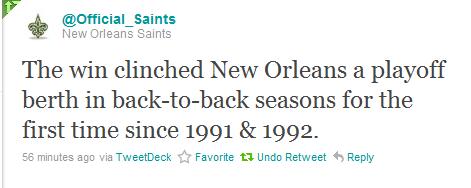
Just ONE MORE NAWLINS THANG: New Orleans Saints 17 – Atlanta Falcons 14. My home town continues to be the Great American Comeback Story.
So, what’s on your reading and blogging list today?
A little Economics this and that …
Posted: December 27, 2010 Filed under: Catfood Commission, Civil Liberties, Civil Rights, The Media SUCKS, U.S. Economy, U.S. Politics, Voter Ignorance, We are so F'd, WE TOLD THEM SO | Tags: AFL-CIO, Chris Hedges, commodity prices, Paul Krugman, wealth gap 44 CommentsI thought I’d post a little end of the year economics stuff just in case you need a nap!!

A nifty chart to show we are SO f'd!!!
I’ve been writing for around a year about a possible bubble in commodity prices but a definite increases in base commodity prices coming shortly. Now, this doesn’t necessarily mean it will involve an increase in over all inflation because these price increases are mostly in the already volatile areas of food and energy which are considered outside the ‘core’ inflation measures because they tend to bump and shuffle a lot. This is from Paul Krugman in his column: “The Finite World”.
Oil is back above $90 a barrel. Copper and cotton have hit record highs. Wheat and corn prices are way up. Over all, world commodity prices have risen by a quarter in the past six months.
Is it speculation run amok? Is it the result of excessive money creation, a harbinger of runaway inflation just around the corner? No and no.
What the commodity markets are telling us is that we’re living in a finite world, in which the rapid growth of emerging economies is placing pressure on limited supplies of raw materials, pushing up their prices. And America is, for the most part, just a bystander in this story.
Krugman goes on to explain how booms in the economies of developing nations is causing increased Demand for certain commodities. This simply means the price will go up when the supply is limited for some reason or another. Some times the supply is slow to increase because of production considerations or inventory considerations. Other times the supply is limited just because there is a finite amount of it on the planet. Some of this may also be due to the market taking in the impact of those just passed subsidies to corn-based ethanol which take farm land out of food/other crop production and funneling it to corn production, This decreases the supply of wheat, soybeans, and cotton too.
And those supplies aren’t keeping pace. Conventional oil production has been flat for four years; in that sense, at least, peak oil has arrived. True, alternative sources, like oil from Canada’s tar sands, have continued to grow. But these alternative sources come at relatively high cost, both monetary and environmental.
Also, over the past year, extreme weather — especially severe heat and drought in some important agricultural regions — played an important role in driving up food prices. And, yes, there’s every reason to believe that climate change is making such weather episodes more common.
Krugman concludes with the important question of what does this mean for us?
So what are the implications of the recent rise in commodity prices? It is, as I said, a sign that we’re living in a finite world, one in which resource constraints are becoming increasingly binding. This won’t bring an end to economic growth, let alone a descent into Mad Max-style collapse. It will require that we gradually change the way we live, adapting our economy and our lifestyles to the reality of more expensive resources.
But that’s for the future. Right now, rising commodity prices are basically the result of global recovery. They have no bearing, one way or another, on U.S. monetary policy. For this is a global story; at a fundamental level, it’s not about us.
Yes. The world economy is “not about us” any more. So many other countries now have huge viable economies that we are no long the center of the Supply and Demand world like we were post World War 2. This is definitely going to take some adjusting on our part and some ignoring of the rhetoric of the right on our country’s role in the world. We can not continue to maintain the idea of American Exceptionalism in its current form given that we are really no longer exceptional in many, many ways. That adaptive behavior does not diminish our historical role as the original provider of Democracy-based Constitutions and Civil Liberties or our military role in freeing many countries from monarchy and fascism in both world wars.
We can continue to pour our resources and the lives of our young into asserting ourselves as the global military police in attempt to maintain our delusion of being ‘special’, or we can put our resources into assuring ourselves and our children a comfortable niche in the world with a respected voice at a big table. The Right Wing has to understand that we don’t own the table anymore. If only our politicians would grow up enough to make the best choice for us instead of deluding us into thinking that we’ll ever see post World War 2 America again.
I want to couple this with something I got in a tweet from the AFL-CIO: ‘U.S. Workers Earned Less in 2009 Than in 2008’. This goes along with the fact that many things we could finance or buy twenty to thirty years ago will elude us today.
New data show America’s workers earned less in 2009 than in 2008, according to the Bureau of Labor Statistics. Compensation was down by 3.2 percent in 2009 with declines in construction and manufacturing fueling the plunge. St. Louis County, the hardest hit, saw a decline of 11.5 percent.
For those lucky enough to have a job, average pay increased by 1.2 percent. But overall income inequality is now at its worst since 1928. As the chart by the Economic Policy Institute (EPI) shows here, between 1979 and 2005, households at the bottom fifth of the income scale have seen an average, inflation-adjusted income growth of just $200. The $200 figure does not represent an average annual increase in income, but rather an increase of $200 over the entire 26-year period. By contrast, a small number of households at the top 0.1% of the income scale saw average income growth of almost $6 million over that same period.
In addition, the “wealth gap,” which differs from the income gap because it measures total net worth, is now 225 times greater between the richest 1 percent and the median family net worth.
Lest we forget, corporations are sitting on $1.93 trillion as of Sept. 30—up from $1.8 trillion at the end of June–and not using some of that money pot to create jobs.
The bottom is falling out for the middle classes in this country. Income inequality is as bad as it was in 1928 during the peak of the Robber Baron age. There is no way we’ll have a shot at seeing ‘morning again in America’–even one concocted from a senile man’s political rhetoric–without a strong middle class. This is one of the reasons that I highly recommend your holiday reading included Chris Hedges ‘Death of the Liberal Class’. Here’s Sanctuary TV’s you tube on his explanation the “genesis of the book”. Wonk mentioned some of his thesis in her excellent post yesterday.
The ‘lies of omission’ that we see in the Main Stream Media today makes this imperative that we have conversations outside of channels that are controlled by for-profit corporations. Listen in to the video at around 2:45.
Most of the images that are disseminated around our culture are skillfully put together and are disseminated by for profit corporations so that we are made to …or we confuse … how we are made to feel with knowledge. Which is precisely how ended up with Barrack Obama.
This is especially true with things economic. I had a conversation with my Republican Dad yesterday which ended up with him accusing me of sounding just like the Democrats after the Great Depression. (I will wear that badge proudly, thank you.) I was trying to explain to him how Social Security isn’t going bankrupt, that the overages are invested in T-bonds and T-bills and that isn’t the same as massive borrowing from the fund by the federal government, and that if social security can’t rely on the interest and their capital invested in T-bonds or T-bills in the future, we will undoubtedly have a much greater problem than having smaller social security checks. (My guess is that we would be in the middle of a government collapse similar to what happened to the USSR in the 1980s.) Dad kept accusing me of living in the theoretical world of economics–me, an empirical economist–when I kept telling him it was just a matter of debits and credits which are anything but theoretical economics.
The deal is this if you read studies, and follow the debits and the credits. The threat to social security isn’t coming from its cash flows. It’s coming from the politicians in Washington, D.C. and it appears that it will shortly be led by the aforementioned Barrack Obama. Some of these people seem intent on collapsing our Republic and its democratic roots. These Bircher-like attacks on the New Deal are real attacks on the ways the government–through New Deal Policies, Laws, and Agenciess- levels the economic playing field for small businesses and working class people. This is the same way that Bircher-like attacks on Civil Rights attacks the ways the government levels the legal playing field for minorities and women.
Again, I’m drawn to the quote most attributed to the late great Senator Patrick Monihan. People and politicians are entitled to their opinions but not the facts. The problem is that fact manufacturing–or labeling political diatribes by media monsters like Glenn Beck–appears to be rampant in the very outlet that provides the life blood of our democracy.
This maldescriptions of unemployment, the role and purpose and very political independence of the Fed are more features of this misinformation campaign. I’m going to further reference Paul Krugman and his economist yogini–yup, there’s at least two of us out there–wife Robin Wells here. They co-authored an excellent essay on “Where do We Go from Here” in The New York Review of Books. This part comes after their joint call to the Democratic congress critterz–left standing from the midterms elections–to fight.
First, it would mean fighting on economic issues. While it is extremely unlikely that Democrats can undertake any further fiscal stimulus, they can put Republicans on the spot, resisting calls for austerity and making the case, repeatedly, that the GOP is standing in the way of necessary action. The fight over renewal of unemployment benefits should be only the start. Democrats can also denounce Republican attacks on the Federal Reserve and defend the Fed’s independence. They can resist attempts to turn back health care reform, on both humanitarian and long-term budgeting grounds, as health care reform is the critical factor in reining in the long-term budget deficit.
Health Care Reform Inc. could be one more rung on the ladder for the middle class on the ladder back to upwards mobility. Instead of repealing the now unpopular bill, we should be working actively to get the right things into its corporate enabling shell. That would be–at minimum–a Public Option. We have to get them to fight on Economic issues. Also, we desperately need to deal with Fannie and Freddie. These organizations used to be the way to home ownership for working class Americans. I stand proudly as an example in that regard. My little kathouse in the bayou in the middle of a solid urban hood shines as a beacon of what those things were supposed to do before they started manufacturing loans to the derivatives market.
And there are steps that the White House could take without congressional approval. Democrats could pressure the administration to fix the inexcusable mess at the HAMP (mortgage modification) program—a program whose Kafkaesque complexity has in many cases made matters so bad for home owners that it has triggered the foreclosures it was supposed to avoid. In addition, mortgage relief would benefit the wider economy. Furthermore, the scope of mortgage relief could be made much wider if Fannie Mae and Freddie Mac were used to guarantee mortgage refinancing. Other proposals go even further: for example, that Fannie and Freddie engineer reductions in mortgage principals. All of this could be done, conceivably, by executive order.
What we are seeing is a brick by brick removal in the walls that support the social net built during the New Deal that helped America become the thing it was during the 1950, 1960s and 1970s. Yes, we helped many countries get rid of Nazis and Fascist and this did make us some what exceptional at the time, but ushering in the very policies and attitudes of fascism does not make us the least bit exceptional now. It weakens the very people that make for a vibrant Democracy. Also, given that the Wikileaks information has been the soul source recently of unmanufactured news and opinion passed off as fact, it also gives us a glance at why the rest of the planet has ceased to see the US as exceptional too.
To paraphrase the words of Common Dreams and Margaret Flowers: We Must Resist. Okay, so this essay was a little Political Economy and not just economics. You awake?
update:
I get to update this post with a link to one of the more influential ‘liberal’ economist who is also writing on the changes in the Political Economy at Project Syndicate. Here’s something from Jeffrey D. Sachs writing on ‘America’s Political Class Struggle’. You may recall that both Krugman and Sachs were called to the Obama woodshed a few weeks ago and told to get on board with the McConnell-Obama tax cuts.
America is on a collision course with itself. This month’s deal between President Barack Obama and the Republicans in Congress to extend the tax cuts initiated a decade ago by President George W. Bush is being hailed as the start of a new bipartisan consensus. I believe, instead, that it is a false truce in what will become a pitched battle for the soul of American politics.
As in many countries, conflicts over public morality and national strategy come down to questions of money. In the United States, this is truer than ever. The US is running an annual budget deficit of around $1 trillion, which may widen further as a result of the new tax agreement. This level of annual borrowing is far too high for comfort. It must be cut, but how?
The problem is America’s corrupted politics and loss of civic morality. One political party, the Republicans, stands for little except tax cuts, which they place above any other goal. The Democrats have a bit wider set of interests, including support for health care, education, training, and infrastructure. But, like the Republicans, the Democrats, too, are keen to shower tax cuts on their major campaign contributors, predominantly rich Americans.
The result is a dangerous paradox. The US budget deficit is enormous and unsustainable. The poor are squeezed by cuts in social programs and a weak job market. One in eight Americans depends on Food Stamps to eat. Yet, despite these circumstances, one political party wants to gut tax revenues altogether, and the other is easily dragged along, against its better instincts, out of concern for keeping its rich contributors happy.
This tax-cutting frenzy comes, incredibly, after three decades of elite fiscal rule in the US that has favored the rich and powerful. Since Ronald Reagan became President in 1981, America’s budget system has been geared to supporting the accumulation of vast wealth at the top of the income distribution. Amazingly, the richest 1% of American households now has a higher net worth than the bottom 90%. The annual income of the richest 12,000 households is greater than that of the poorest 24 million households.
Please go read the rest of the article. I think this shows further evidence that Obama didn’t placate liberal economists.
The Congressional Cash Machine
Posted: December 26, 2010 Filed under: U.S. Politics, Voter Ignorance, We are so F'd | Tags: influence peddling, lobbying 8 Comments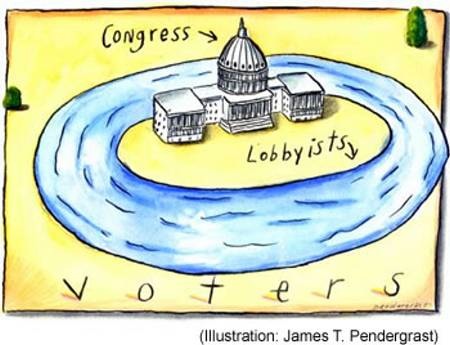 I’m just waiting for life to get back to the normal rat race and off the holiday frenetic rat race. I need to get some plumbing parts, a few store-related things, and a person from my bank to pick up the phone who isn’t distracted or gone. Commerce is dysfunctional this time of year and I just hate it. I found out the hard way that Friday was holiday of some sort and of course, Saturday and Sunday were complete wastes of time. I feel held hostage this time of year. Same thing seems to apply to useful items in newspapers and magazines around the country.
I did manage to find one thing at WAPO today that was snuck in between those perpetual what to do with left overs and presents you do want articles: ‘Lawmakers seek cash during key votes’. Well, isn’t that special? It seems while we were frantically hoping they’d repeal DADT, pass the Dream Act, and ratify START, the Reigndeers were playing Reigndeer games. I’m hoping the information in that article doesn’t get buried in the holiday waste paper.
Numerous times this year, members of Congress have held fundraisers and collected big checks while they are taking critical steps to write new laws, despite warnings that such actions could create ethics problems. The campaign donations often came from contributors with major stakes riding on the lawmakers’ actions.
For three weeks in June, for instance, the members of a joint House and Senate committee worked to draft final rules for regulating the financial industry in the wake of its 2008 meltdown. During that time, the 35 members of the drafting committee collected $440,000 in donations from that same industry, which was then lobbying heavily for looser rules.
What on earth can we do to stop this cash extraction/infusion process from the big special interest groups? Why aren’t people holding their congress critterz accountable for this kind of obvious black mail? This example was just appalling AND unsuprising.
Earlier this month, the chairman of the Senate committee overseeing tax policy, Sen. Max Baucus (D-Mont.), gave himself a birthday-party fundraiser – on the same day that the chamber took its first vote on an $858 billion tax package that would provide breaks to wealthy citizens and business interests.
They must know we’re stupid.
Here’s a real christmas gift from the Center for Responsive Politics: Lobbying Your True Love: Twelve Days of Gifts and Special Interests Access This Christmas. This will let you know who was on the nice list recently. (Hint: it wasn’t you or me.)
Between Jan. 1 and Sept. 30, there were 273 days. That means you should be able to retain the California Pear Growers Association, which reported $20,000 in lobbying expenditures during the first three quarters of 2010, for $73 a day.
To be true to the song, though, you’ll need the Pear Growers trade group every day for 12 days. And 12 days at $73 a day equals $879.
By that same logic, retaining DLA Piper’s services, which is playing a happy tune with $7.6 million in lobbying income this year, would cost $27,875 per day. Good thing they’ll only be need twice — on the eleventh and twelfth days, for a total cost of $55,751.
Your wallet might also take a hit trying to woo Goldman Sachs, which likes the ring of their $3.5 million investments in lobbying between January and September.
While the investment bank’s daily rate is less than half of DLA Piper’s, you’ll pay even more for their services since you’ll need them for eight days: $12,857 per day multiplied by 8 days equals $102,857.
Defense contractor Blackbird Technologies, named after the colly bird, and lobbying firm Drummer and Associates, meanwhile, will each run just $110 a day.
But Leap Wireless International, the parent company of Cricket, will cost ten times as much: $1,099 per day.
And the Dairy Farmers of American, the trade group for maids-a-milking, will cost twice that: $2,220 per day.
On the other hand, the American Alliance for Health, Physical Education, Recreation and Dance — a big fan of ladies dancing — is a steal at just $27 a day. Even for four days of services, you’re only out $110.
Other poultry-related interests — the National Chicken Council, an ardent supporter of French hens, and the United Egg Producers, who have a special place in their heart for geese-a-laying — will cost $586 per day and $165 per day, respectively.
This has got to stop some place. Look at this from the same WAPO link.
Over the course of three weeks in June, the 35 conference committee members collected $440,000 in donations from the financial industry. Sen. Charles E. Schumer (D-N.Y.), a member of the Senate banking committee and a powerful conferee, collected the most that month – about $90,000 from financial interests.
Executives of accounting giant Ernst & Young contributed the lion’s share of that amount for Schumer: $49,000 in all of June, including $2,000 from chief executive James Turley. Ernst & Young works for some of the biggest firms on Wall Street. This week, New York state sued the company, accusing it of using a paperwork shuffle to help Lehman Brothers hide billions of dollars in debt before that firm’s 2008 collapse.
…
Senators collected $469,000 from the financial industry the day before, the day of and the day after that key Sept. 16 vote, a Post review of donations shows. The biggest recipient was Senate Majority Leader Harry M. Reid (D-Nev.), who shepherded the legislation and faced a tight reelection race.
We’ve turned into a plutocracy. No doubt about it. Money doesn’t talk any more. It screams.

 peej
peej Carissa
 bostonboomer
 dakinikat
 ecocatwoman
 jjlo
jjlo mablue2
 Mama Lopez
 peggysue22
 quixote
 skydancingguestblogger
 Mona (aka Wonk the Vote)





Recent Comments