
Musk later accused the reporters of posting “basically assassination coordinates” for him and his family — although he provided no evidence that any of the journalists had done so.
Lazy Caturday Reads
Posted: December 17, 2022 Filed under: just because 14 Comments
Winter’s Day, by Lucie Bilodeau
Happy Caturday!!
Late last night, after receiving widespread condemnation from the likes of the EU and the UN, Elon Musk restored the Twitter accounts of some of the journalists he had impulsively suspended on Thursday. Supposedly he did this based on an unscientific poll of Twitter users.
The Washington Post: Musk’s suspension of journalists on Twitter spurs U.S., international condemnation.
U.S. and international officials condemned Twitter and Elon Musk on Friday after the social media company abruptly suspended several U.S. journalists, expressing concern about retaliation and the potentially chilling effect on free speech.
The moves invited sharp rebuke from public officials at the European Commission and the United Nations, as well as criticism from a U.S. senator. Even some of Musk’s own supporters, who advocate a broad interpretation of free speech, appeared taken aback by the about turn….
Accounts that were suspended include @ElonJet, which tracks the location of Musk’s private plane through the use of publicly available data, as well as other accounts that track helicopter and plane locations. Twitter suspended the accounts of several journalists on Thursday night, including from The Washington Post, the New York Times and CNN.
Also on Friday, the account of Linette Lopez, a journalist who has written critically of Musk and Tesla, also appeared to be suspended. It was not immediately clear what had prompted the suspension….
Sen. Ron Wyden (D-Ore.) tweeted in defense of the reporters Friday, saying Musk’s actions “are a fast track to Twitter becoming obsolete.”
European Commission Vice President Vera Jourová, whose brief includes the rule of law and disinformation, tweeted that the “arbitrary suspension of journalists on Twitter is worrying.”
“EU’s Digital Services Act requires respect of media freedom and fundamental rights. This is reinforced under our #MediaFreedomAct,” she wrote. “@elonmusk should be aware of that. There are red lines. And sanctions, soon.”
Late last night, Musk backed down.
Matthew Murphy at The Daily Beast: Elon Musk Lifts Twitter Suspensions: ‘The People Have Spoken.’
Elon Musk has reinstated the accounts of the journalists he had suspended after claiming they had shared details about the location of his private jet.
The Twitter CEO launched a poll on the social media site on Thursday asking if the accounts of the journalists should be reinstated “now,” or in “7 days from now.”
In the early hours of Saturday morning he tweeted, “The people have spoken. Accounts who doxxed my location will have their suspension lifted now.”
More than 58 percent of the 3.8 million respondents voted for “now” in the poll….
Journalists including Insider columnist Linette Lopez, Ryan Mac of The New York Times, Drew Harwell of The Washington Post, Donie O’Sullivan of CNN, Matt Binder of Mashable, Micah Lee of The Intercept, Steven Herman of VOA, as well as Aaron Rupar, Tony Webster, and Keith Olbermann, all found their Twitter accounts suspended with no warning….
While the accounts of Harwell, O’Sullivan, Binder, Lee, Herman, Rupar, Webster, and Mac were all reinstated, those of Olbermann and Lopez still appeared to be suspended as of Saturday morning.
The ElonJet account that has been dedicated to tweeting the location of Musk’s private jet also remained suspended….
Twitter also targeted rival, Mastodon, by blocking users from adding their Mastodon username to their Twitter profile.
There’s quite a bit of news about January 6 investigations. First, the House select committee will be wrapping up its work next week.
Luke Broadwater at The New York Times: Jan. 6 Panel Plans Vote on Referring Trump for Insurrection and Other Charges.
The House committee investigating the Jan. 6 attack on the Capitol plans on Monday to vote on issuing criminal referrals against former President Donald J. Trump for insurrection and at least two other charges, according to a person familiar with the matter who was not authorized to discuss it.
It had been widely expected the panel would recommend charges against Mr. Trump for obstructing an official proceeding of Congress and conspiracy to defraud the United States. The panel’s members had already argued in federal court that they believed it was likely that he committed those two felonies. But the addition of an accusation of insurrection was a new development.
The House impeached Mr. Trump last year for incitement of insurrection, and the members of the panel have long argued Mr. Trump was the central figure who fomented an insurrection against the United States as he sought to cling to power. Politico earlier reported that a charge of insurrection would be considered.
By Vicky Mount
Representative Jamie Raskin, Democrat of Maryland and a member of the Jan. 6 committee tasked with studying possible criminal referrals, was the lead impeachment manager against Mr. Trump on the count of incitement of insurrection.
Referrals against Mr. Trump, which the committee is slated to approve as part of its report, would not carry any legal weight or compel the Justice Department to take any action, but they would send a powerful signal that a congressional committee believes the former president committed certain crimes….
The committee also was set to consider whether to issue criminal and civil referrals for some of Mr. Trump’s top allies during a meeting scheduled for Monday as it prepares to release a voluminous report laying out its findings about the attempt to overturn the 2020 election.
Members also were expected to discuss the forthcoming report and recommendations for legislative changes.

Kyle Cheney of Politico reported yesterday that Judge Beryl Howell has ordered the unsealing of emails relevant to the efforts to overturn the 2020 election results: Judge unseals new details of contacts among Rep. Perry, Trump-connected attorneys.
A federal judge revealed Friday that earlier this year she granted Justice Department investigators access to emails between three Trump-connected attorneys and Rep. Scott Perry as part of the federal investigation into election subversion efforts by the former president and others.
At the request of DOJ, U.S. District Court Chief Judge Beryl Howell unsealed a June opinion in which she determined that 37 emails sent among Trump-era Justice Department official Jeffrey Clark, his aide Ken Klukowski and conservative attorney John Eastman and Perry (R-Pa.) — another top Donald Trump ally who chairs the House Freedom Caucus — were not protected by attorney-client privilege.
Notably, Howell indicated in her opinion that investigators had prioritized accessing any emails sent to or from Perry’s account.
Howell also unsealed a second opinion, issued in September, in which she determined that 331 documents from Clark — whom Trump nearly installed as acting attorney general as part of his bid to seize a second term — were similarly not protected by attorney-client privilege.
The documents were largely versions of a potential autobiography Clark had outlined in mid-October 2021, writing that recounted a bizarre effort to have Trump install him as acting attorney general in order to get more traction to overturn Joe Biden’s 2020 victory. The outline included a description of a pivotal Jan. 3, 2021, meeting between Trump and senior DOJ officials where almost the entire top echelon of the department threatened to resign if the then-president put Clark in charge.
Clark’s legal team waded into the fight over the apparent book outline. But Howell seemed to disapprove of aspects of the approach Clark’s lawyers took to the document dispute, describing their strategy at one point as “throwing spaghetti at the wall to see what sticks.”
The information revealed in the opinions is the most significant insight yet into what prosecutors are doing with evidence they have obtained in their review of figures associated with Trump’s quest to remain in power despite losing reelection.
The House Ways and Means Committee is considering publicly releasing Trump’s tax returns next week.
The Wall Street Journal: Trump Tax Returns May Be Released After House Panel Meets Tuesday.
The House Ways and Means Committee scheduled a closed-door meeting for Tuesday at which lawmakers are likely to review former President Donald Trump’s tax returns and may vote to release some of them.
The committee obtained access to the returns last month when the Supreme Court removed the final obstacle after a yearslong fight against Mr. Trump. Democrats have little time left to act before they lose control of the House majority and the committee on Jan. 3.
The meeting notice sent to lawmakers Friday doesn’t specify what action the committee might take or which documents, reports or analysis, if any, it might make public. The panel has focused its efforts and its legal case on potential changes to the Internal Revenue Service program for annual audits of presidents, which is an agency policy not required by law.
Under the tax code, the Ways and Means Committee chairman—currently Rep. Richard Neal (D., Mass.)—has the authority to request anyone’s tax returns and records from the IRS. He can then review them, and so can agents he designates. The committee can consider them in a closed-door meeting and then vote to make those normally confidential records public as part of a report to the House.
Under the tax code, the committee has the authority, at its own discretion, to include otherwise confidential tax-return information in reports to the House, which are made public.
“God willing this is the final chapter in this saga,” said Rep. Bill Pascrell (D., N.J.), a senior Ways and Means member who has been a persistent advocate for obtaining the returns.
Read more at the WSJ. I didn’t encounter a paywall when I clicked a link at Memeorandum.
 Shocking new charges have been filed against Edward Kelley, a January 6 defendant, according to Insider: A Capitol riot defendant has been hit with new criminal charges — and this time he’s accused of plotting to kill the law enforcement officials who investigated him.
A man already being investigated for his role in the January 6 riots has been hit with additional charges after being accused of planning to kill the law enforcement officers who investigated his case, according to a criminal complaint unsealed on Friday.
Tennessee resident Edward Kelley, 33, allegedly obtained a list of law enforcement officials and discussed plans, starting December 3, to kill these officials with Austin Carter, 26, and a witness who eventually reported their activities to authorities, the complaint says.
Kelley, who was one of the first people to enter the Capitol grounds on January 6, was previously charged with assaulting, resisting, or impeding officers, civil disorder, destruction of government property, and seven other charges for his role in the Capitol riot.
According to the complaint, a witness who was interviewed by the FBI said Kelley handed Carter an envelope with a document of the names, titles, and phone numbers of approximately 37 law enforcement officials who investigated him and were “present at arrest or home search” of Kelley on May 5, 2022.
The witness then met with Kelley and Carter on December 3 at a park in Maryville, Tennessee, where Kelley discussed plans with both Carter and the witness.
The witness said Kelley stated “with us being such a small group, we will mainly conduct recon missions and assassination missions,” with one of these missions being an attack on Federal agents. KellLaey also asked whether or not the witness owned firearms and said “we will do more long-distance things,” which the witness believed to be a reference to assassinations.
Read more at the link.
I’ll end with this interesting story by Dan Lamothe at The Washington Post: No alien life discovered on Earth, Pentagon says, but search deepens.
A new office at the Pentagon is scrutinizing hundreds of reports of unidentified objects in air, sea, space and beyond, senior U.S. defense officials said Friday, and while it has discovered no signs of alien life, the search is set to expand.
The issue has taken on increasing seriousness as a bipartisan group of lawmakers presses the Defense Department to investigate instances of unidentified phenomena and disclose publicly what they learn. Established in July, the All-domain Anomaly Resolution Office is evaluating recent reports and soon could evaluate accounts that date back decades, officials said.
Black cat in snow, by Vicky Mount
The Pentagon’s top intelligence official, Ronald Moultrie, told reporters during a news conference, the first to discuss the office and its ongoing work, that “At this time … we have nothing” to affirm the existence of space aliens.
The proliferation of drones, including those operated by foreign adversaries and amateur hobbyists, account for many of the reports, officials said.
“Some of these things almost collide with planes,” said Sean Kirkpatrick, the director of the new office, who spoke to the media alongside Moultrie on Friday. “We see that on a regular basis.”
The U.S. government employs sophisticated sensors around the globe to collect data, and the office analyzes it for relevant information, they said, declining to elaborate.
While most of the reports the Pentagon investigates are about aerial objects, defense officials are increasingly concerned about unusual activity below the surface of the ocean, in space and on land. For that reason, the Pentagon now uses the term unidentified anomalous phenomena, or UAP, rather than previous descriptions such as “unidentified flying object.”
Moultrie said that, “Unidentified phenomena in all domains …pose potential threats to personal security and operational security, and they deserve our urgent attention.”
Unidentified “trans-medium” objects, he said, is a class of phenomena that would jump between domains, like from the air to the sea. None has been documented yet, Moultrie noted.

What else is happening? What stories are you following today?
Thursday Reads: Extreme Weather and Random News
Posted: December 15, 2022 Filed under: just because 25 CommentsGood Afternoon!!
There was an outbreak of tornadoes in Southern states yesterday, including in New Orleans. Fortunately they missed Dakinikat, although she heard the nearby hits as she sheltered under her desk. She can tell us all about it in the comments. There’s also a huge winter storm crossing the country. It’s very bad in the Midwest and we are getting a lot of snow in parts of Massachusetts later today and tomorrow. It looks like those of us on the coast will get mainly wind driven rain, but you never know.
CBS News: At least 3 killed, multiple people injured after tornadoes tear through Louisiana.
At least three people have died and multiple people have been injured after tornadoes touched down in Louisiana on Tuesday and Wednesday.
On Wednesday afternoon, a tornado passed through the New Orleans area, killing one and leaving over 42,000 without power in the New Orleans area, according to utility company Entergy.
A 56-year-old woman was found dead outside of her house in St. Charles Parish and eight people were taken to St. Charles hospital with non-life-threatening injuries, Parish president Matthew Jewell said. The Louisiana Department of Health earlier on Wednesday confirmed that two people, a 30-year-old woman and her 8-year-old son, had been killed in Caddo Parish after a tornado touched down in the area Tuesday.
Jewell said that tens of homes were damaged by the tornado, the second in just two weeks that touched the parish.
The tornado also touched down in Arabi, causing “major damage” to St. Bernard Parish. Officials asked that people avoid the area as authorities assess the damage.
“Parish officials have confirmed a tornado touched down in Arabi causing major damage,” St. Bernard Parish tweeted. “Firefighters and police are assessing the damage. Please stay out of the area until further notice. Thank you,”
According to the Jefferson Parish Sheriff’s Office, several homes and businesses suffered “catastrophic damage” and at least one of the sheriff’s office’s facilities suffered “severe damage,” but there were no reported injuries at the facilities, authorities said….
Earlier in the day, at least two tornadoes tore through New Iberia, Louisiana, causing “significant damage” to the Southport Boulevard subdivision and the Iberia Medical Center, New Iberia Police Capt. Leland Laseter said in a Facebook video post.
Read more and see photos at The Washington Post: Storms turn deadly in South as blizzard swirls over Plains, Upper Midwest.
At The New York Times, Jonathan Weisman has a piece on the last weekend’s troubling Young Republicans party: A New York Gala Draws Incoming G.O.P. Lawmakers, and Extremists.
Three incoming House freshmen who flipped Democratic seats in November attended a conservative gala in Manhattan on Saturday — along with white nationalists, right-wing conspiracy theorists and European representatives of far-right parties with authoritarian roots.
The event, sponsored by the New York Young Republican Club, has attracted attention for the remarks made by Representative Marjorie Taylor Greene of Georgia. Ms. Greene told the crowd that had she and Stephen K. Bannon, a former adviser to Donald J. Trump, organized the Jan. 6 attack on the Capitol, she would have made sure the insurgents were armed.
“And I want to tell you something, if Steve Bannon and I had organized that, we would have won,” she told the audience. “Not to mention, it would have been armed.”
But the three congressmen-elect in attendance have received scant notice, and their presence has raised questions about the influence of the party’s extremist fringe on the new Republican-led House.
The leader of the Young Republican Club, Gavin Mario Wax, opened Saturday night’s event on Park Avenue in Manhattan by calling for “total war” on Republican enemies.
Attendees included Peter Brimelow, the founder of the anti-immigration website VDare, which publishes writings by white nationalists and which the Southern Poverty Law Center classifies as a hate group. Also in attendance was Jack Posobiec, a far-right commentator known for promoting the PizzaGate conspiracy theory that Hillary Clinton and Democratic elites were running a child sex-trafficking ring out of a Washington pizzeria.
And beyond Ms. Greene, guests of honor included three Republicans who took districts from Democrats in last month’s midterm elections: George Santos of Long Island; Cory Mills of Central Florida; and Mike Collins of the northern exurbs of Atlanta.
The Republican gala has become an unexpected flash point as the party prepares to take the gavel in the House after winning a razor-thin majority in the midterms. Democrats have questioned the silence of House Republican leaders since the gala’s attendance list and speeches came to light in an article by the Southern Poverty Law Center’s HateWatch.
“The unwillingness of so-called Republican moderates in New York and throughout the country to explicitly denounce the reckless extremism of people like Marjorie Taylor Greene speaks for itself,” Representative Hakeem Jeffries of New York, the incoming House Democratic leader, said in an interview on Tuesday.
Journalists are still evaluating the impact of the thousands of text messages to an from Mark Meadows that Talking Points Memo obtained and released. This is from David Corn at Mother Jones: Newly Revealed Texts Show Mark Meadows Is a Liar.
Mark Meadows is a liar—at least by omission. And newly revealed text messages prove it.
In 2021, the former White House chief of staff for Donald Trump released a book, The Chief’s Chief, which offered a sycophantic account of his tenure serving the reality-TV-star-turned-president. It made little news because it provided little news. In the book, Meadows fawns over Dear Leader. He blames Trump’s 2020 loss on Fox News’ less-than-enthusiastic coverage of Trump, other purported media conspiracies, and massive fraud. Of course, he cites no confirmed instances of significant voter fraud. But he insists it was clear Trump won. “I knew he didn’t lose,” he writes. How? Well, because of all the “palpable” excitement at the Trump rallies and the “feeling I got during the final days of President Trump’s campaign.” Alrighty, then. But there’s more: “If you looked at the social media traffic from that night—which, I did, constantly—there was no doubt about it: President Trump was going to be reelected by a healthy margin.” Talk about reality bias.
No savvy reader would expect Meadows to present an honest and accurate depiction of what transpired in the weeks after the election and on January 6. But he strives mightily to provide a phony recounting. He cites debunked allegations of fraud and claims the Democrats and the liberal media had plotted for years to set up a pretext in which Trump’s assertions of fraud could be dismissed as conspiracy theory nonsense and labeled “crazy” or “paranoid.” He calls this the “long con.” In Meadows’ telling, Trump and his attorneys merely engaged in legitimate court challenges to “uphold the Democratic process.” (Meadows mistakenly capitalizes “democratic.”) The problem, apparently, was that the courts, including the Supreme Court, didn’t have the guts to support these challenges. And then Trump, on January 6, simply made a farewell address to his followers that “did not call for violence,” and afterward he left the stage, informing Meadows he had no intention to head to the Capitol himself. When moments earlier he had told his loyalists that he would march with them toward Congress, Trump “had been speaking metaphorically.” (According to testimony provided to the House January 6 committee, Trump was intent on leading the throng and even got into a physical altercation with a Secret Service agent who would not allow him to do so.) Meadows shares not a single detail about his or Trump’s actions—or inaction—during the ensuing riot.
Meadows was peddling disinformation. His book says nothing about Trump’s multiple efforts after Election Day to overturn the results. Missing from these pages: Trump pressuring Georgia election officials to “find” him enough votes to win that state (an effort in which Meadows participated); the fake electors scheme; Trump’s attempt to force the Justice Department to declare the election corrupt; the crazy conspiracy nutters who met with Trump and pushed him to seize voting machines; Trump muscling his vice president to block the certification of Joe Biden’s victory; Trump’s refusal to take steps to quell the January 6 riot; and much more.
Read the rest at Mother Jones.
Rolling Stone has a creepy scoop about Kanye West and his love of Hitler.
Cheyenne Roundtree at RS: Kanye West’s Love of Hitler Allegedly Goes Back 20 Years.
FOR THE PAST two months, Kanye West has dominated headlines for a nonstop stream of reprehensible behavior. What started out as a controversy over the rapper’s ‘White Lives Matter’ T-shirts descended into a torrent of antisemitic remarks before he appeared on Alex Jones’ show in early December to praise Nazis and Hitler. “I see good things about Hitler,” West said during the bizarre three-hour interview where he falsely claimed Hitler had invented highways and microphones.
West’s remarks mirrored earlier claims former business and music industry sources had told CNN and NBC this fall — that the musician had lauded Hitler and made several antisemitic comments within the past five years, paying at least two settlements to former employees who allege he made such remarks in the workplace.
But as nearly half a dozen sources who worked with West tell Rolling Stone, his alleged obsession of Hitler and Nazis dates back even further than previously reported. They claim that West has been discussing his admiration for Hitler and what he sees as positive achievements of Nazi Germany for nearly two decades, describing it as a well-known but well-kept secret within the rapper’s inner circle.
Beyond just fascination, two sources claim, West allegedly took inspiration from Nazi propaganda strategies and power-gaining tactics to achieve his own fame and success. “It’s not a stretch to now compare Kanye’s ‘by any means necessary’ methods and tactics with Adolf Hitler’s,” a former longtime collaborator says. “To know that a Hitler/[Joseph] Goebbelsplaybook has been a central inspiration to Kanye’s own media playbook helps bring a great deal of clarity to the exact types of moves he’s been making over his career.” (West did not reply to Rolling Stone‘s request for comment.)
In the years before the release of West’s 2004 Grammy-winning debut album The College Dropout, West’s success as a rapper was unclear. While he was a wonderkid producer, music label executives believed West’s semi-preppy look and suburban upbringing wasn’t a fit for the gangster rapper image of the early 2000s. West’s persistence won out when he was signed to Roc-A-Fella in 2002 and quickly began working on his first album. It was in those early studio sessions the then-26-year-old frequently discussed Hitler and Nazis and quizzed others on their thoughts, according to a 2003 music industry source who claims to have witnessed the conversations firsthand. “It was like a daily thing,” the source says.
The topic wasn’t couched in general conversation, the music source says. Instead, West allegedly would approach collaborators and industry executives and ambush them with questions — seemingly trying to catch people off-guard. “Going up to somebody like, ‘So what do you think about the Holocaust?’ the music source explains.
That is sooooo creepy.
Speaking of creepy people, Elon Musk is still a bully and a hypocrite.
The Washington Post: Musk bans Twitter account tracking his jet, threatens to sue creator.
Jack Sweeney, a sophomore at the University of Central Florida, was a big fan of the billionaire industrialist Elon Musk. In 2020, Sweeney launched a Twitter account, @ElonJet, that used public air-travel data to map the flights of Musk’s private jet, thinking it’d be cool to track how Musk managed his business empire.
But when Sweeney woke up Wednesday morning, he was stunned to see that the 530,000-follower account on Twitter, the social media platform Musk bought in October, had been “permanently suspended” without explanation. A notice on Sweeney’s Twitter account said only that the company had, “after careful review … determined your account broke the Twitter rules,” without saying which rules it broke.
On Wednesday evening, the account was briefly restored, with Twitter outlining new rules seemingly designed to prevent Sweeney from posting the real-time locations of planes used by Musk and other public figures as long as he included a slight delay. Sweeney, over Twitter, asked Musk how long he’d have to delay the data to comply.
But Wednesday evening, Musk threatened to escalate the conflict against Sweeney, saying a car carrying Musk’s son, X Æ A-12, had been “followed by [a] crazy stalker” in Los Angeles, implying without providing evidence that location data had been a factor in the purported episode. “Legal action is being taken against Sweeney & organizations who supported harm to my family,” Musk tweeted.
Sweeney, 20, shared publicly available information about Musk’s flights, not his family members or his cars. The records stopped and ended at airports, and Musk has provided no further detail as to what legal basis Musk would cite in a lawsuit.
Musk, a self-described “free speech absolutist,” had been critical of Sweeney’s account but pledged last month to keep it online, tweeting, “My commitment to free speech extends even to not banning the account following my plane, even though that is a direct personal safety risk.” [….]
Sweeney’s other Twitter accounts, which tracked the air travel of college sports teams, celebrities and politicians, including Meta’s Mark Zuckerberg, climate envoy John F. Kerry and former president Donald Trump, remained online for several hours after the Musk jet account was suspended.
But on Wednesday afternoon, after Sweeney began discussing the issue publicly, those accounts as well as Sweeney’s personal account were suspended.
Twitter also blocked people from tweeting a link to a version of the account Sweeney runs on Instagram. When a user tries to tweet the link, Twitter says, “We can’t complete this request because this link has been identified by Twitter or our partners as being potentially harmful.”
Meanwhile, Musk has been selling more Tesla stock. Is it wrong that I hope he keeps losing big?
It looks like Rudy Giuliani could soon be disbarred.
From the WaPo article:
An arm of the D.C. Bar found Thursday that Rudy Giuliani, the former New York mayor and personal attorney to President Donald Trump, violated the terms of his license to practice law in the nation’s capital when he filed a lawsuit in Pennsylvania trying to block certification of the results in the 2020 presidential election.
The preliminary finding by the D.C. Bar’s Board on Professional Responsibility means Giuliani and his legal team will have to file additional briefs detailing his defense and his role in the lawsuit, as officials consider what discipline he should face. Robert Bernius, the board’s chairman, said after a private 15-minute discussion Thursday that the finding was “preliminary and nonbinding.”
Hamilton “Phil” Fox III, the lead prosecuting attorney for the D.C. Bar’s Office of Disciplinary Counsel, told the board that Giuliani’s conduct “calls for only one sanction, and that’s the sanction of disbarment.”
“What Mr. Giuliani did was use his law license to undermine the legitimacy of a presidential election, to undermine the basic premise of the democratic system that we all live in, that has been in place since the 1800s in this country,” Fox said.
But Bernius asked whether disbarment was extreme, noting that former D.C. administrative law judge Roy Pearson Jr. was suspended from practicing law in the city for only 90 days when he sued a dry cleaners for $54 million over a pair of missing pants. That D.C. case garnered national attention.
In hearings last week, Fox argued thatGiuliani had “weaponized” his law license in filing the lawsuit in Pennsylvania that falsely claimed that the November 2020 presidential election in that state was riddled with fraud. Those claims, Fox said, were “unfounded.”
He told the board that Giuliani had a “distinguished” career as a former federal prosecutor and a former U.S. attorney in New York. But “that was 20 years ago,” he said. “It’s like there are two different people. I don’t know if something happened to Mr. Giuliani or what.”
I’ll end there, because I’m late again. Insomnia is playing havoc with my life! What stories are you following today?
Tuesday Reads
Posted: December 13, 2022 Filed under: Afternoon Reads, just because, Twitter | Tags: Anthony Fauci, anti-LGBTQ hate, Denver Riggleman, Department of Homeland Security, Elon Musk, Hunter Walker, January 6 Committee, Justine Wilson, Mark Meadows texts, Oath Keepers, transgender pronouns, Twitter, Vivian Jenna Wilson 9 Comments
Good Afternoon!!

Yesterday, Talking Points Memo released a large trove of Mark Meadows’ text messages. It’s not clear how they obtained them, but the main author of the series of articles is Hunter Walker, who collaborated with Denver Riggleman on the book The Breach, which described Riggleman’s work for the January 6 Committee. Riggleman led the project to identify the senders of text messages that were turned over to the committee. The articles are not behind the usual TPM paywall.
Hunter Walker introduces the series at TPM: A Plot To Overturn An American Election.
TPM has obtained the 2,319 text messages that Mark Meadows, who was President Trump’s last White House chief of staff, turned over to the House select committee investigating the Jan. 6 attack. Today, we are publishing The Meadows Texts, a series based on an in-depth analysis of these extraordinary — and disturbing — communications.
The vast majority of Meadows’ texts described in this series are being made public for the very first time. They show the senior-most official in the Trump White House communicating with members of Congress, state-level politicians, and far-right activists as they work feverishly to overturn Trump’s loss in the 2020 election. The Meadows texts illustrate in moment-to-moment detail an authoritarian effort to undermine the will of the people and upend the American democratic system as we know it.
The text messages, obtained from multiple sources, offer new insights into how the assault on the election was rooted in deranged internet paranoia and undemocratic ideology. They show Meadows and other high-level Trump allies reveling in wild conspiracy theories, violent rhetoric, and crackpot legal strategies for refusing to certify Joe Biden’s victory. They expose the previously unknown roles of some members of Congress, local politicians, activists and others in the plot to overturn the election. Now, for the first time, many of those figures will be named and their roles will be described — in their own words.
Meadows turned over the text messages during a brief period of cooperation with the committee before he filed a December 2021 lawsuit arguing that its subpoenas seeking testimony and his phone records were “overly broad” and violations of executive privilege. The committee did not respond to a request for comment on this story. Since then, Meadows has faced losses in his efforts to challenge the subpoena in court. However, that legal battle is ongoing and is unlikely to conclude before next month, when the incoming Republican House majority is widely expected to shutter the committee’s investigation. Earlier this year, Meadows reportedly turned over the same material he gave the select committee to the Justice Department in response to another subpoena. These messages are key evidence in the two major investigations into the Jan. 6 attack. With this series, the American people will be able to evaluate the most important texts for themselves.
This one is the real shocker. Hunter Walker, Josh Kovensky, and Emine Yücel at TPM: Mark Meadows Exchanged Texts With 34 Members Of Congress About Plans To Overturn The 2020 Election.
White House Chief of Staff Mark Meadows exchanged text messages with at least 34 Republican members of Congress as they plotted to overturn President Trump’s loss in the 2020 election….
Meadows’ exchanges shed new light on the extent of congressional involvement in Trump’s efforts to spread baseless conspiracy theories about his defeat and his attempts to reverse it. The messages document the role members played in the campaign to subvert the election as it was conceived, built, and reached its violent climax on Jan. 6, 2021. The texts are rife with links to far-right websites, questionable legal theories, violent rhetoric, and advocacy for authoritarian power grabs.
A Jester’s Toast, Dan Crowley
One message identified as coming from Rep. Ralph Norman (R-SC) to Meadows on January 17, 2021, three days before Joe Biden was set to take office, is a raw distillation of the various themes in the congressional correspondence. In the text, despite a typo, Norman seemed to be proposing a dramatic last ditch plan: having Trump impose martial law during his final hours in office.
“Mark, in seeing what’s happening so quickly, and reading about the Dominion law suits attempting to stop any meaningful investigation we are at a point of � no return � in saving our Republic !! Our LAST HOPE is invoking Marshall Law!! PLEASE URGE TO PRESIDENT TO DO SO!!”
The text, which has not previously been reported, is a particularly vivid example of how congressional opposition to Biden’s election was underpinned by paranoid and debunked conspiracy theories like those about Dominion voting machines. Norman’s text also showed the potentially violent lengths to which some congressional Republicans were willing to go in order to keep Trump in power. The log Meadows provided to the select committee does not include a response to Norman’s message.
Reached via cell phone on Monday morning, Norman asked TPM for a chance to review his messages before commenting.
“It’s been two years,” Norman said. “Send that text to me and I’ll take a look at it.”
TPM forwarded Norman a copy of the message calling for “Marshall Law!!” We did not receive any further response from the congressman.

Read the rest at TPM.
Two more pieces in the series:
Hunter Walker and Josh Kovensky at TPM: Freedom Caucus Chair Scott Perry’s Work To Overturn 2020 Election Included A ‘Cyber Team’ And An Italian Job.
Kate Riga and Hunter Walker: As The 2020 Election Slipped Away, Andy Biggs And Mark Meadows Schemed To Reverse The Vote In Arizona.
So you can check those out at TPM. It’s quite a scoop for Josh Marshall’s blog.
Here’s another shocker from the Organized Crime and Corruption Reporting Project (OCCRP): Hundreds of Members of Extremist Group Oath Keepers Worked for U.S. Department of Homeland Security, Leaked Roster Shows.
More than 300 people identifying themselves as current or former employees of the U.S. Department of Homeland Security (DHS) or affiliated agencies appeared on an internal roster of the Oath Keepers, a right-wing anti-government group whose leader has been convicted of sedition.
Among them is a man identifying himself as a “20 year Special Agent” with the U.S. Secret Service who worked security for two presidents, a person who said he was a “Current Supervisory Border Patrol Agent,” and one who described himself as an IT employee at the headquarters of the Transportation Security Administration.
The Oath Keepers roster analyzed by OCCRP and its reporting partner, the Project on Government Oversight (POGO), shows that 306 dues-paying Oath Keepers members listed themselves as affiliated with DHS, including 21 who said they were working for the agency at the time their names were added.
Sin Titulo, Clara Ledesma
One hundred eighty-four identified themselves as having served in the Coast Guard, 67 as having worked in DHS itself, 40 at Customs and Border Protection or the Border Patrol, 11 at Immigration and Customs Enforcement, and seven at the U.S. Secret Service, the agency charged with protecting the president, vice president, and visiting heads of state.
The new revelations are troubling, said Rep. Bennie Thompson, a Democratic congressman who chairs the House Homeland Security Committee.
“Extremism within our government is always alarming, but even more so in a department with a law enforcement and national security nexus like DHS,” said Thompson, who is also heading the U.S. House’s investigation into the January 2021 attack on the U.S. Capitol….
According to the Southern Poverty Law Center, an anti-racism group, the Oath Keepers claim to have recruited tens of thousands of current and former U.S. military and law enforcement employees. The Oath Keepers’ top leader, Elmer Stewart Rhodes III, wrote in a 2009 blog post that “men like this on the inside … can and do provide information to expose what is going on,” adding that “we are hearing from more and more federal officers all the time.”

Click the link to read more.
Elon Musk continues his pathetic cries for attention from the right wing mob. I’m sure you’ve heard that he attacked Anthony Fauci on Twitter. From The Independent: Dr Fauci hits back at Musk claims he should be prosecuted: ‘Cesspool of misinformation.’
Dr Anthony Fauci, the outgoing director of the National Institute of Allergy and Infectious Diseases who helped steer the country through the early stages of the Covid-19 pandemic, brushed off criticism from Twitter’s Elon Musk on Monday.
On Sunday, Mr Musk, who has increasingly broadcast far right views in recent months, tweeted: “My pronouns are Prosecute/Fauci.”
Dr Fauci, who has faced hostility from conservatives for years due to his support of public health measures to limit the spread and severity of Covid, told reporter Max Kozlov of the science magazine Nature that he was not bothered by Mr Musk’s attack.
“I don’t pay attention to that, Max, and I don’t even feel I need to respond,” Dr Fauci told Kozlov. “A lot of that stuff is just a cesspool of misinformation, and I don’t waste a minute worrying about it.”
Kozlov tweeted that a full interview with Dr Fauci is forthcoming.
Mr Musk, who was an early skeptic of Covid public health measures and remote work, at one point tweeted that there would likely be no new US cases of Covid by April of 2020. His lack of public health credentials notwithstanding, Mr Musk’s tweet was amplified by critics of Dr Fauci like Rep. Marjorie Taylor Greene of Georgia.
Mr Musk’s tweet also mocked the increasingly common practice of people explicitly stating their preferred gender pronouns, a practice aimed at ensuring that people are not misgendered.
Yesterday, I learned that there could be some personal psychological reasons for Musk’s right-wing radicalization. One of his children, who identifies as a trans woman, has publicly disowned him and changed her surname. She legally changed her name from Xavier Musk to Vivian Jenna Wilson (he mother’s maiden name).
Mercury News: Elon Musk says he lost transgender daughter because of ‘neo-Marxists.’
Elon Musk doesn’t seem to believe he played any role in alienating his 18-year-old transgender daughter, who made the legal move this year to no longer be related to her controversial billionaire father “in any way, shape or form.”
Instead, the Tesla CEO told the Financial Times in an interview published Friday that his child’s decision to distance herself from him was caused by “neo-Marxists” at educational institutions, Page Six reported.
Musk didn’t specify what institutions had worked their influence on his daughter, but he said, “It’s full-on communism and a general sentiment that if you’re rich, you’re evil.”
Hell Methlab, Andrew Brandau
Musk apparently sees no connection between his child’s disenchantment with him and his polarizing comments about gender identity issues. The young woman’s mother, Musk’s first wife, Justine Wilson, has characterized the CEO as a difficult, controlling and patriarchal man to live with.
Musk, who has revived his effort to buy Twitter, first came under fire for his views on pronouns in July 2020, when he tweeted that “pronouns suck.” His partner at the time, the singer Grimes, was outraged, saying, “I cannot support hate. Please stop this. I know this isn’t your heart.” Grimes also told him to get off his phone: “I love you but please turn off ur phone.”
Months later, Musk was criticized again for sharing a meme, since deleted, that seemingly mocked people who put their pronouns in their online bios. In response to criticism to that tweet, Musk wrote on Twitter: “I absolutely support trans, but all these pronouns are an esthetic nightmare.” [….]
In June, a Los Angeles Superior Court judge officially approved two requests from Musk’s daughter to be legally recognized as a woman. In petitioning for the name change, the daughter also expressed the desire to no longer be related to her famous father. The judge signed documents that said that a new birth certificate would be issued to the young woman, which reflects the change in name and gender.

A bit more about Musk from his former wife:
In a scathing essay Wilson wrote for Marie Claire about their marriage, which ended in 2008, she said that Musk grew up in the male-dominated culture of South Africa.
“The will to compete and dominate that made him so successful in business did not magically shut off when he came home,” Wilson wrote. “This, and the vast economic imbalance between us, meant that in the months following our wedding, a certain dynamic began to take hold.
“Elon’s judgment overruled mine, and he was constantly remarking on the ways he found me lacking. ‘I am your wife,’ I told him repeatedly, ‘not your employee.’ ‘If you were my employee,’ he said just as often, ‘I would fire you.’”
After their daughter’s decision to sever ties with her father were made public, Wilson expressed support for her, tweeting, “I’m very proud of you!”
You can read the October 7 interview by Roula Khalaf at the Financial Times if you sign up for a free account. Here are some relevant bits: Elon Musk: “Aren’t you entertained?”
Why does a serious guy with serious ideas indulge in silly Twitter games that could also cost his followers dearly? “Aren’t you entertained?” Musk roars with laughter. “I play the fool on Twitter and often shoot myself in the foot and cause myself all sorts of trouble . . . I don’t know, I find it vaguely therapeutic to express myself on Twitter. It’s a way to get messages out to the public.”
It is fair to say that Musk is obsessed with Twitter, so much so that he’s been embroiled in an epic on/off buyout of the platform that has captivated Wall Street and the tech industry for months….
I had asked over dinner whether his original offer had been a bad joke. “Twitter is certainly an invitation to increase your pain level,” he says. “I guess I must be a masochist . . . ” But he makes no secret that his interest in the company has never been primarily financial: “I’m not doing Twitter for the money. It’s not like I’m trying to buy some yacht and I can’t afford it. I don’t own any boats. But I think it’s important that people have a maximally trusted and inclusive means of exchanging ideas and that it should be as trusted and transparent as possible.” The alternative, he says, is a splintering of debate into different social-media bubbles, as evidenced by Donald Trump’s Truth Social network. “It [Truth Social] is essentially a rightwing echo chamber. It might as well be called Trumpet.”

In the explosion of dream reality, Gary Baseman
Now it’s clear that Musk is turning Twitter into Truth Social or something even worse. This is interesting:
We turn to his views on government and politics and the Twitter Musk appears, the more emotional, unrestrained persona that comes across in his frenetic posts. He is lauding billionaires as the most efficient stewards of capital, best placed to decide on the allocation of social benefits. “If the alternative steward of capital is the government, that is actually not going to be to the benefit of the people,” says Musk.
He is railing against Joe Biden for being in thrall to the unions but also daring to snub him. “He [Biden] had an electric vehicle summit at the White House and deliberately didn’t invite Tesla last year. Then to follow it up, to add insult to injury, at a big event he said that GM was leading the electric car revolution, in the same quarter that GM shipped 26 electric cars and we shipped 300,000. Does that seem fair to you?” [….]
Musk has a dystopian view of the left’s influence on America, which helps explain his wild pursuit of Twitter to liberate free speech. He blames the fact that his teenage daughter no longer wants to be associated with him on the supposed takeover of elite schools and universities by neo-Marxists. “It’s full-on communism . . . and a general sentiment that if you’re rich, you’re evil,” says Musk. “It [the relationship] may change, but I have very good relationships with all the others [children]. Can’t win them all.”
Musk was abused by his father as a child, and his response has been to become a bully.
He also has a dim view of regulators, whom he sees as bureaucrats justifying their jobs by going after high-profile targets like him. He seems to be in a constant feud with one regulator or another, whether it’s over his own pronouncements or over the treatment of staff. Musk is unabashed about driving his employees hard. He was bullied as a child (and has also spoken of emotional abuse by his father) but is now sometimes accused of bullying others. He shoots back: if anyone is unhappy working for him, they should work elsewhere because “they’re not chained to the company, it’s voluntary.
That explains a lot. Read more at Financial Times if you’re interested. I’m beginning to find Musk even more annoying and repulsive than Trump. And here’s the October 2001 Marie Claire essay by Justine Musk: “I Was a Starter Wife”: Inside America’s Messiest Divorce.”
More Twitter News:
Kayla Gogarty at Media Matters: Anti-LGBTQ hate has increased on Twitter since Elon Musk officially acquired the company.
A new report from Media Matters and GLAAD shows that since Elon Musk took over as Twitter CEO and plunged the company into chaos with erratic decisions, anti-LGBTQ rhetoric has increased on the platform, despite his claims and actions to the contrary, including disbanding Twitter’s Trust and Safety Council. Media Matters has found that retweets of right-wing figures’ tweets that included the anti-LGBTQ “groomer” slur increased substantially, as did mentions of right-wing figures in tweets containing the slur.
Key findings include:
- Anti-LGBTQ accounts that saw substantial increases in both retweets of and mentions in tweets with the slur included Tim Pool, Jack Posobiec, Jake Shield, Gays Against Groomers, Blaire White, Allie Beth Stuckey, Andy Ngo, Seth Dillon, and Mike Cernovich.
- Collectively, these 9 accounts saw an over 1,200% increase in retweets of tweets with the slur, going from nearly 3,600 to over 48,000, and they saw an over 1,100% increase in mentions in tweets with the slur, going from over 5,300 to more than 65,000.
- Other right-wing accounts also saw substantial increases of mentions in tweets containing the slur. For instance, Libs of TikTok saw more than a 600% increase in its mentions, going from nearly 2,000 to nearly 14,000, while Rep. Mayra Flores (R-TX) saw a nearly 6,000% increase, going from nearly 70 mentions to over 4,000.
- Anti-LGBTQ figure James Lindsay and right-wing satire site Babylon Bee have earned thousands of retweets on posts perpetuating the anti-LGBTQ “groomer” slur and have been mentioned in thousands of tweets referencing the slur since their accounts were reinstated by Musk.
- Mentions of prominent LGBTQ accounts in tweets with the “groomer” slur also increased during the time frame, with one account seeing an increase of over 225,000% after Musk officially acquired the platform.
Read more at Media Matters.
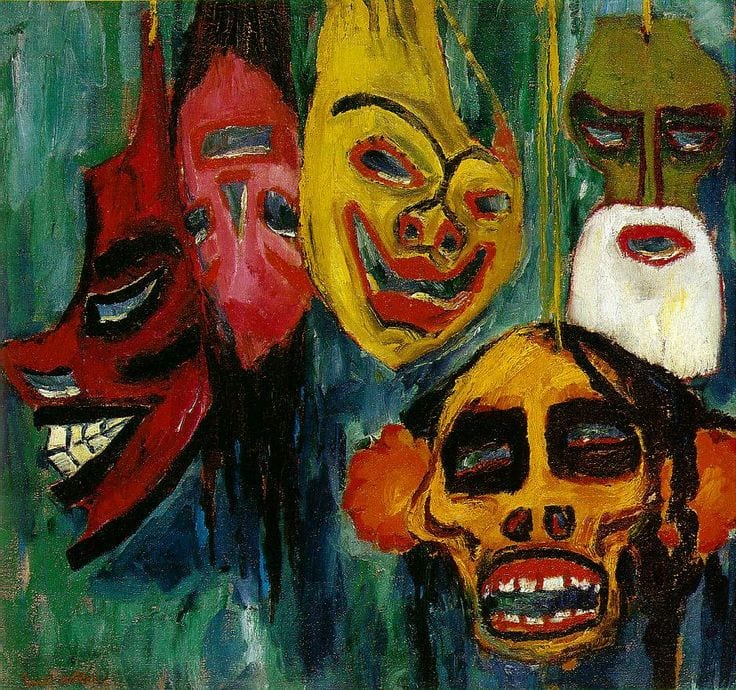
Mask Still Life, David Lynch
The Washington Post: Twitter dissolves Trust and Safety Council.
Twitter on Monday night abruptly dissolved its Trust and Safety Council, the latest sign that Elon Musk is unraveling years of work and institutions created to make the social network safer and more civil.
Members of Twitter’s Trust and Safety Council received an email with the subject line, “Thank You,” that informed them the council was no longer “the best structure” to bring “external insights into our product and policy development work.”
The email dissolution arrived less than an hour before members of the council were expecting to meet with Twitter executives via Zoom to discuss recent developments, according to people familiar with the matter who spoke on the condition of anonymity to discuss the plans.
Dozens of civil rights leaders, academics and advocates from around the world had volunteered their time for years to help improve safety on the platform.
“We are grateful for your engagement, advice and collaboration in recent years and wish you every success in the future,” said the email, which was simply signed “Twitter.”
In less than two months, Musk has undone years of investments in trust and safety at Twitter — dismissing key parts of the workforce and bringing back accounts that previously had been suspended. As the body unravels, Musk is tightening his grip on decisions about the future of content moderation at Twitter, with less input from outside experts.
The move is just throwing away “years of institutional memory that we on the council have brought” to the company, said one council member who spoke on the condition of anonymity due to concerns about harassment on the platform. “Getting external experts and advocates looking at your services makes you smarter.”
Read more at the WaPo.
I’ll end there and turn it over to you. What are your thoughts on all this? What other stories are you following?
Lazy Caturday Reads
Posted: December 10, 2022 Filed under: just because 8 Comments
By Emi Sato, Japan and Canada
Happy Caturday!!
Yesterday Dakinikat posted that DOJ prosecutors had urged District Judge Beryl Howell to hold Trump’s office in contempt for refusal to certify that all classified documents had been returned to the government. Prosecutors met with the judge and three Trump lawyers. The upshot was that Howell refused to the DOJ request.
The Washington Post: U.S. judge won’t hold Trump’s office in contempt, people familiar say.
A federal judge on Friday declined to hold former president Donald Trump’s office in contempt for not fully complying with a May subpoena to return all classified documents in his possession, according to people familiar with the proceedings.
U.S. District Judge Beryl A. Howell told Justice Department lawyers and Trump’s legal team to come to an agreement themselves over what actions or assurances by Trump’s office would satisfy the government, according to these people, who spoke on the condition of anonymity to describe sealed court proceedings….
The hearing punctuated months of mounting Justice Department frustration with Trump’s legal team after attorneys provided assurances that a diligent search had been conducted for classified documents at the former president’s Mar-a-Lago residence and private club.
They made that claim when handing over 38 documents to the Justice Department in response to the grand jury subpoena. But the FBI later amassed evidence suggesting that more classified material remained at Mar-a-Lago.
The Justice Department secured a warrant, and FBI agents searched Mar-a-Lago on Aug. 8, retrieving some 13,000 additional documents, about 100 of them classified. The department is investigating the potential mishandling of classified material, destruction of government property or obstruction of the investigation.
One of the central areas of disagreement between the two sides has centered on the Trump legal team’s repeated refusal to designate a custodian of records to sign a document attesting that all classified materials have been returned to the federal government, The Post first reported earlier this week.
The standoff led to the Justice Department’s request to hold Trump’s office in contempt.
So what happens next? From Raw Story: New court ruling has opened the door for the DOJ to get another Trump search warrant: legal expert.
During an appearance on MSNBC’s “The Katie Phang Show,” former U.S. Attorney Barbara McQuade suggested that a judge’s decision on Friday to not hold Donald Trump and his lawyers in contempt of court could compel the Department of Justice to seek another search warrant for the former president’s properties….
McQuade stated the DOJ has grown increasingly frustrated with the former president and his legal team since they can’t get anyone to sign off on a declaration affirming that all government documents have been turned over to the FBI.
By Dmitry Lisichenko
According to McQuade, the failure to get a contempt of court ruling could lead the DOJ to ask for a search warrant to check for themselves….
“I don’t know that you can ever say they’ve all been returned because there is the possibility that some scrap of paper went undetected,” McQuade replied. “You can ask what is frequently attested to in one of these record custodian documents, which is to say that after a diligent search, to the best of my knowledge, they have all been returned.”
“I think that’s all they are asking for here — they will not even sign that,” she continued. “What does that say? Yes, I think the judge could force someone to do that, but I think that the failure to do that could be a bit of evidence that prosecutors could use as probable cause to obtain a search warrant.”

Republicans, including Donald Trump, are complaining about Biden’s failure to convince Russia to release Paul Whelan, even though Trump and Congressional Republicans did nothing to bring him home during the two years of Trump’s presidency. Elon Musk chimed in of course, saying you should never leave a Marine behind. But Whelan wasn’t a Marine he was captured. He was drummed out of the service with bad conduct discharge.
The Washington Post: Who is Paul Whelan, the former U.S. Marine held in Russia?
The release of Brittney Griner, the American basketball star imprisoned in Russia who was exchanged Thursday for Russian arms dealer Viktor Bout, shed light on the case of another American prisoner, Paul Whelan….
Paul Whelan, 52, is a Marine turned corporate security executive who was convicted of espionage and is serving a 16-year sentence in a Russian prison.
A citizen of four countries — the United States, Canada, Britain and Ireland, Whelan was a former sheriff’s deputy and served several tours in Iraq as an active-duty reservist. He was discharged from the Marines for bad conduct in 2008 after being convicted of charges related to larceny, according to military and court records.
Whelan then spent over a decade working as a corporate security expert. At the time of his arrest, he was corporate security director at BorgWarner, a Michigan-based automotive parts supplier.
In June 2020, Whelan was sentenced to 16 years of hard labor in a Russian prison for espionage, in a trial that he has argued was politically motivated and heightened tensions between the United States and Russia.
So Russia sees Whelan as a spy, while Greiner was arrested for possession of CBD.
His attorney, Vladimir Zherebenkov, has said his client unwittingly received a flash drive containing “state secrets” while visiting Russia for a wedding in 2018. Foreign Minister Sergei Lavrov said Whelan was caught “red-handed,” during a spy mission.
Whelan, arrested Dec. 28, 2018, in a Moscow hotel, has said he thought the flash drive that he received from an acquaintance contained holiday photos. Whelan, his family and the U.S. government have repeatedly stated that the charges are baseless and that he was framed.
The day the verdict was announced, Whelan said he thought it was a foregone conclusion, and shouted from within a glass-enclosed area in the courtroom that Russia “feels impotent in the world, so they’re taking political hostages.”

By Brahim Achir
According to CNN, Germany would have to be involved in order to free Whelan: Russia demanded that a spy held in Germany be freed in exchange for Paul Whelan.
Russia refused to release Paul Whelan alongside Brittney Griner unless a former colonel from Russia’s domestic spy organization currently in German custody was also released as part of any prisoner swap, US officials told CNN, even as the US offered up the names of several other Russian prisoners in US custody that they would be willing to trade.
The US was unable to deliver on the request for the ex-colonel, Vadim Krasikov, because he is serving out a life sentence for murder in Germany….
US officials made quiet inquiries to the Germans about whether they might be willing to include Krasikov in the trade, a senior German government source told CNN earlier this year. But ultimately, the US was not able to secure Krasikov’s release. The German government was not willing to seriously consider including Krasikov –who assassinated a Georgian citizen in broad daylight in Berlin in 2019 – in a potential trade, the German source said.
The US made several other offers to the Russians, sources said, to try to get them to agree to include Whelan in the swap. Among the names floated by the US was Alexander Vinnik, a Russian national extradited to the US in August on allegations of money laundering, hacking and extortion. The US also offered to trade Roman Seleznev, a convicted Russian cyber-criminal currently serving a 14-year sentence in the US, sources said.
Read more at CNN.
Elon Musk has been restoring the Twitter accounts of numerous hate-spewing trolls, including Donald Trump. The guy who got his account back today is a real doozy.
Twitter has unsuspended the account of Baked Alaska, the far-right troll also known as Tim Gionet, who pleaded guilty in July to a misdemeanor of parading, demonstrating, or picketing inside a Capitol building on January 6.
Gionet, who live-streamed his participation in the Capitol riot, was permanently banned from Twitter in 2017 for violating the platform’s hateful conduct policy.
He had used the social media platform to make antisemitic remarks and to post white nationalist content.
Insider contacted the social media platform’s new owner Elon Musk for comment as Twitter no longer has a communications department.
The unsuspension of Baked Alaska’s account follows Musk’s decision to reinstate banned accounts which, according to Platformer, he is referring to as the “Big Bang.”
Shortly after reinstating former President Donald Trump’s Twitter account, Musk polled users on whether he should offer a “general amnesty” to suspended accounts “provided that they have not broken the law or engaged in egregious spam.”
The last time I checked, participating in an insurrection against the government was breaking the law. In fact, Gionet pleaded guilty and will soon be in prison.
Will Sommer at The Daily Beast, Nov. 21, 2022: Jan. 6 Troll ‘Baked Alaska’ Is Going to Jail in 2023 for Attacking Security Guard.
Notorious racist internet troll and Jan. 6 riot participant “Baked Alaska” is officially headed to prison—and not just for his involvement in the riot.
By David Martiashvili
Baked Alaska, whose real name is Anthime Gionet, was arrested shortly after the riot. The feds’ case was helped by Gionet himself, who livestreamed his crimes in the Capitol on the internet.
“Occupy the Capitol, let’s go!” Gionet declared at one point during the riot. “We ain’t leaving this bitch!”
But Gionet is also facing charges for macing a security guard in an unrelated incident in Scottsdale, Arizona, in late 2020. The attack came as the security guard tried to escort Gionet and his friends, who were livestreaming their boorish behavior to their online audiences, out of a bar.
Gionet was initially sentenced to 30 days in jail on the mace charges back in January, but the sentence was on hold pending his appeal. On Friday, though, a downbeat Gionet broke the news to his fans: his appeal had been rejected, and he would be headed to jail on the mace charge in the new year….
Gionet expressed sadness that he would soon be serving his sentence, which starts on Jan. 2, 2023. Making matters worse, Gionet said, his prison sentence for his Jan. 6 actions is still ahead of him.

Meanwhile, Elmo and his new pals Matt Taibbi and Bari Weiss are still tweeting nonsense “Twitter files” about how the pre-Musk platform somehow censored right wing accounts and favored liberals, which is completely false. Musk is even getting pushback from former Twitter CEO Jack Dorsey, who just recently was singing Musk’s praises.
But Musk, Taibbi, and Weiss refuse to release the emails. I wonder why?
Eric Levitz at New York Magazine: The ‘Twitter Files’ Is What It Claims to Expose.
Twitter is not what it seems. The social media platform poses as a neutral marketplace for the exchange of ideas and information; an agora where journalists, politicians, academics, cultural icons, business titans, and ordinary citizens can engage in a dialogue unbounded by gatekeeping elites.
But it is actually a tool of progressive power. While you were hypnotized by viral memes, a cabal of social-justice STEM majors seized the commanding heights of the attention economy. And they have been using it to bend the mass public to their will. By subtly manipulating which forms of speech do and do not gain prominence — and/or, simply banishing wrongthink from its platform — Twitter imposes woke orthodoxy on the nation’s youth while insulating the liberal elite from popular rebuke. This information warfare hasn’t merely cost conservative commentators followers or retweets; it cost a Republican president the White House.
By Emi Sato
That’s the story that conservatives want to tell about what Twitter used to be, in the bad old days before Elon Musk begrudgingly bought it. Fortunately, Twitter’s new CEO has a deep-seated objection to social media companies using their power over discourse to promote partisan causes. Therefore, Musk is using his newfound power over discourse to promote the conservative movement’s demagogic narratives about Twitter and the Democratic president’s son.
Specifically, Musk delivered a vast trove of internal Twitter documents to two independent journalists, Matt Taibbi and Bari Weiss, who have long endorsed aspects of the GOP’s indictment of the platform. Taibbi and Weiss proceeded to publish a pair of exposés on Twitter’s inner workings. Dubbed “the Twitter Files,” these reports featured a couple genuinely concerning findings about pre-Musk Twitter’s operations. But they were also saturated in hyperbole, marred by omissions of context, and discredited by instances of outright mendacity. Musk’s commentary on the Twitter Files, meanwhile, proved even more demagogic and deceptive than the exposés themselves.
For these reasons, the Twitter Files are best understood as an egregious example of the very phenomenon it purports to condemn — that of social media managers leveraging their platforms for partisan ends.

The point of the “Twitter Files” is to once again try to turn “Hunter Biden’s laptop” into a scandal about Joe Biden. The claim is that Twitter hushed this up right before the 2020 election.
There is little question that Hunter Biden was an influence peddler who sought to monetize his access to the American vice president. Burisma was not paying Hunter $50,000 a month for his expertise on the Eastern European natural gas market. It was paying to be one-degree of separation away from Hunter’s father.
This is sordid. But it’s also mundane. If influence peddling were illegal, K Street would house a sprawling penitentiary. Hunter monetizing his last name is not a noteworthy scandal. Joe Biden changing U.S. policy to aid that monetization effort would be. Thus, the key claim in the right’s narrative about the “laptop from Hell” is that Joe Biden pressured the Ukrainian government to oust its prosecutor general, so as to protect Burisma from legal scrutiny.
More details at the link. It’s a long article.
Or as Josh Marshall wrote:
One more maddening story from The Washington Post: Leaders Back Away From Raising Debt Ceiling, Punting Clash to New Congress.
Congressional leaders have all but abandoned the idea of acting to raise the debt ceiling this month before Democrats lose control of the House, punting the issue to a new Congress when Republicans have vowed to fight the move, and setting up a clash next year that could bring the American economy to the brink of crisis.
Reynaldo Fonseca, Nonchalant
Democrats had urged party leaders to act during their lame-duck postelection session to increase the legal borrowing limit, taking advantage of their party’s final months of unified control. Doing so, they argued, would avert a potentially catastrophic conflict over the issue next year, when Republicans have threatened to block the move unless it is accompanied by substantial cuts to domestic spending and social safety net programs.
Failure to raise the statutory cap on the nation’s borrowing power — expected to be reached at some point next year — would lead to a first-ever default, creating financial chaos in the United States and the global economy.
But a lack of political urgency and a shrinking window to act before the holidays appear to have squashed the effort to address the issue this month.
In an institution where action is driven largely by legislative and political deadlines, focus instead remains on avoiding a government shutdown Dec. 16, when a stopgap spending bill lapses. Negotiators are struggling to reach agreement on a sprawling government funding package, widely viewed as the last must-pass vehicle to carry unfinished legislative priorities.
Even if lawmakers reconcile their differences over how much money to split between military spending, a Republican priority, and domestic programs like health and education that Democrats have championed, top lawmakers and aides have acknowledged that it is unlikely Congress will take up a measure raising the debt ceiling.

So we are doomed to spend the “holidays” with the knowledge that Republicans are threatening to use the debt ceiling to end Social Security and Medicare. Thanks Democrats.
What else is happening? What stories have captured your interest today?
Thursday Reads
Posted: December 8, 2022 Filed under: just because 14 Comments
By David Hettinger
Good Afternoon!!
There is some very good news this morning. Brittany Griner has been released from prison in Russia. Paul Whelan is still waiting.
CNN: WNBA star Brittney Griner released from Russian detention in prisoner swap for convicted arms dealer.
Griner was released in a prisoner swap that involved Russian arms dealer Viktor Bout. The exchange, however, did not include another American that the State Department has declared wrongfully detained, Paul Whelan.
“She’s safe, she’s on a plane, she’s on her way home,” Biden said at the White House Thursday morning alongside Griner’s wife, Cherelle. “After months of being unjustly detained in Russia, held under untolerable circumstances, Brittney will soon be back in the arms of her loved ones, and she should have been there all along.”
Biden acknowledged that Griner’s release was occurring while Whelan remained imprisoned, saying that Whelan’s family “have to have such mixed emotions today.”
“This was not a choice of which American to bring home,” Biden said. “Sadly, for totally illegitimate reasons, Russia is treating Paul’s case differently than Brittney’s. And while we have not yet succeeded in securing Paul’s release, we are not giving up. We will never give up.” [….]
Biden said efforts to bring Griner home took “painstaking and intense negotiations” as he thanked members of his administration who were involved.
“This is a day we’ve worked toward for a long time. We never stopped pushing for her release,” he said.
The prisoner swap occurred in Abu Dhabi Thursday, according to senior Biden administration officials. A joint statement from the United Arab Emirates and Saudi Arabia said the Gulf countries played a role mediating the exchange between the US and Russia.
More good news from Sahil Kapur at NBC: House passes bill to protect same-sex marriage, sending it to Biden’s desk.
The House passed legislation Thursday that enshrines federal protections for marriages of same-sex and interracial couples.
The vote of 258-169 sends the Respect for Marriage Act to President Joe Biden, who has championed the bill and is expected to sign it into law. It comes after the Senate passed the same bill last week by a vote of 61-36.
Democrats were unified in favor of the bill, while most Republicans in both chambers voted against it. Thirty-nine House Republicans supported the legislation Thursday and one voted present.
“Your love is your choice,” House Majority Leader Steny Hoyer, D-Md., said on the floor Thursday, saying there is “no reason” to believe that Republican appointees on the Supreme Court won’t want to revisit precedents on LGBTQ rights after overturning Roe v. Wade. “The pursuit of happiness means you can love whom you choose.”
“I am shocked that conservatives that have a libertarian bent believe that somehow we ought to get involved in this,” he said. “It’s not the government’s business.”
The legislation — led by Sen. Tammy Baldwin, D-Wis., the first openly gay person elected to the Senate — would assure that the federal government recognizes marriages that were validly performed and guarantee full benefits “regardless of the couple’s sex, race, ethnicity, or national origin.” It would not, however, require states to issue marriage licenses contrary to state law.
House Speaker Nancy Pelosi was present to gavel down the vote and announce the bill’s passage. Loud applause broke out on the Democratic side of the chamber, while a few Republicans joined in clapping.

Unknown Artist
I’m not posting any New York Times stories today, in support of Journalists who are protesting with a 24-hour walkout. This may just be the last straw that makes me cancel my subscription. I was already thinking about it after they raised my rate to $17 per month recently.
Oliver Darcy at CNN Business: New York Times journalists stage historic 24-hour strike after management and union fail to reach deal.
A 24-hour strike at The New York Times, a historic demonstration in which more than 1,100 employees are expected to participate, began Thursday at midnight, after management and the union representing staffers failed to reach an agreement for a new contract after more than a year and a half of negotiating.
“It’s disappointing that they’re taking such drastic action, given the clear commitment we’ve shown to negotiate our way to a contract that provides Times journalists with substantial pay increases, market-leading benefits, and flexible working conditions,” Meredith Kopit Levien, president and chief executive of The Times, said in an email to the company Wednesday night.
The NewsGuild of New York, which represents journalists and other staffers at The Times, said in a statement that the walkout was “due to the company’s failure to bargain in good faith, reach a fair contract agreement with the workers, and meet their demands.”
The act of protest, which has not been staged by employees at the newspaper of record in decades, will leave many of its major desks depleted of their staff, creating a challenge for the news organization that millions of readers rely on.
An executive at The Times, who requested anonymity to speak candidly, acknowledged to CNN on Wednesday that the work stoppage would certainly create difficulties. But, the executive said, management has readied for the moment and could rely on the newspaper’s other resources, such as its international staff which largely are not part of the union, to fill the voids….
…[S]ome staffers at The Times went as far on Wednesday as to urge readers not to consume the outlet’s content during the walkout.
“We’re asking readers to not engage in any [New York Times] platforms tomorrow and stand with us on the digital picket line!,” Amanda Hess, a critic-at-large for the newspaper, wrote on Twitter. “Read local news. Listen to public radio. Make something from a cookbook. Break your Wordle streak.”
The strike comes as the Gray Lady and the NewsGuild of New York remain at odds over a number of issues, particularly wages, amid a backdrop of layoffs and cuts across the media industry.
Two NYT journalists have chosen not to participate in the walkout. In other words, they are scabs. Why am I not surprised that one is Peter Baker?
Max Tani at Semafor: Two top Times reporters are skipping the walkout.
Two of The New York Times’s top White House reporters are opting out of a labor action Thursday as tensions continue to grow over contract negotiations at the news organization.
Chief White House reporter Peter Baker and Pulitzer Prize-winning White House correspondent Michael Shear told colleagues before the walkout that they would not be participating in the one day work stoppage, three people told Semafor.
Repose, Malcolm Liepke, American, 1953
The rift in the powerful Washington bureau reflects a lingering generational and ideological divide between many in the newsroom and a group of older unionized staff in the D.C bureau.
Some staff in the D.C bureau believe the union should focus more on compensation and other concrete worker protections, and less on broader cultural and social issues that have also been part of rhe union’s bargaining proposals. Union leaders have tried to keep the focus largely on economic issues which unite a larger part of the union.
Shear was among dozens of staff at the paper who previously signed a letter protesting an increase in union dues for individuals making more than $140,000 per year.
But the contract fight has largely united the Times’s feuding tribes, as members of the union who have at times differed over the Times’s coverage of race, sex, and other cultural issues share frustrations over the economic ones. Some sources have also cautioned against reading too much into the divide, noting that the vast majority of unionized D.C. staff participated in the walkout.
The dispute between the paper and the Times union that led to Thursday’s strike largely centers around economic proposals including wages and health and retirement benefits. Unionized staff are seeking greater salary increases, which they hope will offset what they see as cuts in employee healthcare benefits.

There was reportedly a right wing coup plot in Germany.
From CNN last night: Germany arrests 25 suspected far-right extremists for plotting to overthrow government.
German officials arrested 22 suspected members and three suspected supporters of a far-right terrorist organization across the country on Wednesday on suspicion of plotting to overthrow the government.
Alleged members of the plot include a descendant of German royalty and a former far-right member of the Bundestag, Germany’s lower house of parliament, according to German prosecutors and local media reports.
In a statement, the German federal prosecutor’s office said an estimated 50 people were suspected to have been part of the group called Reich Citizens (Reichsbürger)movement, founded no later than November 2021, who were plotting to overthrow the government and replace it with their own order.
“The accused are united by a deep rejection of state institutions and the free democratic basic order of the Federal Republic of Germany, which over time has led to their decision to participate in their violent elimination and to engage in concrete preparatory actions for this purpose,” the statement said.
“The members of the group follow a conglomerate of conspiracy myths consisting of narratives of the so-called Reichsbürger as well as QAnon ideology,” said the statement, which added that the suspected members of the organization were German nationals, while two of the suspected supporters were German and one was Russian.
The Wall Street Journal article on the coup plot suggests that Russia was involved: Germany Arrests Extremists in Plot to Overthrow Government.
Twenty-five people who were partly inspired by the QAnon conspiracy theory were arrested in the early hours of Wednesday, 22 of whom are suspected of conspiring to foment a coup, the federal prosecutor said. Their alleged plans included an armed storming of the federal parliament. The other three, including a Russian citizen living in Germany, are suspected of supporting the group, the prosecutor said.
By Amanda Ba: Sublime Reconciliation (Copyright © Amanda Ba, 2022)
More than 3,000 police officers including special forces conducted raids at 150 properties across Germany, Italy and Austria, in one of the largest operations of its kind in recent history, officials said.
“This organization has, according to our knowledge, set the goal of using violence and military means to overthrow the existing liberal democratic order in Germany,” federal prosecutor Peter Frank told reporters Wednesday. Its members thought Germany was governed by a so-called deep state and would soon be freed by an alleged secret society of officials and military officers from the U.S., Russia and elsewhere, he said.
After years focused on countering the threat posed by Islamist terrorists, German authorities have widened their focus to far-right militants following a spate of attacks. These included the 2019 killing of a local politician in western Germany and an attack by a gunman on a synagogue in Halle, eastern Germany, that left two people dead later that year.
At the same time, concern has grown among German officials about the radicalization of members of the military and security services. Several police officers and members of the armed forces have in the past been arrested in raids connected to extremist groups. In 2020, the government said it would disband part of its elite special-forces unit and rebuild the rest under new leadership after it was infiltrated by far-right extremists.
While members of extremist groups in the armed forces and security and law-enforcement agencies constitute a small minority, the presence of rogue networks within the security establishment is an acutely sensitive matter because of Germany’s Nazi past.

Sounds familiar, doesn’t it? QAnon is becoming a global security threat. But Germany doesn’t fool around when it comes to dealing with Neo-Nazis.
Zeeshan Aleem at MSNBC: How QAnon helped inspire a plot to overthrow the German government.
German authorities arrested 25 people suspected of a right-wing extremist plot to overthrow the country’s government on Wednesday. According to NBC News, the unnamed group, which includes veterans and a German descendant of a royal family, was inspired by “the so-called Reichsbürger, or Reich Citizens, movement which is motivated by conspiracy theories about the role and legitimacy of the modern German state.” But German authorities also named a key foreign influence on the group’s thinking: QAnon.
Reports about the suspected seditious group’s belief system suggest strong parallels with QAnon-type thinking. German prosecutors said the group allegedly believes the country is governed by a secret “deep state” and that, among other things, they were allegedly planning to storm the Reichstag parliament building to install a new government. The members of the group also apparently believe the U.S. would at some point be part of a secret coalition of governments to assault the German deep state, which they saw as a path to liberation.
That connection might seem a bit odd. QAnon is the American far-right conspiracy theory that Donald Trump is on a secret mission to expose and execute a ring of Satan-worshipping liberal elite child traffickers. Why would Germans care about a preposterous myth about American politics?
But QAnon has had significant currency abroad for years. QAnon-affiliated groups have surfaced across Europe, including in Britain, the Netherlands and the Balkans, and data indicates they have their biggest following outside America in Germany.
Girl on a Red Carpet, Felice Casorati, 1912
That’s because QAnon serves as a useful tool for right-wing movements around the world to promote bigoted conspiracy theories and authoritarianism in thinly veiled terms. Social scientists and intelligence officials say that QAnon is a valuable technology for spreading ideas that naturally get traction on the German far right. As a New York Times report from 2020 explained, “the mythology and language QAnon uses — from claims of ritual child murder to revenge fantasies against liberal elites — conjure ancient anti-Semitic tropes and putsch fantasies that have long animated Germany’s far-right fringe.” As Stephan Kramer, head of domestic intelligence in the eastern German state of Thuringia, told the Times, “QAnon doesn’t openly fly the colors of fascism, it sells it as secret code.” It’s likely helpful for the far right that QAnon mythology can hint at antisemitic conspiracies (such as blood libel claims) without explicitly invoking Jews, avoiding the legal restrictions on hate speech in Germany.
What makes QAnon so worrisome is that it also has the capacity to gain purchase among people who we think of as far from fringe extremists. A great deal of polling in the U.S. shows that a huge proportion of Republicans, regardless of educational background, believe in QAnon tenets. How is this possible? One explanation is that if one doesn’t take the theory literally, it’s at its essence a story of the powerful conspiring against the innocent.

Two more stories on the German plot if you are interested:
Euro News: Germany bracing for ‘second wave of arrests’ in far-right ‘coup plot’ case.
The Washington Post: Heinrich XIII, Germany’s ‘Putsch Prince,’ lamented monarchy’s demise.
Back in the USA, Trump is now actively defending the January 6 insurrectionists.
Amanda Carpenter at The Bulwark: How Trump and MAGA Allies Are Defending Violent Jan. 6th Rioters.
Two days after a pair of Oath Keepers were found guilty of seditious conspiracy and three others were convicted of related felony charges, former President Donald Trump celebrated a group that gives aid to January 6th defendants, including some of the Oath Keepers who just received guilty verdicts.
In a bland conference room at the Capitol Hill Hilton, steps away from the site of the Jan. 6th insurrection, Trump, Steve Bannon, and Rep. Marjorie Tayor Greene provided Jan. 6th rioters and their families with messages of hope and good cheer. They came bearing a gift: The trio promised that the incoming Republican-controlled House would use its investigative powers to target the Department of Justice and the D.C. jail where several Jan. 6th defendants are being held.
“People have been treated unconstitutionally, in my opinion, and very, very unfairly, and we’re going to get to the bottom of it,” Trump said in a video message played during the event put on by the Patriot Freedom Project (PFP). Although jailed rioters were not in attendance, a few dialed in to the event by phone; Trump’s message was presumably relayed to them. His latest remarks on the subject follow a pledge he made to a conservative radio host earlier this fall that if he becomes president again, he will issue full pardons and a government apology to rioters.
In his video for the December 1 event, Trump emphasized that the Jan. 6th–related prosecutions were part of “the weaponization of the Department of Justice, and we can’t let this happen in our country.” Bannon was patched in through a live video call and said, “The politics of all this are going to change pretty dramatically with the new Congress . . . and, of course, President Trump’s backing.”

Carl Vilhelm Holsoe, Asleep young woman holding book
Marjory Taylor Greene plans to advance this cause next year in the Republican controlled House.
Greene addressed the group in person, and, befitting her status as the only event speaker currently in office—and therefore potentially able to take action to benefit the rioters—she got down to the specifics. She told the group she had just come from a meeting “about being on [the] Oversight Committee” and that “I specifically asked about the D.C. jail, okay? . . . There’s going to be an investigation into the D.C. jail, I want you to know that, and that’s how we look forward.”
PFP members were undoubtedly already familiar with Greene’s work on the matter. Last year, Greene and Rep. Louie Gohmert (R-Texas) toured the D.C. jail where Jan. 6th rioters are held. She then posted to her congressional website a report titled “Unusually Cruel,” which claimed the Jan. 6th prisoners are being unfairly treated because of their politics.
An actual congressional investigation, however, would mark Greene’s return to committee work after being stripped of her committee assignments by Democrats and eleven Republicans following the discovery of myriad contemptible statements she made before running for Congress.
Greene seems to have learned to censor herself and found more appealing ways to make her arguments. During her presentation to the rioters’ families, she focused on due process rights and concerns about the conditions of the D.C. jail—reasonable-sounding topics, especially when compared to the rank conspiracism she has given voice to in the past. She also told the Jan. 6th families: “Now, I won’t defend what any of them did that day, because I wasn’t happy that day, either.”
This an odd statement, considering that defending the rioters is exactly what the Patriot Freedom Project was created to do. But maybe even Marjorie Taylor Greene understands that vocally supporting violent insurrectionists is too politically toxic to do out loud, especially now that some of them are being convicted of seditious conspiracy.
Read more at The Bulwark.
That’s it for me today. What do you think? What stories are you following?

 peej
peej Carissa
 bostonboomer
 dakinikat
 ecocatwoman
 mablue2
 Mama Lopez
 peggysue22
 quixote
 skydancingguestblogger
 Mona (aka Wonk the Vote)



 Sky Dancing
Recent Comments