
Finally Friday Reads: Trump’s latest Bugaboo
Posted: August 7, 2026 Filed under: #FARTUS, #MAGAnomics, #We are so Fucked, Are we a democracy?, Climate change, corporate greed | Tags: "birth tourism", @johnbuss.bsky.social John Buss, and Peace in the Gulf, Clean Energy Initiatives, Killing Foreign Aid, Todd Blanche 4 Comments
“Went grocery shopping yesterday for a few things, came home, and started drawing this. The Golden Age, BWAHAHAHA!” John Buss, @repeat1968
Good Day, Sky Dancers!
Orange Caligula must still have a lot of childhood nightmares still floating around his brain because he sure finds a lot of monsters under his bed to turn into political talking points and policy nonsense. Case in point, the weirdness that has started around what defines American citizenship since the Roberts court, since the majority didn’t buy his reasoning back in June. The new bugbear is “birth tourism.”
So, the way I understand it, the poor huddled masses yearning to be free have enough bucks to enter the country on jetliners and just hang around in hotels until they get themselves a baby, like the baby has anything to do with this start out with. Sigh. This nonsense comes from a man whose 4 out of 5 of his children are so-called anchor babies. So, what does this mean for Baron’s ascension to the White House? Have we ever totally figured out Melania’s road to citizenship?
Here’s a more reasoned line of analysis from the LA Times. “After Supreme Court loss, Trump again targets birthright citizenship with new orders.” Kevin Rector has the lede.
President Trump targeted birthright citizenship again Thursday by signing a pair of executive orders purporting to narrow it — including by cracking down on “birth tourism” and limiting which children born to immigrants in the U.S. qualify.
The new orders follow a U.S. Supreme Court ruling in June that rejected an attempt by Trump to end birthright citizenship outright.
During a signing ceremony in the Oval Office, Trump called that decision by the high court “very unfair” and said the new orders were an attempt to end birthright citizenship by other means.
“Our country suffers because of it, and we’re ending it a different way,” he said.
Trump promised “big crackdowns” on birth tourism, or the practice of pregnant foreign mothers coming to the United States, or foreign fathers using surrogates already in the U.S., specifically to ensure their children receive U.S. citizenship.
Trump said an entire industry has been built up around the practice, turning birthright citizenship into “a joke.”
“Wealthy people are building businesses around birthright citizenship. That’s not the way it’s supposed to work. It’s a disgrace,” he said. “They’re buying their way in, and we’re not going to let it happen.”
The orders were immediately criticized by proponents of birthright citizenship as an indefensible attempt by the president and his administration to make an end run around the Supreme Court’s clear finding that the 14th Amendment to the U.S. Constitution cannot be undone by the president.
 This is ridiculous, and it’s not going to take a lot of folks’minds off day-to-day living expenses. Also, what about the escalation of that nonsense war you started with Israel? And speaking of foreign affairs, ProPublica‘s Anna Maria Barry-Jester and Sharon Lerner follow the money that’s supposed to go to foreign aid projects as provided by Congress. It seems Trump might be reallocating to things he considers more appropriate. “What Is the Trump Administration Doing With Foreign Aid Money? The billions of dollars Congress has allocated for foreign aid programs must be spent. One proposal from the Trump administration suggested funding research on crime against Afrikaners in South Africa.”
Since he returned to office, President Donald Trump’s administration has upended foreign aid. It’s labeled well-established, long-running programs as “not aligned with American interests” and slashed their budgets.
Still, the billions of taxpayer dollars Congress has allocated for foreign aid programs must be spent; lawmakers have insisted the government continue to fund humanitarian aid, global health and pro-democracy causes around the world. With most of the old programs now gone, however, we wanted to know: What is the Trump administration doing with that money now?
Recently, we published our investigation that found one answer to that question in a little-known bureau of the State Department that has dramatically transformed under Trump. For decades, the Bureau of Democracy, Human Rights and Labor, known as DRL, has supported human rights in some of the most oppressive countries in the world. Now, our reporting found, it’s planning to direct funds to controversial groups supporting right-wing causes in Europe and elsewhere.
Our full story lays out some of the groups the government has considered funding, which include a British free-speech organization that has fought against bans on “gay conversion therapy” and a British American think tank created this year to focus on “existential threats to Britain, to America, and to our shared Judeo-Christian civilisation.” (Administration officials dropped that grant after significant pushback from Congress.)
One proposed grant particularly caught our attention: Trump administration officials suggested funding research on crime against minority populations in South Africa.
It’s clear from sources we spoke with that the key targeted minority population in question is the white ethnic group known as Afrikaners. Afrikaners were responsible for creating the nation’s infamous and brutal racially segregated apartheid system. Previously, DRL staff had been told to begin the process of awarding funds to a group called Lex Libertas, which was founded by a controversial figure who has called for Afrikaner self-governance. The group is currently fundraising to place 3,000 white crosses on the National Mall in remembrance of attacks on South African farmers.
 As usual, Trump’s biggest bugbear is people of color. It amazes me that Congress just can’t (or won’t) figure out a way to stop this. We’ve have breaking news today that Todd Blanche will be the next AG. Once again, Senator Bill Cassiday, Lousyana, has folded. Any chance of doing the right thing just is not possible for him. This is from the
 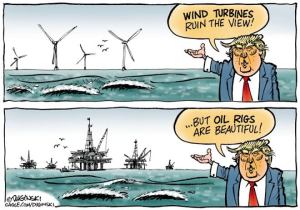 We lose again, as Steve Benen explains the latest attack on renewable energy in the
  And it’s not like the business sector does us any favors either. Take a look at this
 peej
peej Carissa
 bostonboomer
 dakinikat
 ecocatwoman
 jjlo
jjlo mablue2
 Mama Lopez
 peggysue22
 quixote
 skydancingguestblogger
 Mona (aka Wonk the Vote)





Recent Comments