
Social Security: Why mess with an American Success Story?
Posted: December 10, 2010 Filed under: Catfood Commission, legislation, POTUS, The Bonus Class, U.S. Economy, Voter Ignorance | Tags: Clinton Obama presser, payroll tax holiday, Social Security 54 Comments
I spent most of the day listening to the Bernie Sanders show, but stories of the joint Clinton/Obama presser that turned into the Bill Clinton show grabbed my interest. I have more than a passing interest in Social Security. I haven’t paid into it for about 15 years, but I have an exhusband who has and I have 20 years worth of dibs on his account. I’m a tailend boomer with a much smaller nest egg post Financial Crisis than pre Financial Crisis. Ex Hubby’s social security and his pension plan loom on my horizon. They stop me from having bag lady nightmares.
So, what’s all this talk about a payroll tax holiday and why, all the sudden, is the Cat Food Commission’s foray into social security creeping me out? Well, for one I think that a lot of people–including the President–don’t seem to get social security, its history, its issues, and its challenges and that always irks me. For another, I think it opens this trap door to having more of my future Shanghaied. I don’t want any more of anything related to my future going off to Shanghai.
So, since the President–among others–is spreading disinformation about the Social Security program, I thought I’d take the time to remind you that I wrote a four part series on Social Security in May 2009. If you want a little background and perspective, you can go check it out. (Fortunately, it’s here in the file cabinet portion of Sky Dancing.) It is all based on Academic work and people that do active research on the program, its solvency, and its issues.
First, here’s a list of links to those old posts of mine:
Social Security: Reform, Refund or Opt-Out (Part 1) Introduction
Social Security: Reform, Refund or Opt-Out (Part 2) Public Pension Concepts and Alternatives
Social Security: Reform, Refund or Opt-Out? (Part 3) Lessons from the World
Social Security: Reform, Refund, or Opt Out? (Part 4) What to do when Pensions are out of balance
I wanted to point these out since I don’t want to completely reinvent the conversation here. The government has a website that it dedicated solely to the Social Security Act of 1935. There are still many, many people that do a lot of research in the area. Here is a link to one of the new studies that looks at the impact of increasing the level of maximum earnings subject to Social Security and its impact on the program. This is one of the things that is being suggested to increase funding for social security. Here is a brief from the National Academy of Social Insurance that looks at various funding formulas. This group is actually associated with actuaries so it is quite statistics intensive. Findings specific to this brief are:
- The number of Social Security beneficiaries per 100 covered workers will increase from 30 in 2005 to 46 in 2030 and to 50 in 2050.
- Social Security benefits will rise from 4.3 percent as a share of the total economy today to 6.1 percent in 2030.
- When baby boomers are retired, the total number of people each worker supports(including workers themselves, children, retirees, and other nonworking adults) will not be as large as it was when the baby boomers were children.
- As a share of the total economy, spending for Social Security benefits when baby boomers are retired will grow less than spending for public education grew when baby boomers were children.
- While baby boomers may have been a surprise when they turned up in record numbers to enroll in kindergarten in the 1950s, their retirement six decades later is not. Policymakers began to plan as early as 1983, when Congress lowered the cost of Social Security benefits for boomers and later generations by raising the age at which unreduced retirement benefits will be paid.
- Workers’ wages are projected to grow in real terms (that is, faster than inflation). By 2030, real wages will increase 33 percent. Even if policymakers chose to balance Social Security’s finances solely by a tax rate increase, workers’ net wages (after paying the higher tax) would still be 28 percent higher than they are today.
- While earnings that are taxed to pay for Social Security represent 38 percent of the total economy, other national income is not taxed for Social Security purposes.
- Broadening the tax base, reducing scheduled benefits, raising the Social Security tax rate, or allocating other kinds of revenue to Social Security are ways to improve Social Security finances.
So, you can see this isn’t an urgent issue right now. I guess my point is that the ‘sudden’ urgency we seem to have with social security is not something out of the blue and it’s not something that hasn’t been discussed, planned for, or actually worked on. As recently as August, the President himself gave a speech saying just these things which is why I am so confused about the Cat Food Commission’s dalliance with the program.
President Obama said Social Security is not in crisis and only modest changes are needed to keep it solvent.
The president acknowledged at a small town hall gathering in Columbus, Ohio, Wednesday that the pension fund “has to be tweaked because the population is getting older” but said Republicans’ plans to drastically overhaul the program are wrong.
“Social Security is not in crisis,” Obama said. “We’re going to have to make some modest adjustments in order to strengthen it.”
I also wanted to bring up a little bit on the idea of Payroll Tax Holidays and that bizarre Clinton/Obama presser today. I’m even more confused by this sudden urge to create a payroll tax holiday. This is an odd thing.
The tax deal reached between President Obama and congressional Republicans could mean a higher tax bill for roughly one in three workers as a result of the Social Security tax cut Republicans pushed as a replacement for the current Making Work Pay tax credit.
The Making Work Pay credit gives workers up to $400, paid out at 8 percent of income, meaning that anybody making at least $5,000 gets the full amount — and gets as much as anybody else. Its replacement knocks two percentage points off the payroll tax cut, meaning a worker would need to make $20,000 to get a $400 break. Of the nation’s roughly 150 million workers, around 50 million make less than $20,000 and will see at least some increase as a result.
Additionally, roughly a quarter of 20 million state and local workers pay no payroll tax, because they have a separate pension system. Some of those workers with children will benefit from the extension of other tax credits, but overall will have less money in their pocket.
Rep. Raul Grijalva (D-Ariz.), co-chair of the Congressional Progressive Caucus, said many House liberals were opposed to the payroll tax cut because of its effect on the poorest workers. Progressives are also concerned that the tax cut will become permanent and undermine Social Security’s funding stream and political support over time.
Social Security is a stand alone program. Mixing it as part of a goodie bag with other tax things doesn’t strike me as a very good idea from a political standpoint. It’s not part of the general budget. It’s a form of insurance. We (or in my case, my exhusband mostly) paid into it. Why mix it up with other tax give aways?
I did go hunting about for information on Payroll Tax Holidays to see if they really could stimulate the economy effectively. One of my issues is that I know that the FICA taxes are regressive because of the maximum income ceiling so I thought that the spending impact couldn’t be very large. So, it seems like getting rid of some of those taxes really gives more to the rich than the poor. Rich folks really aren’t very reliable spenders. Turns out, my hunch was studied and released in early 2009 at CBPP. They basically say that the biggest benefits would go to workers least likely to spend the money. That also seems to be every one’s take on this program. Also, there are people like me who worked for states and municipalities that don’t do Social Security. We don’t get a thing from this.
A payroll tax holiday, however, would both be costly — a two-month suspension could cost about $120 billion, for example — and likely relatively ineffective as a stimulus measure. Public resources would be better spent on stimulus measures with a higher “bang for the buck,” such as the Making Work Pay tax cut that President-elect Obama has proposed.
Economic stimulus measures aim to encourage an immediate increase in aggregate demand by boosting consumer spending. The most efficient way to boost consumer spending is to put money into the hands of people who will spend it quickly rather than save it; tax cuts focused on moderate- and low-income households are more effective as stimulus than tax cuts that are larger for people with higher incomes, because people at low-income levels spend a larger share of tax cuts they receive than people at higher income levels do.
A payroll tax holiday does not score well on this front — too little of the benefit goes to lower-income households struggling to make ends meet and too much goes to higher-income taxpayers, who are likely to save a significant fraction of any new resources they receive. Under the payroll tax, employees pay tax of 6.2 percent on earnings up to $106,800. So, for example, a worker earning $10,000 would receive a tax cut of just $103 from a two-month payroll tax holiday, while a worker earning ten times as much ($100,000) would receive a tax cut ten times as big — $1,030. Indeed, the highest-income fifth of households could receive more than half of the benefits that would go to workers from a two-month payroll tax holiday.
So, when President Clinton got up to day in a presser with Obama to support this comprise deal, I was really confused. It seemed like a double play triangulation move with a snagglepuss type-exit stage-left by POTUS. You can say a lot about Clinton–both good and bad–but he does understand his economic theory. Why would he support this?
Clinton comfortably outlined how the pending package of tax cuts, business incentives and unemployment benefits would boost the economy – even though it included tax help for the wealthy that Obama had to swallow.
“There’s never a perfect bipartisan bill in the eyes of a partisan,” Clinton said. “But I really believe this will be a significant net-plus for the country.”
When he finished his pitch, Clinton played the role of humble guy, saying, “So, for whatever it’s worth, that’s what I think.”
So, it all boils down to what can we get something past the Republicans? This entire deal puts Social Security in an awkward light. It also uses money for a payroll tax holiday that probably isn’t as efficacious as it could be if put to other uses. It also plays into the idea that giving taxes back to rich people stimulates the economy enough (VOODOO economics). It also indicates that playing up to adherents of VooDoo economics is worth adding to the deficit and to the problems with the deficit and the challenges social security faces in the future. It sets them up to make bigger arguments down the line.
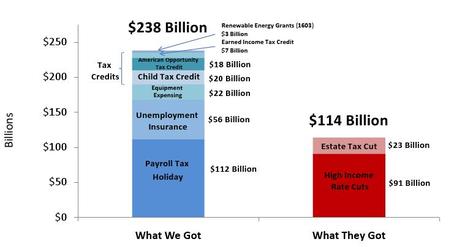
I guess after reviewing everything, I just don’t see how this is worth it. Passing all of this because it’s the best you can do given the state of the Republican Klan in Kongress just isn’t good enough for me. It opens up too many issues in other areas. However, this is the graph they’re circulating as a White House talking point to show how Obama got the better deal. This is the graph that has Charles Krauthammer’s tie in a too tight double Windsor knot so much that Clinton brought it up.

 peej
peej Carissa
 bostonboomer
 dakinikat
 ecocatwoman
 jjlo
jjlo mablue2
 Mama Lopez
 peggysue22
 quixote
 skydancingguestblogger
 Mona (aka Wonk the Vote)





Recent Comments