“Why Natalie gets paid the big bucks.” John Buss, @repeat1968
Good Day. Sky Dancers!
It seems we have more of the same this week, and that’s a damn shame! Voting Rights, Press Access, Trump’s Fanboi treatment of a dictator, and the deconstruction of anything representing fairness and opportunity sally forth. Let’s take a look at the headlines as we get closer to the midterm elections!
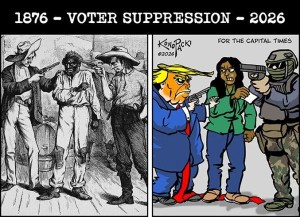
Let’s start with a Supreme Court Decision that’s definitely in the damn shame category. This is from Jacob Knutson writing for Democracy Docket. “Supreme Court revives DHS use of flawed immigration database for voter purges.” Ideology once again trumps law and data.
In a dangerous decision for voters, the Supreme Court authorized the Trump administration to overhaul a federal immigration database into a vast, centralized and deeply flawed database of Americans’ personal information to initiate registration purges.
The decision lets the administration move forward with a key provision of President Donald Trump’s 2025 anti-voting executive order, much of which courts have permanently blocked.
At least five of the Court’s Republican-appointed justices lifted a lower-court order that found the Department of Homeland Security’s (DHS) modification and use of the Systematic Alien Verification for Entitlement (SAVE) system “trampled on the privacy rights of American citizens in a manner that threatens the sacred right to vote.”
The majority’s opinion gave short shrift to the danger of eligible voters, especially naturalized citizens, being wrongly removed from the rolls — a concern highlighted by Justice Ketanji Brown Jackson in her dissent.
“[T]he harm caused by burdening or disenfranchising even a few lawful voters outweighs the nonexistent harm that the Government experiences when it is prevented from taking an action that it likely lacks the authority to take,” Jackson wrote, joined by Justices Sonia Sotomayor and Elena Kagan.
The decision Friday marks a significant loss to voters — particularly naturalized citizens, who have been disproportionately falsely flagged as ineligible voters when states have fed their registration lists into SAVE.
It also deals a blow to voting and privacy groups challenging DHS’s overhaul of SAVE as a violation of federal privacy laws and an unconstitutional attempt to usurp states’ authority over elections.
SAVE has existed for decades as a tool that lets states check the immigration status of people applying for government benefits.
However, in the 2025 executive order, Trump directed DHS to transform the database into a sweeping tool to vet state voter rolls.
The Supreme Court granted the Department of Justice’s (DOJ) request to stay the lower-court ruling even though a coalition of voting and privacy advocates led by the League of Women Voters warned that SAVE was never designed to check voter eligibility and, when used this way, will erroneously flag eligible voters as noncitizens.
“Today’s decision is profoundly disappointing, as it puts millions of Americans at risk of being unlawfully targeted by the administration’s unreliable voter purge database weeks before the midterm elections,” the coalition said in a statement. “However, this case is not over. The D.C. district court ruled that the expanded SAVE program violated multiple laws.”
“We will be doing everything in our power to protect Americans’ voting and privacy rights by ensuring that the district court decision stands,” it added.
The White House is certainly afraid of the results of the upcoming election. So are members of Congress. This is from Susan B. Glasser writing for The New Yorker. “The Week Republicans Finally Panicked About Trump. The President’s party, facing a midterm reckoning, is begging for a way out of his Iran-war doom loop.”
Trump’s ability to change the subject has long been one of his political superpowers. This was widely understood to be one of the reasons—beyond his apparently genuine loathing of the news organizations in question—for his “FAKE NEWS” press ban. I’m sure that he thought the spectacle of his dictator pas de deux with Xi would provide days’ worth of obsessive chatter. It may be, however, that the only person in politics that the President has succeeded in distracting this time is himself.
Forty days before the midterm elections, Washington is increasingly consumed not by Trump’s endless antics so much as by the rapidly clarifying political reality of the predicament in which the President, deeply unpopular and trapped in an unwon war of his own choosing in the Middle East, has got himself and his party. A reckoning—one far harsher than was expected, even a few months ago—now seems imminent.
Few are flatly predicting yet that Democrats will seize control of both the Senate and the House of Representatives—in the Senate, they would need to flip a net of four seats to win the chamber—but, by just about every metric except the vast sums of campaign cash that Trump has drummed up, this election looks increasingly likely to produce an outright repudiation of the President’s party, after a campaign season in which Trump’s own reckless politics and persona have defined the political landscape. No modern President, in fact, has ever gone into a midterm election this unpopular. Trump’s standing with the American public is currently twice as low as it was at this point in 2018, when Republicans lost forty-one seats in the House.
“Since early September, there has been a noticeable shift toward Democrats,” Doug Sosnik, who served as the political director of the Clinton White House, wrote on Thursday, in one of his closely followed election analyses. The movement of voters away from Republicans “hit a tipping point in recent weeks,” Sosnik concluded, with “Democrats now positioned for gains that looked unimaginable at the beginning of the year,” an outcome largely attributable to voters’ rejection of “the increasingly erratic behavior of an out of touch Commander in Chief.” This assessment is not all that different from what Republicans—both privately and, in some cases, publicly—are saying. “Republicans are running out of runway,” Dave Winston, a longtime G.O.P. pollster, warned this week in an op-ed in Roll Call, blaming this development on the fact that Trump’s economic message has been “falling on deaf ears.” The phrase “ringing alarm bells” was used.
The political class has responded accordingly. “The Republican abandonment of Donald Trump begins,” the conservative National Review wrote on Wednesday. That same day, Punchbowl Newssaid this was the week that Republicans were hitting the “panic button.” That afternoon, the right-wing Christian radio host Steve Deace posted a screed on X complaining that Trump’s failed war with Iran risks becoming a “2020 Covid lockdown level of political albatross” that could cost the G.O.P., even in Trump bulwarks such as Deace’s home state of Iowa, where Democrats now look like they could take both the governorship and an open U.S. Senate seat. Just two years ago, Trump won the state by thirteen points.
So many Republican candidates in recent days have broken with Trump that it’s as if a secret memo went out announcing that the floodgates were officially open. (Newsweek even started a tracker of “Republicans breaking with Trump ahead of midterms.”) Among the more notable defections were Republican Senate nominees in Iowa and Michigan, both of whom pleaded with Trump to end the war with Iran, now. “Michigan families are struggling with the price of everyday life,” Mike Rogers, a former congressman who is the G.O.P. nominee in Michigan, says in a new ad, itself a rebuke to Trump’s line that the affordability crisis is just another Democratic hoax. “Groceries cost too much. We have to bring prices down. The war with Iran needs to end and end quickly. When it does, energy costs will plummet.” Representative Ashley Hinson, the nominee in Iowa, echoed that language. “The war needs to be brought to a successful and immediate end,” she said. Democrats quickly pointed out that, so far, Hinson had voted multiple times against resolutions in Congress to stop the conflict.
Well, that’s refreshing! This take is from Bill Scher writing for the Washington Monthly. ‘This Is the Biggest Reason Why a Blue Wave Is Probably Coming. Nothing makes voters angrier at the party in power than having less money in their pockets, and real disposable income is down.” I just hope all these prognosticators are right.
There are lots of reasons to believe Democrats are about to crush the midterm elections. Donald Trump’s average job approval is below 40 percent, about 5 points lower than it was in the 2018 midterms, which were deemed a “Blue Wave.” His authoritarian antics continue to dominate media coverage, as does seemingly corrupt behavior from him and his family. Democrats are ahead in the generic congressional ballot poll average by nearly 9 points, matching the national popular vote margin for the 2018 House elections. In September polling of Senate races, Democrats lead in six states with Republican-held seats, more than the four needed to take control. Gas and food prices remain high, which the public broadly blames on Trump’s ham-fisted tariffs and blunderbuss war with Iran.
There are millions of reasons to believe Republicans are going to hold off a Blue Wave: specifically, the hundreds of millions of dollars they are flooding into political advertising to paint Democratic candidates as radical socialists. As Democrats need wins in states and districts where Trump won comfortably in 2024, the right-leaning voters who will determine the outcomes may well be swayed by the negative advertising avalanche. Furthermore, the Democratic margins in most Senate polling are usually within the margin of error, and there is plenty of precedent for Republicans to outperform polls on Election Day.
But one factor may outweigh the rest: the decline in real disposable income.
Real disposable income measures how much money people have after taxes, adjusted for inflation. Seth Masket, the political scientist who now publishes a Substack newsletter has long tracked the correlation between real disposable income and midterm election outcomes. As The Atlantic’s Derek Thompson observed about Masket’s research back in 2010, “It’s not perfect correlation, but the trend is clear. When folks feel richer, they reward the party in power.” This May, Masket offered a midterm forecast largely based on the specific metric he uses, “growth in per capita real disposable income between the second quarter of the year before the election and the first quarter of the election year,” which came in at a limp 0.4 percent. The model projected a 46-seat net gain for House Democrats, though even Masket said he would consider it surprising if that exact number came to pass.
Allow me to add a data point: the second quarter of the election year.
Per capita real disposable income took a big hit in the second quarter of 2026, with growth coming in at negative 0.4 percent compared to the prior quarter.
And what happened just before the second quarter began? Donald Trump attacked Iran, and oil prices skyrocketed.
If we look at growth in per capita real disposable income from the 3rd quarter in the year before a midterm to the 2nd quarter in the year of the midterm, the 2025-2026 number is also negative: -0.5 percent.
Any such decline is unusual. We’re about to hold the 20th midterm election since 1950. In only four of these, from the period of third quarter to the second quarter, did per-capita real disposable income shrink.
Two of those midterms, 1958 and 1974, tie for the biggest Blue Waves of the last 75 years, each netting Democrats 48 House seats. A third was in 2022 during the Joe Biden presidency, when red-hot inflation chewed up paychecks, but Masket notes it as a massive outlier, with the president’s party coughing up only nine House seats. He attributes the limited losses to a slew of Trump-backed extremist candidates baselessly flogging election fraud and backlash over the right-wing Supreme Court ending Roe v. Wade. I would add that the worst of the inflation spike had ended; 2022’s second quarter decline was not as bad as the preceding four, and the following quarter was positive. In other words, the trajectory was moving in the right direction.
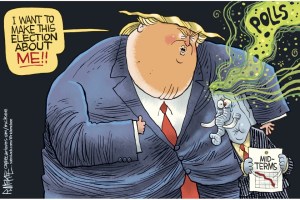
Economics matters. I can speak from recent experience in this second Trump term about what his tariffs and other bad policy are doing to me and I can see by checking the data that I’m not the only one. You can hear in conversations between people and from your friends. The money runs out before the car can be gassed and the grocery shopping is adequate. This is why I laughed at that article about sending women back to being housewives with a few tax cut dribbles. That would mean homeless and starvation for most of America’s families. Also, this is a very bad time of year to cut out programs that feed school children and the elderly. Those headlines do not help the situation at all.
Trump is feeding his fires with government funds. His audacity with this move did not surprise me. Nothing does anymore. Will this be another illegal move left to back pages so know when can really find it? Isaac Arnsdorf has the story for the Washington Post. “Trump ad airing with government funding despite law against ‘propaganda’. The agency responsible for the commercial was not immediately clear.” He clearly has no interest of knowledge of our laws.
A television ad promoting President Donald Trump began airing on cable Wednesday saying it was paid for by the U.S. government, despite a federal prohibition on using taxpayer dollars for “publicity or propaganda.”
The ad is similar to spots released earlier by the nonprofit arm of Trump’s political operation to promote his record in the midterms campaign. But this one includes a tag reading, “Paid for by the U.S. Government.”
Since the 1950s, annual appropriations legislation — including the funding bill Trump signed in February — has routinely included a ban on using federal funds for “publicity or propaganda purposes.” The Government Accountability Office has said the prohibition applies to communications that are “purely partisan” and “designed to aid a political party or candidates.”
The ad consists of a supercut of Trump photos and videos interspersed with text of campaign slogans. The soundtrack features snippets of Trump speeches and a chorus of women singing, “I’ll make them love me.” It ends with Ultimate Fighting Championship CEO Dana White praising Trump over footage of the June match on the White House lawn and military flyovers.
It has aired so far on Newsmax in Chicago and Fox News in Los Angeles, according to ad-tracking firm AdImpact. The firm noted, however, that it could not verify spending data for the ad because the networks airing it were not classifying it as political.
A White House official, speaking on the condition of anonymity because they were not authorized to discuss the matter publicly, argued that the ads are not political and that Trump is not on the ballot.
The president has repeatedly told his supporters to vote as if he were.
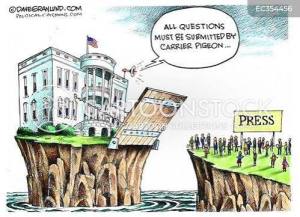
This AP article as provided by the Washington Sunhas news that the Press Pool is back in place at the White House. “White House TV Pool Is Operating Again After Days of Outlets Being Banned When the White House booted CNN and two other outlets from the grounds, the other four networks in the pool declined to participate in a show of solidarity.” Jocelyn Noveck has the lede.
The U.S. network video pool for the White House was back in operation Friday, for the first time since President Donald Trump banned three news outlets in a high-profile showdown over media access.
“As of now, all systems are go,” said a person familiar with the pool, speaking on condition of anonymity because of the fluidity of the situation.
The pool consists of five major U.S. broadcast outlets that take turns shooting and sharing video. When the White House banned CNN — which belongs to the pool — and two other outlets from White House grounds, the other four declined to participate in a show of solidarity.
A judge temporarily struck down the ban of CNN, MS NOW and Politico on Thursday, but his ruling didn’t directly address the pool. The networks continued to refrain from covering Trump as part of the pool even as reporters from all three outlets were allowed back in the White House.
As President Donald Trump prepared to take Chinese President Xi Jinping to visit the National Archives on Friday, the pool’s live feed was being shared again.
This last bit of news has me very angry having lived through the period when segregation in schools was either the rule or the geographic fact up in to the period where desegregation became the rule. This is also from the AP. “Trump administration moves to limit fixes for systemic racism in schools.” Annie Ma has the story.
For decades, a key principle underpinned civil rights enforcement in American schools: Not all discrimination was intentional.
Even if a school policy was written without overt racial bias, it might unfairly hurt one group of students over another, the understanding went. The concept is known as systemic racism, and Republican and Democratic administrations agreed: Schools and universities that received federal funding had an obligation to address it.
Under President Donald Trump’s administration, that’s no longer the case. One by one, the administration has limited the remedies schools can use to address systemic racial injustice.
This summer, the Education Department rescinded a regulation that allowed schools to gauge potential discrimination by comparing outcomes across races, such as the racial breakdown of students in advanced classes. Then, it issued a letter to American schools, emphasizing it’s illegal to consider race when crafting discipline policies — even if one particular racial group ends up suspended or expelled more often.
At the same time, Trump’s Justice Department has stepped away from many school desegregation cases. In a news release Thursday, the department boasted of successfully working through the courts to close more than 50 desegregation cases since Trump took office, with motions to dismiss in the works in many other cases. Previous administrations had used these federal court cases to hold schools accountable when students of color had worse outcomes than white students — high rates of discipline, worse school facilities or reduced access to extracurriculars and advanced coursework.
While Trump’s first administration deprioritized enforcing racial justice, his current administration has gone further — threatening to punish schools for any consideration of race in their policies and practices.
To the administration, the practice of examining different outcomes for particular groups of students, sometimes known as “disparate impact,” was itself a form of racial discrimination.
“The Obama and Biden Administrations weaponized disparate impact by effectively coercing schools to discipline students differently based on race in order to engineer equitable disciplinary outcomes across racial groups,” Education Department spokesperson Sabin Sidney said. “These practices unfortunately led to unsafe classrooms and undermined student learning.”
It’s very difficult for me to see us return to this situation especially given my children and grandchildren are multiracial.
So, that’s pretty much enough to stew on for the moment.
What’s on your Reading, Action, and Blogging list today?
Did you like this post? Please share it with your friends:
The Sky Dancing banner headline uses a snippet from a work by artist Tashi Mannox called 'Rainbow Study'. The work is described as a" study of typical Tibetan rainbow clouds, that feature in Thanka painting, temple decoration and silk brocades". dakinikat was immediately drawn to the image when trying to find stylized Tibetan Clouds to represent Sky Dancing. It is probably because Tashi's practice is similar to her own. His updated take on the clouds that fill the collection of traditional thankas is quite special.
You can find his work at his website by clicking on his logo below. He is also a calligraphy artist that uses important vajrayana syllables. We encourage you to visit his on line studio.


 The White House is certainly afraid of the results of the upcoming election. So are members of Congress. This is from Susan B. Glasser writing for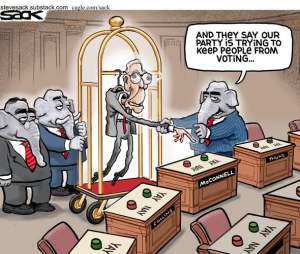
 Economics matters. I can speak from recent experience in this second Trump term about what his tariffs and other bad policy are doing to me and I can see by checking the data that I’m not the only one. You can hear in conversations between people and from your friends. The money runs out before the car can be gassed and the grocery shopping is adequate. This is why I laughed at that article about sending women back to being housewives with a few tax cut dribbles. That would mean homeless and starvation for most of America’s families. Also, this is a very bad time of year to cut out programs that feed school children and the elderly. Those headlines do not help the situation at all.
 This AP article as provided by the
 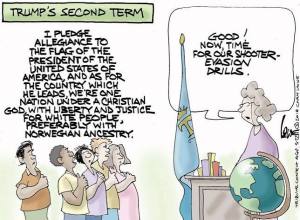 This last bit of news has me very angry having lived through the period when segregation in schools was either the rule or the geographic fact up in to the period where desegregation became the rule. This is also from the AP. “Trump administration moves to limit fixes for systemic racism in schools.” Annie Ma has the story.
 peej
peej Carissa
 bostonboomer
 dakinikat
 ecocatwoman
 jjlo
jjlo mablue2
 Mama Lopez
 peggysue22
 quixote
 skydancingguestblogger
 Mona (aka Wonk the Vote)





Recent Comments