
Mostly Monday Reads: The Clusterfuck Express
Posted: September 28, 2026 Filed under: #FARTUS, #MAGAnomics, American Economic Unbalance, Trump Created Economic Pain, Trump Created Economic Unfairness, Trump grifting | Tags: @johnbuss.bsky.social John Buss, Crisis in Nation's Farms, Crisis in Nation's Food Banks, Eat the Rich, Economic Fairness, Trump Created Economic Pain, Trump Grift 2 Comments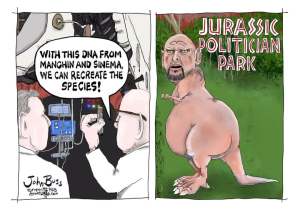
“Sometimes, science isn’t all that great. No need to create DINOs in the lab.” John Buss, @repeat1968
Good Day, Sky Dancers!
If ever a case could be made that the politicians sent to the District to represent the people couldn’t be more out of touch, this year’s case would take top prize. As someone who has taught and studied fiscal and monetary policy for decades, I’ve never had such a tough time explaining how opposite everything is right now. I imagine those who research and breathe military and foreign policy will say the same thing. The people’s priorities are dead last.
And it shows in the headlines. I’m going to start with a few examples of how badly consumers (e.g., voters) are being treated these days. It’s no wonder there’s a scramble to rig and suppress votes by this administration. This is a sad story to bring up as we face the new school term and Thanksgiving. It comes from MTN. “They don’t understand the scale of the hunger!” – An unfolding crisis at the nation’s food banks. Weeks before the midterm elections, the cost crisis is hammering food pantries in red and blue states”. No one can do well at school, work, or life with an empty, aching stomach. Scott McFarlane has the story.
On the shelves inside the giant food bank warehouse in Rockville, Maryland, you see a giant stack of flour packets. The sign next to the stack says “1 each” for those packing up food boxes for families.
A shorter stack of canned “mixed fruit” is next to the flour. An even shorter stack of canned tuna is the next to the fruit.
But it’s the empty shelves above that tell the story.
The demand for donated food is unprecedented at the Manna Food Center.
In fairness, this is a challenging moment for food banks and pantries across the country, including in this diverse suburb 20 miles north of Washington, D.C.
Food banks have two fundamental, destabilizing problems that are getting worse:
- The food is getting more expensive
- The diesel to deliver the food is getting more expensive
With just a few weeks remaining until a highly-anticipated midterm election, the cost crisis is worse than some elected leaders – including President Trump – are acknowledging.
A week of interviews and food pantry visits by Scott MacFarlane Reportsreveals the depths of the problem. Some of the reality is masked by Trump’s claims that the economy is the greatest in history, in the “hottest country in the world.”
A newly-released study called the “Hunger Report”, produced by a Washington, D.C.-based food bank group had an alarming diagnosis: “The state of food security more broadly is deteriorating.”
Some of the findings are just gutting.
The survey found broad swaths of people who acknowledge they:
- Cut the sizes of their children’s meals, due to the cost of the food
- Have children who didn’t eat for an entire day
- Skipped meals, to save money
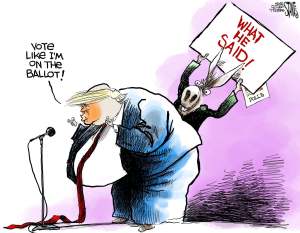 It certainly is the fault of the farmers and ranchers of this country. They are hard hit too. So hard hit, the Iowa is quite close to turning Blue as is Nebraska. This is an article from last May, also known as planting and baby animal season that sums up what the agriculture sector is facing. It’s from an economic stie called MarketPlace. Caitlin Tan has the analysis if the situation. “Many farmers, ranchers stare down an economic crisis. Across the U.S., farmers and ranchers are struggling to weather a growing season plagued by drought, high prices, and a trade war.” Sounds like what you used to read in history about the Great Depression doesn’t it?
American farmers and ranchers are staring down a lot of financial pressure: fuel and fertilizer prices, the war in Iran, tariffs, drought, and more.
In the West, it’s that time when ranchers move their cattle to public grazing lands, so the cattle can eat. But the summer pasture that normally feeds cattle through the fall isn’t very green and lush this year.
“The big word is drought,” said Jim Magagna, executive vice president of the Wyoming Stockgrowers Association.
That means ranchers are looking to buy hay, Magagna said. Extra hay can cost $30,000 on the low end, and hundreds of thousands on the high end.
Ranchers’ other option, he said, is to sell off some of their livestock. Selling could pad ranchers pockets right now, and Magagna advised ranchers to hold onto that cash.
“It may sorely be needed in 2027, 2028 and beyond,” he said, because financial woes are growing for those who live off the land.
“So many farmers are reporting, you know, that they’re kind of on the brink of a crisis situation,” said Aaron Lehman. A fifth-generation farmer, he grows corn, soybeans, and oats, and is president of the Iowa Farmers Union.
Lehman said his costs are soaring, and so are his neighbors’, for labor, health insurance, fuel, and fertilizer.
“For a medium sized farm like mine, they had an increase in costs of about $20,000,” he said.
Last December, the White House announced a $12 billion aid package for farmers. And recently, the White House said China will purchase billions of agricultural products from U.S. farms.
But Lehman is not encouraged by that development.
“Farmers don’t know exactly what to think. They hear some vague news and vague promises and then there’s nothing concrete about it,” he said.
That instability shows up at t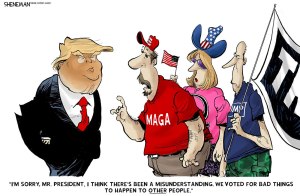 he bank. Nick Levendofsky, executive director of the Kansas Farmers Union, said lenders are backing off.
It’s from that point in the spring to this headline today at CNN. “‘Is it really worth it to keep going on?’ Economic pain hits America’s farm belt.” This does not meet our expectations for a functional market where the supply and demand should equal in the texbook sense. Obviously both producers and consumers are experiencing some pretty drastic factors. All of these factors are from bad policy by the White House. It doesn’t take an economist to figure any of this out. Chris Isidore and Tami Luhby share the lede.
Notice this first farmer has had his farm in the family that made it through the Great Depression and quite a few other kinds of Panics which is what they called some of action in the past.
John Yeley has spent the last 26 years working on his farm, which his family has owned since 1852.
Yeley is the seventh generation to run his farm in Illinois, just over the state line from Indiana. Although he plans to keep doing so, he’s not sure he wants his 16-year-old son and 12-year-old daughter to take over because the current economics are so rough.
“Right now, the way all of this is now, no, I wouldn’t wish it on them,” he said about farming.
Farmers like Yeley as well as agriculture experts agree that the farming sector is in a painful recession. Farms are dealing with record-high diesel prices, a fuel that is critical to their equipment. Trade disputes have cut off access to vital markets. Wars in Ukraine and the Middle East have sent fertilizer costs soaring, just as farmers pay higher interest rates on the loans needed to get from planting to harvest season.
Yeley is not sure he’ll earn a profit this season, even with prices up for for his corn and soybeans.
“We’re not a big county, but we’ve had three farmers go under this year,” said Yeley. “I know that’s on the minds of everybody, is it really worth it to keep going on? The stress level is pretty high.”
Currently, the price of diesel is the most pressing problem for farmers.
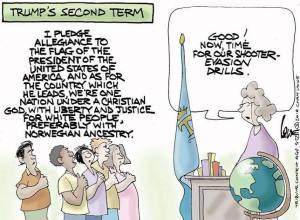 So what kind of idiot would start a series of wars where oil is most at play? Yeah, that’s rhetorical. Trump’s ‘foreign policy’ basically ignores the reality of how intertwined our economies are and how easily a market can be disrupted. That kind of knowledge has been common since the world’s great minds picked apart the Great Depression and the World Wars. Unfortunately, the world’s great minds or even the country’s aren’t a play here. This country isn’t what it used to be at all.
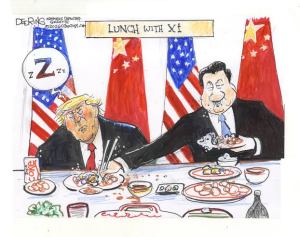
President Trump has asked Xi Jinping, the leader of China, whether he would like to buy American weapons, David Perdue, the American ambassador to China, said in a television interview on Sunday.
“President Trump continues to say, ‘Hey, we sell arms to other people around the world,’” Mr. Perdue said on “Fox News Sunday” while discussing the state visit by Mr. Xi to Washington last week. “He actually asked President Xi would he like to buy some at one point.”
Mr. Perdue did not give further details and did not reveal Mr. Xi’s reply.
An admission that the American president offered to sell arms to China is extraordinary. The Communist-ruled nation is considered by most American policymakers and legislators of both parties to be the greatest military, economic and diplomatic rival of the United States — the only real challenger to America as a superpower.
When asked for comment, the White House said through a U.S. official that the United States had no plans to sell arms to China. The State Department said in a statement that “U.S. law prohibits arms sales to China and there is no offer or plan to sell arms to China.”
The Chinese Embassy in Washington did not immediately respond to a request for comment.
China has the world’s fastest-growing military, and for decades U.S. officials across administrations, including in the current one, have warned of a potential military clash between the two nuclear-armed powers in the Asia-Pacific region, particularly over the island of Taiwan or China’s aggressive actions in territory claimed by U.S. allies in the South and East China Seas.
Chinese defense companies, with the approval of the Chinese government, are supporting adversaries of the United States, including Iran and Russia, by selling them dual-use equipment and satellite imagery, as well as planning the secret export of weapons, according to U.S. officials. The United States has imposed sanctions on some Chinese companies.
 The link is gifted. So is this one written by Guest Essayist Tim Wu, which was published today by The New York Times. Wu worked on economic issues during the Biden Administration. It’s all about the big word that Trump finds appalling. “Affordability Is a Winning Message for Democrats. But There’s an Even Better One.”
The most important political division in our times is not between Democrats and Republicans, or socialists and capitalists; it’s between those who think today’s economic system is fair and working well for most people, and those who do not. While a minority of Americans defend the current system, citing aggregate indicators like growth rates, a majority see things differently.A recent CBS News poll found that some 60 percent of Americans think the economy is “unfair” and that most people under 45 say they have fewer economic opportunities than their parents did. In a recent Economist/YouGov poll, 66 percent of Republicans said that the gap between rich and poor is a “big problem.” Though the stock market is up and the United States is not suffering a recession or mass unemployment, Gallup’s monthly Economic Confidence Index has been persistently negative.
To run a proper affordability campaign — one that taps into a discontent even deeper than that over high prices — Democrats should cater to this widespread sense of unfairness. The key message is rebalancing: a promise to level out a lopsided economy that favors huge concentrations of wealth.
That message can risk sounding like generic political talk about standing up for the little guy. Credibility has to come from a platform of policies that shift economic power away from the big guys in ways that voters can readily understand.
You see this in the platforms of candidates who have run on affordability. Mr. Mamdani’s government-run groceries stores are supposed to make milk cheaper, yes — but also to undercut the power of corporate food conglomerates. Ms. Sherrill’s utility tariff for data centers is designed to lower energy prices for consumers, yes — but also to force Big Tech to pay for its own infrastructure. Mr. Sand hopes to lower home prices, yes — but in part by barring private equity from buying up single-family homes as investments.
What we are seeing is the resurgence of an age-old American ideology of economic balance. While it lacks a formal name, it may well be the most popular ideology in the country.
There are signs on the campaign trail that some Democratic candidates grasp the appeal of this broader affordability message, as when Mr. Talarico, running for Senate in Texas, says that “the biggest divide in this country is not left versus right” but rather “top versus bottom.” Democrats should not be afraid to hit this message harder: The problem is not just high prices but also the structure of the economy. If Democrats can embrace what affordability is really about, they might do even more than win elections; they might bring about the change that most Americans, including most Republicans, say they are looking for, and in so doing, realign our politics.
This article by Josh Marshall writing at TPM shows that the grifting is still ongoing. Why do we have to put up with this? “US Tax Dollars Now Used to Secure Deals for Trump Family Cronies.” Why isn’t this an outrage to everyone in the Congress? Mike Johnson clearly needs to go, but who knows what’s up around Shreveport. I certainly don’t.
This has gotten very little attention, as far as I can tell. But it sounds quite sleazy and another example of the US government becoming a de facto investment arm of the Trump Corporation/TrumpaNostra. Lukoil, the Russian oil company, put up for sale most of its foreign assets outside of Kazakstan about a year ago. This was in response to new US sanctions. Carlyle Group and a couple other bidders have wanted to purchase these assets but approvals have been stalled in regulatory approvals in Washington. Now a group lead by billionaire financier Todd Boehly is close to securing the deal. Partnering with him are, according to The Financial Times (paywall), a group of “Gulf power brokers with ties to the Trump family” and … the US government itself, in the form of the US International Development Finance Corporation.
The current CEO of the DFC is Ben Black, son of Leon Black, a decades-long Trump pal and business associate, who is deep, deep into the Epstein saga and controversies.
The Trump-connected families are …
The US International Development Finance Corporation and Sheikh Tahnoon bin Zayed al-Nahyan, the United Arab Emirates’ national security adviser and brother of its president, are in Boehly’s consortium. The billionaire Syrian-Qatari Al-Khayyat family, which has worked closely with the White House and Trump family members on property and energy projects, is also included.
The Al-Khayyat bros (two brothers, not using that term just loosely) are partners in that (fairly controversial) Albanian resort development that Jared and Ivanka. So pretty extensive ties. The UAE guy’s brother speaks for itself.
International oil financing is way outside my expertise. But it certainly sounds like the US government through the DFC is being used leverage a deal for business pals of the Trump family. The US government has to approve any deal. And one would imagine this deal will have something of an inside track since the US government is a member of the consortium making the deal. I don’t think there’s anything specifically or narrowly illegal about this. But it’s pretty clearly the US government now becoming a tool – now through direct investments of US tax dollars – of Trump family business.
Yes, it’s said that Life is Unfair, but does our government really have to make it so much worse for the majority of us? And, why do people keep voting these idiots into office? Haven’t we had enough of this?
So, yes, I’m a disgusted about things today. Why aren’t these crooks headed to jail?
What’s on your Reading, Action, and Blogging list today?


 peej
peej Carissa
 ecocatwoman
 jjlo
jjlo mablue2
 Mama Lopez
 peggysue22
 quixote
 skydancingguestblogger
 Mona (aka Wonk the Vote)





Yeah, Right. Just keep telling lies. May the voters make you the biggest loser. Or are you talking climate change?