
Lazy Caturday Reads: Climate Change and the LA Wildfires
Posted: January 11, 2025 Filed under: cat art, caturday, Climate change, just because | Tags: Big Oil, Climate change, Los Angeles wildfires, Palisades Fire, snow 4 CommentsGood Afternoon!!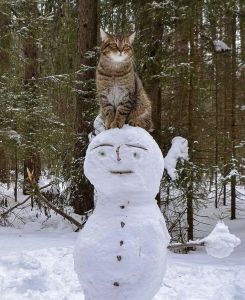
We are getting some snow here in Greater Boston. It doesn’t look like it will amount to much, but it’s pretty to look at. I miss having big snowstorms. It seems as if climate change has destroyed us New Englanders’ identity as tough people who handle deep snow and frigid cold with aplomb.
In the winter of 2014-2015, Boston got an unbelievable snow total of 110 inches, with 64.8 inches coming in February. On January 26-27, a blizzard dropped more than 34 inches of snow. Now we’ve gone through several mild winters with very little snow. Personally, I miss the old days of giant snowstorms. And I know I’m not alone.
This is a transcript of a program at WBUR in February, 2024: What we lose if snow disappears.
Snowpack is getting less reliable in American winters. And in many places, that’s not just an environmental problem, but an emotional one, too.
Guests
Justin Mankin, climate scientist. Director of the Climate Modeling and Impacts Group at Dartmouth College.
Tony Wood, reporter for the Philadelphia Inquirer. Author of “Snow: A history of the world’s most fascinating flake.“
Also Featured
Benjamin Moser, Pulitzer Prize-winning writer.
Ben Popp, executive director of the American Birkebeiner Ski Foundation….
MEGHNA CHAKRABARTI: This is On Point. I’m Meghna Chakrabarti, and sure snow can be a pain in the butt, I know. But for folks who grew up with long winters, snow also carries memory with it of ethereal beauty, hard slogs, and hard times overcome of crystalline joy. I grew up in a place with a pretty temperate, very rainy winter.
So when I moved to New England and experienced my first big blanket of snow, I was left with only one feeling: pure magic. Now though, for listeners who shared those stories with us that you just heard, they were from upstate New York, Utah, Colorado, Wisconsin, New Hampshire, Washington State, Maine, Iowa, Ohio, the Dakotas and more.
For all of them, winter is very different. Because the magic feels like it’s fading away….
(LISTENER MONTAGE)
I’m standing in my front yard and there is a tiny bit of ice that used to be snow that’s melted in the shade, and we’ve had almost no snow.
It’s February 2nd and I live in Western New York and there is no snow today. The ground is bare. I can see grass. This is completely different from what I experienced when I was growing up.
I have a four-year-old golden, who’s only ever played in a few inches of snow. Has no idea what it’s like to run and fly and bound through endless puffy snow.
This year’s snow amount is quite depressing.
I think our snow drought is contributing to our overall drought that we’ve been experiencing in eastern Iowa over the last five years or so.
This year for the very first time, when I go outside, sometimes I occasionally find flies or mosquitoes or bees, and so to me, seeing insects that are typically not around during the winter months. It tells me there’s clear change happening.
I miss the snow. I miss watching it fall. I miss how it muffles the noise and just makes things so peaceful and quiet.
I really miss having snow for Christmas and for the kids to play sled and built snow forts.
When my kids were growing up, they were outside all the time. Now our young grandchildren can’t really go outside so much and all the time. Because it’s a mud pit instead of a snow mound. So it’s hard.
The roads in town are as oddly bare as the trails here and one local businesses’ electronics door front sign captures our community’s collective sentiment. It keeps flashing “Pray for snow.”
CHAKRABARTI: It is true. Snowfall is becoming less reliable and snowpacks are shrinking. Winter snowpack in many parts of the continental U.S. have shrunk by 10% to 20% per decade over the last 40 years. That’s according to a study published last month in Nature. There is some annual variation, but overall winter and its signature precipitation are changing.
Snow has a way of creating a shared identity, a sense of wonder, a sense of fun for people who live in those cold places. It binds communities together. So what do we lose when that snow melts away?
Climate change is not only changing the way we live; it is change how we see ourselves. Read the discussion at the WBUR link. If you live in a place that used to get lots of snow, I think you’ll find it interesting.
 The Guardian: 2024 was hottest year on record for world’s land and oceans, US scientists confirm.
It was the hottest year ever recorded for the world’s lands and oceans in 2024, US government scientists have confirmed, providing yet another measure of how the climate crisis is pushing humanity into temperatures we have previously never experienced.
Last year was the hottest in global temperature records stretching back to 1850, the National Oceanic and Atmospheric Administration (Noaa announced, with the worldwide average 1.46C (2.6F) warmer than the era prior to humans burning huge volumes of planet-heating fossil fuels.
This new record, 0.1C (0.18F) hotter than the previous high mark set in 2023, means that all of the 10 hottest years since 1850 have occurred in the past decade. The data supports separate figures released by European Union scientists this week that also show a record 2024, albeit those figures showed 2024 was 1.6C (2.8F) hotter than pre-industrial times, the first measure beyond the internationally-agreed threshold of keeping long-term temperatures below a 1.5C (2.7F) rise.
Nasa, which also released its temperature data on Friday, concurs that 2024 was a record year, being 1.47C (2.6F) hotter than the pre-industrial era. “All the groups agree, regardless of how they put the data together, there’s no question,” said Gavin Schmidt, a senior climate scientist at Nasa. “The long-term trends are very clear.”
Schmidt said the levels of global heating are pushing humanity beyond its historical experience of the Earth’s climate. “To put that in perspective, temperatures during the warm periods on Earth three million years ago – when sea levels were dozens of feet higher than today – were only around 3C warmer than pre-industrial levels,” he said. “We are halfway to Pliocene-level warmth in just 150 years.”
Last year saw a record hot year for the United States, Europe and Africa, as well as another record year for the Arctic, which is warming up at three times the rate of the global average.
The year was marked by severe events worsened by the climate crisis, with temperatures so hot in Mexico that howler monkeys fell from trees, a double-whammy of hurricanes that flattened swathes of the US south-east, devastating floods in Spain and record low water levels in the Amazon river. Southern Africa got just half of its normal rain levels.
Now in 2025 we are seeing an unbelievable climate disaster in Los Angeles. I heard this morning that the burned area in LA is now larger than the city of Boston.
CBS News: Maps show how California’s Palisades Fire in Los Angeles area compares in size to major U.S. cities.
California’s Palisades Fire, the largest of the deadly wildfires that ignited this week in the Los Angeles area, has devastated communities and upended thousands of lives, forcing people to flee homes that were lost to the blaze. The inferno has scorched dozens of square miles, and maps from CBS News show how its size compares to those of major U.S. cities.
Here’s a look at how the Palisades Fire compares to the size of 13 cities across the U.S.
The maps show comparisons to Baltimore, Boston, Chicago, Dallas, Denver, Detroit, Miami, Minneapolis, New York City, Philadelphia, Pittsburgh, Sacramento, and San Francisco.
Check out the comparisons to cities you are familiar with.
Analysis by meteorologist and climate journalist Eric Holthaus at The Guardian: The Los Angeles wildfires are climate disasters compounded.
An exceptional mix of environmental conditions has created an ongoing firestorm without known historical precedent across southern California this week.
The ingredients for these infernos in the Los Angeles area, near-hurricane strength winds and drought, foretell an emerging era of compound events – simultaneous types of historic weather conditions, happening at unusual times of the year, resulting in situations that overwhelm our ability to respond.
On Wednesday, Joe Biden pledged the assistance of the Department of Defense to reinforce state and local firefighting capabilities, a rare step that highlighted the extent to which the fast-moving fires have taxed response efforts.
As of Wednesday evening, the Palisades and Eaton fires have each burned more than 10,000 acres and remain completely uncontained. About one in three homes and businesses across the vast southern California megacity were deliberately without power in a coordinated effort by the region’s major utilities to contain the risk of new fire starts due to downed power lines.
The Palisades fire now ranks as the most destructive in Los Angeles history with hundredsof homes and other structures destroyed and damage so extensive that it exhausted municipal water supplies. In Pacific Palisades, wealthy homeowners fled by foot after abandoning their cars in gridlocked neighborhoods. In Pasadena, quickly advancing fire prompted evacuations as far into the urban grid as the famous Rose Parade route.
Early estimates of the wildfires’ combined economic impact are in the tens of billions of dollars and could place the fires as the most damaging in US history – exceeding the 2018 Camp fire in Paradise, California.
Fire crews have been facing a second night of fierce winds in rugged terrain amid drought and atmospheric conditions that are exceedingly rare for southern California at any time of the year, let alone January, in what is typically the middle of the rainy season – weeks later (or earlier) in the calendar year than other historical major wildfires have occurred.
Analysis:
The next few days will be a harrowing test. Lingering bursts of strong, dry winds into early next week will maintain the potential for additional fires of similar magnitude to form. In a worst-case scenario, the uncontained Palisades and Eaton fires will continue to spread further into the urban Los Angeles metro, while new fires simultaneously and rapidly grow out of control – overtaking additional neighborhoods and limiting evacuation routes more quickly than firefighters can react. In conditions like these, containing a wind-driven blaze is nearly impossible.
These fires are a watershed moment, not just for residents of LA, but emblematic of a new era of complex, compound climate disaster. Conditions for a January firestorm in Los Angeles have never existed in all of known history, until they now do.
The short answer is that the greenhouse gases humans continue to emit are fueling the climate crisis and making big fires more common in California.
As the atmosphere warms, hotter air evaporates water and can intensify drought more quickly.
Melting Arctic ice creates changes in the jet stream’s behavior that make wind-driven large wildfires in California more likely. Recent studies have found that Santa Ana wind events could get less frequent but perhaps more intense in the winter months due to the climate crisis.
The more complicated answer is that these fires are an especially acute example of something climate scientists have been warning about for decades: compound climate disasters that, when they occur simultaneously, produce much more damage than they would individually. As the climate crisis escalates, the interdependent atmospheric, oceanic and ecological systems that constrain human civilization will lead to compounding and regime-shifting changes that are difficult to predict in advance. That idea formed a guiding theme of the Biden administration’s 2023 national climate assessment.
Read the rest at The Guardian.
Tzeporah Berman at The Guardian: Los Angeles is on fire and big oil are the arsonists.
Apocalyptic flames and smoke are raging through southern California in the worst fire in Los Angeles county’s history. At least seven people have died. Thousands of structures have been destroyed. Hundreds of thousands of people have fled their homes. The private forecaster AccuWeather estimates initial damage and economic loss at more than $50bn and has the potential to be the costliest wildfire disaster in American history. The impacts of the disruption and loss faced by community members is incalculable.
While some media outlets are discussing the link between the Los Angeles fires and the climate crisis, the president-elect Donald Trump and rightwing media are using this devastating event to foster misinformation including denying the role of climate crisis.
These powerful interests are ignoring what is fanning wildfire flames – fossil fuel-driven climate change – and trying to deflect attention elsewhere. This is not surprising. Denying science and promoting false narratives squarely falls within the playbook of the fossil fuel industry and its proponents. Take for example, Trump calling the climate crisis a hoax and once again threatening to withdraw the US from the Paris agreement.
Oil, gas and coal companies have been lying to us for decades. A 2015 investigation by Inside Climate News revealed that ExxonMobil’s own scientists knew as early as the 1970s that burning fossil fuels would cause global warming and increase the likelihood of extreme weather events. Instead of pivoting toward cleaner energy solutions, Exxon and other major players funded misinformation campaigns to sow doubt about climate science, delaying action and worsening the crisis.
California is part of a growing number of states and local governments challenging these lies through litigation. The legal suits against six oil companies and the American Petroleum Institute accuse them of deceiving the public regarding the connection between fossil fuels and climate crisis and profiting from that deception. The aim of the litigation is to redirect those profits into funds to address the damage of climate crisis on California. The litigation is still underway.
The science is clear. Wildfires are getting worse due to climate crisis as a result of increased temperatures and drier conditions in southern California. While more work needs to be done to determine the specific role fossil fuels played in the Los Angeles fires, we do know that emissions from the world’s 88 largest fossil fuel companies are responsible for 37% of the cumulative area burned by forest fires in the western US and south-western Canada between 1986 and 2021.
Ethically, the responsibility is undeniable. By continuing to expand production, fossil fuel companies are prioritizing shortterm profits over longterm planetary survival. As academic Naomi Oreskes points out in her book Merchants of Doubt, this is not mere negligence – it is a calculated decision to disregard human and environmental well-being.
David Gelles and Austen Gaffney at The New York Times: ‘We’re in a New Era’: How Climate Change Is Supercharging Disasters.
As Los Angeles burned for days on end, horrifying the nation, scientists made an announcement on Friday that could help explain the deadly conflagration: 2024 was the hottest year in recorded history.
With temperatures rising around the globe and the oceans unusually warm, scientists are warning that the world has entered a dangerous new era of chaotic floods, storms and fires made worse by human-caused climate change.
The firestorms ravaging the country’s second-largest city are just the latest spasm of extreme weather that is growing more furious as well as more unpredictable. Wildfires are highly unusual in Southern California in January, which is supposed to be the rainy season. The same is true for cyclones in Appalachia, where Hurricanes Helene and Milton shocked the country when they tore through mountain communities in October.
Wildfires are burning hotter and moving faster. Storms are getting bigger and carrying more moisture. And soaring temperatures worldwide are leading to heat waves and drought, which can be devastating on their own and leave communities vulnerable to dangers like mudslides when heavy rains return.
Around the globe, extreme weather and searing heat killed thousands of people last year and displaced millions, with pilgrims dying as temperatures soared in Saudi Arabia. In Europe, extreme heat contributed to at least 47,000 deaths in 2023. In the United States, heat-related deaths have doubled in recent decades.
“We’re in a new era now,” said former Vice President Al Gore, who has warned of the threats of global warming for decades. “These climate related extreme events are increasing, both in frequency and intensity, quite rapidly.”
The fires currently raging in greater Los Angeles are already among the most destructive in U.S. history. By Friday, the blazes had consumed more than 36,000 acres and destroyed thousands of buildings. As of Saturday, at least 11 people were dead, and losses could top $100 billion, according to AccuWeather.
Read more analysis at the NYT link.
CNN Live Updates: Deadly Los Angeles wildfires: New evacuation orders as biggest blaze stretches east.
More stories to check out:
Shane Goldmacher and Lisa Lerer at The New York Times: As L.A. Fires Rage, Trump and Newsom’s Hostilities Resurface.
Peter Baker at The New York Times: As a Felon, Trump Upends How Americans View the Presidency.
AP: Trump is planning 100 executive orders starting Day 1 on border, deportations and other priorities.
Kyle Cheney at Politico: Rudy Giuliani held in contempt for second time this week.
Adria R. Walter at The Guardian: DoJ releases its Tulsa race massacre report over 100 years after initial review.
NBC News: Key senators receive Pete Hegseth’s FBI background check days out from confirmation hearing.
Ivan Nechepurenko at The New York Times: Kremlin Confirms Readiness for Putin to Meet Trump.
That’s all I have for you today. Take care, everyone!


 peej
peej Carissa
 ecocatwoman
 mablue2
 peggysue22
 quixote
 skydancingguestblogger
 Mona (aka Wonk the Vote)



 Sky Dancing
Tom Boggioni at Raw Story: Jeff Bezos’ WaPo reeling from losses and ‘internal drama’ as Trump returns to DC: report.
At a time when the always newsworthy Donald Trump is headed back to the White House, the venerable Washington Post should be gearing up to cover his second term but instead is being subjected to an exodus of top reporters and internal strife, reports the Wall Street Journal’s Alexandra Bruell.
In her report for the Journal, Bruell notes that Amazon founder and billionaire Jeff Bezos, who bought the Post in 2013 for $250 million, just watched his investment lose around $100 million last year as new management has failed to stop the bleeding.
The Journal also reports that top-flight journalists are also fleeing to greener pastures under the management of interim executive editor Matt Murray and publisher William Lewis who has still not righted the ship since his hiring.
Adding to the Post’s problems was a decision to spike an endorsement of Vice President Kamala Harris before the 2024 presidential election that led to a revolt by readers with a reported 250,000 people canceling their subscriptions within days.
According to the Journal, “The changes inside the Post have left many staffers frustrated and confused about the future, the people close to the newsroom said. Journalists across areas from politics to national security, including Ashley Parker, Michael Scherer, Tyler Pager and Hannah Allam, have defected to publications such as the New York Times, the Atlantic and ProPublica. Josh Dawsey, a political investigations and enterprise reporter, is leaving for the Journal, where he worked before the Post,” adding, “National editor Philip Rucker, investigations editor Peter Wallsten and senior national investigations editor Rosalind Helderman are in the latest batch of newsroom leaders taking calls from other publications.”
Fucking Ross Douthat … “O Canada, Come Join Us”
https://www.nytimes.com/2025/01/11/opinion/columnists/o-canada-come-join-us.html
Come home, BB, and we will build a snowman, throw snowballs at the boys next door, go sledding in the park and then have some hot cocoa (with mini marshmallows) to warm up indoors. We’ll be kids again.
We have about 2 feet of snow on the ground here. Yesterday, it snowed for most of the day. From the windows, the cats and I watched it come down. It was our second snowstorm this week. It’s pretty but I’m ready for spring.
Beata
That sounds wonderful, Beata.