
Sunday Reads: Some like it Chill
Posted: August 20, 2023 Filed under: just because | Tags: @repeat1968, Climate change, Climate Deniers, Drought and Heat Wave, Hurricane Hilary, John Buss, Maui Fires, New Orleans Heat Dome, Stormy Weather, The Parrot and the Igloo 5 Comments

Hurricane Hilary swirls near Baja California, Mexico, on Friday. (National Oceanic and Atmospheric Administration)
Good Day, Sky Dancers!
The stress from extreme weather should be sending a huge wake-up call to the community of humans sharing the planet. Relentless heat here is setting records week after week. Now we’re staring down a map of disturbances in the Atlantic and the Gulf that reminds me of Multiball mode in pinball. We’re still receiving unsettling news from Maui after fires destroyed a historic town. Now, we’re watching a Hurricane threatening a good portion of the west coast. I’m still worried about the koala population decimated by fires in Australia in 2020.
Why aren’t we doing more?
This is from Politico. “Hilary will produce ‘really significant impacts’ in California, FEMA administrator warns “People really need to take this storm in California serious,” Deanne Criswell said.” I’m reading this as I begin my hurricane preparations and readiness as a 30-year veteran of hurricanes. I really hope the people in California are getting up to speed quickly.
As the federal government prepares its response to the tropical storm expected to hit parts of Southern California on Sunday afternoon, FEMA is bracing for potentially devastating flooding.“Hurricane Hilary is going to produce some really significant impacts to Southern California,” FEMA Administrator Deanne Criswell said Sunday during an interview on CBS’ “Face the Nation.”
Though the total amount of rain appears unlikely to exceed that of similar storms that more frequently make landfall on the East Coast, people should not downplay this threat, Criswell said.
“People really need to take this storm in California serious,” she said on ABC’s “This Week.” “I think it’s interesting that the total rain amounts aren’t like what we see in some of our Atlantic storms and Gulf storms, but it’s going to really be potentially devastating for them in these desert areas.
The emergency management agency already has a team embedded in California, and is moving additional resources into the state, Criswell said, as the storm moves north toward Mexico and the southwest United States, where it’s expected to cause “catastrophic” flooding.
“They’re a very capable state as well and they have a lot of resources,” Criswell said of California Sunday. But if it does exceed what their capability is, “we’re going to have additional search-and-rescue teams, commodities on hand to be able to go in and support anything that they might ask for.”
The storm is the latest in a series of natural disasters and extreme weather that left communities in need of federal assistance. Wildfires in Hawaii recently raged across a historic Maui town, leaving more than 100 dead and even more without shelter. President Joe Biden will visit Lahaina on Monday to see the devastation first-hand and “reassure” residents “that the federal government is there,” Criswell said.

Volunteers from the West Orange County Community Emergency Response Team load sandbags for local residents as the hurricane approaches. Allen J. Schaben/Los Angeles Times/Getty Images
Isn’t it a relief to have a president in charge of things whose response is not limited to throwing paper towels at people? While President Biden has worked to get a climate change policy on the American Agenda, it’s blocked by the same old pols who adore fossil fuels and the money they receive from them. West Virginia Senator Joe Manchin is a perpetual spoiler. This is from the Washington Post. “White House is torn over Joe Manchin’s fury at climate law he crafted. As White House officials weigh how much to give in to his demands, rift grows between president and senator from West Virginia.”
The obscure federal agency that oversees the nation’s immense tangle of pipelines, power lines, and transfer stations is unfamiliar to most Americans. But it has very much been on Sen. Joe Manchin III’s mind.
By the end of last year, the West Virginia Democrat had become deeply displeased with how the Federal Energy Regulatory Commission was helping the Biden administration advance its aggressive climate goals. Manchin, a staunch ally of fossil fuel interests, was particularly critical of the agency’s efforts to write regulations that more fully consider climate impact when it reviews new natural gas infrastructure.
So he kneecapped the agency. The chairman of the Senate Energy and Natural Resources Committee, Manchin refused to hold a confirmation hearing for the reappointment of Richard Glick, the agency’s chair and a key ally of President Biden, after Glick’s term expired at the end of the year. That has effectively stripped the board of its Democratic majority, leaving it deadlocked and limiting its ability to advance renewable energy projects.
Manchin isn’t the essential tiebreaking vote for Democrats in the Senate anymore, but a year after the enactment of the Inflation Reduction Act — which wouldn’t have passed without his support — he’s irate at the way Biden is implementing the law. And he’s fighting back: Besides his pressure on FERC, Manchin has vowed to oppose appointments to the Environmental Protection Agency and the Interior Department. He is even publicly flirting with running for president in 2024, an unlikely prospect but one that could be devastating for Biden — and a situation that senior White House officials are closely monitoring.
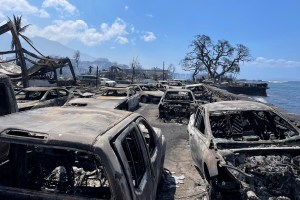
In this photo provided by Tiffany Kidder Winn, burned-out cars sit after a wildfire raged through Lahaina, Hawaii, on Wednesday, Aug. 9, 2023. The scene at one of Maui’s tourist hubs on Thursday looked like a wasteland, with homes and entire blocks reduced to ashes as firefighters as firefighters battled the deadliest blaze in the U.S. in recent years. (Tiffany Kidder Winn via AP)
The horrifying Maui fires are nearly contained, but their damage to one community will be a forever thing. This is from Forbes. “Maui Fire Death Toll Reaches 114 As Island Nears Containment Of Multiple Blazes” The response to the fires is under investigation. Why did this happen? It is probably the more acute question.
The cause of Maui’s wildfires has been attributed to multiple factors. When the blazes first began raging, experts pointed to drought conditions, dry vegetation, and strong winds caused by Hurricane Dora, which was several hundred miles away from Hawaii at the time. Media reports suggested the island’s first fire was likely caused by a power line in the woods of the Maui Bird Conservation Center. Hawaiian Electric, which services 95% of Hawaii’s residents, is facing several negligence lawsuits from residents alleging failure to maintain their equipment and clear vegetation located near utility poles. However, the power company told Forbes this week a cause for the fire had yet to be determined.
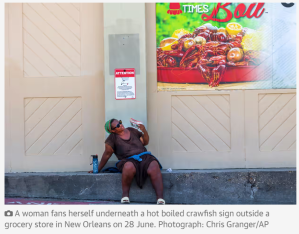
Believe me, it’s odd to live in a tropical zone, experiencing basically desert conditions week after week after week. It’s not normal. I haven’t opened my curtains in days, and I judge the heat by how many cold baths I take. Early in the morning, Temples panting worried me, and I put her in a cold bath. The relentless heat has been the most significant weather topic we’ve had since Hurricane Katrina. The biggest question is, “Will this be the new normal?
The answer – according to the World Meteorology Organization–is yes.
The summer of extremes continues. July was the hottest month ever recorded. The high-impact weather is continuing through August.
“This is the new normal and does not come as a surprise,” said Alvaro Silva, a climate expert with WMO. “The frequency and intensity of many extremes, such as heatwaves and heavy precipitation, have increased in recent decades. There is high confidence that human induced climate change from greenhouse emissions is the main driver,” he told a regular media briefing in Geneva.Moderate and severe heat warnings for the third week of August have been issued by several national meteorological and hydrological services in Europe, including from France, Switzerland, Germany, Poland, Croatia, Italy, Greece, Hungary, Austria, Lithuania.
WMO stresses the need to follow authoritative warnings from national meteorological and hydrological services to stay safe.
During the weekend of 19-20 August, maximum temperatures may reach up to 40 °C in parts of southern France, according to Meteo-France. It said it would be the most intense heatwave of the summer of 2023. This situation is due to a strong high pressure and subtropical warm air from North Africa.
Meteo-Suisse has issued level 3 amber alerts for most of the country, with maximum daytime temperatures between 33 and 35 °C and high nighttime temperatures.Morocco set a new national temperature record of 50.4 °C in Agadir on 11 August, as temperatures crossed 50°C for the first time. Turkey reported a new national temperature record of 49.5°C on 15 August, beating the previous record of 49.1°C set in July 2021. Many parts of the Middle East also saw temperatures of above 50°C.
Spain, including Canary Islands and Portugal, also experienced extreme heat, fuelling an extremely severe fire risk. As of 17 August, the Tenerife wildfire continued out of control, with more than 2600 ha burnt area and people evacuated in some sites. Dry conditions, maximum temperatures above 30 °C, night temperatures above 20 °C, peak wind gusts above 50 km/h were observed on 16 and 17 in some AEMET weather stations of Tenerife.
Japan has also suffered a prolonged heatwave, with many station records broken, according to the Japanese Meteorological Agency, which issued concurrent warnings for torrential rain and typhoon-related floods.
While climate change is controversial to interests aligned with the oil, coal, and gas industries, data shows that America’s voters aren’t as skeptical as some would have you believe. “Climate change issues have a reputation for being divisive. Data show it’s not quite true. The majority of the country believes climate change is happening and is worried for the future. But experts say real change won’t happen until the beliefs are more personal.” This is reported by Grace Manthey.
Climate perspectives vary across the country, but by smaller margins than political leanings.
Nearly three-quarters of Americans believe global warming and climate change is happening. Two thirds are worried about it, according to The Yale Program on Climate Change Communication.
Yale’s program produces Climate Opinion Maps based on a large national survey dataset with more than 28,000 respondents collected between 2008 and 2021. And, the strong majorities nationwide don’t just apply to believing climate change is impacting the weather and might harm people. The data show widespread support for government intervention:
77% of Americans support funding research into renewable energy sources and tax credits for electric vehicles and solar panels
72% believe the government should regulate CO2 as a pollutant
66% support imposing strict limits on coal power plants and taxing fossil fuel companies
For context, the largest popular vote percentage in a presidential election in American history was in 1964, when President Lyndon B. Johnson won 61% of the popular vote.
President Ronald Reagan’s 1984 win was considered a landslide when he nearly swept electoral votes. But Reagan only won about 59% of the popular vote.
These climate change opinions vary by geography with some resemblance to political trends, and democrats are more likely to have pro-climate leanings, a recent Pew survey found.
But the issue isn’t black and white: republicans are not completely against climate-friendly changes and geographic trends on climate opinions aren’t as extreme as political ones.
Here’s something that seems contradictory.
In 92% of counties in the country, more than half of residents are worried about global warming.
That includes Mobile County, AL – the county surrounding the city of Mobile – where 58% of residents are worried about global warming and 59% believe it will harm people.
Meanwhile, Donald Trump received 55% of the 2020 presidential vote in Mobile County.
The most significant disconnect seems to be that those that haven’t experienced it don’t connect to the issue. The analysis in the article is interesting. You can read more at the link. Texas Public Radio provides some clues in its investigation “Why Climate Change Denial is still working.” It’s reported by David Martin Davies.
You may listen to it at the link. Here’s another link to a different interview.
https://twitter.com/NOLALeyda/status/1690372060789313540
Lipsky is a contributor to the Rolling Stone. “How Sun Myung Moon ‘Digested the Scientists’ and Fueled Climate-Change Denial. In an excerpt from his new book The Parrot and Igloo, Rolling Stone contributor David Lipsky reveals a forgotten chapter in the climate crisis — when two once-respected scientists became merchants of doubt and mouthpieces for the Unification Church’s controversial leader.
IF THERE WERE A DENIAL Mt. Rushmore the two biggest heads would be S. Fred Singer and Frederick Seitz. Dishonesty’s Lincoln, lying’s Washington. Together, the two graybeard prophets launched a movement.
Frederick Seitz’s slab would be the larger and more solemn. Most decorated scientist ever to slip over to the dark side, the non-truth side. With just about the grandest possible resume entry: former President of the National Academy of Sciences.
He did it for the old man reasons. Because the new politics made him nervous. Because the new generation made him feel vulnerable and defensive, rickety. (Seitz called students “the youth.”) There are accomplished people who fear any change to the order that once promoted them is really a portent of chaos and doomsday. When Seitz was a university president, one student said hello — and he coolly explained college presidents are not people you say hello to. Fifty years later, climate denial’s most coveted honor is the Frederick Seitz Memorial Award. Its first statuette was delivered by Dr. S. Fred Singer.
Singer’s Rushmore head would smaller, sneakier, giving visible side-eye. He is the man responsible for all of it. There was a big denier convention a decade ago. (Held in Las Vegas; because denial is classy.) The president of a denial think tank raked his eyes across the denial ballroom, took in the denial faces at the denial tables making up his denial audience. “Fred Singer is the most amazing and wonderful person participating in the global warming debate today,” this president explained. “If there’s any person in the world responsible for the development of a skeptics movement on global warming, it’s Dr. S. Fred Singer… Fred is a giant. He is a hero.” Singer is the origin of denial. And here is his origin as a denier.
At this stage of the denial story — end of the eighties, that John Hughes decade — Frederick Seitz is already a denier. This is a story about how and where S. Fred Singer joined him. Singer began as a straight scientist — an environmentalist. Did not attain promotion at the EPA. (HR Departments: be careful who you disappoint.) So he quit. And came back changed. Served briefly in Washington as the Department of Transportation’s chief scientist. And then the surprising part, the historical part of Fred Singer’s journey — his real travels and adventures — began.
The thing this story shows about deniers: they will accept money from . . . anyone. (And once you deny — once your lips break that truth barrier — the succeeding denials become easier and easier. In a sense, you become deaf to the sound made by your own life. As you must.) That openness is what this story is also about. And about how everybody, even people with the most powerful friends, can eventually require the services of a professional denier.
Our friend @repeat1968 (John Buss) gets the last word.
What’s on your reading and blogging list today?
And please stay safe wherever you are!
I had the pleasure of meeting, setting up her microphone, and listening close up to Etta James at Jazz Fest. Believe me, it’s one of the performances I’ve witnessed that I will never forget.


 peej
peej Carissa
 ecocatwoman
 mablue2
 peggysue22
 quixote
 skydancingguestblogger
 Mona (aka Wonk the Vote)



 Sky Dancing
Well, it’s back to the cold bath for me! Take care if you’re in any of these danger zones! We care about you!
Yes, ditto on all this and for you Dak…try to stay cool babe.
Hmmm…
https://www.techtimes.com/articles/295369/20230820/x-glitch-wipes-out-iconic-tweets-links-2011-2014-updates.htm
“ X, the social media platform formerly known as Twitter, has encountered a significant technical glitch that has led to the deletion of images and links posted on the platform between 2011 and 2014.”
“ The glitch appears to have a widespread impact, affecting tweets created during the specified period.
PCMag tells us in a report that notable among these is the disappearance of Ellen DeGeneres’ iconic Oscars selfie. This snapshot generated over 2.8 million retweets and earned its place as the most retweeted post in history.”
Read the rest at the link.
Musk really knows how to fuck things up
Assuming that is what it is. At some point data is going to be unwieldy. You either have to spend money and find new ways to store it, while still leaving it accessible, or purge it. Selective history in the making..Make hard and backup copies of everything.