
Lazy Caturday Reads
Posted: July 3, 2021 Filed under: just because 30 Comments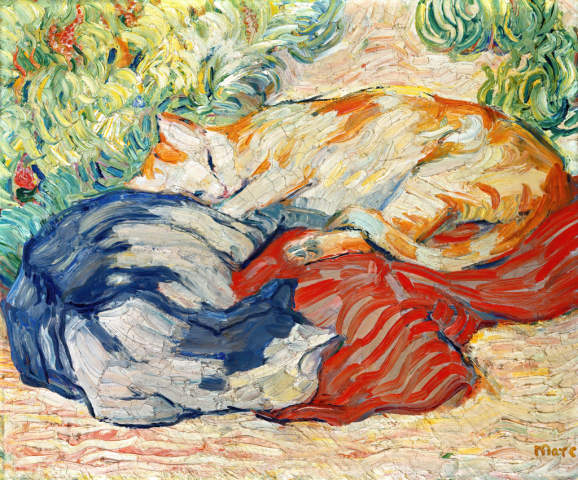
Two Cats on Red Cloth, by Franz Marc
Good Afternoon!!
It has been a strange couple of weeks here in Massachusetts. I don’t usually write much about local news; I hope you won’t mind me doing so today.
Last week we had a heat wave with temps in the high 90s and even hitting 100 last Wednesday. Hours later, intense thunderstorms blew through, taking down trees and knocking out power for thousands of households; and the temperatures dropped into the 60s. Rain has continued for days and yesterday and today temperatures have been in the 50s!
And it wasn’t just the weather. We had two apparent hate crimes
here last week. Even in the one of the bluest of blue states, we can’t escape the horror Trumpism has unleashed. Last Saturday a man who apparently was a white supremacist murdered two black people. NBC News: Fatal shooting of 2 Black people in Massachusetts investigated as hate crime, officials say.
Authorities are investigating a Massachusetts shooting that left two Black people dead as a hate crime after investigators found “some troubling white supremacist rhetoric” in the gunman’s handwriting, officials said Sunday.
Suffolk County District Attorney Rachael Rollins, who identified the suspected gunman as 28-year-old Nathan Allen, said during a press conference on Sunday that investigators found “antisemitic and racist statements against Black individuals.”
“There was hate in this man’s heart,” she told reporters Monday.
Allen was killed by police officers on Saturday afternoon shortly after stealing a plumber’s truck, crashing it into a house and shooting two Black bystanders multiple times in Winthrop, just outside Boston, according to Winthrop Police Chief Terence Delehanty.
The slain bystanders, who were both Black, were identified as David Green, 58, a retired Massachusetts State Police officer; and Ramona Cooper, 60, an Air Force veteran who still worked with the military, according to Rollins. Allen shot Green four times in the head and three in the torso, and Cooper three times in the back.
“He walked by several people that were not Black and they are alive. They were not harmed,” she said. “They are alive and these two visible people of color are not.”

Two Cats, by Suzanne Valadon, 1918
On Thursday a rabbi was stabbed in Brighton. NBC 10 Boston: ‘An Act of Hate And Darkness’: Leaders Denounce Violence at Vigil for Recovering Rabbi.
Rabbi Shlomo Noginski of the Shaloh House, who was stabbed in Boston’s Brighton neighborhood Thursday, used judo training to divert the violent attack out of sight from children, according to his colleague.
“The stabbing happened right here, where you stand,” said Rabbi Dan Rodkin, executive director of the Shaloh House, a Chabad center that runs a school, camp and more. He was speaking to a swath of elected officials, Jewish leaders and community members who gathered in a show of support Friday in Brighton Common, the scene of the stabbing.
Noginski was stabbed eight times in the arm and shoulder just outside of the Jewish Day School on Chestnut Hill Avenue Thursday afternoon. His accused attacker, Khaled Awad, appeared in court Friday, where prosecutors said that the incident began with Awad holding a gun and demanding that Noginski give him the keys to a van.
Police were investigating whether the attack was a hate crime, though many of the speakers at the vigil argued the stabbing was an act of hate.
Noginski’s wife told NBC10 Boston he remained very weak but was happy to be out of the hospital and was looking forward to getting back to work as soon as possible.
A black belt in judo, Noginski used his expertise to defend himself and save children from the traumatic event, Rodkin said. The school told parents that it went into lockdown, but all the children were safe.
“We are here to send a message to everyone — that we, Boston, are not going to sit back,” Rodkin said. “We will fight back. We will bring goodness to the world. We’ll make sure that we will become better people and we will send a strong message — that evil has no place in America.”
Today we saw another unusual event in our state. There was an armed standoff just north of me in Wakefield, MA early this morning. State police were forced to shut down a stretch of I-95 and people in the town were told to shelter in place. This story actually hit the top of Memeorandum this morning.
AP: 9 people in custody after hourslong armed standoff on I-95.
Massachusetts state police said nine suspects have been taken into custody following an hourslong standoff that prompted the partial closure of Interstate 95….
The standoff shut down a portion of I-95 for much of the morning, causing major traffic problems during the Fourth of July holiday weekend.
Authorities said the southbound interstate reopened, but northbound lanes remain closed.
In Massachusetts, Interstate 95 runs from the Rhode Island line, around Boston to the New Hampshire line. Wakefield is just east of where Interstate 95 and 93 meet north of Boston.
The standoff began around 2 a.m. when police noticed two cars pulled over on I-95 with hazard lights on after they had apparently run out of fuel, authorities said at a Saturday press briefing.
Between eight to 10 men were clad in military-style gear with long guns and pistols, Mass State Police Col. Christopher Mason said. He added that they were headed to Maine from Rhode Island for “training.”
The men refused to put down their weapons or comply with authorities’ orders, claiming to be from a group “that does not recognize our laws” before taking off into a wooded area, police said.
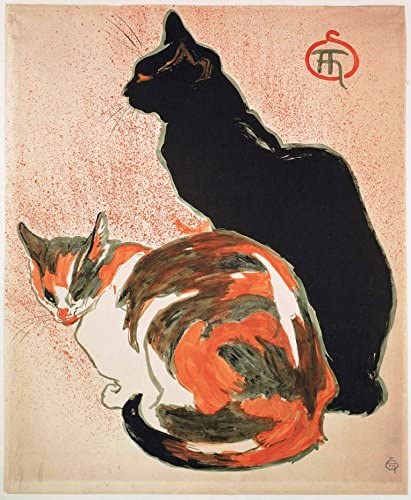
Two Cats, by Theophile Steinlen, 1899
The men belong to a group calling themselves “Moorish American Arms.” WABC NY: 9 arrested from heavily-armed group of men claiming not to recognize laws after standoff.
The bizarre incident played out Saturday morning after a state trooper saw a group of eight to 10 men in military-style uniforms refueling their vehicle on the side of 1-95 around 1:30 a.m. in Wakefield, about 10 miles north of Boston.
The men — who carried tactical gear like body cameras and helmets and had long guns slung over their shoulders — told the trooper they were on their way to Maine from Rhode Island for “training.”
During the traffic stop, two arrests were made. The rest of the group, identifying themselves as “Moorish American Arms,” fled into a wooded area. All were detained by 10:45 a.m. local time, police said….
Massachusetts officials said the group claimed it “does not recognize our laws.” ABC News is asking federal officials whether or not this group is known for extremism.
The Southern Poverty Law Center identifies the Moorish sovereign citizen movement as “collection of independent organizations and lone individuals” that “espouse an interpretation of sovereign doctrine that African Americans constitute an elite class within American society with special rights and privileges that convey on them a sovereign immunity placing them beyond federal and state authority.” [….]
“Members of the Moorish sovereigns, called Moors, have come into conflict with federal and state authorities over their refusal to obey laws and government regulations. Recently, Moorish sovereign citizens have engaged in violent confrontations with law enforcement,” according to the SPLC.
Last month, a Los Angeles man who identified himself as a Moorish sovereign was arrested in Newark, New Jersey, after locking himself inside a woman’s home and declaring it his ancestral property.
UPDATE: CNN reports that there have now been 11 arrests. They say bad news comes in threes, so I hope that will be the end of violent incidents here for now.
Now for some national news.
Trump and his acolytes in Congress continue their efforts to destroy U.S. democracy. William Saletan at Slate: Trump Is Working Harder Than Ever to Undermine Democracy.
On Wednesday, two dozen House Republicans flocked to Texas to show their support for Donald Trump. They joined the state’s Republican governor, Greg Abbott, in applauding the former president as he toured the border, denounced the U.S. government, and repeated the lie that he had been removed from office illegally. “Biden is destroying our country, and it all started with a fake election,” Trump declared as the lawmakers looked on in silence or approval. He accused the United States of “phony elections,” called it a “sick country,” and bragged that as president, he had seized military funds—against the will of Congress, and in defiance of the Constitution—to fund his border wall.
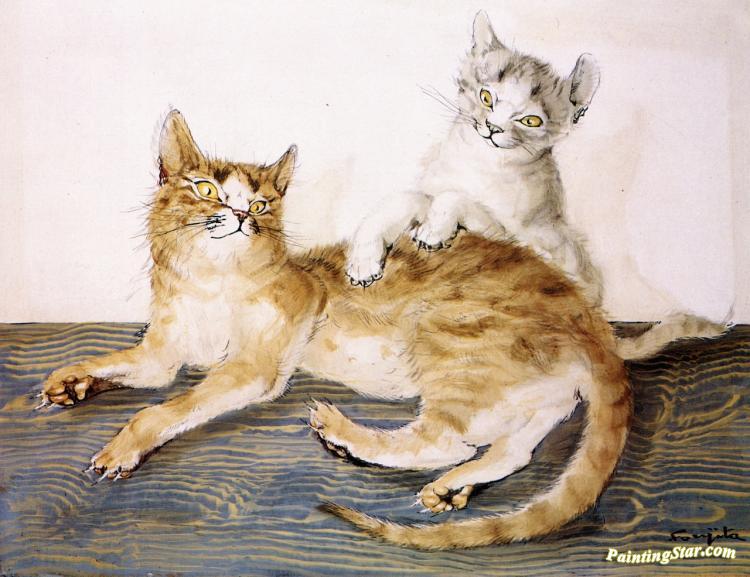
Two Cats Playing, by Tsuguharu Foujita
For many Americans, Trump’s disappearance from Facebook, Twitter, and the mainstream media has left the impression that he has gone away. That impression is false and dangerous. Trump has tightened his grip on the GOP, and he has escalated his campaign to undermine American institutions. His authoritarian movement is a direct challenge not just to President Joe Biden but to the larger alliance of democracies. The fundamental political conflict in our country is no longer between Democrats and Republicans. It’s between people who believe in a democratic republic and people who don’t….
The authoritarian menace extends into our country. In his inaugural address, Biden noted that he was taking office “just days after a riotous mob thought they could use violence to silence the will of the people, to stop the work of our democracy.” He described his inauguration, in the wake of the Jan. 6 insurrection, as “the triumph not of a candidate, but of a cause: the cause of democracy.” A month later, in a conference with European allies, Biden implicitly connected Putin’s propaganda to Trump’s attacks on NATO and the American electoral system. “Russian leaders want people to think that our system is more corrupt or as corrupt as theirs,” said Biden.
Trump is working to spread that message of American corruption and to destabilize the U.S. government. In rallies, interviews, and emails to his supporters, the former president rejects the 2020 election as “fake,” a “hoax,” and a “crime.” He calls Biden’s government “illegitimate” and “unconstitutionally elected.” In May, he said his supporters were right to call him “the true President,” and he essentially demanded to be restored to office, arguing, “If a thief robs a jewelry store of all of its diamonds (the 2020 Presidential Election), the diamonds must be returned.” Republican leaders, far from repudiating Trump’s role in the Jan. 6 attack, blocked his conviction in a Senate trial, thwarted a proposed commission to investigate the attack, and reaffirmed their allegiance to him. On Thursday, House Minority Leader Kevin McCarthy was asked twice whether Trump was “accountable in some way” for “the events leading up to Jan. 6.” McCarthy refused to answer.
Please read the rest at the link. It’s frightening, but true. Yesterday the Arizona Republic broke the news (behind a paywall) that Trump tried to overturn election results in the state–like he did in Georgia. The New York Times: Trump Is Said to Have Called Arizona Official After Election Loss.
President Donald J. Trump twice sought to talk on the phone with the Republican leader of Arizona’s most populous county last winter as the Trump campaign and its allies tried unsuccessfully to reverse Joseph R. Biden Jr.’s narrow victory in the state’s presidential contest, according to the Republican official and records obtained by The Arizona Republic, a Phoenix newspaper.
Two Cats, by Wendy Webber
But the leader, Clint Hickman, then the chairman of the Maricopa County Board of Supervisors, said in an interview on Friday that he let the calls — made in late December and early January — go to voice mail and did not return them. “I told people, ‘Please don’t have the president call me,’” he said….
The Arizona Republic obtained the records of the phone calls from Mr. Trump and Mr. Giuliani after a Freedom of Information Act request.
The Arizona Republic reported that the calls came as the state Republican chairwoman, Kelli Ward, sought to connect Mr. Hickman and other county officials to Mr. Trump and his allies so they could discuss purported irregularities in the county’s election.
Ms. Ward first told Mr. Hickman on Nov. 13, the day after the Maricopa vote count sealed Mr. Biden’s victory in Arizona, that the president would probably call him. But the first call did not come until New Year’s Eve, when Mr. Hickman said the White House operator dialed him as he was dining with his wife.
Mr. Hickman said the switchboard operator left a voice mail message saying Mr. Trump wished to speak with him and asking him to call back. He didn’t….
Four nights later, the White House switchboard operator called Mr. Hickman again, he said. By then, Mr. Hickman recalled, he had read a transcript of Mr. Trump’s call with Brad Raffensperger, the Georgia secretary of state whom Mr. Trump pressured to “find more votes” to reverse his defeat in the state.
“I had seen what occurred in Georgia and I was like, ‘I want no part of this madness and the only way I enter into this is I call the president back,’” Mr. Hickman said.

You can listen to the calls at this Raw Story link.
This post is getting long, so I’ll end with this piece at The Atlantic by U. of Chicago Law Professor Daniel Hemel: The Trump Organization Is in Big Trouble.
If the facts alleged in yesterday’s indictment are true, the Trump Organization and its longtime chief financial officer, Allen Weisselberg, have engaged in blatant tax evasion for more than a decade.
Early reports characterized the crime in question as involving “fringe benefits.” This gives entirely the wrong impression. The Trump Organization and Weisselberg aren’t being charged with tripping over some hyper-technical provision on the margins of the tax system. They are being charged with blatantly violating basic tax-law requirements—and bilking New York State and New York City out of hundreds of thousands of dollars along the way.
Two Cats, by Tony Woods
Probably the strongest allegation relates to an apartment on Riverside Boulevard in Manhattan where Weisselberg lives with his wife. According to the indictment, the Trump Corporation—one of the Trump Organization’s many business entities—paid roughly $100,000 a year in rent, utility bills, and garage expenses for this apartment starting in 2005. The Trump Corporation allegedly didn’t report those payments as compensation on Weisselberg’s W-2 forms, and Weisselberg allegedly didn’t include those amounts in income on his own tax returns.
But the Trump Organization did, according to the indictment, maintain a separate set of books that accounted for the payments as part of Weisselberg’s compensation. Notably, when the Trump Corporation paid Weisselberg’s rent, according to the indictment, the Trump Organization reduced Weisselberg’s salary by a corresponding amount. (Both Weisselberg and the Trump Organization pleaded not guilty yesterday.)
One can describe this as a “fringe benefit”—a tax-law term for any payment for services that is not part of stated compensation—but it’s also plain old tax fraud. Under federal and New York State tax law, lodging provided by an employer to an employee is part of the employee’s gross income. There are limited exceptions to this rule—for example, if the employee is required to live on the employer’s business premises as part of the job, or if the employer is a religious institution and the employee is a clergy member. But Weisselberg wasn’t living on Trump Organization premises because of some business need (and Trumpism is only metaphorically a religion). And if the Trump Organization was keeping a separate set of books recording compensation that it didn’t report to tax authorities, then this was no unintentional oversight.

Read more at The Atlantic. I don’t dare to get my hopes up at this point, but I’m watching and waiting. Maybe this time Trump will actually pay a real price for his behavior.
I hope you all are having a nice Fourth of July weekend. Remember the Delta variant is out there and fully vaccinated people have caught it–so stay safe and wear a mask if you’re around a lot of people indoors. I worry about all the folks who will crowded together even outdoors watching fireworks displays.
Friday Reads: We need a Voting Rights Act!
Posted: July 2, 2021 Filed under: Congress | Tags: 19th Amendment, 2021 Supreme Court Rulings, Indigenous Americans and the fight to vote, Voting rights People of Color 11 Comments Good Day Sky Dancers!
The Democratic Congress Critters have abandoned hope for any sort of Voting Rights Act just as we continue to see the Republicans chip away at voting access and the Roberts Court continue to ensure that. I keep wondering what exactly Chief Justice Roberts has against ensuring all citizens have access to their constitutional right to vote.
The editorial board at WAPO explores this writing: “The Roberts court systematically dismantles the Voting Rights Act.”
At times, Chief Justice John G. Roberts Jr. has labored to maintain the Supreme Court’s legitimacy against the gale-force pressures of partisan acrimony and social division. When it comes to voting rights, he has pushed in the opposite direction, presiding over the court’s systematic dismantling of the Voting Rights Act, overriding Congress’s clear intentions and gravely injuring U.S. democracy.
The first major blow came in 2013, when the court eviscerated the act’s Section 5, which required states with a history of racial discrimination to preclear changes to voting rules with the Justice Department. The decision left in place a backstop, Section 2, which allows legal challenges to discriminatory election rules after they have been enacted. On Thursday, the Roberts court sharply limited that provision as well.
The court upheld two Arizona election rules the Democratic National Committee claimed discourage minority voting. The legitimacy of Arizona’s policies could be debated, and the court could have struck them down without indulging in dangerous overreach. But in its reasoning and guidance for future cases, the six justices in the majority, including the chief, flashed a green light to state lawmakers eager to erect new barriers to voting.
The majority imposed stipulations on applying Section 2 that “all cut in one direction — toward limiting liability for race-based voting inequalities,” Justice Elena Kagan pointed out in a dissent. This new list of restrictions, Justice Kagan continued, “stacks the deck against minority citizens’ voting rights. Never mind that Congress drafted a statute to protect those rights.”
The majority invites states to argue that unnecessarily strict voting rules impose no more than mild burdens on casting ballots, despite the fact that the Voting Rights Act was meant to eliminate obvious as well as subtle forms of voting discrimination. What may appear to be mere inconveniences or seemingly race-neutral rules can in practice reduce minority voting. Some of that is fine, the court said. While admitting that one of the Arizona laws in question disproportionately affects Black, Latino and Native American voters, the majority declared that the difference was too small to matter. Yet elections are often decided by fractions of percentage points, and every vote should be seen as precious.
This reminds me of how the’ve been chipping away at Abortion and other privacy-related rights. It also reminds me of how they keep enabling dark money in elections. What’s with Justice Roberts any way? I mean we know that Republican politicians know they’re increasingly a rump party. They also know that gerrymandering and voting restrictions are the only way to slow down the tsunami of voters not in their narrow demographics. Joan Biskupic, CNN Legal Analyst, put it this way: “John Roberts takes aim at the Voting Rights Act and political money disclosures, again.”
The Supreme Court under Chief Justice John Roberts has hollowed out the historic Voting Rights Act, curtailed regulation of big political donors and limited challenges to partisan gerrymandering.
The final two decisions of the court session on Thursday continued this trend of Roberts’ stewardship that cuts to the heart of democracy and generally benefits conservatives over liberals, Republican voters over Democratic voters.
The pattern on voting rights traces to Roberts’ early years serving in the Ronald Reagan administration when the young GOP lawyer opposed racial remedies and argued for a constricted interpretation of the 1965 Voting Rights Act.
The Supreme Court under Chief Justice John Roberts has hollowed out the historic Voting Rights Act, curtailed regulation of big political donors and limited challenges to partisan gerrymandering.
The final two decisions of the court session on Thursday continued this trend of Roberts’ stewardship that cuts to the heart of democracy and generally benefits conservatives over liberals, Republican voters over Democratic voters.
The pattern on voting rights traces to Roberts’ early years serving in the Ronald Reagan administration when the young GOP lawyer opposed racial remedies and argued for a constricted interpretation of the 1965 Voting Rights Act.
That emphasis reemerged again Thursday, just as Attorney General Merrick Garland has pointed to a “dramatic rise in state legislative actions that will make it harder for millions of citizens to cast a vote that counts.” Dissenting liberal justices on Thursday observed that “efforts to suppress the minority vote continue” yet “no one would know this from reading the majority opinion.”
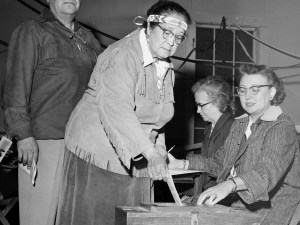
Voting rights advocate Lucy Nicolar Poolaw of the Penobscot Nation casts the first Native American vote allowed on a reservation in Maine, 1955.
WAPO’s E.J. Dionne puts it even more succinctly: “Oligarchy Day at the Supreme Court”.
Thanks to the six right-wing justices on the Supreme Court, our country has just become less democratic. In twin rulings issued Thursday, they said that states can make it harder for people to vote and they made it easier for big donors to sway elections in secrecy
You wonder if July 1, 2021, might come to be known as Oligarchy Day.
It should certainly be the day when advocates of democracy and equal rights rip off their blinders and stop pretending that the court’s conservative majority is in any way impartial or nonpartisan. The decisions in both cases could have been written by the Republican National Committee, attorneys for the Koch brothers and advocates of voter suppression.
In a much-anticipated case on voting rights, the court let stand Arizona laws requiring election officials to discard ballots cast in the wrong precincts and prohibiting campaign workers, community activists and others from collecting ballots.
The larger implication: The ruling in Brnovich, Attorney General of Arizona v. Democratic National Committee will weaken Section 2 of the Voting Rights Act, the most important part of the law left standing after the court’s 2013 decision gutting Section 5 of the law. That part had required Justice Department pre-clearance of voting rules changes in places that had a history of racial discrimination.
In an eloquent dissent rooted in fact, history and a respect for Congress’s right to legislate under the 15th Amendment, Justice Elena Kagan demolished the majority’s crabbed view of democracy. She noted that the Voting Rights Act “confronted one of this country’s most enduring wrongs” and “pledged to give every American, of every race, an equal chance to participate in our democracy.”
She concluded: “That law, of all laws, deserves the sweep and power Congress gave it. That law, of all laws, should not be diminished by this Court.”
But it was.
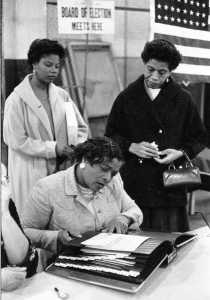
Three African American women at a polling place, one looking at a book of registered voters on November 5, 1957, in New York City or Newark, New Jersey] / TOH, Library of Congress
Last fall, I attended a series of round table discussions on the “The Long 19th Amendment” provided by the Radcliffe Institute. I learned that the amendment not only extended the franchise to women but was also key to extending voting rights of our Indigenous Peoples. Here’s an ariticle from Indianz on the Native American Suffragette, Jenni Monet, and her fight to ensure all Americans can vote.
It took the better part of a century to pass a law saying American women had the right to vote. It took even longer to deliver this right to Indigenous women — which really short-changed all Native Americans.
For the longest time, the word “suffrage” has been aligned with the historic passage of the 19th Amendment, a decree ratified a century ago, this week, outlawing discrimination of voters on the basis of their sex. But in reality, such shorthand, couched in twentieth-century white feminism, was exclusionary. The right to vote in Indian Country tells another side of this struggle in which Indigenous women were on the frontlines from the start.
While the 19th Amendment represents a cornerstone of gender equality in America, few know about the way the vote was won or the limitations it imposed on people of color. Public school curriculum often portrays this history of the suffrage movement through the important advocacy of notable white women, Elizabeth Cady Stanton and Susan B. Anthony.
But there were so many more who helped make female suffrage possible; a few of them were Indigenous women: lawyers such as Marie Louise Bottineau Baldwin of the Turtle Mountain Chippewa Tribe, Yankton-Sioux writer, Gertrude Simmons Bonnin also known as Zitkala-Sa, and Omaha lecturer Susette La Flesche Tibbles.
Leading up to the ratification of the 19th Amendment on Aug. 18, 1920, these Native women participated in suffrage parades, made compelling speeches, and wrote commentary that would likely have gone viral, today. But more intriguing, Indigenous women were the source of inspiration for the movement’s lead organizers, Stanton and Matilda Joslyn Gage.
The women, two New Yorkers who lived on the colonized homelands of the Iroquois Confederacy, wrote how they grew motivated to make lasting voting rights change after recognizing the roles women played in the tribes. Then as now, the Confederacy’s six nations of the Onondaga, Mohawk, Seneca, Cayuga, Oneida, and Tuscarora functioned as a government based on female authority in which Haudenosaunee women maintained authority over their subsistence economy.
They also had final authority over land transfers and decisions about engaging in war. And they practiced a structure of political power shared equally among all clan families and their members — a pure democracy — what also inspired the birth of the United States.
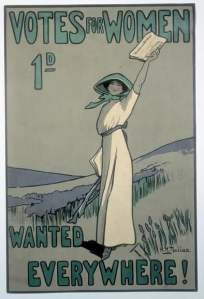
Poster from 1909
NPR has more on this: “Not All Women Gained the Vote in 1920. For many women, the 19th Amendment was only the beginning of a much longer fight.”
When the 19th Amendment became law on August 26, 1920, 26 million adult female Americans were nominally eligible to vote. But full electoral equality was still decades away for many women of color who counted among that number. The federal suffrage amendment prohibited discrimination on the basis of sex, but it did not address other kinds of discrimination that many American women faced: women from marginalized communities were excluded on the basis of gender and race. Native American, Asian American, Latinx and African American suffragists had to fight for their own enfranchisement long after the 19th Amendment was ratified. Only over successive years did each of those groups gain access to the ballot.
In 1920, Native Americans weren’t allowed to be United States citizens, so the federal amendment did not give them the right to vote. The first generation of white suffragists had studied Native communities to learn from a model of government that included women as equal democratic actors. But the suffragists did not advocate for indigenous women. Nonetheless, Native American activists like Zitkála-Šá continued to organize and advocate with white mainstream suffragists. With the passage of the Snyder Act in 1924, American-born Native women gained citizenship. But until as late as 1962, individual states still prevented them from voting on contrived grounds, such as literacy tests, poll taxes and claims that residence on a reservation meant one wasn’t also a resident of that state.
Native-born Asian Americans already had U.S. citizenship in 1920, but first generation Asian Americans did not. Asian American immigrant women were therefore excluded from voting until the Immigration and Nationality Act of 1952 allowed them to gain citizenship more than three decades after the 19th Amendment. Despite being barred from citizenship and from voting, Asian American suffragists such as Dr. Mabel Ping-Hua Lee worked alongside white Native-born women in the years leading up to 1920; Ping-Hua Lee and others advocated within their communities and even marched in suffrage parades.
Latinx women contributed to the success of the suffrage movement at both the state and federal levels, particularly with their efforts to reach out to Spanish-speaking women. And in Puerto Rico, suffragists like Luisa Capetillo worked to attain women’s voting rights, which were first given to literate women in 1929 and all Puerto Rican women in 1935. Yet literacy tests remained an effective means of keeping some Hispanic and other women of color from voting long after the federal amendment was passed. It took a 1975 extension of the Voting Rights Act, prohibitingdiscrimination against language minority citizens, to expand voting access to women who rely heavily on languages other than English.
Some African American suffragists in the north were able, with the 19th Amendment, to realize the rewards of their activism, but throughout much of the country the same voter suppression tactics that kept black men from the polls kept black women from voting, too. Literacy tests, poll taxes, voter ID requirements and intimidation and threats and acts of violence were all obstacles. The struggle for suffrage, which began for black women in the early 1800s, continued until activists such as Fannie Lou Hamer and Diane Nash won the passage of the Voting Rights Act of 1965, 200 years later.
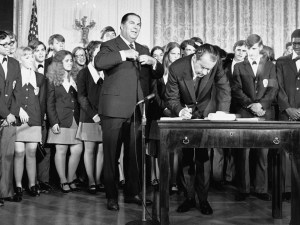
Nixon signs the 26th amendment lowering the voting age from 21 to 18 on July 5, 1971.
There is an interactive display at the link along with some photos of suffragettes of color.
Access to voting is a signficant right for a functional democracy. U.S. News & World Report provides the status of current Republican-held states and their voting restriction laws. “ Report: Republican-Led State Legislatures Pass Dozens of Restrictive Voting Laws in 2021. States with Republican legislatures have passed waves of new laws making it harder for constituents to vote in response to the 2020 election, experts say.”
The court’s ruling follows a report finding that as of mid-June, 17 states had passed 28 laws making it harder for constituents to vote in 2021, according to the Brennan Center for Justice at New York University’s School of Law. The report notes that the last year a similar number of laws passed restricting access to the ballot was 2011 – when 14 states had enacted 19 such measures by October.
Eliza Sweren-Becker, a voting rights and elections counsel at the Brennan Center, called the new wave of voting laws “an unprecedented assault on voting rights” as well as “a voter suppression effort we haven’t seen since the likes of Jim Crow.”
The nation’s high court previously gutted a key provision of the Voting Rights Act in 2013, when Chief Justice John Roberts wrote a majority opinion arguing that jurisdictions with a history of racial discrimination in voting should no longer be subject to oversight from the Department of Justice before effecting changes to their voting laws.
The Brennan Center report attributes this year’s batch of restrictive voting laws to “racist voter fraud allegations behind the Big Lie (a reference to former President Donald Trump’s repeated false claims of a rigged election) and a desire to prevent future elections from achieving the historic turnout seen in 2020.”
Commenting on the former president’s claims of mass voter fraud, Sweren-Becker says, “We know that’s false, but we have officials at the state level passing these laws making it harder for people to vote.”
Some of the specific provisions in these laws that can have a negative impact on voter turnout according to the Brennan Center include restrictions on voting by mail – some 63.9 million ballots had been sent as of Election Day 2020, data from the U.S. Elections Project indicated – challenges to in-person voting, and limitations on the number of mail ballot drop boxes in precincts.
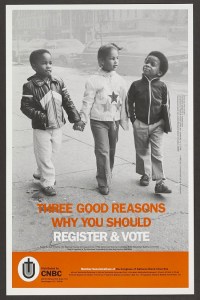 As of now, The John Lewis Voting Rights Act is stalled. The GOP is resisting all forms presented.
Republicans during a U.S. House Judiciary panel hearing on Tuesday argued that a bill that would reinstate a preclearance section of the 1965 Voting Rights Act is unnecessary because there is no discrimination in voting.
The top Republican on the panel, Rep. Mike Johnson, (R-La.), said that the legislation is not needed and that the federal government should not be telling states how to run their electoral processes.
He added that recently voting bills passed by Republicans in Georgia and Florida are meant to “enhance election integrity and increase the public’s waning confidence in our election process.”
“It is outrageous to see the federal government fighting back against these common sense reforms, such as the latest lawsuit filed by the Department of Justice against Georgia over its election law,” Johnson said. The Justice Department announced last week that the agency is suing Georgia in an attempt to overturn the state’s sweeping elections law passed in March.
The comments from the GOP came as Democrats again attempt some type of federal action on elections laws, after a massive legislative package by Democrats known as H.R. 1 was blocked in the U.S. Senate by Republicans. Democrats say the GOP state laws broadly disenfranchise many voters, including those of color, rural residents and people with disabilities.
Rep. Steve Cohen, the Tennessee Democrat who held the House hearing as the chair of the Subcommittee on the Constitution, Civil Rights, and Civil Liberties, contended it is necessary for Congress to pass H.R. 4, the John Lewis Voting Rights Act.
Republicans seem intent on chipping away the rights of ordinary Americans. It is time to stand up against their continued attempts to maintain and expand all vestiges of white nationalism, white male patriarchy, and a dominist christianist oligarchy. The song below sustained me through our fight for the ERA. I got to see and sing this with her in our first Women’s Festival in 1982. I tried desperately to create a festival in 1983 with participation and leadership of black women in the Urban League. We had a successful Festival that follwed Maya Angelou speaking at Equality. Our main speakers were Betty Friedan and Kate Millet. Equal rights and voting rights is important to all our rights in all the various way we participate in American Communities.
Whats on your reading and blogging list today?
Thursday Reads
Posted: July 1, 2021 Filed under: just because 10 CommentsGood Morning!!
This morning, Trump Organization Chief Financial Officer Allen Weisselberg turned himself in to prosecutors in Manhattan.
The New York Times: Top Trump Executive Allen Weisselberg Surrenders to Face Charges.
Donald J. Trump’s long-serving chief financial officer, Allen H. Weisselberg, surrendered on Thursday to the Manhattan district attorney’s office as he and the Trump Organization prepared to face charges in connection with a tax investigation, people with knowledge of the matter said.
The exact charges were not yet known. Prosecutors were expected to unseal an indictment later in the day against Mr. Weisselberg and the Trump Organization, the real estate business that catapulted Mr. Trump to tabloid fame, television riches and ultimately, the White House.
Mr. Weisselberg, accompanied by his lawyer, Mary E. Mulligan, walked into the Lower Manhattan building that houses the criminal courts and the district attorney’s office about 6:20 a.m. He is expected to appear in court in the afternoon along with representatives of the Trump Organization.
The charges against the Trump Organization and Mr. Weisselberg — whom Mr. Trump once praised for doing “whatever was necessary to protect the bottom line” — emerged from the district attorney’s sweeping inquiry into the business practices of Mr. Trump and his company.
As part of that inquiry, the prosecutors in the office of the district attorney, Cyrus R. Vance Jr., had been examining whether Mr. Weisselberg failed to pay taxes on valuable benefits he and his family received from Mr. Trump, including private school tuition for at least one of his grandchildren, free apartments and leased cars.
The prosecutors, who are also working with lawyers from the office of the New York State attorney general, Letitia James, have also investigated whether the Trump Organization failed to pay payroll taxes on what should have been taxable income.
The specific indictments will remain sealed until after 2PM today, when we will learn more about the charges against the company and Weisselberg. More information from The Washington Post:
Weisselberg arrived at the Manhattan criminal courthouse through an employee entrance at about 6:20 a.m., according to journalists who saw him arrive. His attorney, Mary E. Mulligan, confirmed the surrender in a text to The Washington Post.
“Mr. Weisselberg intends to plead not guilty and he will fight these charges in court,” Mulligan said in a statement sent on behalf of Weisselberg from herself and co-counsel Bryan C. Skarlatos….
Although the indictments could pose trouble for Trump, exposing his company to potential fines and intensifying pressure on Weisselberg, neither the former president nor anyone else in his firm is expected to face charges this week. Prosecutors hope Weisselberg will offer testimony against Trump in exchange for lessening his own legal risk, according to a person familiar with the case.
From left, Jennifer, Barry, Erica, Jack, Hilary and Allen Weisselberg are pictured at the inauguration of President Donald Trump in 2017.
Weisselberg, who has worked for Trump since the 1980s, is considered the most important figure in the Trump Organization apart from Trump family members. The Washington Post has previously reported that Weisselberg was a key figure in the investigations by Vance and James. Both have scrutinized whether Trump misled lenders or tax authorities, or evaded taxes on forgiven debts or fringe benefits for employees, according to court papers and people familiar with the cases.
In recent months, both sets of investigators have spoken to Jennifer Weisselberg, the chief financial officer’s former daughter-in-law, who said that Weisselberg’s son Barry had been given a free apartment and a hefty salary while he worked at the Trump Organization’s Central Park ice rink. Prosecutors were looking into whether taxes were paid on the benefits, people close to the investigation said.
The now-merged investigations of Trump’s company appear to be the longest-lasting and most extensive prosecutorial examination ever undertaken of the Trump Organization.

From The New York Times, some background on the Trump CFO: Weisselberg, ‘Soldier’ for Trump, Faces Charges and Test of His Loyalty.
Interviews with 18 current and former associates of Mr. Weisselberg, as well as a review of legal filings, financial records and other documents, paint a portrait of a man whose unflinching devotion to Mr. Trump will now be put to the test.
“Allen is a soldier,” said John Burke, a former Trump executive who worked with Mr. Weisselberg in the early 1990s. “Allen was good at doing what Donald wanted him to do.”
A bookkeeper by training who grew up in Brooklyn, Mr. Weisselberg rose steadily within the Trump Organization to become perhaps the former president’s most trusted business adviser. Over decades, Mr. Weisselberg’s personal and family life became increasingly fused with the company and with Mr. Trump, who is just 14 months older.
After raising his sons on Long Island, Mr. Weisselberg and his wife moved into a Trump-branded building on Manhattan’s West Side, where they lived rent-free for years. He bought a home in South Florida, not far from Mr. Trump’s Mar-a-Lago resort, and traveled there and back on weekends on Mr. Trump’s jet. His older son, Barry, went to work for the company managing Wollman Rink in Central Park and acted as the D.J. for Mr. Trump’s Christmas parties, where Allen Weisselberg let loose on the dance floor, according to people who attended. In 2004, Mr. Weisselberg appeared in an episode of “The Apprentice,” Mr. Trump’s reality television show.
“They are like Batman and Robin,” said Barry Weisselberg’s ex-wife, Jennifer, who has aided Mr. Vance’s investigation after a contentious divorce. “They’re a team. They’re not best friends. They don’t spend all their time together, but the world became so insular for Allen that he did not know anything else.”
Mr. Weisselberg had become so woven into the fabric of the Trump Organization that when Mr. Trump moved into the White House in 2017, he entrusted Mr. Weisselberg, along with the former president’s adult sons, with running his company. His earnings reflected his importance: Between 2007 and 2017, his total pay averaged nearly $800,000 a year; in 2018, he earned more than $977,000 in salary and deferred compensation, according to tax return data obtained by The Times as part of an investigation published last year.
In other news, yesterday the House voted to form a committee to investigate the January 6 Capitol attack.
CNN: House votes to create select committee to investigate January 6 insurrection.
The House voted Wednesday to create a new select committee that will investigate the deadly January 6 attack on the US Capitol, in a vote falling mostly along party lines that signals the political fight to come over the panel’s examination of the insurrection.
The House voted 222-190 to formally create the select panel. Just two Republicans joined with Democrats to support its formation — Reps. Liz Cheney of Wyoming and Adam Kinzinger of Illinois.
Ahead of the vote, House Speaker Nancy Pelosi said on the floor that she was “heartbroken” Congress could not establish a bipartisan commission. Even though the speaker said she was still “hopeful” that a bipartisan commission could happen in the future, Congress had to move forward with the select committee.
“We cannot wait,” Pelosi said Wednesday. “We believe that Congress must in the spirit of bipartisanship and patriotism establish this commission. And it will be conducted with dignity, with patriotism, with respect for the American people, so that they can know the truth.”
Pelosi made the move to establish the committee after Senate Republicans blocked the formation of a bipartisan commission to investigate the January 6 attack.
“Our bipartisan, good-faith proposal was met with a filibuster. Now that Senate Republicans have chosen to block the formation of an independent commission, it falls to the House to stay the course and get the answers they deserve,” said House Homeland Security Chairman Bennie Thompson, who is one of the potential candidates to chair the select committee.
Also yesterday The New York Times published a stunning in-depth video investigation of the Capitol attack. If you haven’t watched it already, I hope you’ll do it today.
From the article:
Congressional committees have looked into police and intelligence failures. The Justice Department has launched a nationwide investigation that has now resulted in more than 500 arrests. And while Republicans in Congress blocked the formation of a blue-ribbon bipartisan committee, House Democrats are poised to appoint a smaller select committee.
Even now, however, Republican politicians and their allies in the media are still playing down the most brazen attack on a seat of power in modern American history. Some have sought to paint the assault as the work of mere tourists. Others, going further, have accused the F.B.I. of planning the attack in what they have described — wildly — as a false-flag operation.
The work of understanding Jan. 6 has been hard enough without this barrage of disinformation and, hoping to get to the bottom of the riot, The Times’s Visual Investigations team spent several months reviewing thousands of videos, many filmed by the rioters themselves and since deleted from social media. We filed motions to unseal police body-camera footage, scoured law enforcement radio communications, and synchronized and mapped the visual evidence.
What we have come up with is a 40-minute panoramic take on Jan. 6, the most complete visual depiction of the Capitol riot to date. In putting it together, we gained critical insights into the character and motivation of rioters by experiencing the events of the day often through their own words and video recordings. We found evidence of members of extremist groups inciting others to riot and assault police officers. And we learned how Donald J. Trump’s own words resonated with the mob in real time as they staged the attack.
Meanwhile the Department of Homeland Security is warning that more violence could be coming later this summer. CNN: DHS raises alarms over potential for summer violence pegged to August conspiracy theory.
Department of Homeland Security officials are warning that the same sort of rhetoric and false narratives that fueled the January 6 attack on the US Capitol could lead to more violence this summer by right-wing extremists.
A growing belief among some Donald Trump supporters that the former President will be reinstated in August, coupled with relaxed Covid-19 restrictions, has DHS officials concerned that online rhetoric and threats could translate into actual violence in the coming months as more people are out and in public places.
The August theory is essentially a recycled version of other false narratives pushed by Trump and his allies leading up to and after January 6, prompting familiar rhetoric from those who remain in denial about his 2020 election loss. But the concern is significant enough that DHS issued two warnings in the past week about the potential for violence this summer.
In a closed-door meeting last Wednesday, DHS officials briefed lawmakers on the role that misinformation and disinformation play in creating circumstances for people to act violently, according to a congressional source familiar with the briefing.
On Monday, DHS issued an intelligence bulletin to state and local law enforcement partners about the increasing opportunities for violent extremist attacks this summer, including concerns that QAnon conspiracy theorists continue to promote the idea that Trump will return to power in August, according to a source familiar.
A few more stories to check out:
Robert C. Gottleib at CNN: Why a gag order against Trump would be a good idea.
Ryan J. Reilly at HuffPost: ‘Sedition Hunters’: Meet The Online Sleuths Aiding The FBI’s Capitol Manhunt.
Charles Pierce at Esquire: Kristi Noem Is Activating Forces That She Does Not Understand and Will Never Be Able to Control.
Politico: Biden admin preps for next pandemic as Delta variant surges.
Ed Yong at The Atlantic: The 3 Simple Rules That Underscore the Danger of Delta.
The New York Times: Supreme Court Upholds Arizona Voting Restrictions.
Stay tuned. I’m sure there are multiple legal experts salivating to get their hands on and analyze the indictments this afternoon. It should be interesting.

 peej
peej Carissa
 bostonboomer
 dakinikat
 ecocatwoman
 mablue2
 Mama Lopez
 peggysue22
 quixote
 skydancingguestblogger
 Mona (aka Wonk the Vote)



 Sky Dancing
Recent Comments