
Full Cold Moon Reads
Posted: December 25, 2015 Filed under: Afternoon Reads | Tags: Christmas Eve Bonfires, Full Cold Moon, Lutcher Louisiana 6 Comments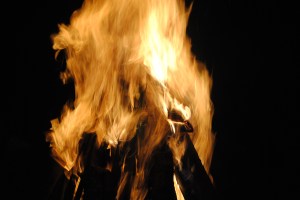
2015 continues to wind down and it can’t happen soon enough for me!
There’s a “Full Cold Moon” today which is an infrequent event. This is when a full moon happens on the day designated for Christmas. We also have an unearthly visitor whizzing by us in the form of a space rock. The pictures for today are from the Lutcher Bonfires made to signal a path into the bayou for Père Noël. I’m going to give you a little background on both since it’s probably a day that you’d prefer to avoid reality for awhile, like me.
Most parts of the U.S. won’t see a white Christmas this year, but they will see a bright one, as a full moon coincides with the holiday for the first time in 38 years.
The final full moon of the year each December is known as the Full Cold Moon, and it hasn’t fallen on Christmas since 1977. Astronomers say it won’t happen again until 2034.
If you want to catch a glimpse, NASA says the moon will reach its peak at 6:11 a.m. EST on Christmas morning.
Moonrise and moonset times vary slightly depending on your location, even within time zones. In New York, the moon rises at 4:28 p.m. EST on Christmas Eve and sets at 7:03 a.m. EST Christmas Day, while the times are a few minutes earlier in Boston to the northeast, and about 20 minutes later in Atlanta to the southwest. Times are similar in other cities across the country, but if you want to be precise about it, you can look up the moonrise and moonset times for your city here.
If clouds interfere with your view, the Slooh Community Observatory is hosting a free webcast beginning at 7 p.m. EST on Christmas Eve. As a bonus, their telescopes will also be tracking Comet Catalina, a recently discovered comet that should be visible for the next few weeks. You can watch the webcast here until midnight EST.
It has been an unusually busy holiday for stargazers, with an asteroid buzzing by Earth this morning. The space rock, about 1.24 miles wide, stayed a safe distance away, passing about 6.6 million miles from our planet.
Full Cold Moons had special meaning to Native Americans long before we brought our European myths and ways to North America. As usual, the solstice is really the reason for the entire season every where!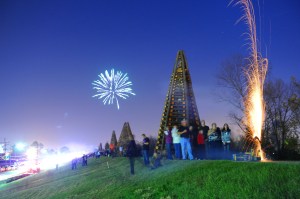
In Native American cultures which tracked the calendar by the Moons, December’s Full Moon was known as the Full Cold Moon. It is the month when the winter cold fastens its grip and the nights become long and dark.
This full Moon is also called the Long Nights Moon by some Native American tribes because it’s near the winter solstice—the night with the least amount of daylight.
So, the tradition of the Lutcher Bonfires on the Mississippi River Levees is an interesting and fun one. The traditional ones are teepee shaped. They are a Cajun tradition here in Louisiana for Christmas Eve. They happen in St. James Parish which we call one of the River Parishes down here.
Many of the bonfires are built in the traditional “teepee” style with a center pole that anchors the structure. Others come in different shapes and color schemes.
“There’s one constructed in the form of a fish with scales, one in the form of an old sailboat with oars,” Keller said. “Then some of the more traditional ones are painted different colors: red white and blue, black and gold, purple and gold.”
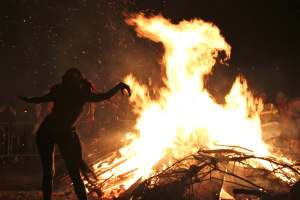 There’s some history involved with the tradition, of course. They are actually based on Celtic traditions where Druids would conduct ceremonies to honor the Sun. The idea was to ensure that the days would get longer after the Winter Solstice.
The area of Louisiana now known as the River Parishes (St. James, St. John and St. Charles) was settled in the early 1700’s by the Old World French and Germans. These early colonists brought with them the knowledge of both summer and winter bonfire customs and traditions which they had known in their native lands. By sharing this knowledge with their many descendants, they provided the inspiration for a practice which has evolved into one giant celebration—the present-day Christmas Eve levee bonfires!
Of necessity, survival and the establishment of a new colony were the principal concerns of the French and Germans who first settled along the lover Mississippi River. These early colonists undoubtedly built a few celebration fires, but early history of the area has failed to record any information about this. As a result, as the bonfire custom increased in recent generations, so has speculation about the origin and development of tradition.
For example, one of the more recent and increasingly popular explanations is that the bonfires were a “Cajun tradition”, first used to light the way for “Papa Noel”, the Cajun version of Santa Claus. This charming version, although improbable, has been depicted annually in front of a Paulina, LA business establishment where a levee scene shows “Papa Noel” with his pirogue drawn by alligators named Gaston, Ninette, “Te-Boy”, Celeste, Suzette, etc.
Some Acadian exiles from Nova Scotia settled in St. James Parish as early as 1765, with many more arriving in the 1780’s, but “Papa Noel” was not yet known to them. It was on New Year’s Eve that the little French children received their gifts.
In South Louisiana of old, Christmas was a strictly religious observance, and it was New Year’s Eve that was marked by the exchange of gifts and the “reveille” to see the old year out and to greet the new year. In Cabanocey: The History, Customs and Folklore of St. James Parish, published in 1957, the author, Lillian Bourgeois, tells of this custom of celebrating New Year’s Eve with a gathering of family and friends who enjoyed a gumbo supper, eggnog and the burning of huge cone-shaped bonfires on the batture, the land area between the base of the levee and the water’s edge. With the passage of time, these activities gradually moved to Christmas Eve.
Some have also offered the theory that the bonfires served as navigational signals to guide ships along the river, or were used to light the way for the faithful to attend Midnight Mass.
Through 1865 letters still in existence, it has been established that the summer feast of St. John the Baptist was then celebrated in neighboring St. John Parish (known as the Second German Coast) with the lighting of fires and the homecoming of relatives who lived away.
A recently discovered 1871 picture shows members of the Lacoul and de Lobel Mahy families gathered around two bonfires built on the levee in front of Laura Plantation in West St. James Parish. The men pictured are wearing coats and the women are wearing hats, but the time of the year is not specified.
In 1989, I participated in a local study on the development of Christmas Eve bonfires in the River Parishes. Many older residents or their descendants were interviewed to learn their knowledge of the history and traditions of the custom.
In a personal interview with H. D’Aquin Bourgeois, son of George Bourgeois, a St. James Parish native born in 1855, I learned that the elder Mr. Bourgeois, an enterprising merchant, had built Christmas Eve levee bonfires in front of his New Camellia Plantation store as early as 1884. Throughout the year, he collected wooden shipping crates, some as large as 3’x5’, in which merchandise for his store had been shipped. These crates, along with old lumber, were used to construct a Christmas Eve bonfire for the pleasure of local residents and the children of his store patrons. The blazing bonfire, the sound of exploding fireworks provided by the store owner, and the gleeful sounds of the children attracted riverboat crews who interrupted their travel to join in the celebration. Bonfires at this location continued until 1930, and in later years grandchildren and great-grandchildren of the original builder resumed bonfire construction at the same site.
Another 1989 interview with Mrs. Hilda Gabb Cambre, a St. James native born in 1901, revealed that she had known Christmas Eve yard bonfires during childhood days spent on her grandfather’s Magnolia Plantation in West St. James Parish. The bonfires, built with any type wood available, were part of a festive occasion where lanterns were placed in the trees and eggnog was served to guests. In later Christmas seasons, kerosene-soaked cotton balls were lit and rolled down the levee. (Could this be a counterpart of the German wheel-rolling down the hillside?)
You can read more about the history of the bonfires and the memories of the River Parish Elders at the link I provided. The one really wonderful thing about Louisiana is its unique heritage that is directly 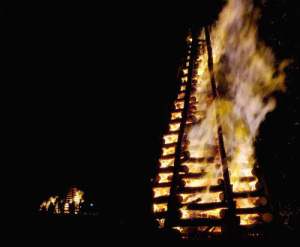 attributable to its French roots as well as the many cultures that eventually settled here or were brought here through the institution of slavery. The bonfires went off without a hitch last night even though it’s near 80 here, foggy and quite drizzly. The foghorns were blaring on the Mississippi River last night. The kathouse is just a few blocks away from it and the Poland Avenue Wharf. It’s home to the best seat to see the New Year’s fireworks too!! So happy to be ending the year and looking to the start of the Carnival Season on 12th night!!
I do have a bit of sad/bad news. A morning fire has damaged the Clinton Birthplace in Hope Arkansas. The Birthplaces of US Presidents are generally historic sites and are used to illustrate the various backgrounds and childhoods of our premier elected leaders. This is a site maintained by the National Park Service. Arson is suspected.
Hope officials suspect arson in a fire that broke out about 3:20 a.m. today at the house in Hope where Bill Clinton spent the first four years of his life. It is now a historic site maintained by the National Park Service.
Damage was reported to the back wall on the east side of the house and the fire spread to the second floor. Smoke and water damage was reported inside. Officials didn’t specify what evidence led them to believe the fire was set. But a report by KSLA also said graffiti was found on the property.
So, I’ll make this short today since I’m sure you’re all using the time off today happily or productively! Whatever way you spend your day, please have a great one and remember that you always have friends that love you completely here at Sky Dancing!!!
What’s on your mind today?


 peej
peej Carissa
 bostonboomer
 ecocatwoman
 mablue2
 peggysue22
 quixote
 skydancingguestblogger
 Mona (aka Wonk the Vote)



 Sky Dancing
I enjoyed learning about the bonfires on the levees.
The days are getting longer — may they bring peace and health to us all!
Ah, New Orleans! The place where no one ever gave up who they were.
Thanks for this historic perspective, Dankinikat. I’ll sing a verse of Un Canadien Errant in your honour tonight.
At Yiddish festival, Trump’s name is ‘blote’ (mud)
Merry Christmas Sky Dancers!
Merry Christmas, Fannie, and Happy New Year.
What a great post, Kat,some of it, totally new information for me, interesting stuff.
Joy and love to all of our Skydancers!