
Friday Reads: Nearly 10 years after and we’re still traumatized and victimized
Posted: August 14, 2015 Filed under: just because 21 Comments Good Afternoon!
Some times right wingers get so caught up in their frames that they will drop all buzz words and pretension of being anything other than self-aborbed assholes steeped in white privilege. Yesterday, the Editors of the Chicago Tribune let slip the dogs of class war. There are many who seek a return to colonial plantation economics by demonizing and isolating the poor and disadvantaged. These folks with dreams of Randian dystopias are the worst of rent seekers who peddle influence through lobbyists and stupid, greedy politicians. Their attack dogs usually frame class warfare on the poor and middle class families by poor shaming and seek elimination of unions, public education, and safety nets like those for the elderly and the unemployed. It’s rare you get to actually see one of these “conservatives’ write–even metaphorically–about cleansing society of them in such an honest way.
The Chicago Tribune published an op ed by Kristen McQueary that openly pined for a Katrina-like disaster for Chicago so that the kind of carpetbaggers we’ve been dealing with here who have been sucking all the resources and profits they can out of us can free Chicago from its black population and teacher unions and other right wing bugaboos. She wails and laments that it was only use of metaphor. Most of us can see the true intent. Here’s McQueary’s little wet dream.
That’s why I find myself praying for a storm. OK, a figurative storm, something that will prompt a rebirth in Chicago. I can relate, metaphorically, to the residents of New Orleans climbing onto their rooftops and begging for help and waving their arms and lurching toward rescue helicopters.
Tell me exactly again how this little white girl can compare feeling overtaxed and overregulated by her local government so much that 10 days on a roof experiencing unimaginable heat, hunger, death, and thirst could compare–even “metaphorically”–to her “struggle”. Her goal?
Residents overthrew a corrupt government. A new mayor slashed the city budget, forced unpaid furloughs, cut positions, detonated labor contracts. New Orleans’ City Hall got leaner and more efficient. Dilapidated buildings were torn down. Public housing got rebuilt. Governments were consolidated.
An underperforming public school system saw a complete makeover. A new schools chief, Paul Vallas, designed a school system with the flexibility of an entrepreneur. No restrictive mandates from the city or the state. No demands from teacher unions to abide. Instead, he created the nation’s first free-market education system.
Hurricane Katrina gave a great American city a rebirth.
She obviously did no homework on the ground when she wrote these things. I doubt she’d put her children into any charter school here where most are under-performing as badly as before but hey, some nice white, upwardly mobile carpetbaggers are making profits out of it instead of teacher’s making living wages.
Part of the “reform” was the wholesale firing of some 7,000 teachers, most of whom were black, who formed the backbone of the city’s middle class. That hurt.
One parent complained that the all-choice system actually disempowered parents. If she complained, she risked being asked to leave the charter school. The schools have more autonomy, but parents have less power.
Berkshire says the charter sector is now consolidating, with chains taking over most of the stand-alone charters, and with the successful charters defined as those that produce the highest scores. Innovation is hard to find. What is common practice is long days, tough discipline, testing, and “no excuses.” One parent lamented that the charter sector thinks that parents and children are problems, not patrons of the schools.
Ignored in the celebratory accounts, she says, is the large number of young people who are not in school and the persistence of poverty and youth violence …
The performance of these schools is now well documented. However, these numbers mater not to ideologues like McQueary who would rather read effusive statements of similarly minded ideologues and reports cooked up by think tanks wishing to see more of the same.
But then there is Mercedes Schneider, who reports that the state released 2015 ACT scores for every district, and the New Orleans Recovery School District ranked 70th out of 73 districts in the state. Its ACT scores are virtually unchanged over the past three years. The RSD ACT scores of 16.6 are far below the state average of 19.4.
An average ACT score of 16.6 is low. Louisiana State University requires a composite score of 22. A composite of 20 qualifies for La’s tuition waiver to a 4-year institution; a composite of 17 qualifies for tuition waiver for 2-year technical college.
And here’s the latest study by Research on Reforms in New Orleans, comparing the Orleans Parish public schools to the reformers’ Recovery School District. “A study of three ninth grade cohorts, beginning with the 2006-07 year, shows that the percentage of OPSB 9th graders who graduate within four years is almost double that of RSD 9th graders, and the RSD’s dropout rate is nearly triple that of the OPSB.”
New Orleans’ poor Black children are still being left behind. Indeed, all poor children are on an “education island” according to analysis done by Andre Perry.
The middle class opted out of the public sector, and the least powerful are on an educational island. Eighty-seven percent of the children in New Orleans public schools are African-American. In the 2004–05 academic year, 77 percent of New Orleans students were part of the free and reduced lunch program, which was how schools primarily measured poverty.
The term “economically disadvantaged” is the designation currently used, but it entails the percentage of students eligible for SNAP, TANF or Medicaid. At the start of the 2014 academic year, 84 percent of students were economically disadvantaged. Economically disadvantaged students make up 92 percent of enrollment at Recovery School District charter schools.
For the educated, New Orleans is the most wonderful city on the planet. But our enjoyment is a function of a peculiar distance from the poor.
Scott Eric Kaufman–writing for Salon–analyzes the piece.
McQueary provided a laundry list of conservative goals that the city met after it had been battered so badly it barely function as a city anymore: “[a] new mayor slashed the city budget, forced unpaid furloughs, cut positions, detonated labor contracts[,]” making “New Orleans’ City Hall leaner and more efficient.” It never occurred to her that if your ideology requires thousands dead and hundreds of thousands displaced in order to be enacted, the problem likely isn’t the city — it’s your ideology.
Putting aside that McQueary’s vision of Chicago as a mansion on the hill requires the eradication of many of its African-American residents, the most disturbing aspect of her editorial is that she imagines herself to be one of those residents, stranded on a rooftop waving this very op-ed like a bed-sheet in the hopes of being rescued.
“I can relate, metaphorically, to the residents of New Orleans climbing onto their rooftops and begging for help and waving their arms and lurching toward rescue helicopters.” She did, literally, write that. But she went one step further, arguing that her plight is more desperate than those in New Orleans because “here, no one responds to the SOS messages painted boldly in the sky.”
Besides the fact that that final line makes absolutely no sense — New Orleans residents weren’t hiring biplanes to alert authorities as to their whereabouts via skywriting — the problem with McQueary’s editorial is that it exists, which points to a failure of judgment on her part, as well as that of every member of the editorial board who read and signed off on her egregious “hot take.”
Indeed, this has been a “hot take” for some time. David Brooks–notorious unemployable plutocrat–started this meme almost immediately with his little puddling space on the NYT. This is from September 8,2005.
Hurricane Katrina has given us an amazing chance to do something serious about urban poverty.
That’s because Katrina was a natural disaster that interrupted a social disaster. It separated tens of thousands of poor people from the run-down, isolated neighborhoods in which they were trapped. It disrupted the patterns that have led one generation to follow another into poverty.
It has created as close to a blank slate as we get in human affairs, and given us a chance to rebuild a city that wasn’t working. We need to be realistic about how much we can actually change human behavior, but it would be a double tragedy if we didn’t take advantage of these unique circumstances to do something that could serve as a spur to antipoverty programs nationwide.
The first rule of the rebuilding effort should be: Nothing Like Before. Most of the ambitious and organized people abandoned the inner-city areas of New Orleans long ago, leaving neighborhoods where roughly three-quarters of the people were poor.
Yes. Those ideas worked so well we now can read these headlines in the Time Picayune: “New Orleans is 2nd worst for income inequality in the U.S., roughly on par with Zambia, report says.” This story dates from roughly a year ago on August 8, 2014.
New Orleans ranks second worst in the country for income inequality, according to Bloomberg, which maintains a ranking of the most unequal cities in the country. The report puts inequality in New Orleans roughly on par with that in Zambia, according to statistics kept by the Central Intelligence Agency.
Bloomberg plotted America’s 50 most unequal cities according to their Gini coefficient, which measures the concentration of income, rather than overall income (gross domestic product) or the wealth of the average citizen (median income). In a country with a Gini coefficient of 0, all residents enjoy the same level of income. In a country with a Gini coefficient of 1, a single person holds all the country’s wealth.New Orleans’ Gini index was .5744.
Only Atlanta — .5882 — had a higher coefficient than New Orleans, according to Bloomberg. Atlanta’s median household income was $46,466, more than $12,000 higher than that of New Orleans. Even as Atlanta had more inequality than New Orleans, the average resident in Atlanta was much better off than the average New Orleanian.
Adam Johnson–writing for Alternet--considered the Op-Ed to be down right evil. Again, we’ve seen this before from the corporate elite who just love to make money at our expense and to label us a wasteland where they can come imprint their culture and priorities onto us. Forget the fact we invented jazz, a unique form of American cuisine, and nearly every one in the world wants to visit, we’re just one big wasteland that is overrun with poor folk!
It’s a sentiment not uncommon on the corporate right. The idea that Katrina was a sort of biblical flood that washed away liberal excess in New Orleans is taken as gospel by conservatives and corporate democrats alike. Even Obama’s Secretary of Education got into a bit of hot water when he said in 2010 Katrina was “the best thing that happened to the education system in New Orleans”.
He later walked back the statement after a torrent of backlash but his point was clear: mass tragedy provides an opportunity for corporate forces to expedite the raiding of public trusts and circumvention of democracy and collective bargaining. It’s an axiom so taken for granted that a recent tone-deaf tweet by the New York Times even insisted the foodie culture was “better” after Katrina. Needless to say this left a bad taste in several people’s mouth, going viral for the wrong reasons:
But McQueary’s piece is far worse. Praising a devastating storm that killed 1,800 people as a net positive is already a terrible thing. Expressly wishing for a devastating storm to come along and wipe out the third largest city in America so one can expedite a Randian end times is positively psychotic. In an attempt to be polemical, Ms. McQueary exposes the dark heart at the core of what Naomi Klein calls “disaster capitalism”. For these people, it is not a thought experiment. It’s not rhetorical. It’s real. They truly believe largely-black, union-friendly cities would be better off in the long run handing over the reigns of their local governments to technocratic, largely white neoliberal systems. To them, the tragedy of Katrina wasn’t the mass displacement and death of thousands, it was that it didn’t happen soon enough.
Just two weeks after Katrina, when 96% of the corpses still remained unidentified and the Superdome was, according to FEMA, a “toxic biosphere“, Koch-funded Freedom Works published an op-ed in The National Review calling the storm a “golden opportunity” and insisting officials use the ensuing chaos to push for massive corporate overhaul of the New Orleans education system.

McQueary attempted to make the giant leap between the subject she wanted to write about—i.e. perceived fiscal irresponsibility in Chicago—and the subject she hopelessly tried to connect it to—her idea of the rebirth of New Orleans on the ten-year anniversary of Hurricane Katrina.
Now there’s no doubt that New Orleans has made great strides and implemented remarkable reforms in the aftermath of Katrina. As McQueary rightly points out, the city is in many ways back to normalcy (or whatever the New Orleans equivalent of “normalcy” is) and has emerged from catastrophe a stronger place.
But there is no balance to her idealized perception of a utopian New Orleans where corruption, overspending, and waste (to her mind, in the form of “unnecessary” city employees) have been thoroughly uprooted. She forgets the fact that in the past ten years New Orleans has seen a mayor federally indicted and jailed for giving his sons’ company prejudicial treatment in city contracts, many thousands of poor New Orleanians still unable or unwilling to return to a city that doesn’t want them, and a New Orleans East that remains utterly blighted and left behind in the overall recovery of the city—and those issues are only the tip of the iceberg.
But I might have been able to forgive her for her misguided and Ayn-Rand-esque idealizing of my hometown, if she had not simultaneously idealized and glossed-over the depth of suffering and pain that so many New Orleanians went through—including myself.
So when I see a professional writer from the premier newspaper of the city in which I currently reside—who decidedly did not experience this catastrophe herself—writing about “wishing for a storm in Chicago… A dramatic levee break. Geysers bursting through manhole covers. A sleeping city, forced onto the rooftops,” I get a little angry.
Better yet, I get infuriated.
Again, let me tell you, the recovery from Hurricane Katrina is a totally different experience and depends on which side of town you live on. It’s been characterized as a Tale of Two Cities. Uptown is under perpetual road reconstruction. Downtown still is pockmarked with deep, deep potholes and impossible roads. That’s just one really noticeable example that I personally can provide. There are a lot more provided in this WBUR interview with Allison Plyer, chief demographer at The Data Center with Here & Now‘s Peter O’Dowd discussing a new report.
“We know from the disaster literature, a couple of things: that whatever the trends were before the disaster tend to get accelerated after the disaster, and also folks that were doing okay, or doing well, actually benefit from all the new infrastructure. But folks who were poor or had poor health, it’s really hard for them to recover. The shock is often too much.
So what we’re seeing is growing income inequality as many of our white households are doing much better but black households are not. We see employment rates for black men are virtually the same that they were before the storm, but for white men they are much better. It’s interesting down here, if you talk to folks, it’s almost like a tale of two cities and it often splits on racial lines.
So you’ll talk to white folks and they’ll say, ‘Wow! The city is doing much better. Never been better, all these great things are happening. Entrepreneurship, the economy is great, our wages are up. Etcetera, etcetera.’ But you’ll talk to black folks and they’ll say, ‘Things are much worse, a lot of our neighbors aren’t here. It’s been such a struggle to rebuild. I don’t even had some of the business networks I used to have.’”
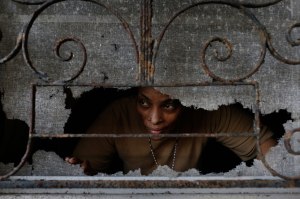
Angell Marie Boutte has been living in her Gentilly home since 2007 without electricity and water.
Then, there’s actual reporting like this from the National Geographic: “10 Years After Katrina, Some Are ‘Homeless in Their Own Homes’; Even after a decade, elderly, frail, and disabled New Orleanians are without homes or essential services.”
The state-administered Road Home program, financed with grants from the U.S. Department of Housing and Urban Development, has handed out $9 billion in rebuilding grants to 119,000 Louisiana homeowners. But thousands of those recipients were never able to finish repairs. There are many reasons for this, but the most common is contractors who took grants and didn’t finish work. Ramm-Gramenz says nine of ten of her cases involve contractor fraud, which ran rampant in the wake of the hurricane, especially with older people.
“It breaks my heart,” says Travers Kurr, a street-outreach worker for UNITY of Greater New Orleans, who, since Katrina, has worked with hundreds of people living in squalor in their own flood-damaged homes, often surrounded by mildewed photographs of happier days.
Despite their limitations, some of these people may have been capable of living on their own before the flood. Neighbors say they used to see Angel Boutte outside of her home and they often brought her plate dinners. But in recent years, she’s become a recluse within her family’s house, which Boutte says has barely been touched since floodwaters submerged it and she was rescued from the roof by helicopters (records indicate Boutte did not receive a Road Home grant).
Recently, Boutte, 52, peeked through a window screen that’s ripped in the middle, showing her black dress and a large crucifix. She’s lived in the once-tidy brick house since she was about six, she says. Her mother died in 1984, and her father died in 1998. And while the house may look bleak now, Boutte remains confident that people will come to her aid.
An analysis by The Data Center found that 25 percent of residential home addresses in New Orleans were still blighted or vacant in 2010, five years after the storm. Since that time, the city has demolished a total of 4,106 buildings through a careful blight-abatement process, but tens of thousands of empty properties remain.
There are some wonderful pictures at that link of people living in New Orleans right now that you would swear were living in the worst countries in Africa. Also, try these pictures of abandoned homes that are still standing today from The Telegraph if you want to see what I drive by all the time. The only picture in this post that is directly post Katrina is the one at the top. The other three are from these links which are definitely worth the seeing.
I can personally tell you that I am not better off.
What’s on your reading and blogging list today?


 peej
peej Carissa
 bostonboomer
 ecocatwoman
 mablue2
 peggysue22
 quixote
 skydancingguestblogger
 Mona (aka Wonk the Vote)



 Sky Dancing
WTF is wrong with these people who cavalierly wish for disaster? McQueary has no idea what it would be like.
As for “… designed a school system with the flexibility of an entrepreneur,” that is exactly the problem. Entrepreneur worship gets us jobs that do not pay a living wage, and bloated corporate pay in reverse proportion to company performance. Profit-making ideology distorts the process and aims of public education.
That is the problem. Their nearly only priority is making profits which is no way to run a public good where the benefits of society outweigh the costs. All you do is bloat the costs by profiteering and self-serving.
Guess the Trib is feeling a little bad about that op ed …
Now for some thing more databased … it’s the same study I mentioned towards the end of the blog post.
Katrina didn’t do any favors, but New Orleans made some gains
http://www.chicagotribune.com/lifestyles/travel/sc-trav-0818-travel-mechanic-20150811-story.html
McQueary’s “apology” was stupid. Why did she bother? And…she calls herself “Statehouse Chick.” Very telling.
Thanks for writing this, Dak. This is very important stuff.
Ditto. It puts me in a very serious mood. My cousin died there in a hospital, thought a bus was coming for her, so did the others. It never came. The family still has scars, and each and every anniversary there are feeling of no “toughing things out”. You got to see the photos. You got to know all about it, you got know they waited, and waited, and waited for FEMA.
I just want to put this McQueary woman in a hospital, with conditions that make it impossible for her to help herself, and let her listen to the howling winds coming, and getting louder as the lights go dark, and you are left on your own. I’d like to know if she cries out, or does she laugh, until her last breath is taken. She has no idea what happens to your energy during a emergency like Katrina, especially when you are counting on others, especially when you can’t get save yourself.. All she thinks about is her own kind, the rich and the powerful. I’d like to spit on her, or throw a shoe at her head for saying in her apology “we can’t keep borrowing our way into bankruptcy. Are you kidding me, does she think someone was giving out loans to poor people on the day Katrina arrived?
Exactly BB, it is revealing when she calls herself statehouse chick. Luna, dammit if I know what the hell is wrong with her, except her head is stuck so far up her ass, it’s creepy. People like her make me want to grab a shower. Good God.
Here’s another to go with New Orleans: At one point they never had a DA’s Office!
135 Million Police Force
30 Million Jail
6 Million Court System
and 15 Million DA’s office
http://www.buzzfeed.com/albertsamaha/indefensible-new-orleans-public-defenders-office#.xdXXAO5ya
Indefensible!
People with all kinds of privilege have no idea what’s going on around them.
And they don’t want to know.
And if they did know, they wouldn’t care. They would find some way to blame the victims.
As ‘Sesame Street’ Heads To HBO, Will Low-Income Kids Lose Out?
http://www.npr.org/sections/ed/2015/08/13/432112558/sesame-street-heads-to-hbo-is-it-a-win-win-for-kids?utm_source=facebook.com&utm_medium=social&utm_campaign=npr&utm_term=nprnews&utm_content=20150814
Yes!!!!!! Idiots.
New Orleans to clueless outsiders: We wouldn’t wish Katrina on anyone
http://www.nola.com/katrina/index.ssf/2015/08/hurricane_katrina_recovery.html?ath=6a5ee2e1e63127b92ab53d811c513a63#cmpid=nsltr_strybutton
oh good gawdess it get’s worse …
McQueary: Hurricane Katrina and what was in my heart
http://www.chicagotribune.com/news/opinion/commentary/ct-chicago-hurricane-katrina-column-20150814-column.html
McQueary is far beyond clueless. How TF can you write about wanting a disaster and expect anyone to think kindly of you?
Right. A “revolutionary change” for the worse.
Chicago is several times the size of New Orleans anyway. There’s no real comparison between the two. The woman is either clueless or a sociopath.
my guess is she’s so lost in white privilege land she’s clueless
She seems to be under the impression that she, and all her friends and family members would be spared in this disaster she is hoping for.
I think you hit it on the head with “sociopath”. Her twisted way of thinking is typical of a lot of right wing attitudes. I am sickened and disgusted with her original piece.
The NOLA.com editorial is excellent.
That is one of the sickest responses to Hurricane Katrina I’ve ever heard. She needs a new career, perhaps something in a field where she makes minimum wage. That might give her a taste of reality.
McQueary should be shamed out of the public arena.