
Blessed are the Poor or maybe not …
Posted: October 9, 2013 Filed under: poverty, social justice | Tags: war on the poor 14 CommentsSo, ya’ll know I’m not a deist or a christian. But, I do know a lot about the theology having studied it and basically grown up a Presbyterian by default. I say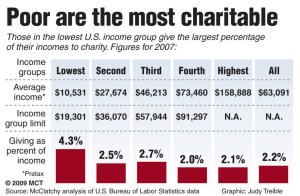 default because I was baptized Presbyterian mostly because my mother’s golf partner at the country club was the Presbyterian minister’s wife. The next time we moved, I was the only one in the family that stuck with the church thing mostly because the best music program in the city was in the Presbyterian church because the minister’s wife was a serious piano teacher. The minister was great. He drove around in an orange fiat convertible with a tweed jacket, a golf tam, and leather gloves. When he wasn’t writing his sermon about what to do the next time you were sitting in the locker room at the country club, he was at the country club golfing. I have to admit to being kind’ve of an outlier in my family since I’m not a millionaire. I’ve seen what kind of trivial concerns the rich tend to have and I really don’t want to be a part of it. I’d much rather appreciate my daily bread instead of a pair of manolo blahniks.
I just don’t care that much about money. I have very simple needs plus I’m a Buddhist and that’s sort’ve a lifestyle thing with us. I say all this because I have been on both sides of the income spectrum and I actually chose downward mobility. However, I didn’t want to choose poverty. That’s a more difficult thing to avoid these days; especially if you’re an aging woman in a red state where the governor hates all teachers and professors.
I guess I was the only rich republican kid that read the four woes listed in Luke 6:24–26 that start with “Woe to you…” when I was a good little Presbyterian in sunday school.
…who are rich, for you have already received your comfort.
…who are well fed now, for you will go hungry.
…who laugh now, for you will mourn and weep.
…when everyone speaks well of you, for that is how their ancestors treated the false prophets.
So, given Republican officials are cross-waving christians and just sort’ve wear the entire thing on their sleeves self righteously, why is there a war on poor people? I also read the four beatitudes in that same sermon on the plain in Luke’s gospel that starts out “Blessed are you…”
…who are poor, for yours is the kingdom of God.
…who hunger now, for you will be satisfied.
…you who weep now, for you will laugh.
I frequently wonder if their new testaments don’t have those particulars. I do have to say that most of my jaunty minister’s sermons had to do with it being easy to forget about reality when you’re sitting in a country club. (I think he may have been reminding himself. You should’ve seen the manse.) Maybe that is the thrust of the problem that we’re witnessing a bunch of self-professed christians declare war on the poor.
American conservatives for the past several decades have shown a remarkable hostility to poor people in our country. The recent effort to slash the SNAP food stamp program in the House (link); the astounding refusal of 26 Republican governors to expand Medicaid coverage in their states — depriving millions of poor people from access to Medicaid health coverage (link); and the general legislative indifference to a rising poverty rate in the United States — all this suggests something beyond ideology or neglect.
I also missed the part where Jesus wanted fetuses to come unto him but poor children and their mothers could just go to bed hungry.
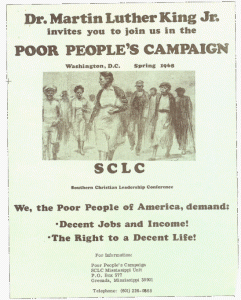 I left Nebraska nearly 20 years ago to discover a little something different in life down here in New Orleans. About 10 years ago, I bought a very modest house in the ninth ward of New Orleans. My neighborhood is undergoing incredible gentrification and I have to admit that I could not afford my house any more. Neither could any of the neighbors that were here when I moved here. I actually think this is part of a bigger plan to stop the poor and the black from returning to New Orleans but that is another post for another day.
There is a deliberate strategy of punishing the poor put into place by many southern, Republican governors that profess to be pious Christians. This includes my hyper-charismatic Catholic converted Bobby Jindal and both of the freaky Republican governors of the surrounding state. Their position on providing a medicaid expansion to the state to heal the poor is basically let them die in the poorly run privatized hospitals that Jindal sold to his donors at a really cheap price. I guess you have to be a leper to get health care according to biblical fundamentalists.
While Republicans in Congress weren’t able to defund Obamacare, many Republicans at the state level have found a different way to block low-income Americans from receiving cheaper health insurance. An estimated eight million Americans will remain poor and uninsured even after Obamacare is rolled out, due to the decision of many Republican governors and state legislators to reject the Affordable Care Act’s expansion of Medicaid.
When the Supreme Court upheld Obamacare last year, it also issued a less-noticed ruling that states could opt-out of the law’s Medicaid expansion, which broadened eligibility requirements for the program and provided federal funds to help pay for it. As this essentially amounted to free money until 2016 — at which point the federal government would pay for “only” 90 percent of the expansion — you’d think it’d be a no-brainer to accept it, right?
Well, not if you’re Rick Perry! Or Scott Walker, or Nikki Haley, or Bobby Jindal, or a ton of other red-state governors who decided to forego helping their poorest residents get health insurance because, well, that could alienate the GOP base voters next time they face a primary.
In total, 26 states have rejected the expansion, including the state of Mississippi, which has the highest rate of uninsured poor people in the country. Sixty-eight percent of uninsured single mothers live in the states that rejected the expansion, as do 60 percent of the nation’s uninsured working poor.
In general, states that rejected the expansion also have stricter eligibility requirements for Medicaid. While the 24 states that agreed to expand the program have a median income limit of $12,200 for Medicaid applicants, the limit is $5,600 —less than half the federal poverty level — in the states that rejected it.
One piece of the puzzle seems to come down to ideology and a passionate and unquestioning faith in “the market”. If you are poor in a market system, this ideology implies you’ve done something wrong; you aren’t productive; you don’t deserve a better quality of life. You are probably a drug addict, a welfare queen, a slacker. (Remember “slackers” from the 2012 Presidential campaign?)
Another element here seems to have something to do with social distance. Segments of society with whom one has not contact may be easier to treat impersonally and cruelly. How many conservative legislators or governors have actually spent time with poor people, with the working poor, and with poor children? But without exposure to one’s fellow citizens in many different life circumstances, it is hard to acquire the inner qualities of compassion and caring that make one sensitive to the facts about poverty.
A crucial thread here seems to be a familiar American narrative around race. The language of welfare reform, abuse of food stamps, and the inner city is interwoven with racial assumptions and stereotypes. Joan Walsh’s recent column in Salon (link) does a good job of connecting the dots between conservative rhetoric in the past thirty years and racism. She quotes a particularly prophetic passage from Lee Atwater in 1982 that basically lays out the transition from overtly racist language to coded language couched in terms of “big government”.
Finally, it seems unavoidable that some of this hostility derives from a fairly straightforward conflict of group interests. In order to create programs and economic opportunities that would significantly reduce poverty, it takes government spending — on income and food support, on education, on housing allowances, and on public amenities for low-income people. Government spending requires taxation; and taxation reduces the income and wealth of households at the top of the ladder. So there is a fairly obvious connection between an anti-poverty legislative agenda and the material interests of the privileged in our economy.
Many in the U.S. have fallen below the poverty line since the last recession because of loss of jobs combined with the increasing amount of income inequality in this country. It is really through no fault of their own. So, why do these memes and canards about the poor persist?
The bottom 1 percent in the U.S. live on an income that is one six-hundredth of the average for the richest 1 percent of Americans. They live on less than the average GDP per capita of a low-income country such as Afghanistan, Mozambique, or Haiti. And they live at or below the national poverty lines of such countries as Ghana, Congo, and Mongolia. Despite living in one of the richest countries in the world, the bottom 1 percent of Americans see incomes below the global median. The more successful disabled beggars of Addis Ababa in Ethiopia earn more than $2 on a good day, according to the International Labor Organization.
It is true that from an objective standpoint, living on $2 in a richer country is associated with better outcomes than living on $2 in a poor country—you are more likely to live in a house with basic utilities, and your children are less likely to die. In those terms, extremely poor Americans have it better than similarly poor Ghanaians—especially because the poorest in America will spend more than $2 a day even if their incomes are considerably below that. On the other hand, Ghanaians living on $2 a day are around average in their society; they don’t face the social stigma and exclusion of being so far removed from “normal” living standards.
Despite the physical and social costs of poverty, we have done a terrible job at raising the incomes of the poorest Americans over the past 20 years. The proportion of America’s households that live on less than $15,000 a year is as high as it was in 1989, while the proportion on more than $200,000 has gone up by two-thirds. That may be one reason for the country’s sluggish growth over that time—there isevidence that greater income equality is associated with stronger income growth for all.
There’s a solution to America’s extreme poverty problem. The example of countries where considerable proportions of the population live on less than $2 a day, as well as historical experience in the U.S., show that the most powerful tool to make poor people’s lives better is simply to give them cash. Brazil’s program of cash transfers, called Bolsa Familia, reduced inequality and increased both school enrolment and the number of poor people who were working. Perhaps we should try something similar in the U.S., providing an income floor for all Americans.
I’m going to give you a flashback from the past–1968– in an old conversation between William F. Buckley and Noble Prize winning economist Milton Friedman who was a big free market advocate back in the day. This is his suggestion of negative income tax.
I’m not showing you this to say it’s the way to go, I show you to ask a few questions: Would this conversation even be possible today? Have you seen any conversations recently on policies from the party of jaysuz and guns that provides any suggestions on how to actually help the poor?
America faces an opportunity gap. Those born in the bottom ranks have difficulty moving up. Although the United States has long thought of itself as a meritocracy, a place where anyone who gets an education and works hard can make it, the facts tell a somewhat different story. Children born into the top fifth of the income distribution have about twice as much of a chance of becoming middle class or better in their adult years as those born into the bottom fifth (Isaacs, Sawhill, & Haskins, 2008). One way that lower-income children can beat the odds is by getting a college degree.[1]Those who complete four-year degrees have a much better chance of becoming middle class than those who don’t — although still not as good of a chance as their more affluent peers. But the even bigger problem is that few actually manage to get the degree. Moreover, the link between parental income and college-going has increased in recent decades (Bailey & Dynarski, 2011). In short, higher education is not the kind of mobility-enhancing vehicle that it could be.
It seems that more of us are facing more uphill battles. It makes me wonder why the social activism and political activism of a Martin Luther King or a Cesar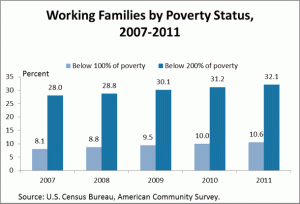 Chavez who fought for rights of the poor has declined?
Two factors seem to be relevant in explaining the political powerlessness of the poor. One is the gerrymandering that has reached an exact science in many state legislatures in recent years, with unassailable majorities for the incumbent party. This means that poor people have little chance of defeating conservative candidates in congressional elections. And second are the resurgent efforts that the Supreme Court enabled last summer to create ever-more onerous voting requirements, once again giving every appearance of serving the purpose of limiting voter participation by poor and minority groups. So conservative incumbents feel largely immune from the political interests that they dis-serve.
It would seem that more and more of us have interests aligned with poor folks. That is why the Republican party has also upped it’s race-baiting, women-baiting, GLBT-baiting, and immigrant-baiting. It is continuing to splinter the vast economic interests of the many into many morality plays. Even the Catholic church–a long time advocate of the poor and disenfranchised–has spent more effort on stomping on the secular rights of women and GLBTs than its usual role of ministering the poor. So, many social institutions have simply fallen prey to the same kind of divide and set-one-on-the other attitudes stoked by the money and the greed of folks like the Kochs.
I have no idea how these distortions have take center stage in our country to the point where our war on poverty has turned to a war on the poor. I can only think that those of us that fall into the category of having a shrinking pie are like dogs fighting over scraps thrown under the table by our 1 percent masters. It’s time for us to regain our perspective, if not our moral base.


 peej
peej Carissa
 ecocatwoman
 mablue2
 Mama Lopez
 peggysue22
 quixote
 skydancingguestblogger
 Mona (aka Wonk the Vote)



 Sky Dancing
Real life imitates the Onion
http://huff.to/1bZM8v4
The Onion in July: “Vatican Quickly Performs Damage Control On Pope’s Tolerant Remarks.”
The Associated Press today: “Pope Francis’ Controversial Remarks Prompt Vatican ‘Damage Control'”
Whoa!!
🙂
Even back in the summer, the church had gotten Francis to backtrack on the abortion part of his comments, virtually the next day.
It appears the RWNJs are coming apart over the debt ceiling.
Good post Dak.
Excellent post, Dak.
This is a fantastic post. Thanks. As someone with an M.Div. — and someone kicked out of the denomination that called me “pastor,” because I was lesbian and in a relationship — this makes particularly good sense 🙂
Their loss. Can’t help but always think that, Joyce 😉
The greedy crowd never read the “do unto others as you would have them do unto you” parts either.
My first job in practice after grad school was at a private clinic with lots of upper-middle and rich-class patients. They had problems, which they hid under their clothes and cars and expensive haircuts and bleached, orthodonticized teeth. My next job was at a nonprofit community clinic where we saw anyone regardless of ability to pay. The patients there had problems, and were up front about that. No veneer. (For the most part; nothing’s every 100%.)
All those holier and richer than thou people — amazing how money can insulate them, for a time, from the reality that they get sick and die just like everyone else. They can buy home health services and more drugs for their problems, and never worry about the co-pays.
I know there is an idea floating around that Obama should just ignore the debt ceiling because of the 14th amendment, part of which says that “The validity of the public debt of the United States shall not be questioned.”
I think it’s really a gray area whether this applies to the debt ceiling, which is why I think the White House should definitely do that. Let Supreme Court decide on that. However, the case is not going to go to SC immediately, so until the case gets there, Treasury can issues as much debt as they think necessary. Once the case is in the court, the Supreme court can either agree with White House and invalidate debt ceiling completely (a win for WH), or disagree and codify debt ceiling (status quo). But even in the latter case, justices can only make it illegal for White House break the debt ceiling in the future – but they will not be able to invalidate the debt that Treasury already issued beyond the limit, because that WILL contradict the 14th amendment. There will be preliminary injunctions to stop the Treasury, but it’s also likely that no one actually has the legal standing to stop Treasury.
Beautifully written, Dak.
Thanks for writing this dak. It’s a topic I’d been considering writing about but I haven’t been able to muster the strength to tackle it. My post surgery recovery has knocked most of the wind out my sails.
The Christianity of today’s world does not resemble the Christianity of my youth. Back then it was all about Jesus and aspiring to live a Jesus-like life. Kindness, compassion for all regardless of status or standing in society. Too many of today’s so-called Christians demonize and/or look down upon the poor as a lesser life form & not worthy of understanding, kindness or compassion. The dichotomy astounds me and I’ve been wishing that some daring journalist would confront these holier than thou types about how their words and actions actually are in conflict with the belief system they say they adhere to. While a non-believer now, I still think that “do unto others….” is an excellent value to live by.
Amanda Marcotte addresses the fundamentalist mindset that is controlling the Republican Party: http://www.alternet.org/belief/how-christian-delusions-are-driving-gop-insane?page=0%2C2&paging=off¤t_page=1#bookmark
A very interesting backstory of how we come to religion. The fact is that we are born into it owing to family affiliation while few seek it out on their own.
As a once practicing Catholic, raised in the doctrine taught by Catholic schools, I doubt that I was ever infused with the religious gene because I had too many questions that were left unanswered. Little of it made any sense but the policy was based on “faith” that we were being more prepared for an afterlife. My one big question was asking how a kind and benevolent god could stand by and allow something as horrendous as the Holocaust to happen but sent messages that homosexuality was an “abomination” when he was credited for creating perfection.
I honestly hold with the belief that we are here through randomness and that man created the idea of god to overcome fears to overcome that thinking that life may have no meaning in and of itself.
The best we can hope for is that we take care of one another. ensuring that we live with those brief lives assured of having access to the basis: food, clothing, shelter, medical care.
What we have instead is an overpopulated planet seriously feeling the effects of global warming which will have a destructive effect on maintaining those basic needs as our recources run dry.
And much of these man made disasters are brought about because of this lingering theory of carrying out the will of an unseen and unproven deity invented to keep us in line.