
Who Can be Trusted with Infrastructure? Certainly not for-profits …
Posted: April 6, 2013 Filed under: corporate greed, corporatism, Gulf Oil Spill, We are so F'd | Tags: infrastructure failure, New Orleans, oil spills 15 Comments The one thing that has become apparent to me recently is that privatizing anything related to important infrastructure is a recipe for one disaster after another. For-profit corporations are into maximizing profits to owners by either slashing costs or hiking prices. They rarely do anything that actually improves service or delivery quality. When you experience any kind of disaster that taxes the infrastructure, you learn quickly how negligent for-profits are when it comes to maintaining or fixing infrastructure. My reality since Hurricane Katrina is living with infrastructure that comes and goes on a windy day, on a drizzly day, on any kind of day that might cause our privately owned electric and natural gas company’s patched together infrastructure to hiccup. We get power outages at the super bowl, in my home, and in our water treatment plant. I’ve experienced two boil water orders in the last six months and dozens of electric outages for days on end. Cox cable’s infrastructure is just about as bad. They patch things up when they have to do it. I’ve heard excuses about hungry squirrels, curious racoons, and unusual wind events to the point I could just scream.
Then, there’s these oil pipe disasters. Why on earth would you trust an oil company with any kind of pipe line given their obvious neglect? There is a THIRD major oil spill in a week. This time it is in Texas.
Thousands of gallons of oil have spilled from a pipeline in Texas, the third accident of its kind in only a week.
Shell Pipeline, a unit of Royal Dutch Shell Plc, shut down their West Columbia, Texas, pipeline last Friday after electronic calculations conducted by the US National Response Center showed that upwards of 700 barrels had been lost, amounting to almost 30,000 gallons of crude oil.
By Monday, Shell spokespeople said inspectors found “no evidence” of an oil leak, but days later it was revealed that a breach did occur. Representatives with the US Coast Guard confirmed to Dow Jones on Thursday that roughly 50 barrels of oil spilled from a pipe near Houston, Texas and entered a waterway that connects to the Gulf of Mexico.
Coast Guard Petty Officer Steven Lehman said that Shell had dispatched clean-up crews that were working hard to correct any damage to Vince Bayou, a small waterway that runs for less than 20 miles from the Houston area into a shipping channel that opens into the Gulf.
The spill was contained, said Lehman, who was hesitant to offer an official number on how much crude was lost in the accident. According to Shell spokeswoman Kim Windon, though, the damage could have been quite significant. After being presented with the estimate that said as much as 700 barrels were found to have leaked from the pipeline due to an unknown cause, investigators determined that 60 barrels entered the bayou.
“That’s a very early estimate–things can change,” Officer Lehman told Dow Jones.
Meanwhile, though, rescue works in Arkansas have been getting their hands dirty responding to an emergency there. A rupture in ExxonMobil’s Pegasus pipeline late last week send thousands of barrels of oil into the small town of Mayflower, around 25 miles outside of Little Rock. Authorities evacuated more than 20 homes in response, and by this Thursday roughly 19,000 barrels had been recovered.
Mayflower, Ark is still fighting the sludge and will likely be doing so for some time.
We tend to think of oil spills on a massive scale, so large they are hard to imagine. Millions of barrels of crude pouring into the Bering Sea from the slashed hull of the Exxon Valdez. Tens of thousands of workers and volunteers combing hundreds of miles of Gulf Coast beaches after the Deep Water Horizon spill. But in Mayflower, Ark., the scale of an oil spill there is disturbing not for its size, but its proximity. On March 29, a 20-inch buried pipeline burst under the small town, turning backyards into tar pits and suburban streets into oil slicks.
This will probably be yet another part of our new reality given the age of pipelines–around 70 years old–and the continued negligence of oil companies who continue to make record profits and enjoy stupendous tax breaks in this country.
Wanna another weird example of infrastructure failure?
Residents of Washington, DC are used to jokes about metaphorical hot air, humidity, and the swampy history of their city. But there’s something they may not know about the District: it’s overrun with methane, which sometimes makes manhole covers explode.
Natural gas is mostly methane, and it is carried through underground pipes to heat buildings and cook food. Those pipes are often old, and this led ecologist and chemical engineer Robert Jackson of Duke University to drive around DC over a period of two months, regularly measuring the air to take methane levels.
He and his research team found methane leaks everywhere, with thousands of places having significantly higher than normal methane concentrations, and some places reaching 50 times normal urban levels (100 ppm vs 2 ppm). A similar study in Boston last year found essentially the same results. In DC, the source wasn’t the swamp on which the city was built — it was fossil fuel. (The methane they measured had more carbon-13 rather than the normal, modern carbon-12.)
You can laugh about this but I’ve actually seen exploding manhole covers in action. I was gigging at Balconies restaurant down in the French Quarter. The piano was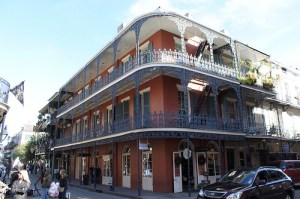 situated under a window and the restaurant–now defunct–was located in a building on the 600 block of Royal. It’s a really famous intersection and the building is one of those that gets photographed all the time. The window is basically to the left of the open door where they black car is passing the building. Mule drawn carriages would stop there frequently to listen to me play and to have a cocktail or cafe au lait brought out for the occupents. Anyway, one night, after a series of exploding man hole covers had been shutting down the electricity in the Quarter, one of them in the middle of this street took off like a cannon and sliced through the top part of a car right before my eyes. Of course, the electricity went off in the area and shut down the grocery across the street, the restaurants and everything in that locale. But, I’ll tell you, that manhole cover was an unbelievable projectile. Oh, it of course, the natural gas in town is Entergy-controlled. The other thing I recall was the distinct smell of ozone burning up and the wierdish green light show. This was about 15 years ago, but damn, I will never forget watching the roof of a hard top car get sliced off like a piece of salami. It’s been fixed now since the city doesn’t tolerate anything being wrong in the French Quarter, but for about 3 months of the summer 1996, it was a wild trip with a series of exploding manhole covers and black outs. It was also the same summer I got Karma so, who knows. Maybe it was just one of those summers.
Anyway, after having lived in a city where levees failed us and electricity fails us all the time, I would just like to say that no private corporation should be left on its own with unmonitored vital infrastructure. All kinds of things are at stake. Also, you can’t trust any oil company to do right by any one but themselves after a spill. I have experience in that area too.


 peej
peej Carissa
 bostonboomer
 ecocatwoman
 mablue2
 Mama Lopez
 peggysue22
 quixote
 skydancingguestblogger
 Mona (aka Wonk the Vote)



 Sky Dancing
I couldn’t agree more kat. Our government is selling off everything to the highest bidder from toll roads to schools to prisons and so on. Profit is god, safety – not so important.
Your quote from the Coast Guard about “correcting any damage to Vince Bayou” really got me. When will They learn that you cannot correct environmental damage? Oh & the oil in Arkansas, it’s not crude it is tar sands like that spilled in the Kalamazoo River and that which will be traveling through the Keystone XL pipeline. Rachel had a kick ass segment this past week on Arkansas & Keystone. I couldn’t help saying to the tv – it’s about damn time there was some honest media coverage of this.
They’re arguing that the Keystone pipeline will be better because it’s newer. All I can think about is the ogallala aquifer and all that farm and ranchland in about 5 states. can you imagine what contamination of that thing would do to our food stock? BP basically has caused oysters to go extinct and you still can’t trust anything near the Gulf. Gulf seafood is basically a no go any more despite what they try to tell people in ads.
I’m with you. There is simply no reason to build Keystone while there are so many reasons not to – especially all the damage done in just the last few years by oil spills. I seriously doubt that Gulf seafood will ever be what it was. Then again most people will eat it anyway, denying that oil + corexit have poisoned the water, the submerged lands/sea bottom & every living thing existing in the water.
The only reason I can think of is to prevent the pipeline going east to west and save Canada. For that, however, we ought to be granted land and citizenship there.
So as I understand it, they pumped tar sands sludge requiring solvents and higher pressure backwards through the old pipe because they got some idiot in the EPA or FDA to sign off on it. They should have asked a “not on payroll” plumber.
These oils spills are awful. I’m sure Obama is going to approve Keystone XL too. What a nightmare!
Great post, Kat.
Did you get an email? Blue Lyon is going to hang it up.
That’s a shame.
I know, hnuh.
She has been pretty busy doing this:
http://neophytephotographer.wordpress.com/
Dak, I sense futility in this post. It’s hard to read that first paragraph from a person in your field. Or, maybe it’s the rage.
I am just sick and tired of all the lame excuses these private firms have for problems that are the result of their lack of attention to maintenance. Our levees stand out as the worst example. For profits cut corners so they can pay out high profits. We pay for that in all kinds of horrible ways.
Yes and the key is that “we” pay for their problems. Because they’re not adequately regulated, the shareholders just get the extra profits without bearing the risks.
Yeah, I retired this year. I was going to kill myself early arguing why the word “minimum” meant the bottom line in construction standards, even in waterproofing.
One of the last hospital jobs I worked on, in 2011, they were still fighting over already installed steel from China. Mind you, it theoretically passed testing before it was installed and subsequent testing revealed otherwise. I’ve was on another job in 2009 with the same problem.
So, here we are in CA in 2013 and the same thing has happened on the SF Bay Bridge redo, where substandard Chinese bolts were installed.
It isn’t like you can send an email and everyone stops using inferior products. The real problem is denial, and budgets and bottom line profit.
I couldn’t agree more: I can’t exactly trust the government with anything important, but at least it does not have a motive to rip me off.
This cartoon is perfect for this post: