
Day One of HCRA Arguments
Posted: March 26, 2012 Filed under: Health care reform, SCOTUS 10 Comments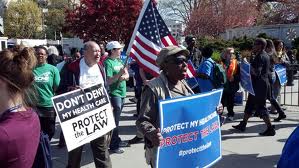 I thought I’d post some links on today’s arguments before SCOTUS in case you haven’t been able to keep up with the news. The big day for the arguments for and against the mandate come tomorrow. Protestors were all over the area in front of the nation’s courthouse and people were lined up for days to get inside. The go-to blog for this appears to be SCOTUSblog who posted this update of the day’s events.
The comments and questions of the Justices during the 89-minute exchange left the distinct impression that they are prepared to rule on the constitutionality of the mandate that individuals must buy health insurance, and not push the issue off into the future. The exact route they would take was a bit uncertain, but their skepticism about taking a pass now was clear.
That did not mean, of course, that the Court would ultimately uphold the mandate. That is tomorrow’s question, although the Justices asked many questions about the mandate, showing they are deeply curious about its scope and meaning. But an argument that at times seemed almost to bog down in the dense complexity of the tax code pointed toward a refusal to bar the lawsuits that had challenged the mandate and had put its survival before the Court this week. One of the telltale signs of that sentiment was that not one Justice, and no lawyer at the lectern, said that it would be premature and a contradiction of the Court’s tradition against deciding constitutional issues prematurely for the Court to rule promptly on the mandate’s validity.
The Court had selected a Washington attorney from outside the case, Robert A. Long, Jr., to make an argument that the Supreme Court and no lower court had any authority to rule on the challenges to the mandate, on the theory that the requirement is a part of the tax code and the Anti-Injunction Act of 1867 had closed the courthouse doors to any lawsuit against a tax law before it took effect. But the most difficult questions from the bench Monday were aimed at Long’s argument. And most of the Court seemed to be leaning toward some version or variation of the argument made by Solicitor General Donald B. Verrilli, Jr., speaking for a government that very much wants a final decision soon on the mandate.
Here are some other links to the story.
Politico: First glimpses of Supreme Court’s Thinking
Justices on both ends of the ideological spectrum appeared skeptical that an arcane law, known as the Anti-Injunction Act, should delay a Supreme Court ruling for more than two years. The law prevents people from challenging most taxes until they’ve been paid — and the penalty for people who avoid the individual mandate will be enforced through the tax code.
NYT: Health Act Arguments Open With Obstacle From 1867
The answer to that question is not obvious. The United States Court of Appeals for the Fourth Circuit, in Richmond, Va., ruled last year that it was powerless to decide the law’s constitutionality for now, and a prominent judge on the United States Court of Appeals for the District of Columbia Circuit agreed.
Their opinions relied on an 1867 federal law called the Anti-Injunction Act, which says that “no suit for the purpose of restraining the assessment or collection of any tax shall be maintained in any court by any person.” In other words, people who object to taxes must pay first and litigate later.
But the first penalties do not kick in until 2014, and they must be paid on federal tax returns by April 2015. That means, the appeals court judges said, that federal courts are forbidden for now to hear challenges to the health care law.
The Atlantic On Line: How Obamacare will Be Settled
In the first century of our nation’s history, Congress hewed to a very literal, limited understanding of the relevant text of Article I: “To regulate Commerce with foreign Nations, and among the several States, and with the Indian tribes.” Put simply, Commerce Clause legislation could regulate only business-related activities in interstate commerce.
The inception of contemporary Commerce Clause doctrine dates to the Interstate Commerce Act of 1887, regulating railroad monopolies, and the Sherman Antitrust Act of 1890, designed to curb monopolies and trusts. The Court upheld the Sherman Antitrust Act in 1905 — in Swift and Company v. United States, 196 U.S. 375. However, the justices based that decision on the finding that the effect of price-fixing by Chicago meat-packers on interstate commerce was not “accidental, secondary, remote or merely probable” but immediate. The opinion reinforced the traditional literal view of Congress’s Commerce power.
The Supreme Court case that established the constitutionality of the expanded interpretation of Congress’s commerce power was National Labor Relations Board (NLRB) v. Jones & Laughlin Steel Corporation, 301 U.S. 1, in 1937. The case originated in Aliquippa, Pennsylvania, where Jones & Laughlin was penalizing and discriminating against workers attempting to unionize. NLRB ordered Jones & Laughlin to end its coercive union-busting tactics; the firm refused to obey. After the circuit court refused to enforce the NLRB’s order against Jones & Laughlin, the NLRB appealed to the Supreme Court.
Jones & Laughlin argued that Congress could not regulate its labor practices because manufacturing is an intrastate activity, not interstate commerce. The firm based its argument on then-standard reasoning stemming from a 1918 Supreme Court case, Hammer v. Dagenhart, 241 U.S. 251. In Hammer, the Court allowed a father to commit his son to child labor in a North Carolina textile mill despite the Keating Owen Child Labor Act of 1916, reasoning that mill work was part of intrastate manufacturing, not commerce between or among states.
WAPO: Absolutely everything you need to know about health reform’s Supreme Court debut
Anti-Injunction Act
What it is: The Court opens its oral arguments with a debate over whether it can even issue a ruling on the Affordable Care Act since its penalties for not carrying insurance have not come into effect yet. Under a law passed in 1867, the Anti-Injunction Act, a tax cannot be challenged until someone has actually had to pay it. Health reform’s penalties don’t start until 2015.
What they’ll argue: One weird quirk of this provision is that neither the defendants or plaintiffs think it applies: Both sides think the Court should be able to rule right now . So the court appointed an outside lawyer, Robert Long, to argue on their behalf. Long will likely look to the Fourth Circuit Court of Appeals for precedent. It ruled, in September, that the Anti-Injunction Act prevented it from issuing a ruling on the health law.
When it happens: Monday, March 26, 10-11:30 a.m.
Why it matters: The Anti-Injunction Act gives the Supreme Court an opportunity to put off its decision for at least three years, potentially diffusing the law slightly as a 2012 election year issue. This could be a mixed-bag for health care supporters: On the one hand, it gives the law three more years to be implemented. On the other, it would still make the law’s fate seem uncertain, and likely extend the national debate around the Affordable Care Act.


 peej
peej Carissa
 dakinikat
 ecocatwoman
 mablue2
 peggysue22
 quixote
 skydancingguestblogger
 Mona (aka Wonk the Vote)



 Sky Dancing
Slate has video of Dahlia Lithwick’s reactions after watching today’s arguments.
http://www.slate.com/articles/video/slate_v/2012/03/supreme_court_begins_review_of_president_obama_s_health_care_reform_law_video_.html
I sure hope this has big repercussions!
you and me both
Excellent news!
Going to send some money to the ACLU. People complain about the ACLU, but when their Liberties are in danger, they are thankful when they step up to the plate and defend people no mater what their politics are…freedom laws are easier to take than they are to get back. I am glad they are there fighting the good cause.
Yay!
What a mess. With Medicare for All you could get around the whole individual mandate & commerce issue.
Now we have lots of lawyers and $$$ spent while fewer and fewer have decent health care. I don’t know whether to be depressed or angry.
I am for the Public Option HR 676, the next best thing to Single Payer:
This will be interesting to watch. Thanks for all the links.
This message from my new Kindle — just so you know this is the real NWR!
HP bought up some mobile WiFi companies ….
meaning poor service for rural areas.
Back to Supremes — did I read that the Gov lawyer was arguing one side at a lower level and the switched his argument???? Is the fine for not paying — a fine or not? Meaning not buying a commercial for profit insurance Corp “health” product?