
Greedy Bastards
Posted: January 26, 2012 Filed under: Banksters, commercial banking, Corporate Crime, corruption, financial institutions, Global Financial Crisis, investment banking, lobbyists, U.S. Economy, U.S. Politics | Tags: Dylan Ratigan, extractionism vs capitalism, Greedy Bastards 15 CommentsNo, I am not making an editorial comment.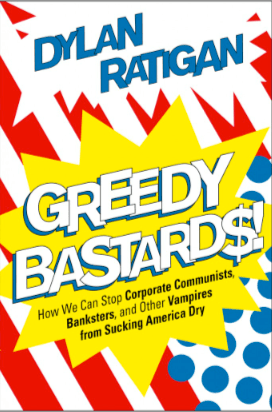
But after nonstop blathering served up by the GOP, only to be followed by President Obama’s Teddy Roosevelt impersonation [although I have to admit—the State of the Union was a surprisingly good speech], I thought a moment of palate cleansing might be in order. In this case Dylan Ratigan offers up the sorbet.
Ratigan is someone willing to call out the shysters, the casino players and shakedown artists, including their political handmaidens for what they truly are, and ‘Greedy Bastards’ is the title of his newly released book. The author’s name may ring a bell because Dylan Ratigan has a public platform on MSNBC, an hour-long show Monday through Friday. The program airs at 4:00 pm, EST, in my neck of the woods.
Ratigan’s slant focuses on the collision of worlds, that of finance and politics, how the incestuous relationship is literally squeezing the life out of the United States. His take is not an indictment of capitalism. Rather it is an indictment of what is posing as capitalism, a system he refers to as ‘extractionism.’
Ratigan is not a newcomer or a pundit simply reading a script. He worked the financial beat with Bloomberg News, serving as Global Managing Editor to Corporate Finance until 2003. He’s also the former anchor and co-creator of CNBC’s Fast Money. He has launched and anchored a number of financially-related broadcasts over the years but decided to leave Fast Money after the 2008 financial meltdown. Ratigan has publicly stated that he was personally disgusted by the Wall Street banking sector’s shakedown of the American public. The Dylan Ratigan Show was launched to provide discussion and analysis of the financial/government intersection, a system that has acquiesced to the wanton theft of the Nation’s wealth and resources by . . . Greedy Bastards, of course.
Though the show has been on air for three years, Ratigan has admitted that his voice was finally heard after an infamous meltdown last August. It was an on-air rant that would have made Patty Chayefesky proud, a Howard Beale moment.
That woke people up! It also led to Ratigan’s Get the Money Out [of politics] Movement, working towards a Constitutional Amendment to remove the corrosive element of money in the political sphere. And then, there’s the book.
One thing I liked about Ratigan’s approach is that instead of pointing out one segment of the population for public pillorying, his title basically refers to a state of mind and the all too frequent way of doing business and politics in the 21st century.
For instance, in the case of capitalism, Ratigan uses the example of venture capital, a subject that has come up in reference to Romney’s connection to Bain & Company, specifically Bain Capital. From Chapter 1:
If I start a venture capital firm that lends out money to drug researchers trying to find new cures for disease, and I get rich doing it, then I made my money by investing in the productive future of the country. I used my money in a way that facilitated scientific innovation and a cure. I’m what the director of the Havas Media Lab Umair Haque a ‘capitalist who makes.’ But instead, if I take the same money and use it to lobby for changes in government regulation—changes that help me trick a union into investing its retirement savings in flawed investments so that I can collect the commissions—then I may move as many dollars into my bank account as someone who funded cures for diseases, but I haven’t made anything. I’m a ‘capitalist who takes,’ exploiting my power to influence the government for my own private gain, no matter the harm to anyone else. I’m a greedy bastard.
The latter example, taking money from others without providing anything of value is, according to Ratigan, the opposite of capitalism. An extractionist system loses increasing value over time until there’s nothing left. Call it the vampire or vulture model. A system based on the extractionist principle, provides no incentive for people to make good deals, where both sides benefit. Instead, it rewards those who take and give nothing in return.
Sound familiar?
Ratigan covers the areas that have pushed the extractionist model to the max: banking, education, healthcare, energy, trade negotiations and the unholy alliance of government and big money fueling the feeding frenzy of the Nation’s resources and our future. But unlike many gloom and doom tomes, Ratigan offers solutions and brings an optimism to the subject, namely that we have the ideas, the people and yes, even the money to solve what at times seems insolvable. He concludes in a rather convincing way that what is needed is a realignment between investment and the needs of capable, innovative people. If loans and investments offered the highest returns when they provided the highest value as opposed to simply taking the highest risk, then prevailing attitudes and business practices would shift and win/win deals would be created.
 Sound like pie in the sky? I don’t think so. Yes, it’s a matter of will, public pressure to exact the necessary changes but this realignment idea is possible by citing the goals first, and then targeting the resources to get there. Ratigan refers to this as hotspotting—zeroing in on the problem, determining what methodology provides the best results, and then aiming resources to match those needs.
Though some critics have dismissed this idea, it is very attuned to what Bill Clinton recently suggested in his Esquire interview about highlighting the successes and needs across the country, and then linking them, matching them up. Just another turn on the realignment idea:
. . . the two best things you could do are the infrastructure bank and a simple SBA-like loan guarantee for all building retrofits, where the contractor or the energy-service company guarantees the savings. So that allows the bank to loan money to let a school or a college or a hospital or a museum or a commercial building or factories for lease unencumbered by debt to loan it on terms that are longer, so you can pay it back only from your utility savings. You could create a million jobs doing that because of the home models that are out there now.
There are these two guys on Long Island who started a little home-repair deal. They got thirty-five employees now, and they’re — they can go in, tell you how much they’ll save you. There’s an operation in Nebraska that’s in and out in a day, and they’re averaging more than 20 percent savings, and conservative Republican Nebraska is the only state in the country that has 100 percent publicly owned power.
And,
You’ve got Orlando with those one hundred computer-simulation companies. They got into computer simulation because you have the Disney and Universal theme parks, and Electronic Arts’ video-games division. And the Pentagon and NASA desperately need simulation, for different reasons. So there you’ve got the University of Central Florida, the biggest unknown university in America, fifty-six thousand students, changing curriculum, at least once a year, if not more often, to make sure they’re meeting whatever their needs are, and they’re recruiting more and more professors to do this kind of research that will lead to technology transfers to the companies. You’ve got Pittsburgh actually becoming a real hotbed of nanotechnology research. You’ve got San Diego, where there are more Nobel-prize-winning scientists living than any other city in America. You’ve got the University of California San Diego and other schools there training people to do genomic work. Qualcomm is headquartered there, and there are now seven hundred other telecom companies there, and you’ve got a big private foundation investing in this as well as the government, and nobody knows who’s a Republican or who’s a Democrat, they’re just building this networking.
We have fabulously innovative, creative people working on all kinds of things. Our true wealth is in our people; our true value is . . . us.
Ratigan is now on a 30-million jobs tour showcasing business enterprises that are, in fact, answering a need, offering value to their communities, providing jobs and in the best capitalist tradition—making a profit.
The endnote is that the country hasn’t lost its edge. We’ve lost the path that works, the one that values quality and integrity. Greedy Bastards will always exist, those hoping to make a quick buck [or trillions of bucks] off the backs of others. They have no shame. The goal is to make them and their thievery the exception, not the rule.
Btw, Ratigan’s book is highly readable, written for the layperson. No economic degrees required. If you’ve been following the financial blowout and/or Ratigan’s show, this will be a fast review. If you’re just starting to pay attention, consider the book a primer—what the country underwent and where we need to go. The sooner, the better. Ratigan encourages us to reclaim our voice, demanding that our people and country come first.
It’s a worthy message. Read the book. Get the word out.


 peej
peej Carissa
 ecocatwoman
 mablue2
 Mama Lopez
 peggysue22
 quixote
 skydancingguestblogger
 Mona (aka Wonk the Vote)



 Sky Dancing
Why does everyone who supposedly has solutions always put them out while on their book tour, making a buck for themselves? When you have a national TV show, you really don’t need a book to sell your own “hotspotting” buzz word as a fix.
On his first show, he was extolling the virtues of Kleiner, Perkins with their managing partner. Woohoo, their venture capital firms exercise in wonderfulness caused the internet bubble of the ’90s. There was nothing too worthless to not be taken public, then pumped and dumped once the rubes were on board. To get past the housing bubble, we don’t need another one of those which only fed greed. The TBTF banks made their own bundle from that bubble but it was spread a little wider.
Unfortunately, there is no way to get around the hard times it will take to deleverage our economy so we can get back to some semblance of normalcy. Until consumers have paid down the large scale debt run up over the past few decades they will not be able to drive a recovery. Thus the government should be spending money now to get some growth underway, and yes some inflation, to help with that deleveraging. I believe that without stimulus, we can all “buzz word” til the cows come home and it will only help around the edges at best.
One of Ratigan’s other proposals is a national method of financing elementary and secondary education. Pardon me but that is not a serious proposal and it will never happen in this country. The best we’ll be able to do is get financing done at the state level, and that’s a long shot. I would prefer realistic proposals and not “wouldn’t it be nice” scenarios before I can take it seriously and not just some bull sessions about what might work.
Just because I’m skeptical of TV hosts bearing gifts doesn’t mean there aren’t a lot of good things in the book which should be tried. My own feeling is we should let 1000s of flowers bloom and see what works best.
I think the book is just another platform to get the discussion and action going. Ratigan freely admits that he didn’t seem to be changing anyone’s mind until that rant last August. Then he got noticed. That’s when he generated a team for pushing the ‘Get the Money Out’ of Politics Amendment, which has nearly 300,000 signatures and the city council of NYC and LA signed on.
This isn’t fairy dust stuff, this is political activism. It’s extraordinarily difficult to move the direction of a country this size but every voice, every action is a yank on the steering wheel. And people are waking up. This book is for the average citizen, who’s had his or her life turned upside down and wondered–what the hell just happened? Ratigan explains it in simple language but minces no words–it was a heist, the biggest in history. He goes through all the major sectors, the history to date and the fault lines. And then, gives examples of things out there that are actually working, that could be expanded.
Healthcare, for instance. He goes into a quite a bit of detail on the Mayo Clinic, their setup, what they’re doing, how they’re doing it. And what do the outcomes look like, what are the costs? Or Camden, N. J., a very unlikely place to look to for positive examples. But there are sick people in Camden, chronically sick people who represent 1 percent of the population, eating up 30% of the healthcare costs. How do you bring those costs down while still providing decent care for your patients or perhaps providing better care than before? What are the similarities between these patients? Doctors and health officials in Camden identified the problem, they worked on that question and came up with doable approaches that they’re tweaking as they go along.
I wish there was a silver bullet but this is going to take a lot of work and determination. And a lot of cooperation between people of goodwill, who want to get something done. It’s not going to happen overnight. It took us 30 years to get in this mess. The Amendment, for instance? The target date is 2014. Is it going to be successful? I have no idea. But one thing’s for sure–nothing will happen if you don’t try.
What I appreciate in Ratigan’s effort is his honesty. He makes suggestions. He doesn’t have all the answers but he’s convinced the answers are out there. He’s also willing to spend the time looking for answers, and then bring those solutions, approaches and programs to the public’s attention. Then, it’s up to us to start working in our local communities, banging on our representatives’ doors or doing whatever we can to effect change. Even if it’s simply reaching out to a neighbor. According to Chris Hedges, that in itself can be a political act.
The country is loaded with talent and we can connect and network anywhere. Maybe it’s a question of seeing the glass half empty or half full. I’m generally of the latter persuasion. But I have my dark moments, too.
The Mayo model is familiar since the collaborative practice at Scott and White took great care of my mother when she had heart and lung issues with sometimes contradictory treatments. Unfortunately, most of the country does not have access to this model of care.
Healthcare Like No Other for More Than 100 Years
I just finished the book and found a lot of information detail to supplement my understanding of the Financial Crisis. Most of all, he is able to frame the discussions such that the lay person can understand his points. At times he gets long winded, but is always on point.
I particularly like his comments that banks / business need to be aligned to the interests to their customer. He sights the example of Goldman createing securities with junk, selling it to custormers and then writing Credit Default Swaps to cover the expected loses as an example of not being aligned.
I also recommend people to read this to bring themselves up to speed on several subjects
I agree, fiscal. Ratigan can get into manic mode, even on the air. But I thought he did a good job of framing the issues, giving the history of what happened in understandable [if not infuriating] terms.
One of the areas I disagreed with Ratigan was about letting the ‘revenge’ lever go. I think to reestablish faith, the Rule of Law has to be applied and enforced. The Law should apply equally to all [even though it doesn’t work out that way all the time]. But in this case, the malfeasance and fraud was so egregious, the damage so great to so many people that not to bang the gavel, not to investigate and prosecute makes a mockery of the entire system, even when the system was working reasonably well. And I don’t think of that as revenge. That’s fair justice. In the 1880 collapse, I read they strung the bankers up on the lamp posts. I wouldn’t go that far but I think a number of these people deserve jail time. We need an aggressive forensic auditor like William Black to sift through the mess. He and his team did it for Poppy Bush, during the S&L scandal. They could do it again.
Sorry for the OT, but this is really interesting. Bob Dole has put out a statement against Newt.
Here’s the link.
http://www.nationalreview.com/corner/289360/dole-goes-nuclear-nro-staff
The standard Republicans have been out in force with anti-Uncle Newt comments. Bob Dole is interesting though. I haven’t read anything about him in an eon. Joe Scarborough has been on a rip about Uncle Newt and what a disaster he would be for the Party. So, the establishment Republicans seem to be standing shoulder-to-shoulder, screaming No, No, No!
But the press? They can’t get enough of the craziness.
We shall see.
Peggy -I would build the gallows in the morning, trial at 10:00 and the hanging at noon to allow the body to sift in the wind.
This whole crisis is so blatently wrong and created by the likes of Greenspan. Summers, Cox, Mozillo and the regulators etc. Oh by the way Goldman Hank Paulson purchased a lot of CDS’s from AIG who knew by the summer of 05 that they were going to blow up. AIG stopped selling them. Goldman knew it by summer of 06 and started dumping their positions. While Treasury secretary he had to know about the interconnectivenes.
My understanding is that 70% of the CDS’s were naked ( ie specultion with out owning the securities). They are described in the Lewis book “The Big Short”. Hence the term used by Ratigan ” the Wall Street Casino”.
The whole AIG bailout was to pay back the Derivatives to the big banks.
Obama has not prosecuted these people. We just found out AG Holder and his prosecution deputy came from the Law firm which defended the big banks, Bill Black openly says that Obama will not prosecute because of campaign contributions.
It is a pity that the Republicans can only put up morons for candidates.
Yeah, I agree [though I’ll leave the stringing up to you :0)].
And some very sorry news on the AG push back on the sweetheart deal the Administration is hot to trot to give the TBTFs, including immunity from civil or criminal prosecution. Eric Schneiderman, the AG from NY State, was the first to say NO, these institutions deserve a thorough investigation and prosecution. Well, Schneiderman signed onto Obama’s new criminal task force, presumably to investigate but composed of people from the first ‘task’ force that has done absolutely nothing. And the ‘discussions’ with the banks are ongoing.
Sounds as if Schneiderman went to the Dark Side. Obama certainly knows how to defang his opponents. If the Administration was serious about any actual justice, Eric Holder would be fired, yesterday. And someone like Black would be sitting in his seat.
There’s no remedy coming from the Republican side. Just same old/same old.
Interestingly enough, I just came in, flipped on TV and Ratigan was on with . . . the director of Health Services from Camden, NJ. Talk about weird. But something I had no idea about [or I don’t recall reading it], Camden got the idea of pulling the data and crunching the numbers from what the Police Commissioner in NYC had done to reduce crime in the city. He was also on the show. When the Commissioner’s team did the metrics on the crime problem, they found 10% of the criminal population was committing 50% of the crimes. And these people came from 7 distinct areas of the city. In 30 months, they had a 40% drop in the crime rate. In Camden, they’ve reduced costs 40-50% and are providing better care to the chronically ill.
It’s like what the manager of the Oakland baseball team did in Moneyball. This network/pattern is overlapping everywhere! Freaky.
Brad DeLong: The British Economy Is Now Doing Worse than it Did in the Great Depression
Austerity is working, though not as supposed by the dumb asses.
Very interesting post, Peggy Sue. I didn’t read it earlier because I was trying to finish my post on Romney. I like Ratigan, although it didn’t know much about his history before reading your post. Ralphb does make some good points.
I’m also a little confused about why education is referred to as extractionistic. Does Ratigan really believe that educational institutions give nothing back to society? Maybe I’m misunderstanding what he means.
He feels the schools are failing, badly. And from our standing in Reading, Math and Science compared to the rest of the world, he’s right. His main argument is the whole school thing [if I’m remembering correctly] has turned into a war between adults, jockeying for position and power with few incentives to improve–they’re the only game in town unless you can afford private school.
That’s not to say there aren’t great public schools out there. But too often quality follows your zip code. We have to do better.
The power players are all in Switzerland now, fancy digs and expensive wine, trying to figure out why the neoliberal formula went off the rails. Touching that someone in the group mentioned how relieving the burden on the ‘ordinary’ people might be in order. They’re probably worried about their heads.
And did you catch the whine from Jamie Dimon? He thinks it’s a form of bigotry or prejudice [or some such nonsense] that bankers are being singled out for public disdain. He and his fellow TBTF execs bring down the world, make out like bandits and his feelings are hurt. It’s so unfair!
Oh, boo-hoo. Pull out the tiny violin.
Incredible!
Oh please… Jaimie Dimon should be in jail. He needs to STFU.