
Controversial Keystone Pipeline put on Hold
Posted: November 10, 2011 Filed under: Environment | Tags: Keystone Pipeline 5 Comments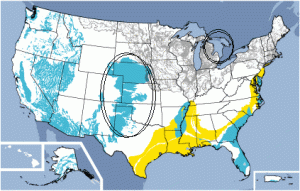 I was rather surprised to see that the state of Nebraska played a big role in getting President Obama to delay a decision on the Keystone Pipeline. Nebraska is a sparsely populated state with an overwhelmingly old, white, Republican profile. This does seem to wreak of a ‘not in my back yard’ kind of protest but I have to agree that there’s a lot at stake if the oil leaks. You can’t run anything through Nebraska that doesn’t endanger the Ogallala aquifer which is an important source of clean water. It is expansive and important to quite a few industries, communities, critters and people. You can see that it spreads under the entire state and the western sections of Kansas, Oklahoma, and Texas if you look at the map up there on the left. Yup, it’s a nifty map for a change!!
The impacted states are all highly reliable Republican but the zone is basically home to thousands of ranches and farms that rely on the aquifer. The decision has been delayed until after the election which seems a suspiciously convenient time even though Nebraska is a reliably Republican state.
The State Department said in a statement that it was ordering a review of alternate routes to avoid the environmentally sensitive Sand Hills region of Nebraska, which would have been put at risk by a rupture of the 1,700-mile pipeline carrying a heavy form of crude extracted from oil sands formations in Alberta, Canada, to refineries in Oklahoma and the Gulf Coast.
The move is the latest in a series of administration decisions pushing back thorny environmental matters beyond next November’s presidential election to try to avoid the heat from opposing interests —business lobbies or environmental and health advocates — and to find a political middle ground. Mr. Obama delayed a review of the nation’s smog standard until 2013, pushed back offshore oil lease sales in the Arctic until at least 2015 and blocked issuance of new regulations for coal ash from power plants.
The proposed project by a Canadian pipeline company, TransCanada, similarly put President Obama in a political vise, squeezed between the demand for a secure source of oil and the thousands of jobs the project will bring, and the loud agitation of environmental advocates who threatened to withhold electoral support next year if he approved it.
Mr. Obama said in an interview with an Omaha television station last week that he would make the ultimate decision about the pipeline, but sought to portray Thursday’s announcement as solely a State Department matter and not the result of political calculation.
“I support the State Department’s announcement today regarding the need to seek additional information about the Keystone XL pipeline proposal,” the president said after the announcement. “Because this permit decision could affect the health and safety of the American people as well as the environment, and because a number of concerns have been raised through a public process, we should take the time to ensure that all questions are properly addressed and all the potential impacts are properly understood.”
He said he remained committed to a politically balanced diet of increased domestic oil and gas production combined with incentives for the development of carbon-free alternatives.
While environmental groups welcomed their temporary victory on the pipeline project, some expressed skepticism about the president’s motives. Glenn Hurowitz, an environmental activist and senior fellow at the Center for International Policy, said the delay could leave the final decision in the hands of Mr. Obama’s Republican successor.
“This decision just puts off a green light for the tar sands by a year,” Mr. Hurowitz said in an e-mailed statement. “That’s why I’m a little dismayed at suggestions that this kick-the-can decision means environmentalists will enthusiastically back President Obama in 2012. Is the price of an environmentalist’s vote a year’s delay on environmental catastrophe? Excuse me, no.”
This definitely pits the farming/ranching pioneering west against the oil industry and those industries and communities reliant on oil. It should be an interesting fight to watch since the pipeline threatens a lot of pristine habitat–including the amazing Sand Hills–as well as the aquifer. Having endured the Gulf Oil Spill, my suggestion to my old home state is to fight this with everything you’ve got. They’ll put your lifestyle and your livelihoods in danger because there are a lot more of them with power than you.


 peej
peej Carissa
 bostonboomer
 ecocatwoman
 mablue2
 Mama Lopez
 peggysue22
 quixote
 skydancingguestblogger
 Mona (aka Wonk the Vote)



 Sky Dancing
Why is this part of the pipeline subject to the State Department? I thought State already ok’d this a few weeks ago.
Because it runs between Canada and US. It’s essentially a country to country negotiation. I’m not sure that the State Department is the only department that eventually has to okay this. I would assume energy and the department of interior would be involved too. Maybe more.
I’m guessing that most of the people living in the US have no idea about this pipeline nor the environmental impact when an oil spill occurs. I no long will use the word “if” but rather when a spill happens. Put the pipe anywhere and it will happen. Especially with the players who have a dirty track record.
Yes. Plus, I think tar sands are a horrible way to extract oil. I’d rather they not pillage Canada to sell us oil too.
I got a notice today that they’re okay some strip mining next to Bryce Canyon which is one of the most beautiful national parks I’ve ever visited. I really wish we could get the department of interior to think a lot more about our natural resources and less about enriching folks like the Koch Brothers. Notice the trade offs here:
The stewardship of the BLM of Native American prehistoric ruins is not that great.The BLM puts up signs about respecting the heritage blah blah — and then does nothing beyond that. Yesterday we visited a prehistoric rock art site. Several had been removed — bullet holes here and there.
I’ve also been the the Bryce Canyon area — and there is no excuse for the destruction of that area in order to pad the pocket of the 1%.
Not much is going to be left for the next generations — little spots of walled and fenced “natural” areas that only escorted groups will be allowed to visit. No more discovering the wonders of nature on their own like our generation.
The Natives of Canada are getting a raw deal — they have the most to lose.