
ADHD Awareness Week: Oct. 16-22
Posted: October 16, 2011 Filed under: education, just because, psychology | Tags: ADHD, Attention Deficit Hyperactivity Disorder, brain imaging, language development, literacy, narrative, private speech 31 CommentsThis week is ADHD Awareness Week. I’ve been thinking about what I’ve learned about this developmental disorder over the past decade or so; and I thought I’d share some of it with you.
I used to be somewhat skeptical about the existence of Attention Deficit Hyperactivity Disorder (ADHD). After all, this supposed disorder didn’t exist when I was a kid, as far as I knew. (It turns out the behavior patterns associated with ADHD were observed as early as the 1790s). It seemed to me a bad idea to give children speed, which is basically what the stimulant drugs used to treat ADHD are.
When I went back to college to study psychology, I became friends with another student who had the diagnosis. Interacting with this young man and observing his behavior convinced me that ADHD really does exist.
My friend (I’ll call him “Bill”) had difficulty paying attention in class and sometimes he would stare out the window for long periods of time. He had trouble concentrating on writing assignments, because he was easily distracted. Paradoxically, Bill could focus his attention for long periods of time on something he found very interesting, like using the computer, playing music, or running. Those are common symptoms of ADHD.
People with ADHD tend to be impulsive–they may do or say things without thinking about the consequences, and this can lead to problems with other people.
I saw Bill get into trouble in his personal relationships again and again. He would make appointments to spend time with someone, forgetting that he had already made an appointment with another person–sometimes even two or three other people–for the same day and time. He often had to call people and cancel plans because of this. Most of the time, friends were understanding, but Bill ran into trouble when he made these mistakes in interactions with professors and other people he wanted to impress.
Although I liked Bill very much, I admit that I tired of hearing about his constant scheduling mixups, and about people who were angry with him about them. He wasn’t always easy to be friends with.
Something else I noticed in my interactions with my friend Bill was that he often used language in unusual and interesting ways. He sometimes had difficulty finding the right word and would make up words or describe emotions and behavior in unexpected ways. It’s possible that Bill had some kind language disorder in addition to ADHD, but he told me that he could often recognize fellow sufferers by the way they used words. I came to believe that Bill thought about things from a different perspective than most people, and I found that aspect of his ADHD somewhat charming.
As an undergraduate, I became fascinated with children’s language development; and I went on to specialize in that field in graduate school. One of the papers I wrote in order to qualify as a Ph.D. candidate was about ADHD and two aspects of language development: private speech and narrative (storytelling).
Private speech is self talk that young children use to support their play and other activities. They speak out loud to themselves, describing what they are doing or working out problems as they go along. Here’s an example:
A number of researchers have found that children with ADHD use more private speech and use it for about 3 years longer than typically developing children, who have generally stopped talking out loud to themselves by age 7 or 8. Children with ADHD may continue to do so until age 11 or so. The assumption is that children with ADHD use private speech more than other children because it helps them stay focused on tasks.
My main focus in graduate school was on children’s narrative development–basically the way children develop the skills used in telling stories. Narrative skills are used in forming autobiographical memories as well as in structuring reality and understanding the world around us. They are also an important facet of early literacy and an important predictor of how well children will perform academically. Children with ADHD tend to tell stories that are more poorly organized and less cohesive than those told by typically developing children.
So there are a couple of concrete examples of differences in language abilities between children with ADHD and typically developing children. In recent years there have also been brain imaging students that demonstrate that the brains of children with ADHD develop more slowly in some ways than the brains of typically developing children. Here’s one example:
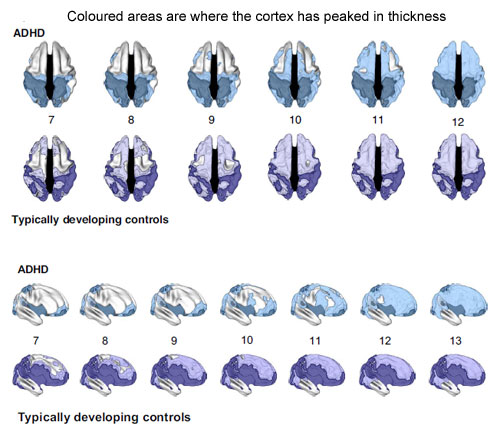
Philip Shaw, Judith Rapaport and others from the National Institute of Mental Health have found new evidence [that]….When some parts of the brain stick to their normal timetable for development, while others lag behind, ADHD is the result….they used magnetic resonance imaging to measure the brains of 447 children of different ages, often at more than one point in time.
At over 40,000 parts of the brain, they noted the thickness of the child’s cerebral cortex, the brain’s outer layer, where its most complex functions like memory, language and consciousness are thought to lie….
In both groups of children, parts of the cortex peaked in terms of thickness in the same order, with waves of maturity spreading from the edges to the centre….[but] the brains of ADHD children matured about three years later than those of their peers. Half of their cortex has reached their maximum thickness at age 10 and a half, while those of children without ADHD did so at age 7 and a half[.]
Isn’t it interesting that children with ADHD tend to lag behind in brain development by about three years–about the same length of time they continue to using private speech after typically developing children have stopped?

The caudate nuclei are highlighted in red
Here’s another blog entry on a different study of brain development in children with ADHD. This study found that children with ADHD had smaller caudate nuclei than typically developing children. This was a small study of 26 5-year-olds.
The basal ganglia (or basal nuclei) are the parts of the brain involved with voluntary motion and some forms procedural learning (development of a motor skill through practice, such as playing a musical instrument). The caudate nucleus specifically functions in learning and memory; it tells the cortex (the area of our brain where higher reasoning occurs) to do something based on current conditions. Importantly, the caudate nucleus controls motor skills partly through inhibition of particular behaviors, and disinhibition of others; an overactive caudate nucleus may be implicated in obsessive-compulsive disorder.
Smaller caudate nuclei had been documented before in older children with ADHD, but not before in children so young. The authors point out that previous studies have not been able to sort out what comes first: changes in brain structure or the behavior, which is part of the motivation of looking at younger children.
Just in time for ADHD Awareness Week, new guidelines have been released for the treatment of ADHD in children as young as 4. I must admit I find that a bit troubling. I hate to see kids get labeled as having a psychological disorder before they even start kindergarten. From the Wall Street Journal:
Attention deficit hyperactivity disorder can be diagnosed in children as young as age four, according to new treatment guidelines by the American Academy of Pediatrics.
The guidelines, released Sunday at the academy’s annual meeting in Boston, provide instructions for pediatricians on diagnosing and managing ADHD in children four to 18. They say behavioral management techniques should be the first treatment approach for preschool-age children.
But they also suggest doctors consider prescribing methylphenidate, commonly known by the brand name Ritalin, in preschool-age children with moderate to severe symptoms when behavior interventions don’t provide significant improvement. It’s a potentially controversial recommendation, because these medicines aren’t approved by the Food and Drug Administration for use in that age group.
I’m not an expert on ADHD, but I am recovering addict, and I worry about children so young being given powerful mind-altering drugs. My friend “Bill” had been prescribed Ritalin as a child, and he felt that using the drug had resulted in his abusing cocaine and alcohol as a young adult.
Generally speaking, I’d like to see doctors, teachers, and parents use behavioral solutions for ADHD symptoms, rather than drugs. At the same time, I know that psychoactive drugs have been extremely helpful to me in dealing with severe depression. There are times when drugs are a good solution, but only in concert with therapy and self-awareness.
Again, I haven’t had a great deal of practical experience with ADHD. I’d be interested in hearing from anyone here who has. All-in-all, I think it’s a good thing that developmental disorders are recognized now more than when I was a kid. I can only assume that some kids fell through the cracks back then, while now kids with these problems get attention and treatment–however flawed it may be.


 peej
peej Carissa
 ecocatwoman
 mablue2
 Mama Lopez
 peggysue22
 quixote
 skydancingguestblogger
 Mona (aka Wonk the Vote)



 Sky Dancing
Do improvements come because of age?
Are you aware of tests where only Ritialing or only behavioral solutions were used?
I’m not aware of such studies. I guess there could be some, but I’m not sure how many people use only behavioral treatments.
On the age issue, it used to be thought that people improve with age, but now there are many adults who have the diagnosis.
I’m not a clinician, so I’m really not familiar with all the studies on treatment. I’ve only really researched the language connection.
Earlier today, this playground rhyme I read in a book once popped back into my head for some reason:
I got my ritlin,
you got your dex
Give us a pill
We won’t be wrecks!
I think I must have been channeling you.
BB, my son was diagnosed with dysgraphia in the 2nd grade, he has trouble with forming letters in his hand writing…it is supposed to be a common dysfunction, and his father seems to suffer from it too. People w/dysgraphia tend to do well in math…and are able to calculate things in their head without the need to write anything down. But this inability to connect the formation of letters has caused numerous problems. He has had to give oral exams instead of writing the answers out. He used to have a laptop that used to work very well, but he is so concerned about blending in, he refuses to use it. They checked him for ADHD and said he may have some slight form of it. But what is really something, is that his reading comprehension is very high. So it does not affect the way he reads…I find it interesting the problem expresses itself in the writing of words, and not language, he also has lots of the same issues that Bill had.
(If you can follow what I wrote, it seems a bit convoluted.)
That’s really interesting. The more we learn, the more it seems that there are many different ways of experiencing the world. I tend to agree with the researchers who argue that ADHD and autism are on a continuum in the population. We all have some of the symptoms, and in some people they interfere with competing in the modern world. But there are probably hidden advantages to many “disabilities.”
The good news is that as we become aware of these differences, we can find ways for kids to work around them. Your son should embrace his uniqueness and look for the hidden advantages to seeing the world in a “different” way. I know it’s hard for kids, but as people get older and more self-aware, I think that can happen.
wonderful!
This blog is relevant for me in three ways:as a teacher-I have a second grader who chooses/uses odd words (bundle for binder, shed for closet) and I have just lately been wondering if attendion could play a role, as a mom of a child with heavyduty adhd and as a person with adhd myself.
A question: your research seems to contradict Russell Barkley’s who says kids with ADHD don’t have an internal dialogue helping them do things that come with the territiory of getting older- making your bed, say, or any of the tedious household chores that have to get done. If I am reading him correctly, thats why these kids are so immature compared to peers no self talk, no foundation- everytime may as well be the first time with the exception that they know they hate it!
Am I missing something in eitherr or bboth of your research?
Thanks
Debra B.
Hi Deb,
This isn’t my own research. I just wrote a lengthy paper on the relationship between ADHD and language. But I have read most of Russell Barkley’s work. He actually makes the same argument I do about private speech–that kids with ADHD need to use it more and longer because it helps them regulate behavior. He thinks it helps them to inhibit impulsiveness. He was very focused on “executive functioning.” He argued that kids with ADHD have deficits in the frontal lobes in the areas involved in planning and so on. I don’t know how he has integrated the new brain imaging studies into his theory.
There are theoretical disagreements about the functions of private speech, but what seems to happen is that children talk out loud until they can internalize what Vygotsky called “externalized thought,” and then it becomes the internal dialogue that adults use to regulate their behavior. The big disagreement is whether the private speech actually becomes “thought.” Visual and other types of imagery are “thought” too, and they don’t involve language. It’s a pretty complex subject, but fascinating.
Um, yeah, I think a diagnosis at four years of age with psychotropic drugs may be a bit quick. Not to say that I don’t appreciate the science as it is presented here. However, “norms” of psychological development are captive to what society accepts as best at the time.
Speaking for myself, I was quite late in speaking. Did not say a word for the first three and a half years of my life. And as noted by my family, have not shut up since.
I was also a late speaker. Didn’t talk baby talk, either, much to my mother’s concern. When I finally opened my mouth to say something, it was “gee mother, I think it’s going to rain today. What do you think?”
I realized when I was taking a Spanish language course at the local junior college many years ago that I understood what the instructor was saying, I could write what I heard, but I couldn’t verbalize, I think because I didn’t have the vocabulary to say what I wanted nor did I have proficiency in the verb tenses. I think I’m a good candidate for the total immersion method of learning a language. Maybe I should move to San Miguel de Allende, Mexico.
My niece didn’t speak at all until she was two. No baby talk at all, but she would communicate nonverbally using gestures and speaking gibberish. Then, shortly after she turned two, she began speaking in complete sentences. She was the youngest of six children, so we just assumed that it had something to do with the fact that her peers weren’t using baby talk. She’s an adult now, and was an excellent student throughout her academic career and just graduated from law school, so her early inability to use baby talk hasn’t seemed to harm her in any way.
Age 2 isn’t particularly late to begin talking. That’s probably about average. Kids can understand language very early and most kids communicate with gestures before they can form words to communicate their needs. Talking requires certain types of physical maturation–not just in the brain, but also in the throat and mouth. Again, each child has his or her own timetable, based on genetics and experience.
I have a huge problem with the clinical tendency to label difference as “disorder.” I’m not a clinical psychologist, and never had any interest in being one.
Neverthless, it is well recognized that many children are late talkers. That is a completely different issue than ADHD. Private speech is something that all children use, and it is very helpful to them and an important part of development.
The notion of developmental “norms” is pretty old-fashioned. Every child develops on his or her own timetable. But there is value in knowing that some differences exist, so that kids aren’t held to some unrealistic standard or “norm.” We all have ADHD-like symptoms, but some kids are at the far end of the continuum and may need some support from parents and teachers.
I don’t want to say that no child should take a drug, but I think it should be a last resort. I certainly think age 4 is waaaayyyyy too young! I’m sure that drug companies are pushing for this type of research.
This is probably not relevant to ADHD, but it is something I always wondered about. When I was in one of the earlier elementary grades, I was given an audiology exam, along with all the other kids. Headphones were put on and the tester delivered tones to either the right or the left ear. I was supposed to raise my right hand if I heard the tone in my right ear and my left if I heard the tone in my left. I heard the tones perfectly well but had no idea whatsoever which ear I was hearing it in so just took guesses as to which hand to raise and hoped fervently that I was correct. The tester was peeved, kept telling me it wasn’t a game and starting over from the beginning again. She finally dismissed me and no doubt wrote down that I was uncooperative, but the truth is I simply had no idea which side I was hearing the sounds on. I would have no trouble doing the task today. What was that all about? Why didn’t I know which ear I was hearing things in?
I don’t know why that happened, but the person who was testing you was an idiot. It takes time for kids to know right from left anyway.
I didn’t have to know right from left. I just had to raise my hand on the same side I heard the sound on.
Oh, I see. How old were you at the time?
One of the earlier elementary grades, anytime from K-3, don’t remember exactly which. I was 4 when I entered kindergarten, 8 when I exited third grade. I have a feeling that it was kindergarten or first grade, but not exactly sure. I think I was older than 4 at the time and younger than 8.
I’m not sure what caused that. But the tester should have tried to talk to you so he/she could understand what the problem was, rather than criticizing you for having trouble recognizing the direction of the beeps. You could have had some kind of subtle hearing problem.
Slightly OT but maybe this will help someone else:
I have a learning disability called dyscalculia. Even though I have a high IQ, and learned to read and write when I was 3, I could never learn even simple math. My teachers would repeatedly send notes home to my mother saying I needed to relearn my addition and subtraction or my multiplication tables. They said I needed to work harder. But I couldn’t remember math no matter how hard or long I worked at it. I still can’t. I reverse numbers but not letters. I can’t tell left from right or north from south. I can’t read maps or understand time well. If someone says, “It’s 10 minutes until 12:00”, I don’t understand that. I was talented in art and writing, but my problems with math ( and the associated disorders ) made me feel stupid growing up. My older brother was a genius in math ( but not in art or writing ) and my teachers compared me to him unfavorably. I wasn’t diagnosed with dyscalculia until I was a senior in college. The diagnosis helped me to accept myself as I am and stop berating myself for things I couldn’t learn. I have tried to embrace my innate strengths rather than always focusing on my weaknesses. It’s still a struggle sometimes though. I want to be like Dak and understand that stuff! 🙂
That’s very interesting. I do think the benefit of getting a diagnosis as a child is gaining self-awareness and self-acceptance. Once you understand a problem, you can sometimes take conscious step to deal with it also. Thanks for sharing that. I had never heard of dyscalculia before.
The dyscalculia is similar to dysgraphia, only it is associated with numbers and not letters. I think it is interesting that in my son’s case, he’s ability to do math is heightened where in Beata’s case her ability to write was more dominant. It is like the brain is overcompensating for the loss…
Thank you for this fascinating post, BB. When my daughter was two, she was attacked in her preschool by another student her age. She still has faint scars on her face from where he dug his fingernails into her. The preschool, although shiny and new with supposedly all of the latest bells and whistles, was staffed only to the state mandated minimums. I discovered, after my own investigation, that the student who attacked my daughter had also attacked several other students at various times. The preschool director told me that this student’s mother was shocked and couldn’t believe that her little angel was actually attacking other students because he was the perfect child at home. My sister-in-law was an elementary school teacher at the time, and she said the student’s behavior was typical of a child with ADHD in that, when the student is getting individual attention from a teacher or a parent, they are able to control their behavior, but in group situations they get easily frustrated and sometimes act out violently. While I am almost fanatical in my belief that we should take every measure we can to avoid dependency on prescription medications, it seems to me that even though this child was only two years old, he would have benefitted from some drug intervention.
IMHO, a two-year-old who attacks other children is probably being abused or neglected in some way at home. I think that should have been looked into. A kid who attacks other kids should not be allowed in pre-school anyway. That isn’t even fair to the teachers, much less the other kids. I’ve heard stories like that about older kids though. A friend of mine is a first-grade-teacher and she has been attacked by kids in her class when they weren’t on their meds.
I’m so sorry that happened to your daughter!
You’re absolutely right, he should have been removed from the preschool altogether, but this was a crappy preschool. The only way I found out that this child was attacking other children was by talking to other parents out in the parking lot. The school acted like his attack on my daughter was a unique episode. They didn’t want to lose the money by kicking him out, and they thought they could cover up the fact that it was a chronic problem. I got lucky, I took my daughter to the really good preschool with the two year waiting list, and told them my tale. They fell in love with my daughter, and felt horrible about what happened to her, and moved her to the top of the wait list so I was able to get her into the good preschool within two weeks of the incident. I told the director of the first preschool that I was getting my daughter out and that I wouldn’t file a complaint with the county as long as my daughter was never in a room with that little boy for the little time she had remaining there. Of course, as soon as I got her out of there, I filed a complaint with the county. It was a terrible situation. I needed my job and I needed decent childcare. Note to all parents and prospective parents out there, just because a preschool or childcare facility is brand new, doesn’t mean it’s going to be run well, and the only good childcare has a long waiting list, so get on it well in advance of when you need it.
Wow, quite a story. I’m just glad it worked out for you and your daughter. My friend the teacher has complained to parents and administrators, and the complaints seem to fall on deaf ears. She teaches in an inner city school, and I’m sure some of those problem kids have terrible parenting. It’s tragic what happens to children. It breaks my heart.
Thanks for an interesting and clear summary of ADHD.
Very interesting about the language characteristics. I’d never heard about that before.
I had an interesting experience at a cafe a few weeks ago. Three girls age 4 years old came in with their parents. (Ironic that the girls were the same age in light of the behavior of one of the girls.)
I was sitting in the booth next to one of the girls, facing the family (mother, father and the child). The two other girl’s behavior could also be observed. These girls were on their best behavior — they made food choices on the menu and were well behaved.
Meanwhile the girl in the next booth was walking on top of the table — in order to bounce between her mother and father. She would stand on the table for several minutes — while the parents were trying their best to get the child to sit and stay off of the table. At one point the father asked the little girls why she couldn’t be good like the other girls.
Finally the father called the waitress over and asked that their meal be packed for take out. He couldn’t take the child’s hyper active behavior.
I’ve never seen a child of her age repeatedly stand and walk on the table. The parents were making an effort to teach the child appropriate dining out behavior. All of this was happening behind my husband’s back. He could hear the parents as they tried to get the girl’s attention and get her to stay off of the table.
Testing ADHD kids with any of the commonly used tests for learning disabilities is darn near impossible. The model of individual test giving is to have the child sit across the table. In one case I tested a 2 year old child while he was swinging — and he was able to keep busy while doing very well on the test. My scores from that test were the most accurate — he managed to graduate from college with honors — at a much later age than most students. He has his own time table.
Of course kids are born with specific temperaments too. She could have had a difficult temperament, high in activity and anxiety. She might end up being neurotic, but to put her on mind-altering drugs that young? I think it would be big mistake. If the parents wanted to teach the child appropriate behavior, they should start at home, IMO. But it sounds like you know more about this than I do.
That girl probably should have been taught how to behave at home — but who knows perhaps her parents thought she was ready for a dinner out. Perhaps it was too much stimulus and she will grow out of her hyper phase. I hope so. There is far too much drugging — way too early. But I have never seen a 4 year old walking on the table like she did.
I used to test for learning disabilities years ago — there is so much new research and testing tools. It was my way to understand dyslexia that appears to be genetic in my family.
The last time I tested a student was about 10 years ago — and it was impossible to complete the test. Mostly because he hadn’t been taught manners by his parents. In his culture boys aren’t taught to respect teachers (or testers).
Isn’t the research into innate temperament fascinating? Every so often I go to the University and try to read the research journals.
I couldn’t agree more with your statement of “I’d like to see doctors, teachers, and parents use behavioral solutions for ADHD symptoms, rather than drugs.” My 3rd grade teacher thought I had ADHD and the principal and her tried to convince my parents that I needed to be on ritalin.
Problem was…the signs weren’t there, and…I didn’t have it! I just had lots of energy. And…I was easily controlled with the right motivation (through behavior modifications/reinforcement).
I’m glad you didn’t take the drugs. I think schools use ADHD to control energetic kids. Kids that age need to be moving around. I think the better schools recognize that now, but when I was in elementary school we had to sit in rows and stay in our seats. I was always getting in trouble for talking in class, etc.