
Karl Marx: The Comeback Kid
Posted: April 10, 2011 Filed under: Economic Develpment, financial institutions, Global Financial Crisis | Tags: Commerce, economics, finance, Financial Development, Financial Institutions, Karl Marx 23 Comments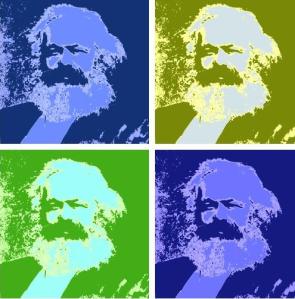 technology, pushing them to take more and more expensive credits, until their debt becomes unbearable. The unpaid debt will lead to bankruptcy of banks, which will have to be nationalised, and the State will have to take the road which will eventually lead to communism”
Karl Marx, Das Kapital, 1867
Okay, I got your attention and that’s my purpose. I’m really not a closet Marxist, but I do feel that some of that old school political economics he brought to the realm of economic thinking way back when is still worth contemplating. The above quote from Marx is a fairly good summation of his intellectual endeavors. He starts out with some really great assumptions then jumps the shark with vague, unmapped conclusions, But, Marx was a philosopher and jumping sharks seems to be an occupational hazard for them. Economics these days relies on mathematical models and empirical study.
Marx is one of those folks–along with equally fringe Frederick Hayek– who is getting a second look in a back-handed way. What’s pretty interesting is that a lot of the criticism of Marx and Lenin forgets that they had more against “financial capitalists” than they had against “industrial capitalists”. Both Rand and Ron Paul sort’ve remind me of them in that way. Marx actually looked at us ideally as a society of producers. He didn’t like how financiers fit into that picture at all. He railed against the UK’s Bank Act of 1844 that was a response to a fairly huge financial crisis. He argued that the “1844 Act had been deliberately designed to keep interest rates artificially high, benefiting the financial section of the capitalist class at the expense of the industrial section”. He also had a lot to say about paper money that wasn’t convertible to things like gold and it’s hard not to hear Marx in Ron Paul’s diatribes.
Marx also introduced the idea of commodity fetishism, which is a fairly compelling description of the modern US economy. He felt we’d all become slaves to it eventually. So, even though he never really fleshed out much worth implementing, he and Lenin had some interesting commentary on what they saw as problems that would arise from a society that became increasing focused on financial services and became addicted to consumer goods.
In an odd way, the financial crisis has brought on renaissance of the Marxist critique as well as a huge number of libertarians that are trying to have a Hayekian renaissance. Academics that study financial economics are asking similar questions but not quite in the way that you would think. The odd thing is that the very line of research that used to soundly tromp the Marxist assumption of the financial capitalist as parasite is sort’ve headed towards a refinement of the idea that too many bankers spoil the economy.
Every one is pretty much in agreement that much of the time, market economies do a fairly good job of sorting out who gets what. You can even speak with economists in Cuba and find out they are all planning for liberalization as long as it doesn’t reintroduce a flurry of exploitation. The problem is that real life markets don’t function very well when there are too many ‘frictions’. Just as in physics, frictions deform things. Frictions are basically things that cause less-than-efficient outcomes in markets where efficiency is strictly defined as the maximum quantity produced at a minimal price. In some cases, these things are caused by governments. Regulations, tariffs, quotas, and taxes can all cause frictions. Some are put in place purposely to warp the market outcome as is the case with sin taxes. Third party payers–like the health insurance industry–create frictions. Advertising creates incredible frictions.
Markets can have naturally occurring frictions like the placement of oil reserves or diamonds or gold in certain locations in the world. They can have frictions due to technology or economies of scale where it’s most efficient to have a single producer or monopoly because it is least expensive or necessary to create the minimal cost plant size. Think how huge car manufacturing or steel plants have to be so they are cost effective. Frictions are everywhere and they warp market outcomes. Free Market fetishists tend to ignore any friction not created by the government. In some cases, government is the source of the friction; in other cases, government–through regulation or policing of markets–can remove the frictions. Financial markets are riddled with two notorious frictions: information asymmetry and moral hazard. You can see how Marx grasped those problems philosophically. Lenin actually did studies using numbers. Hayek had his explanations of financial crises as did J.M. Keynes. Keynes went so far to say that financial markets were driven by “animistic spirits”. We’ve come a long way since all of them were actively writing but yet, some of the themes remain the same in new veins of inquiry.
There are several things out in the blogosphere that have brought me to discuss this topic with you. The first is a NYT editorial called ‘Banks are Off the Hook Again’. Banks are trying to get Federal lawmakers to override state laws on foreclosure in an attempt to avoid prosecution and the results from their foreclosure practices. They are–per usual–succeeding.
As early as this week, federal bank regulators and the nation’s big banks are expected to close a deal that is supposed to address and correct the scandalous abuses. If these agreements are anything like the draft agreement recently published by the American Banker — and we believe they will be — they will be a wrist slap, at best. At worst, they are an attempt to preclude other efforts to hold banks accountable. They are unlikely to ease the foreclosure crisis.
All homeowners will suffer as a result. Some 6.7 million homes have already been lost in the housing bust, and another 3.3 million will be lost through 2012. The plunge in home equity — $5.6 trillion so far — hits everyone because foreclosures are a drag on all house prices.
The deals grew out of last year’s investigation into robo-signing — when banks were found to have filed false documents in foreclosure cases. The report of the investigation has not been released, but we know that robo-signing was not an isolated problem. Many other abuses are well documented: late fees that are so high that borrowers can’t catch up on late payments; conflicts of interest that lead banks to favor foreclosures over loan modifications.
The draft does not call for tough new rules to end those abuses. Or for ramped-up loan modifications. Or for penalties for past violations. Instead, it requires banks to improve the management of their foreclosure processes, including such reforms as “measures to ensure that staff are trained specifically” for their jobs.
This is a really good example of maintenance of mutually destructive frictions in a market. It creates uncertainty. It does not contribute to translucence and information. It ensures a lop-sided process. In short, it guarantees certain market failure and it sets up the winners and the losers. It’s something about which both Marx and Hayek would rant. For that matter, J.M. Keynes wouldn’t be so judicious about it either.
The second thing that ties all this together is a vein of academic research with some interesting empirical evidence. Financial Economists Jean-Louis Arcand, Enrico Berkes, Ugo Panizza have an interesting question: ‘Too Much Finance?’ backed up by sophisticated econometric analysis rather than philosophical shark-jumping. Although it is not the least bit Marxist or anti-capitalist or even hostile to finance, it does sort’ve address the age-old Marxist hypothesis that eventually financial capitalists will take over the economy and bring both workers and industrial capitalists to their knees. In this case, the authors argue that there’s a positive role for financial markets, but it’s a limited one that we’ve possibly overstepped. Finance has gone from greasing the wheels of commerce to something altogether different. The old academics that just loved the financial markets and came up the current company line back then were Bagehot (1873) and Schumpeter (1911).
There’s been a line of study since then that connects economic growth to the size and depth of a country’s financial system. That line of study has basically been the empirical evidence that caused most folks to dismiss both Hayek and Marx outright. In fact, when I do many of my models I use some kind of proxy for ‘financial development’ due to this line of literature when I’m looking at emerging markets or developing nations. In order for businesses to grow large, they have to have access to fairly huge amounts of money and that requires fairly big banks and a developed equities market. It also requires good central banks and regulation. Think about GM or Walmart. The odd collection of savings accounts and checking accounts at your local credit union are not going to fund them for one second of business. So, up until recently, most finance evidence has shown positive correlation between how big or developed the finance sector is and how big the overall economy gets. Well, that would be until now.
There’s been an incredible amount of new research showing that our financial development has reached some new Rubicon. Here’s the literature review from the paper above. Now, remember, all of these guys are mainstream finance researchers. We’re not talking the Cato Institute or the Mises Institute or the Marx-Engels Institute which all have their own little views of what causes financial crisis that most of us consider shark-jumping.
The recent crisis has however raised concerns that some countries may have financial systems that are “too large” compared to the size of the domestic economy. Wolf (2009), for instance, noted that over the last three decades the US financial sector grew six times faster than nominal GDP. He argued that there is something wrong with a situation in which, “instead of being a servant, finance had become the economy’s master”. For his part, Rodrik (2008) asked whether there is evidence that financial innovation has made our lives measurably and unambiguously better.
The idea that there could be a threshold above which financial development hits negative social returns is hardly new. Minsky (1974) and Kindleberger (1978) emphasized the relationship between finance and macroeconomic volatility and wrote extensively about financial instability and financial manias. More recently, in a paper that seemed controversial at the time but looks prophetic now, Rajan (2005) discussed the dangers of financial development, suggesting that the presence of a large and complicated financial system had increased the probability of a “catastrophic meltdown”. In an even more recent paper, Gennaioli et al. (2010) show that, in the presence of some neglected tail risk, financial innovation can increase financial fragility, even in the absence of leverage.
Besides increasing volatility, a large financial sector may also lead to a suboptimal allocation of talents. Tobin (1984), for instance, suggested that the social returns of the financial sector are lower than its private returns and worried that a large financial sector may “steal” talent from productive sectors of the economy and therefore be inefficient from society’s point of view (for a more nuanced opinion, see Philippon 2010).
The ability to increase in size as well as the ability to rent-seek laws that privilege them has become a hallmark of the financial industry since 1980. The Arcand et al (2011) paper has some even more interesting contributions to this age-old question about financial markets.
- First, we build a simple model finding that, even in the presence of credit rationing, the expectation of a bailout may lead to a financial sector that is too large with respect to the social optimum.
- Second, we use different datasets (both at the country and industry-level) and empirical approaches (including semi-parametric estimations) to show that there can indeed be “too much” finance.
Our results show that the marginal effect of financial development on output growth becomes negative when credit to the private sector surpasses 110% of GDP. This result is surprisingly consistent across different types of estimators (simple regressions and semi-parametric estimations) and data (country-level and industry-level). The threshold at which we find that financial development starts having a negative effect on growth is similar to the threshold at which Easterly et al. 2000 find that financial development starts increasing volatility. This finding is consistent with the literature on the relationship between volatility and growth (Ramey and Ramey 1995) and that on the persistence of negative output shocks (Cerra and Saxena 2008).
- Third, we discuss how our results relate to the current crisis and show that all the advanced economies that are now facing serious problems are located above our “too much” finance threshold.
We also run a battery of tests showing that the size of the financial sector played an important role in amplifying the effects of the global recession that followed the collapse of Lehman Brothers in September 2008.
The original paper is here at Ugo Panizza’s blog. The authors are all affiliated with Graduate Institute of International and Development Studies (Geneva, Switzerland). I’ve seen the methodology, you’ll probably want to skip that section unless econometrics is an occupational hazard for you like it is for me.
Anyway, I think this is an interesting question to look at from a historical perspective as well as from a future of our economy perspective. It also has interesting ramifications for regulators. Marx argued that bankers would start calling the shots for the industrialists and the industrialists would have to cave in in order to get money. He felt that this would create incredibly problems with allocation of scare resources which is the central problem of economics. Again, his conclusions went way beyond his simple analysis, but it does seem ironic that the very literature that once proved him wrong is showing signs that there may be a point at which he could be right.


 peej
peej Carissa
 ecocatwoman
 mablue2
 Mama Lopez
 peggysue22
 quixote
 skydancingguestblogger
 Mona (aka Wonk the Vote)



 Sky Dancing
I Dakinikat,
There is some jargon in your post that I don’t understand.
What does it mean to “rent-seek laws”?
Anyway, it looks to me like old Karl was right about the banks. I really don’t think he jumped the shark.
I agree. We need a better understanding of what rent is and how it is used
Yup, it’s jargon. Sorry about that Chief, per Wikipedia:
and here’s the definition of economic rent:
An Economic Rent basically a rate of return than is higher than the activity would get in a market if it were truly a perfectly competitive market. Lobbying is a rent-seeking activity by businesses. They seek monopoly and extraordinary profits. They don’t just want a market rate of return. They wouldn’t be satisfied with that so they try to get laws passed that help them get above normal rates or returns. The AMA does that on doctor’s salaries by limiting the number of med students and the number of doctors that can go into specialties. Same as medieval guild behavior.
Thanks, Dak. I think I understood everything else. Very interesting post!
I understand everything except restricting quantities of goods in order to make a windfall profit. If quantities are restricted, then fewer goods are sold, which would seem to translate into less money. Except, of course, if the price of the goods are raised enough to make an extraordinary profit above what the return would be in a perfect market situation. I guess that must be what they do then, to make that profit (economic rent).
Well, I think the shark jumping was on the existence of Communism. I think these systems collapse. I just don’t think they lead to workers’ paradises.
Oh, I get it. I thought you meant the specific statement you quoted.
So an economic rent is a profit? A return higher than it takes to produce a good and sustain the supply?
It’s an extraordinary profit above what the return should be under perfect market situations. It’s usually gained by manipulating quantity or price. When you restrict quantity of a good that’s in high demand, its price will go up because of the manipulation. You can only restrict quantity when you are in a market that’s not competitive or one’s that been granted protection by government. It’s a profit that wouldn’t exist if real market conditions prevailed.
OK, thx.
So is the idea to do as little restriction as possible combined with as high a price as possible to make an economic rent?
OK, I know making an economic rent is not the idea, but I’m just curious, is that what they do if they want to make one?
The diamond cartel..DeBeers
yup, that’s the textbook example
Branjor: If corporate interests want to make economic rents, they must find ways to restrict quantities sold or to get higher than called for prices. Usually, they do that by lobbying governments to pass laws in their favor. Their subsidies, restrictions on imports, licenses, patents, etc. all restrict quantities and increase prices for consumers. The oil industry does it by not having enough processing capacity. They simply refuse to increase the amount that can be processed and that don’t look for new refineries. We don’t need any more drilling. What we need is more oil refineries right now. They don’t want to incur the costs because it restricts their profits for two reasons. One is the huge costs and second it limits their capacity without looking like they’re doing it purposefully. I’m sure they could find some island somewhere to build refineries but it’s not in their interest. It’s more profitable to give every one the impression their not allowed to drill enough.
If the beginnig of that last sentence of Marx’s prediction were true. Instead of the State nationalizing failed banks, the banks have capitalized the corrupt State. Surprise! Megatheocorporatocracy is born.
If only…
Yup,Marx argued that the middle class would see the corruption inherent in the system and rise up along with the working class. Because some countries experienced that–except it was sort’ve the peasant class instead–we here in the US got our New Deal and then there was also enforcement of monopoly law to stop some of the other behaviors. Since the 1980s, we’ve had nearly no enforcement of monopoly laws and we’ve seen a stripping away of the safety net. Marx would predict we’ll see that revolution. I don’t think he saw how effectively people would be co-opted, however, by corporate and kleptocracy propaganda. The media is part and parcel of the kleptocracy now. Even Thomas Jefferson didn’t foresee that. The co-option of media by corporate interests and the co-option of the Supreme Court has really changed the game. Since our checks and balances are failing, that means something else must work to change the system. I dunno. The Arab uprising looks more like people demanding to join the middle class in those countries. Not sure what’s left to us …
That’s the subject of my new post (failure of checks and balances), sort of anyway.
Nor did Jefferson and Marx live to see the fulfillment of Edward Bernays’ (evil) genius. They’ve gotten good at using our brains against us.
I enjoy reading American History of the late 19th century. I have found this article to be very illuminating. This was the beginning of the Gilded Age with continued wealth aggregation and the eventual rise of the Labor Unions. The only difference this time is that the taxpayers bailed out the financial institutions.
http://piggington.com/the_real_great_depression_panic_of_1873
…..Mortgages were easier to obtain than before, and a building boom commenced. Land values seemed to climb and climb; borrowers ravenously assumed more and more credit, using unbuilt or half-built houses as collateral….
The cost to borrow money from another bank — the interbank lending rate — reached impossibly high rates. This banking crisis hit the United States in the fall of 1873. Railroad companies tumbled first. They had crafted complex financial instruments that promised a fixed return, though few understood the underlying object that was guaranteed to investors in case of default. (Answer: nothing)
The Panic of 1873 was a biggie. That was a huge recession. It changed the world’s silver policies. There were lots of recessions that followed. Bankrupted a lot of companies. None of them got to restructure their and none of them got bailed out. That one really did the railroads in and it was followed by a strike in 1877. Interesting times.
comment by IbnOmar2005 Ibn Omar
via twitter deck–>
DAK,
What do you make of the report and the summation above? Sure sounds as it Gaddafi squandered the money away, and it is no wonder he had so many palaces, while pretending to live in a tent.
I’m not sure Libya made any really huge amounts of cash, but whatever cash it had, the Gadhafi family squandered it all.