
A Military Coup is not the Same Thing as Democracy
Posted: February 14, 2011 Filed under: just because 30 Comments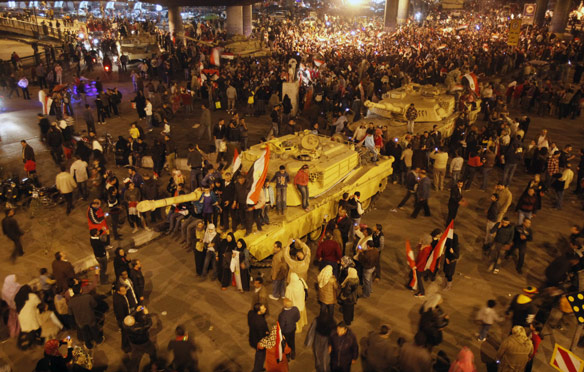
Celebration in Tahrir Sq. after Mubarak's ouster (CBC News)
Like so many other people, I was thrilled while following the protests in Egypt for the past three weeks. I’m very happy that Hosni Mubarak is no longer in power. But let’s get real. That doesn’t mean there will be democracy in Egypt.
On Saturday, I wrote a post about the hypocrisy of President Obama praising the protesters and calling for democracy in Egypt when he clearly doesn’t support democracy here at home. Now I want to take another look at the quote from Obama’s Feb. 11 speech on Egypt that I included in that post:
There are very few moments in our lives where we have the privilege to witness history taking place. This is one of those moments. This is one of those times. The people of Egypt have spoken, their voices have been heard, and Egypt will never be the same.
By stepping down, President Mubarak responded to the Egyptian people’s hunger for change. But this is not the end of Egypt’s transition. It’s a beginning. I’m sure there will be difficult days ahead, and many questions remain unanswered. But I am confident that the people of Egypt can find the answers, and do so peacefully, constructively, and in the spirit of unity that has defined these last few weeks. For Egyptians have made it clear that nothing less than genuine democracy will carry the day.
Admittedly, Obama noted that there will be “difficult days ahead” for the Egyptian people, but generally speaking he made democracy in Egypt sound like a fait accompli
But what really happened in Egypt is a military coup. If the military threw out Ahmadinijad and took control of the Iranian government, what would President Obama call that action? Would he praise the Iranian military as he did the Egyptian army? Would he say that the Iranian people’s wishes had been heard and responded to?
The military has served patriotically and responsibly as a caretaker to the state, and will now have to ensure a transition that is credible in the eyes of the Egyptian people. That means protecting the rights of Egypt’s citizens, lifting the emergency law, revising the constitution and other laws to make this change irreversible, and laying out a clear path to elections that are fair and free. Above all, this transition must bring all of Egypt’s voices to the table. For the spirit of peaceful protest and perseverance that the Egyptian people have shown can serve as a powerful wind at the back of this change.
Good luck with that. Believe me, I hope it happens. But I also hope the Egyptian protesters are prepared to keep on fighting, to be arrested and tortured, and perhaps to be put down violently when the world stops watching so closely.
I don’t always agree with Larry Johnson, but I have to say he was spot on when he said in so many words that Obama’s speech was laughable and naive.
Let’s look at what has happened since the ouster of Mubarak.
From yesterday’s NYT (also quoted in Johnson’s post):
The Egyptian military consolidated its control on Sunday over what it has called a democratic transition from nearly three decades of President Hosni Mubarak’s authoritarian rule, dissolving the feeble Parliament, suspending the Constitution and calling for elections in six months in sweeping steps that echoed protesters’ demands.
One thing I’ve garnered from listening to the experts discuss this situation is that six months is way too soon for opposition parties and candidates to get ready for an election. Until now there has just been one party–Mubarak’s party. And the army’s job was basically to make sure that Mubarak stayed safe and in control. The army got rid of him because he was no longer useful, but why should anyone think the army will be a force for positive change? Back to the NYT article:
Since seizing power from Mr. Mubarak on Friday, the military has struck a reassuring note, responding in words and actions to the platform articulated by hundreds of thousands in Tahrir Square. But beyond more protests, there is almost no check on the sweep of military rule. Its statement said it would form a committee to draft constitutional amendments — pointedly keeping it in its hands, not the opposition’s — though it promised to put them before a referendum.
Okay so the generals are being “reassuring.” Of course. But that is meaningless as long as they have all the power. Here is Larry Johnson’s assessment:
Once upon a time this kind of act would have been called a military coup. Didn’t matter whether it was benign or malicious–if the military suspended normal law and procedure and put itself in charge then the resulting rule of government was commonly referred to as a Military Government. But not in Barack Obama’s new fantasy world of political nonsense. Nope! This is democracy in action. The people have spoken and we should celebrate.
So let’s extend this logic to Iran. Let’s say a million Iranian’s take to the streets demanding change. Let’s say that poor Ahmadhinejad, who is a weak example of a Mubarak type figure, resigns and flees to a resort on the ocean. Let’s say the Revolutionary Guard suspends Iran’s legislature, suspends the constitution and promises (double pinky swear) to hold elections in six months. That is democracy in action?
The silliness surrounding the reaction in the West, especially in the United States, to the political drama unfolding in Egypt is staggering….Pretending that Egypt is embracing democracy because the military has taken power is the kind of insanity and bizarre logic that was the hallmark of the Mad Hatter in Lewis Carroll’s underground fantasy.
Where I part ways with Johnson is when he asserts that the uprising in Egypt is “likely to shift the Middle East in the direction of Islamic extremism.” I’m not sure that is going to happen–but he probably knows more about the situation than I do.
I want to take a look at today’s events in Egypt. But first, a little background on the role of the army in Egypt. They are involved in everything, not just the government, but also the economy and business. Are they really going to be willing to give all that up and cede control to a civilian government?
The armed forces own and operate hundreds of companies that produce bread, durable goods, even vehicles. Robert Springborg, professor of National Security Affairs at the US Naval Postgraduate School, tells RFI it is not likely that the military would let go of these lucrative activities.
[….]
Springborg says that Egypt’s military has opposed free market reforms since the 1980s, and by keeping power now it will continue to hinder the country’s economic development, especially after the economy took a hit after the demonstrations.
“The military has chased away, threatened with prosecution, significant members of the liberal economic elite,” he said.
“The military takeover here is absolutely no answer to the country’s economic problems,” he said.
To me, it sounds like it will be every bit as difficult for the Egyptian people to displace the army as it would be for the American people to get the corporations off our backs.
So what has happened in Egypt in the past day? According to the very knowledgeable Robert Fisk at The Independent, the army may be “tightening its grip on Egypt.”
Two days after millions of Egyptians won their revolution against the regime of Hosni Mubarak, the country’s army – led by Mubarak’s lifelong friend, General Mohamed el-Tantawi – further consolidated its power over Egypt yesterday, dissolving parliament and suspending the constitution. As they did so, the prime minister appointed by Mubarak, ex-General Ahmed Shafiq, told Egyptians that his first priorities were “peace and security” to prevent “chaos and disorder” – the very slogan uttered so often by the despised ex-president. Plus ça change?
In their desperation to honour the ‘military council’s’ promise of Cairo-back-to-normal, hundreds of Egyptian troops – many unarmed – appeared in Tahrir Square to urge the remaining protesters to leave the encampment they had occupied for 20 days. At first the crowd greeted them as friends, offering them food and water. Military policemen in red berets, again without weapons, emerged to control traffic. But then a young officer began lashing demonstrators with a cane – old habits die hard in young men wearing uniforms – and for a moment there was a miniature replay of the fury visited upon the state security police here on 28 January.
It reflected a growing concern among those who overthrew Mubarak that the fruits of their victory may be gobbled up by an army largely composed of generals who achieved their power and privilege under Mubarak himself.
There have been reports in many newspapers that the generals have been trying to crush the strikes by workers that have continued after the coup against Mubarak. This is from the Washington Post:
Police officers, ambulance drivers, bankers, journalists and archaeologists marched through the streets of Cairo in separate protests Monday. Emboldened by a sudden burst of freedom that has flowered since President Hosni Mubarak’s departure on Friday, the demonstrators demanded higher wages and other benefits.
“This is our ideal chance to make our voices heard,” said Ahmed Mahmoud, a manager at a state-owned bank. “You would never see these kind of protests before, not when we had a dictator.”
The Supreme Military Council, which took power after Mubarak’s resignation, responded with a communique in which it urged Egyptians to go back to work, saying the stoppages were harming the country’s security and economy. The council imposed martial law on Sunday, and officials hinted that they would ban strikes if things did not improve.
“Honorable Egyptians regard these demonstrations, which are taking place at a critical moment, as leading to negative consequences,” read the communique, the fifth handed down by the military council since last week.
Here is a similar story in the Guardian UK. Even more ominously, at Common Dreams, there is a story that asserts that the military will ban unions and professional people from holding meetings, while claiming that, of course they support people’s rights to protest–just not right now, and especially not to make demands for higher wages.
There is a brief op-ed in the Financial Times today, written by Mohamed El-Erian, who grew up in Cairo. This is his “to do list” for Egypt:
…the armed forces, in their transitional role,… [must] lift Egypt’s emergency law, in place since 1981. Fair and free elections for parliament and the presidency must follow, as must constitutional reforms that provide for broad-based political participation and better protection of individual freedoms.
Next, the nation’s economy should be properly reset. The revolution brought most corporate activity and government services to a virtual standstill. Shortfalls in corporate and government receipts are now inevitable. Capital flight must be addressed through financial buffers, and the resumption of domestic and foreign investment inflows. Offsetting that discredited part of the business community that maintained corruption-laden relationships with the regime must also be a priority.
To support this Egypt’s economic and political institutions must be revamped, to ensure greater transparency, accountability, and checks and balances. It is important that happens in a manner that discourages the personality cults that so undermined the country in the past. Reforms to political parties and other bodies must be the first priority, but corporate reforms should follow quickly. At the same time, addressing social grievances must be brought to the top of the agenda. Urgent steps are needed, in particular, to ensure the efficient provision of basic food, along with health and shelter to the poorest segments of the population
That’s a pretty long and probably not very realistic list. As I wrote on Saturday, I’d love to see all of those things happen here in the U.S. too. But will they? Not likely. Of course young Americans haven’t been out in the streets protesting and workers and unions haven’t either. Why the hell not?
We’ll just have to wait and see what happens in Egypt, but IMHO, the protests must continue–even in the face of violence from the army–if there is any real hope for democracy in Egypt.
As for President Obama, my guess is that he really couldn’t care less what happens to the people of Egypt as long as he can still rendition people there to be tortured and interrogated.


 peej
peej Carissa
 ecocatwoman
 mablue2
 peggysue22
 quixote
 skydancingguestblogger
 Mona (aka Wonk the Vote)



 Sky Dancing
I think it’s important that we not take our eyes off of the process of change there. We need to make sure the people of Egypt get what they asked for. This was a soft coup. We have a lot of influence with the army there. We should continue to engage them to make sure it doesn’t shut down. I don’t think it will turn into some Islamic state. I do think we could see a possible rotation of pharaohs, however if we don’t audit their every move and influence what we can. That Common Dreams article that said that unions were likely to be banned worried me.
I agree. And as Americans, we need to keep our eyes on Obama and what he does. I don’t believe he cares about democracy in Egypt. He’d like the interest to die down so he can help install another strongman dictator.
Another one of his “learning moments”
BostonBoomer, your comment above is well taken.
Thanks, Pilgrim. The only way Obama will support democracy–whether here or in other countries–is if he’s forced to.
I called it a military coup days ago. So I agree on the whole this article.
Let’s see if the State of Wisconsin will see some street action:
http://news.firedoglake.com/2011/02/14/debate-over-wisconsin-collective-bargaining-gets-heated-as-republicans-waver/
I heard about that. Do you live in Wisconsin?
I don’t. Power to the People of Wisconsin.
Agreed!
Great post.
Here’s something from Democracy Now I just finished reading, on topic here. (The video only shows a portion, for me anyway, but the transcript is full.)
After the Revolution: Mubarak is Gone After 30 Years in Power, But Questions Remain as to How Transition Will Proceed
Thanks, I’ll go check it out. I’m not actually sure that the military has met any of the protesters demands. I think so far it’s all promises–but I could be wrong.
Thank you, bb! I’ve been thinking the same thing and was wondering if anyone else did too. You voiced my concerns perfectly.
p.s., you folks are running one the best blogs on the intertubz. thanks to all for keeping on keeping on… and with such grace and style to boot!
Hi Gxm17,
Thank you very much. We’d love to have you commenting more often too. I know I’ve missed you.
I don’t think there’s any doubt that the ‘revolution,’ soft coup, whatever is in its infancy. Toppling an oppressive leader does not a democracy make. The Egyptians have a lot of hard work ahead of them and most likely severe economic reprecussions to weather. They need to organize democratic institutions, revamp their constitution, set up an independent judiciary, form political parties and more, all the while being vigilent of those forces licking their chops, more than ready to take advantage of the unsettled climate. We don’t know how this is going to play out. The military could always renege on its promise to midwife a more just society into existence, put another strong man into power and continue collecting their sizeable perks.
But it could be something entirely different. And I would think the Western democracies would do everything they could to support the democratic voices within Egypt, whether we fully agree with them or not. The day of putting our own SOB in place, propping him up with a gazillion dollars to the detriment of the native citizenry appears to be coming to an end.
I hope this Administration has a plan in place. I fear they do not. This is going to take time, patience and perseverence and very savvy people on the ground.
I still say, what I saw over the 18 days in Cairo was nothing short of remarkable. I understand Wael Ghonim and his group has met with the military and came away feeling their plans to start revamping civil/governmental institutions are genuine. They’ve promised to hold a general council of various groups in 10 days.
We shall see.
Peggy Sue: I think I was typing out my thoughts and reading them about the same time you were submitting yours! LOL
Great minds and all that, Fredster :0)
I hope you’re right, Peggy Sue. I don’t think Western countries want to lose control of Egypt though, and that is what will happen if they achieve a real democracy. This revolt is as much against the U.S. as their own government, since we’ve been propping up their dictators since the ’50s at least.
Here are my thoughts on some of this and I claim no expertise in any of it.
The country does have to get back to a *working* status so that businesses can continue. They need to do that so that the Egyptian people will have access to food, banking and the other normal routines.
I share the concern about the military, but for now, who else could be attempting to run the country? Honestly, I don’t know.
There is no way in hell they are going to get a constitution, political parties and other things done in six months. Perhaps what is needed is a provisional civilian government working in conjunction with the military to build a new political landscape. Of course, who will be the leaders of a provisional government and how will the be selected?
All excellent points.
Mahmoud Salem Sandmonkey | Identity Revealed | Video | Mediaite
I know it is OT. Just saw this come across on my reader. Now to read the comments. Excellent post BB.
Yesterday, Juan Cole had this post up: Communique No. 5 Suspends Constitution, Prorogues Parliament | Informed Comment
Dak he mentions something about the unions.
I put that in the post, but the story about strikes being banned still hasn’t been confirmed.
This is a great post, BB. I have been thinking many of the same things, especially after reading some information about unions being banned or thwarted.
I also agree with Gxm17. You all rock! I’m so glad there’s another blog on my to-read list. The good ones are few and far between these days.
Thanks, and I’ve been checking out your blog lately too.
I saw yesterday that there are NO tourists in Egypt at the moment.Now would be the right time for anyone to visit.
So much of the local economy is based on small or very small businesses catering to tourism that no doubt a lot of people are suffering.
I remember visiting Egypt a long while back, during one of the Egypt-Israel wars, and there were no tourists then too. Although we could not stop off along the Nile, or in the desert, we were able to visit Alexandria, Cairo, Luxor and Aswan. (My boyfriend at the time was an archaeological student).
I remember that we were the only 6 tourists in the whole of Luxor, where the Valley of the Kings is situated, and that it was wonderful.
Have commercial flights resumed? Has the State Dept. given an okay to going there? They probably need to get that going again as it’s a big source of revenue.
What balderdash! On what factual basis can anyone assert that “what really happened in Egypt was a military coup”. What military coup assumes power in a literal vacuum and immediately promises and begins putting in place a framework for free elections? The first free elections held in Egypt in at least thirty years; the last was a complete sham inasmuch as the opposition could not meet the eligibility requirements to get any of its candidates on the ballot. THERE WAS NO MILITARY COUP IN EGYPT. What stupidity! When millions of people hit the street and in no uncertain terms DEMAND the end to the reign of a tyrant who suspended the Egyptian constitution some thirty years ago and who has reigned by running a less than benevolent police state (with a horrendous record especially with respect to human rights), that is absolutely not a military coup. And anyone who can seriously assert that it is a military coup seriously needs his or her head examined. What is more, there is no comparison whatsoever of what is ostensibly weighed as democracy here at home whether or not our current Commander in Chief — oh, and does that make the U.S. President a military coup leader? — supports the example the previous commentator argues that Obama does not and the conditions that deprived Egyptians of democracy. It never ceases to amaze me that in this land (the United States) where we have so very, very much in terms of liberty and in freedom and democracy just how ignorant and appallingly myopic we are when it comes to seeing what huge parts of humanity do not have. I am sorry but when a comment is just plain dumb (as is the one made by the previous commentator here), I call it as I see it. And when it is especially ungrateful and in particular skewed so as to deny the fundamental transition and gargantuan step forward the Egyptian people have taken by giving themselves permission, by EMPOWERING themselves, by standing up and demanding something so basic and fundamental — so basic and fundamental that we who enjoy this great liberty fail to appreciate what we have or to understand what has been denied more than 60 million Egyptians now for some three decades, I in particularly am very deeply offended by the total insensitivity and complete lack of empathy evidenced in such a comment. Enough said. Bull is bull.
Clearly you haven’t read the post you commented on or any of my previous posts on the Egyptian situation.
What happened was a slow coup, and the military is now running the government of Egypt. They threw out the Constitution and dissolved the Parliament. Those aren’t necessarily bad things, but we need to see if they are replaced with something besides military rule.
I hope and pray that the Egyptian people will be successful in winning control of their country. They have a long way to go, and all signs indicate that the protesters are well aware of that, even if you are not.
No the President of the US is not a coup leader–that’s just plain hiliarious. His preference was for Mubarak to stay in control, and failing that for Suleiman to take over.
Obama isn’t any kind of leader at all. He is an empty, vacuuous, amoral tool of oligharchs, as anyone with half a brain can see at this point.
Anyone with memory of military coups is aware of the fact that the military often step in at a time of civil unrest to “restore order”.
The formation of a military led government tends to be prefaced by promises of “democratic” elections within a relatively brief period of time.
However history does not always repeat itself, and in Egypt’s case we can only hope.
Wikipedia offers several definitions of a military coup:
Guardian coup d’état: the “musical chairs” coup d’état. The stated aim of such a coup is usually improving public order, efficiency, and ending corruption. There usually is no fundamental change to the power structure. Generally, the leaders portray their actions as a temporary and unfortunate necessity. An early example is the coup d’état by consul Sulla, in 88 B.C., against supporters of Marius in Rome, after the latter attempted to strip him of a military command. A contemporary instance is the civilian Prime Minister of Pakistan Zulfikar Ali Bhutto’s overthrow by Chief of Army Staff General Muhammad Zia-ul-Haq in 1977, who cited widespread civil disorder and impending civil war as his justification. In 1999, General Pervez Musharraf overthrew Pakistani Prime Minister Nawaz Sharif on the same grounds. Nations with guardian coups can frequently shift back and forth between civilian and military governments. Example countries include Argentina (1930 to 1983), Pakistan, Turkey(1978 and 1980), and Thailand. A bloodless coup usually arises from the Guardian coup d’état.
Veto coup d’état: occurs when the army vetoes the people’s mass participation and social mobilisation in governing themselves. In such a case, the army confronts and suppresses large-scale, broad-based civil opposition, tending to repression and killing, the prime example in Marxist historiography is the coup d’état in Chile in 1973 against the elected Socialist President Salvador Allende Gossens by the Chilean military.
http://en.wikipedia.org/wiki/Coup_d'état
Thanks, Laurie.