
The Parable of the poor little rich people
Posted: January 13, 2011 Filed under: income inequality | Tags: bonus class, Brad Delong, Catherin Rampell, Emmanuel Saez, fractured parables, Income Inequality, Mega rich, Paul Krugman, Robert Reich 16 Comments Last September, Chicago Law Professor and neighbor of the Obama family Todd Henderson complained that he just couldn’t make ends meet on a combined family income estimated to be about $400,000 a year. In February, CNN Morning News Anchor Kiran Chetry interviewed then-White House budget director Peter Orszag. She seemed flummoxed that 1/4 of a million dollars wasn’t a modest family income for civilized parts of the country.
“You also talk about letting taxes expire for families that make over $250,000. Some would argue that in some parts of the country that is middle class.” Back in reality, more than 98 percent of U.S. households make less than $250,000.
What is it with all these rich people who continue to whine about not having enough money to exist when they clearly are very wealthy when compared to the vast majority (98%) of Americans? What kind of warped perspective on life leads them to shed incessant tears during this kind of economy? Why-oh-why do we have such a candy ass batch of plutocrats? Don’t we at least deserve a few that are sincerely rugged?
This is wonky, but there’s a very simple narrative underlying the numbers and analysis.
Catherine Rampell–writing for Economix–offered up an answer in an article called ‘Why So Many Rich People Don’t Feel Very Rich’. It involves a nifty graph. (You know me and nifty graphs.) I actually got a better nifty graph from Brad Delong’s page in a thread called On the Richness of the Rich Once Again. But, I would have never found either nifty graph without the help of ‘Why Does Inequality Make the Rich Feel Poorer?‘ over at Paul Krugman’s blog. I’m going to discuss all of that and harken back to Robert Reich’s thing at Alternet called The Problem Is That America’s Richest 1% Are Raking It in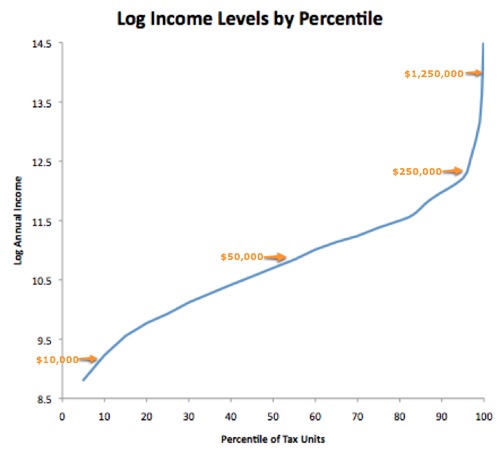 . You should be able to grok the theme of the parable of the poor little rich people by now.
Now what I have to do is explain why the rate of change along the slope of a curve using log income levels by percentile translates into pearl clutching in mamby pamby plutocracts. I know you hate math and it makes your stomach turn. I promise not to use the numbers. We’re going to just talk about the picture and the lines. Over on your right is Brad’s nifty graph. You can see that the curve is upward sloping but the slope varies depending on where you are on the curve.
You can see, however, it is positive at all points. This indicates a direct or positive relationship between two things. If one goes up, the other does too. Because the curve isn’t a straight line, the rate at which the curve goes up is different depending on where you are. This is reflected by the steepness or the flatness of the curve. Think of it as a hill. You have to slog up a steep hill, but a flat hill makes it easier to go forward.
One of the things of interests shown by this graph is the Log of Annual Income and the other is the percentile of tax units. The difference between Rampell’s graph and Delong’s graph is the log calculation. Brad explains why she needs to use the log of annual income compared to the level. Basically, the log turns the comparison in to a growth rate of annual income. A level is simply a level. The log means that we’re using the rate of change happening in incomes as we go up and down the curve. That rate of change is radically different at the richest levels. You can see that the slope almost goes vertical there compared to the middle levels where the curve is less steep and somewhat more horizontal. There’s a story that explains that. Krugman explains it well so I’m going to start with his explanation.
What Rampell has in mind is a vision of society as being something like a long street running up a hill, in which rising altitude goes along with rising income. And each person along that street evaluates himself or herself relative to the neighbors on either side, rather than the whole street.
Now, there are two slightly different interpretations of this story. What Rampell seems to suggest is that people compare themselves only to their uphill neighbors — and since the hill gets steeper as you move up the street, the rich feel worse because the guy to the right is increasingly different from themselves.
An alternative is that people compare themselves to neighbors on both sides, but it’s the convexity that changes: if you’re in the middle of the income distribution, your uphill neighbor is about as much richer than you than your downhill neighbor is poorer, but in the upper reaches that’s no longer true. (I was taught, long ago, that the income distribution is more or less lognormal for most of its range, but turns Pareto at the upper tail. If you have no idea what I’m talking about, never mind.)
Either way, what’s true is that the gap between the rich and the superrich has grown dramatically.
This is basically the parable of keeping up with the Jones. The deal is that there’s not much difference between Mr. Jones on the right of your house (slightly richer) and Mr. Jones on the left of your house (slightly poorer) and you when you’re all average Joes. That puts you in the flatish middle part of the curve. If you look at the longest part of the line, you’ll see that most of us are basically average Joes. The poorest of us have slightly steeper curves. Average Joes can see life styles on either side of us that are within our reach. Our curves are pretty flat compared to the really steep line up in the upper right hand quadrant where dwells that upper 2 percenters.
Law Professor Hendrix who is way above you in that upper right hand quadrant with the upper 2 percenters has a different situation because of his really steep curve. If he looks to Mr. Obama on the right of him, he sees the President with a bunch of best selling books and fantastically better buying power. Mr. Obama has a lot more income than Law Professor Hendrix can ever hope to grab. This causes Hendrix great despair and makes him feel oppressed. (However, not his wife who evidently told him to take his whiny ass thread down.)
You and I can probably compete with the Jones on both sides of us. Both sides are within our reach. However, Law Professor Hendrix cannot. Hence, he despairs. Krugman also has another graph up using a database up on Emmanuel Saez’s Home page that shows this in a slightly different way. You can see the flatness of the curves breaking down the top income earners into three groups. The top 10 to 5% segment has a relatively flat curve. The next group still has a relatively flat curve. They are the top 5 to 1% group. Once you hit the top one percenters the graph looks vastly different. That means the one percenters experience a more dramatic rate of change as their incomes go up and down. When they are rich they are very very rich and if they drop, they really, really drop. They experience much bigger changes in income at that level than us at the lower levels. We bleed slowly. They hemorrhage. Changes to them seem monumental even though they’re making a huge amount of money to begin with.
Okay, so here’s my additional insight to our parable. These curve shapes have most likely been exacerbated when the government implemented the Bush tax cuts and extended them just recently. The biggest benefits went to (drum roll please) the upper 1 percent.
Economists and tax analysts have long known that the biggest dollar value of Mr. Bush’s tax cuts goes to people at the very top income levels. One reason is that two of his signature measures, tax cuts on investment income and a steady reduction of estate taxes, overwhelmingly benefit the wealthiest households.
…
Families in the middle fifth of annual earnings, who had average incomes of $56,200 in 2004, saw their average effective tax rate edge down to 2.9 percent in 2004 from 5 percent in 2000. That translated to an average tax cut of $1,180 per household, but the tax rate actually increased slightly from 2003.
Tax cuts were much deeper, and affected far more money, for families in the highest income categories. Households in the top 1 percent of earnings, which had an average income of $1.25 million, saw their effective individual tax rates drop to 19.6 percent in 2004 from 24.2 percent in 2000. The rate cut was twice as deep as for middle-income families, and it translated to an average tax cut of almost $58,000.
Basically, the Bush tax cuts and the Obama-McConnell extension gave them more to whine about. Commence shedding those crocodile tears. So, what’s their solution? They want us to feel their pain and sacrifice as much as they feel they are sacrificing and suffering. Well, a good portion of them feel that way other than the ones that understand what’s actually going on. Policy wonk Robert Reich can clue you in on that one.
But isn’t it curious that when it comes to sacrifice, Republicans don’t include the richest people in America? To the contrary, they insist the rich should sacrifice even less, enjoying even larger tax cuts that expand public-sector deficits. That means fewer public services, and even more pressure on the wages and benefits of public employees.
It’s only average workers – both in the public and the private sectors – who are being called upon to sacrifice.
This is what the current Republican attack on public-sector workers is really all about. Their version of class warfare is to pit private-sector workers against public servants. They’d rather set average working people against one another – comparing one group’s modest incomes and benefits with another group’s modest incomes and benefits – than have Americans see that the top 1 percent is now raking in a bigger share of national income than at any time since 1928, and paying at a lower tax rate. And Republicans would rather you didn’t know they want to cut taxes on the rich even more.
You already know the parable of the squeaky wheel and how it gets the grease right? However, our version of this parable has a particular nasty twist so we’re going to call it a fractured parable. The grease turns into political donations. They get the grease. We get the screws.


 peej
peej Carissa
 bostonboomer
 ecocatwoman
 mablue2
 Mama Lopez
 peggysue22
 quixote
 skydancingguestblogger
 Mona (aka Wonk the Vote)



 Sky Dancing
Hi Dak,
Thanks for expounding on this incredibly depressing topic. Ugh. I’d say I hate rich people, but someone would probably jump on me and tell me how selfish I am.
I don’t hate rich people, but I sure wish they’d get things into perspective.
Rich people live in a vacuum unless something comes along to break the seal.
You know perfectly well what it is, Kat.
And I think it’s another of the many problems we’ve created in America that’s slowly smacking us in the face.
Working people -people who live off their paychecks- at income levels like $250K or $500K live as well as they can afford the same way people at $30K do. It’s just at another level. As people get raises and other increases in income, their expenses go up as well, bigger houses, fancier cars, pricier restaurants and vacations, and everything else they buy. And if most of your income each month goes out the door, you feel like you don’t have enough money.
The American Dream of making a better life changed during the Reagan ’80s and people started trying to live like the TV shows Dynasty or Dallas. And that’s only spread and intensified since, to a feeling of entitlement and greed. It’s become so ingrained it doesn’t feel like greed; but the ratio of income/expense just feels like not enough.
And that’s a dangerous dynamic in an economy that’s being very selective about who’s making money. Rich people who live off their income and feel less secure in their jobs or in their ability to continue earning raises or even at the same pay level feel like they don’t have enough money. Workers with income of $500K who’ve been putting aside big chunks of cash for retirement and their kid’s college may be feeling the pinch. And what do they do? Downsize? Sell their house? In this market? Maybe they have a second house, a vacation home, and can’t unload that either but have to keep making mortgage payments, insurance, taxes, maintenance.
I’m not boo-hooing for them but I think in this economic climate a lot of people with high incomes and big obligations are feeling a lot closer to the street than they expected.
(BTW, great post. You and BB are in top form!)
Yeah…Right! Zal, Kat and BB always seem to be “on.” Even when they are sick with the flu, or dizzy from inhaling toxic fumes from the gulf oil spill.
I really wish Paris Hilton wasn’t a role model and that we’d move beyond channels that promote life styles of the rich and famous. We feed the little green monster too much.
And they say America doesn’t torture. They have to keep the have NOTS in their place. Then they wonder why Americans turn to crimes of property, forgery, larceny and fraud.
The key to feeling wealthy is to live within one’s means. If $400k dude didn’t have to live in Hyde Park, and didn’t have to have his kids in private school, and didn’t have to have a new car every two years, he’d feel much wealthier. I see this all the time, people making over $250k per year, but drowning in debt because of things they “must” have.
The more you have, the more you want…and drowning in debt is living beyond your means.
Then there are the folks that are just making it, and they are also drowning in debt because they must put food, gas, utilities, mortgages, medical bills, prescriptions and all the necessities of life on a credit card, simply because there is not enough money to pay for it all. Those people are drowning too, only the difference is one is “want debt” the other is “need debt.” (Did that make sense…)
Yes, it did make sense. I don’t mean to sound insensitive toward people who have mountains of debt due to joblessness or illness or even the mortgage crisis. Obama’s neighbor sounds to me like some people I know who simply spend much more than they earn, and seem to have some sense of entitlement about it. He doesn’t feel rich because he wants what he wants whether or not he can afford it. An average family should be able to feel well off on $400k/year.
Because I went to day time art classes at a community art center, I met rich people…well I called them rich…rich enough to be able to go to day time art classes. However they did not see it that way. I developed the theory that even Bill Gates feels hand to mouth …because they all know and watch ,someone else who is much wealthier,they , themselves do not feel wealthy. But my cut off line for wealthy is: if you can afford a weekly cleaning lady, look out now, you are wealthy.
My father raised me thinking we were middle class. We were definitely not. My aunt and uncle in Kansas City were incredibly rich so we looked poor by comparison. I can remember when my best friend in the 1970s said her dad was making around $42,000 thinking that they must be in the poverty level. I got to university and studying economics and found out I’d been raised in a complete vacuum. My exhusband’s friends called my house the mansion. It was nothing compared to my aunts and uncles huge estates in Kansas City. I would really laugh at them for that. They all lived in very ‘average’ houses. My uncle had an elevator even. It was one of those huge tutor affairs built during the gilded age. Took servants to run it itoo. My mom’s side of the family was so different from my dad’s side of the family who really grew up dirt poor. I was lucky enough to have them to ground me. Youngest daughter’s friends are all super rich and they shudder coming down to my neck of the woods; the ghetto! Believe me, most of my neighbors are employed at things like construction work, teaching, etc.. My house is exactly on the average so, usually is my income. I never wanted to have that false perspective again so I stay put where life is more real. Every one in this country thinks they’re middle class and that’s kind’ve an issue, imho.
Wow! You did grow up in a bubble. I grew up in an apartment in the Bronx with my dad making $7000/yr. at the Brooklyn Navy Yard. I had more toys than other kids in the neighborhood, so thought we were economically well off.
When my two children were ages 11 and 13, I arranged a family vacation. They went from sugar to shit, in just a matter of a week. The first of the family had oplymic swiming pool, and a huge house situationed near the Bass Brothers.
The second family, were working class families, big on barbques and food spread out during lunch and dinner. Lots of kids running in/out. Here they heard stories, and listened intently to their family history.
The third family was living in shacks in Mississippi. Elderly, and to the point of not making the needed repairs
to fix their places up. It was here that those old kinfolk
reached into their wallets, and pulled out money, and told the kids, buy yourselves something nice. Both of them tried to refuse, and the old folks would not hear of that.
Upon their return to school that fall, they both wrote about their vacation, and what they thought of those who live so completely different from each other, and what they had aspired to when they grew up.
They both have done well, middle class. But I just don’t know, because the son lost his job, and struggles to hang on to what he worked towards, his home. His wife, in her last semester of nursing school, was disgnosed with gullain barre syndrome. And my grandchildren are taking on more chores in the household, yard, etc. and they seem to be happier for the extra responsiblity given them. It’s a case of worry for all. They will overcome the hurdles, because that is what living is all about.
It sounds like you grounded your kids well. That’s really what I think parenting is all about. Making them good decision makers and grounding them in life’s realities. You can’t protect them from everything or shelter them or hide them from stuff with out setting them up for failure in situations later. Youngest daughter is enamored by money at the moment. The rest of us from Grandad, to aunt, to sister and me, mom, are trying to disabuse her of the notion that money solves everything.
“Every one in this country thinks they’re middle class and that’s kind’ve an issue, imho.”
I run into this all the time. I’ve friends who make on 150-200k a year and think they are middle class. I always qualify for them ‘upper middle class’ and tell them most Americans are living on less. It always gives them a shock.
Me, I don’t know where I place. I’m on a relatively fixed income, with farming to augment. I work hard with my hands, but can make a living computer programming, teaching, whatever. If one looks at amount, for my area, I’m just a bit over the poverty level. However, I can eat all I want so I don’t really feel poor. I just have to budget a lot. I know I feel really poor when I look at real estate around me. I know that if I sold the farm today, I could not afford to buy it back tomorrow. That makes me feel poor.