
Once Upon a Time: Christmas in Medieval England
Posted: December 21, 2010 Filed under: Festivities, just because 22 CommentsOne of the crazy things I do with my copious free time (haha) is Medieval/Renaissance re-enactment. I try to combine that with my love of research and recently wrote a small article for a very local newsletter (distribution about 30, I think :)). I hope you all will enjoy reading a bit about how Christmas was celebrated 500-1000 years ago.
In the old, pre-Gregorian, calendars the shortest night of the year, winter solstice, falls on 24th December (in modern, Gregorian, calendars it falls on the 21st or 22nd). Therefore the 25th was the day when the duration of the sun’s light began to grow. This event, and the midwinter season, was celebrated in every known pagan European religion. For example, the Romans had the day of Sol Invictus (25th December) and the weeks long festival of Saturnalia and the northern Germanic and Norse cultures celebrated Jultide or Yule and Midwinternacht.

Christian bishops living in the 350s chose the 25th of December as the day to celebrate Christ’s birth. The symbolisms of the lengthening daylight and forthcoming emergence of plants and animals in Spring were inescapable. It was also very convenient to graft the celebration of Christ’s birth onto the existing pagan holidays. This meant that the Christmas traditions celebrated in Medieval England, and many of those celebrated today, are an amalgam of pagan and Christian ritual and belief. Both the pagan and the Christian worlds centered around an agrarian lifestyle which is foreign to many of us today, and their rituals reflected this lifestyle.
There was no huge run up in the days before Christmas. The Christmas season often started on Christmas Eve or Day, although Advent, which consists of the 40 days leading up to the 25th of December, was observed in various places in England. The feast of St. Nicolas occurs during Advent, but St. Nicholas, as Santa Claus, was not an important part of Christmas until after the Reformation.
Churches and other buildings were decorated with greenery for Christmas and the following days, a custom with many pagan antecedents. At that time of year in England holly, ivy and mistletoe were generally the only green things. There were few conifers in Medieval Britain, just scotch pine, yew and juniper, and therefore no Christmas trees. The decorative greenery often remained in place until the eve of Candlemas (February 2nd).

Traditional entertainments during the Christmas season included plays, music, singing and caroling, dancing, sports, board games and eventually, cards (The first card decks were not known in England until the 15th C). The plays were often mystery plays, which celebrated the story of Christ’s birth, the visitations to the shepherds and travels of the wise men. Mystery plays were presented by the Guilds and associations of the local town or city and were very important to both the players and the viewers. Mummers plays, acted with colorful masks representing different characters, were also very popular and went back to pagan traditions. Caroling was popular and was eventually outlawed in churches because the carols were thought inappropriate to be performed in church, even if they were religious in nature. The main caroler was circled by dancers, who sang the chorus and refrain back to the singer. These songs could be quite bawdy, and some had early, pagan, antecedents. The upper classes might hold war games, as they did at Berwick on Christmas Day in the 1340s where a team of twenty English and a team of twenty Scots jousted, and three men were killed. Winter sports for the lower classes included skating, sledding, snowball fights and perhaps ball games if the snow was not too deep.
Celebrations on Christmas Day itself consisted of three masses in church and a feast. The first mass was celebrated at midnight and was called the Angel’s Mass. The second mass was the Shepherd’s mass, and it was celebrated at dawn. The third mass, that of the Divine Word was celebrated during the day.
Feast days broke the normal agricultural round, providing a day and night free of work for the poor and rich alike as they attended church and a feast instead. The feast was therefore an important part of Christmas Day celebration. The Yule boar, a Viking and Roman tradition was an actual pig for those who could afford it or had killed it in hunting, or a pie shaped like a boar for those who couldn’t, and was often the centerpiece of the feast.
Landowners owed many of their peasants food and drink at Christmas in return for labor done during fall and winter, and provided the feast or part of a meal as payment. Peasants often owed food payments at Christmas, and these may have gone to enrich the feast. The lower classes also benefited from the large feasts prepared for the nobility and gentry on feast days, receiving left-overs and other bounty. Feasts were held in the great halls of the castles and homes of the nobles and knights. For the great religious feasts, such as Christmas, the peasants were allowed into the halls and could feast along with the aristocrats. They ate different foods but all participated in watching the entertainment and celebrating the season.
The Christmas season was celebrated over at least the 12 days of Christmas, which ended on the 6th of January (Epiphany), when tradition says the three wise men visited the Christ child. Work for most of the people continued, but perhaps at not the normal pace. Most of the 12 days of Christmas had rituals for each day, however small.
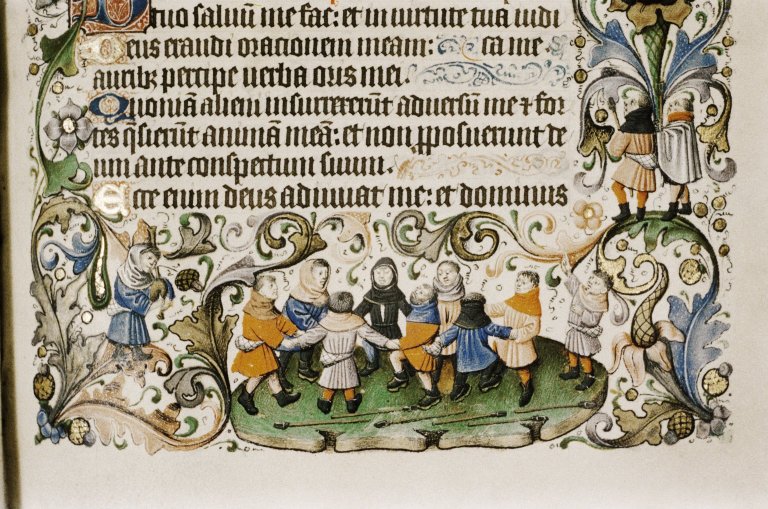
Shepherds Caroling after Hearing of Christ's Birth: MS Douce 38, Book of Hours, Use of Rome
In some areas celebrations continued for a full 40 days, until Candlemas, the fest of the Purification of the Virgin, on 2nd February. On this day parishioners came to mass with a penny and a candle which were both blessed and then given to the parish as part of their tithes. The parishioner often took away another blessed candle, for use during frightening events, illnesses and such.
December 26th was St. Stephens day. This day is now called ‘Boxing Day’ in Britain and is the day when presents are traditionally exchanged. This tradition may, or may not, be Medieval. It was certainly popular in Victorian England, when tradesmen and women were given bonuses and boxes of food by their rich patrons. On this day in Medieval times young children would catch and punish wrens. The wren had supposedly betrayed St. Stephen by singing sweetly when he was attemping to escape. The poor animal would be killed and then paraded through town wreathed in holly. Anyone wishing to could pay the young hoodlums in charge of the bird for a lucky feather which averted shipwreck. Horses were also bled on St. Stephen’s day. Such bleeding was meant to make them healthy and strong. The timing was such that they had a break from work for at least two days after the bloodletting, which could help them recover.
St. John the Evangelist had his feast day on the 27th of December. This was a day to drink in excess, supposedly to celebrate St. John overcoming the poison he had been made to drink. Drinking on this day was supposed to make men strong and maiden’s fair. I suppose it might have, we all know what drink does to one’s perceptions!
Holy Innocents’ or Childermas Day, the day King Herod had all the boy children in Judea killed, was the 28th of December. On this day children were both ritually beaten and given great freedoms. Some dioceses in England celebrated the boy-bishop on this day. This was a custom which went back to the pagan Saturnalia, when one day of the festival was given over to topsy-turvy changes, with masters becoming servants, servants masters, and so on. The boy-bishop was chosen from amongst the choristers on St Nicholas’ day in early December. He became bishop for 3 weeks of relative mayhem during which he visited ecclesiastical establishments and noble households in the vicinity. Under his rule the canons were replaced by choir boys, priests by altar boys, and so on, until Childermas day, when normalcy returned. Noble households often practiced this kind of satire during the Christmas season with masters assuming a servant role and vice versa, if only for a few hours or days. A Lord of Misrule would be declared and mayhem could result.
January 1st was the day to celebrate Christ’s circumcision (I know, I know, but any excuse for a party!) and acceptance into Hebrew society. In Roman times the day marked the ascension of new senators as consuls and administrators to their new positions in the Empire, which they held for a year. The day also marked the beginning of the new year in the Roman calendar, and in most Christian calendars as well, although the 25th of March (feast of the Annunciation) was considered the first day of the year by some.
The day after Epiphany (7th of January) was called Plough Monday. This ended the midwinter festival season, and signalled that people were to get back to work. You know what the ploughmen were doing on that day!


 peej
peej Carissa
 ecocatwoman
 mablue2
 peggysue22
 quixote
 skydancingguestblogger
 Mona (aka Wonk the Vote)



 Sky Dancing
Fascinating, Sima…Thank you for posting this. Being a fellow medievalist you must be familiar with this site here:
Got Medieval
I will just take this opportunity to plug this site, it is something to see all those sadistic monkeys nestled in the margins of medieval manuscripts.
Those little beasts are funny-strange. I love looking for people and seeing what they are doing in the margins.
My partner does illumination and calligraphy. He’s quite good at the illumination.
Speaking of medieval
How dare this hospital actually provide care for the woman housing the fetus!/s
Have I mentioned how happy I am that the Catholic church is on the decline?
Phewww. Just got up, talk about a late night! And today is supposed to be all about getting the food etc for Christmas.
I wanted to post my list of resources for the post, because this isn’t a link type post, the resources were books.
Bailey, Mark
2002 The English Manor c. 1200-1500 Manchester University Press, Manchester
Cheney, C. R. (ed)
2000 A Handbook of Dates for Students of British History (rev. by Michael Johns) Cambridge University Press, Cambridge
Farmer, Jacqueline (children’s book, but nicely done)
2010 Oh Christmas Tree Charlesbridge, Watertown MA
Hammond, P. W.
1998 Food and Feast in Medieval England Wren’s Park Publishing, Stroud, Gloucestershire
Henish, Bridget Ann
2002 The Medieval Calendar Year Pennsylvania University Press, University Park, PA
Jackson, Sophie
2005 The Medieval Christmas Sutton Publishing Stroud, Gloucestershire
Mortimer, Ian
2010 The Time Traveler’s Guid to Medieval England: An Handbook for Visitors to the Fourteenth Century Touchstone, New York, NY
Reeves, Compton
1997 Pleasures and Pastimes in Medieval England Budding Books, Stroud, Gloucestershire
Life is so much more interesting when you know history.
So true….
When people talk about putting christ back into christmas, I usually laugh and say, well Mithra is really the reason for the season. When Constantine locked up all the religious leaders in Roman to come up with a Roman Religion, Mithra was high on the list. He was actually a minor Persian Deity but very popular with the roman soldiers at the time who brought him back to Rome. He and some of the other gods lost the vote to the christians on which would become the new roman religion because it was argued that since a lot of slaves liked the jesus dude, it would be easier to romanize and acculturate them and you can tell if you read the Paulist stuff with all its emphasis on supposedly submitting yourself to a master. The new roman religion heavily edited its text to get the slaves to stop revolting. Anyway,if you study up on Mithra, you’ll be surprised at how much was borrowed … including HIS birthday which is december 25th.
I found this interesting link to some of the Mithra cults’ practices and history. They actually built the Vatican on the Mithra temple grounds. So, the Roman holiday started out as a celebration of Mithra’s birthday and as it spread around the conquered lands, it picked up a lot from the various pagan celebrations. All the Mithra stuff is very well documented from the time period while there is no actual historical record of a jesus at all which makes you go hmmmmm.
I love the holidays but have made sure to explain to my children that the origin of the holiday and have made sure they understand that it is largely symbolic and it’s timing was due to the pagan practice of celebrating the solstice.
My oldest is funny. He works for a daycare that is owned by Christian folk. While discussing religion they were perplexed that he would grow up in a Christian household and yet be allowed to formulate his own belief system. I’ve always wanted my children to enjoy spirituality rather than view it as something obligatory.
I think it’s wonderful how it’s morphed into sort of the ultimate spiritual mix of celebrations. It’s like there’s something in it for every one!
And of course, it’s Festivus for the Restivus!!
Very interesting post, Sima. Yesterday, my sister told me that in the early days, Jews were forced to run races for entertainment and people were even killed in honor of Christmas. Do you know anything about that? They may have been talking about Saturnalia.
BTW, the Catholic Church still celebrates the Circumcision. It’s a holy day of obligation, unless something has changed since I was an active member of the Church.
There was a lot of Saturnalia brought into the holiday too. I would hope no one was killed over it though! That sort’ve takes it to another level!
I need to do a bit more research on that, but off the top of my head I’d say it’s highly possible that Jews were forced to do things on Christian holidays.
I don’t think the Romans would have really discriminated against whatever group they were forcing to do whatever. What I mean is that the pagan Romans were pretty egalitarian in their cruelty and pretty lenient in whatever you wanted to worship. Long as you paid taxes, they didn’t care much, although interfering with or speaking against worship of the Emperor (which was really worship of the state) could get you in deep doo-doo. The Jews and Christians sensibly refused to do this, being worshippers of only one God. Hence the persecution.
I read an interesting aside, talking about history and our perceptions of people in the past. The person said that from our perspective, every culture in the past was both dirty and cruel, except for the Romans, who were just cruel. Made me laugh out loud, I have to admit.
As for killing people on Christmas, I don’t think so. That could be a pagan thing, but I don’t think it was Saturnalia. Mithras was reborn on the 25th, and he died a bloody death, but no-one that I know of acted it out with real humans, even the Romans.
The Celts would burn prisoners in their whickermen in celebration of the Gods. Perhaps that’s where the rumor came from? The Romans really hated the human sacrifice thing, although they had practised it in their not so distant past before the Empire, and theoretically the gladiatorial games were sacrifices to the dead. They started as funeral games under the Etruscans. Celtic areas under Roman control lost their whickermen and bloody druid groves.
Once uponce a time….
That’s how my mom said I repeated it when I was little.
Somebody gave me a Christmas tree complete with lights and decorations yesterday! So I put it in a place of honor, of course. I love christmas trees, but am horrified now by its symbolism – the dead body of the Goddess, all got up. Sigh.
I prefer the pagan version of the holiday and find the history surrounding it fascinating.
I really like the amalgam of traditions. It has only been as an adult that I’ve discovered how very much Christian traditions are an outgrowth of older pagan traditions. This isn’t because the idea was particularly hidden from me, it is because I didn’t notice it when young, I think.
I love going to mass, although I am not Catholic. I squint my eyes and imagine Jupiters’ priests moving up and down the aisles. At the end of the cathedral instead of a cross and icons, I see a bejewelled and gold embellished Goddess or God, looking almost alive through the smoke of incense and candles.
What a visual, beautiful! I try to do that too, Sima, imagining priestesses of the Goddess instead. I’ve gone to church a few times since my father died as the priest who did his funeral has been reaching out to me. I don’t know how much more I can do it, though I did enjoy the Anglican high mass they had on Christ the King Sunday.
Loved this, Sima. Thanks.
Gratuitous cute animal video warning!!
This was great! I need to get my dog singing along.
LOL! Thx, love cute animals!
really nice… thanks for sharing!
this was a fun post to read. Just can’t share the 3 masses thing with my mother-in-law. She lives to take us to church. It’s truly the only thing that makes her happy so we make the trek every xmas and easter. I will admit that I can tell you how many pews, ceiling tiles, icons and people there are by the end of the mass. When my mind wanders… I count things.
I truly do enjoy the history, fascinating and enlightening.
You had me at the first sentence of this post. 🙂 Very interesting, thanks.
And to all at Sky Dancing, wishing you a wonderful and peaceful holiday, in whatever way you choose to celebrate!