
Sky Dancing in the Garden: Here comes Dream time!
Posted: December 6, 2010 Filed under: gardening | Tags: dreaming, gardening, seed catalogs 26 CommentsNote: I’m posting this on Monday because Sunday was super busy, both personally and on the blog!
And now, for something entirely frivolous and decadent.
This year’s gardening catalogs.
Many a garden writer has said it before, and many will say it again (in fact, this one is just about to).. catalogs are for dreaming. In catalogs there are no slugs, no snails, no powdery mildew and no late blight. The plants are a glistening glossy green, with bright shiny flowers that stand out like beacons under the perpetual benevolent sunshine. Every plant is wonderful, superlative, the cream of the crop. The vegetables look, taste, and even smell better in your favorite garden catalog, or at least, so say their descriptions.
Watering? Only from this stylish classic verdigris water can on page 25 or the oh-so-environmentally conscious drip irrigation ‘system’ on page 50.
Bugs? NEVER! But if you might see a stray sign of a leaf-hopper on the poor neighbor’s fuscia, head out to page 65 for a complete list of bug preventatives.
The thing that draws me in every time, every single dang time, is the ‘NEW VARIETIES!’ I love reading about new vegetable varieties. I’ll read a bit, then my gaze’ll wander and I’ll stare out the window at the cold, grey, wet winter’s day. In my mind’s eye I see this or that great new broccoli variety, or corn, or swiss chard, or whatever, growing proudly in long rows; producing abundant, life-sustaining nutrition (and a few bucks for the poor farmer). And this or that great new variety will be innately resistant to slugs and will scoff at both heat and cold, wet and dry. It’s such a great variety, it’ll grow under your bed, or on the moon! Ok, I’m getting a bit carried away.
Catalog season generally starts in December. It can run into April in some areas of the country or end as early as February in others, because it ends as soon as planting begins and reality sets in. I keep all the farming and gardening related catalogs in the same pile and look through them before I go to bed, or when I have a few free moments. It’s a peaceful, dreamy time.
If you’re anything like me, you get tons of gardening catalogs from seed suppliers from all over the country. It’s hard to tell the good seed company from the bad, hard to tell what will grow in your area and what won’t. Therefore, here’s a few tips.
Do a bit of google research to explore where a seed company is getting their seed. Few actually grow seeds themselves (although some do). Many smaller seed companies still offer non-Monsanto (or other huge agri-business) controlled seed.
Beware of seed that is copyrighted or trademarked. This doesn’t mean it’s an F1 hybrid, this means it’s actually illegal to grow it yourself. If it’s that important to some business, you probably don’t need it.
To determine if a variety will grow in your area: Start with the basic hardiness zones. If the variety is within your zone, it’ll probably grow. But remember, many varieties need heat, so a zone 8 in the PacNW is not going to get as much heat as a zone 8 in northern California. This matters for things like corn and eggplant and many flower varieties. Most catalogs do not give heat requirements (known as degree days), so here’s how I figure it out. I use a catalog provided by a local (to me) seed merchant; Territorial Seeds. This is a great company, and they do a lot of their own growing and testing down in Oregon. I look at the days to maturity they give for different varieties of vegetables and flowers. Although the days to maturity are still a bit low, because they are in Oregon and I’m in Washington, I at least get in the ballpark. Then I compare these days to those in other catalogs. For each vegetable, this gives me an offset for each of the other catalogs, which I can use to get a semi-accurate guess whether something will grow for me or not.
Why do I do this? Because my favorite seed place is Johnny’s, in Maine. And in Maine you can, for instance, grow corn varieties which won’t grow in the Puget Sound area of Washington. Maine is hotter and has more days over 60 F than Washington, even though coastal Washington has a higher hardiness zone.
Another point to consider: Look at the natural habitat of the plant. Make sure your garden area is similar to that natural habitat if you want carefree gardening. For instance, rosemary is naturally a Mediterranean scrub plant. It likes cool mornings and nights, mist, wind, quickly draining soil and hot sun. It doesn’t like snow, and it doesn’t like places without that mist and wind. So around my area rosemary often dies. However, I can grow it because I live in a little valley on a peninsula with sea water within a mile or two on 3 sides. I get the winds and the mist, boy, do I get the winds! I then went further for my rosemary and grow it in raised beds to achieve the drainage it wants.
For farming, I use Johnny’s and Territorial seed mostly. I get catalogs from other seed merchants, but they don’t hit a chord with me, for some reason. I use Nichols and various other places for herbs. I love the Heirloom seed catalogs and tomato catalogs. I use onion starts, rather than the little onion bulbs or seeds. I get mine from Dixondale farms. Drip Works is a great drip irrigation site, and cheaper than the ‘system’ available in most catalogs. Green house stuff comes from Charley’s in Washington, or Greenhouse Megastore or other places across the Internet.
So let’s hear it, what are your winter gardening dreams, 2011 gardening plans and favorite catalogs and tips for seed selection?


 peej
peej Carissa
 bostonboomer
 ecocatwoman
 mablue2
 peggysue22
 quixote
 skydancingguestblogger
 Mona (aka Wonk the Vote)



 Sky Dancing
I’m thinking I may start some grapes this spring. I think Muscadet are the only ones that work in my tropical zone. I’ve been looking for some that will do well here. I’m thinking I can grow them across the back fence. My grandmother used to grow Concorde grapes and they were so great when they were ripe!!
I love grapes, but haven’t had much success with them, yet. I think it’s because I planted them on a hillside for good drainage and then forgot about them when they needed water. Duh! I love the Concorde grapes, just love them. Partner about holds a gun to my head every year so I’ll make him grape jelly from them.
Anyway, I found a couple of links which might help decide about grape varieties for you.
Grape growing in Texas
http://aggie-horticulture.tamu.edu/southerngarden/Texaswine.html
And a vineyard on Lake Pontchartrain:
http://www.pontchartrainvineyards.com/History.html
I’ll look in my grape catalogs and see if they have any southern coastal varieties.
It’s really odd but on the North Shore of Pontchartrain they’re in a temperate growing zone and on the South of the lake, we’re in a tropical zone. It’s amazing the difference in the weather. But on the north shore they grow all kinds of wonderful things!
I think you mean muscadine grapes–muscadet is the wine! Although this website covers growing muscadines in NC and GA, the principles are the same: http://www.ncmuscadine.org/growerslib.html.
oh,yup … but I guess you know what I have in mind for the fruits of the garden!!!
Yum! I haven’t done any grape wine making, but I’ve made mead and beer (which is weird, because I don’t drink beer) and various fruit wines. It’s fun and the results can be really good.
I spent some time reading up on it and got a subscription to Wine Maker Magazine for a year. I just want a little crop of it to call my own!!!
Thank you for this Sima, I forgot what a joy it is to thumb through those catalogs. When we lived in Connecticut, we used to get bulbs from this place: White Flower Farm: The premier American source for plants, shrubs, bulbs, and gardening supplies delivered from our nursery to your home. I don’t know if they are still as good as they used to be back in the day.
Burpee’s was the bible in Iowa.
Yep! It’s still out there and going strong. I think it’s still very strong in that region, along with Stokes and a few others.
I still get the White Flower Farm catalog, and it’s quite good. My father loves it. He does more of the landscaping, beautiful garden variety of gardening. I do more of the vegetables in rows, weedy herb garden variety.
White Flower Farm is lovely, and fun to visit, great landscaping plants (some vegetables and herbs too) but they’re pricey and the people who work there are sometimes a little snooty. It’s about a 20 minute drive for us and we go once a year just for fun.
Our favorite nursery in Connecticut is Twombly’s in Monroe. Not super fancy but they have a big inventory, healthy plants, and helpful knowledgable people. Highly recommend to anybody in New England.
I do a 30 ft square urban garden with tomatos, pickles, cabbage, string beans, swiss chard and rubarb. 40 plants of tomatoes, different varieties allows good eating. Small chest freezer allows tomatoes and beans for winter soups. We did 5 gallons of saurkraut which has less salt versus commercial offerings. Crtitical for heart patients. Also did dandoline wine this year which should be available for christmas.
I am a firm believer of high tomato cages which minimize the molds etc. We have a earth machine compost bin where all vegetabel scraps go. We always remove tomato seed before freezing and one year put them in the compost bin. Next year I had massive tomoatoe plant seedlings where ever I put the compost.
Deer are a problem and I found a product called Liquid Fence which is a emulsified egg yolk spray. Smells horrible and you put it on folliage and repeat every two weeks. Very light spray does the job and the deer stay away from a habit perspective. Works for flowers also.
Just would add that you need 8 hours of sun which can be a problem in urban gardens. This year, I swore it was going to be my last year in growing garden (69 yrs old).
However after reading your post, I might check out the sites you recommended
For deer, a quick and easy and rather gross, I have to admit, way to deter them is to pee around the garden. Not in it, but around it. Needless to say, my partner would do this part, if we needed it.
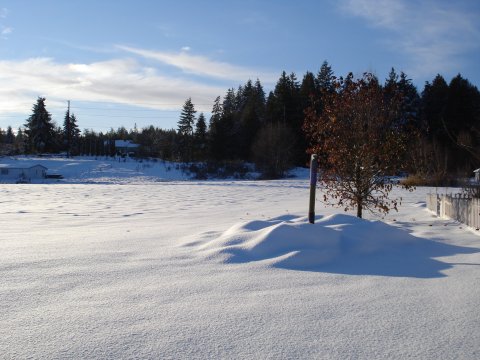
We are lucky in that although we have deer all over the place around here, they never come out into the big open fields which are our farm (see the picture of the snow, above, that’s part of our farm). Don’t know why, but they just don’t.
Burpee is still a good catalogue for vegetables, although they tend to promote a lot of hybrids. In my vegetable growing days, my favorite catalogue was Shepherd’s Seeds. Unfortunately, Shepherd’s Seeds was sold to White Flower Farm, who ran the company into the ground before folding it. Fortunately, Renee Shepherd has started selling seeds again at Renee’s Garden (http://www.reneesgarden.com/about/reneebio.htm). If you’re looking for gourmet varieties, I recommend searching Renee’s. Seed Saver’s Exchange is another resource to know about, since they offer older and heirloom varieties.
Someday I’m going to have me an orchard. However, next year I’ll be looking to add to my blueberry bushes(I have 5) and maybe add some more strawberry plants(I’ve got about a dozen). I saw some pictures in catalogs for cherry bushes, those sound interesting and I may need to research them. My husband also got me two raspberry plants. 1 died and the other didn’t produce. I read something about the canes producing every 2 years so we shall see if I get raspberries. As for veggies, I always plant lettuce, tomatoes, cucumbers, jalepenos, banana peppers, and bell peppers. I’d like to plant some squash but I would need a compact and most squash aren’t.
Sima, have you ordered from Seed Savers Catalogue? What’s your opinion?
I really like the idea behind Seed Savers, and I have ordered from them from time to time. They do well.
For doing large amounts of seed like a farm, they can be expensive. Mind you, I should start doing some of my seed with them because I like to let plants go to seed and I could then harvest that seed!
Another good organic seed place is Seeds of Change, located down in New Mexico. They have good varieties for the hotter areas of the country.
That sounds good for me!!
Happy you give Seed Savers a thumbs up; that’s the catalogue I’ve been dreaming with the past couple of weeks. I chose them because they’re based in Iowa, which is in hardiness zone 5 and Connecticut is 6. But I’ll check out Seeds of Change now, as well. Want to start with heirlooms and see how it goes. I like to let plants go to seed, too, I love the way they look, watching them change, so I figure if I do well enough it’ll be an investment.
As I’ve said before, this’ll be my first full-fledged vegetable garden on my own (grew up helping my grandfather and great aunt with theirs). I’ve been gardening flowers for 12 years, and did well with a few vegetables I snuck in between, and my herbs thrive, so I hope I’m not overconfident but I think even at 54 I can start up a garden big enough to supply us and our weekending friends. And here’s a window into how weird my thought process is: I’m looking forward to my mistakes almost as much as the successes. Eager to start! Hope you do lots more posts about vegetable farming.
Try the Johnny’s seeds I link to in the article as well. They are employee owned and grow a lot of their own stuff. They are close in zone to you also.
I think if you are growing flowers you’ll do great with veggies. They are easy, mostly. The thing to do, for me, is remember to harvest them on time. I’m bad about this, because I love looking at them, and keep thinking ‘a little longer, they’ll be a little bigger’. Then they go to seed!
I started the farm younger than you, I was about 32 when I started it all alone after a divorce. But it didn’t really get going until my partner arrived, and now, when I’m 48, it’s starting to actually thrive. So I think you should be fine, agewise!
Garden mistakes can be fun. You’ll learn a lot regardless!
Funny, I just now spent an hour going through Johnny’s seeds from your link! Looks great. Can really lose track of time reading about tomato varieties or cover crops. (Okay, that’s a sentence I never thought I’d write!) I’ll definitely order through them and see how that goes.
My partner said, this past weekend, so do you think we’ll get everything we need from your garden next summer? The land’s not even cleared yet, much less fenced and prepared — I’m still chainsawing! Um no, I told him. The other thing about gardening, about enjoying it and being successful, is you’ve got to have patience and get into the rhythm of the process. I’d lost most of my patience during the years I climbed up professionally and navigated city life in New York, if you have patience you often lose out to the person who’s impatient, but gardening helped me regain it. Interesting you mention you started farming after a divorce. I tell my friends gardening is what I did when they went into therapy. And IMO it’s been more effective than doctors and medication have been for them. It gave me a chance to relearn patience and listening to my own thoughts, letting inner thought travel a full distance whether it’s about something personal or public, like politics. It also can be a great stress reliever, physically — when Bush was President I dug out a new garden from a plot that was full of rock (typical Connecticut) and then built a long stone retaining wall with the rocks — can’t tell you how many times I struggled with getting out a boulder, and succeeded by using my anger at Bush as fuel, and ever after I’ve had the pleasure of that gorgeous stone wall. I think a big problem driving people deeper into stress, and even depression, today is constant intrusion and the lack of something to point to and feel happy about thinking: I did that. A lot of people don’t give themselves time to think, using things like going to the gym or running with an ipod in their ears as stress-relievers, which is better than nothing but I think can’t compare with a little silence and a final product like fresh salad or stonework. Maybe that’s overly simplistic but still I think it’s true.
Hi peeps! I wondered where you all were!
Being located in wine country I don’t have quite the same restrictions as you in the tropics. However, I thought the info in this article was interesting. It discusses leaf stripping of vines, and some recommendation for types in Florida.
http://www.quisqualis.com/tv05grapelon04.html
Hi! Good to see you!
if you are looking for more information on USDA plant hardiness zones, there is a detailed and interactive USDA plant hardiness zone map at http://www.plantmaps.com/usda_hardiness_zone_map.php which allows you to locate your USDA zone based on zipcode or city.
There is also an interactive heat zone map for each state that tells you the average number of days where the temperature exceeds 86 F. Check out this Oregon heat zone map at http://www.plantmaps.com/interactive-oregon-heat-zones-map.php
Thanks for all of these great links.
I have been going back and forth about a veggie garden. We have dogs and didn’t want to section them off from part of the yard so it never got any where.
But those catalogs really are dream time. I forgot about all that time spent looking through them….truly relaxing. We would pick and plan our favorites with dog-eared pages.
I am working on boring lawn issues now. When we first moved in I tried to convince hubby to rip out the lawn and place ground cover down. Growing up we had a blue star creeper as a lawn and it was gorgeous.
http://www.google.com/images?client=opera&rls=en&q=blue%20star%20creeper&oe=utf-8&um=1&ie=UTF-8&source=og&sa=N&hl=en&tab=wi