
Morning Again in America (for Bankers and CEOs)
Posted: September 1, 2010 Filed under: Uncategorized Comments Off on Morning Again in America (for Bankers and CEOs)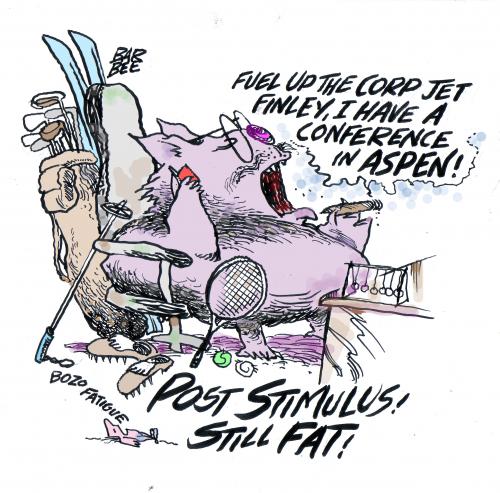 The current bout of unemployment is so stubborn that there’s now talk of tax cuts coming from the Obama administration even though Obama has made it clear that the debt and the deficit are high on his radar. Too bad they won’t help the people without jobs and the businesses without customers.
There’s also pressure on the Federal Reserve to do something, anything. If you know any thing about money creation, you know that bank lending is the critical channel for transmitting monetary policy into the real sector where the GDP growth resides. No bank lending, impotent monetary policy. It’s very simple.
The recession of the 1980s (Reagan’s first term) was somewhat created by high interest rates. Bringing interest rates down reinvigorated the economy. Well, that and Reagan’s war time spending in a period of relative peace which is basically highly stimulative fiscal policy. Reagan was a huge deficit spender and a lot of it went to rebuilding the Navy in American ship yards. So, that started the “morning in America” phenomenon.
This time things are different; especially if you’re just a little guy or the small business owner on Main street. It’s morning again in America for a the privileged but not for you.
The Institute for Policy Studies has just released its 17th annual executive survey on executive pay. The subheading is pretty telling and basically is summed up “how CEOs laid off thousands while raking in millions”. This recovery and the stimulus package and corporate bailouts have done very well by the nation’s already abfab rich.
Corporate executives, in reality, are not suffering at all. Their pay, to be sure, dipped on average in 2009 from 2008 levels, just as their pay in 2008, the first Great Recession year, dipped somewhat from 2007. But executive pay overall remains far above inflationadjusted levels of years past. In fact, after adjusting for inflation, CEO pay in 2009 more than doubled the CEO pay average for the decade of the 1990s, more than quadrupled the CEO pay average for the 1980s, and ran approximately eight times the CEO average for all the decades of the mid-20th century.
American workers, by contrast, are taking home less in real weekly wages than they took home in the 1970s. Back in those years, precious few top executives made over 30 times what their workers made. In 2009, we calculate in the 17th annual Executive Excess, CEOs of major U.S. corporations averaged 263 times the average compensation of American workers. CEOs are clearly not hurting.
But they are, as we detail in these pages, causing others to needlessly hurt — by cutting jobs to feather their own already comfortable executive nests. In 2009, the CEOs who slashed their payrolls the deepest took home 42 percent more compensation than the year’s chief executive pay average for S&P 500 companies. Most careful analysts of the high-finance meltdown that ushered in the Great Recession have concluded that excessive executive compensation played a prime causal role. Outrageously high rewards gave executives an incentive to behave outrageously, to take the sorts of reckless risks that would eventually endanger our entire economy.
I thought I’d add something here just for Riverdaughter since we know there’s massive layoffs in her industry from CNN.
“I think that really shows a really perverse incentive system in this country,” said Sarah Anderson, lead author of the Institute for Policy Studies’ 17th Annual Executive Compensation Survey. “You are handsomely rewarded for slashing jobs in the middle of the worst economic crisis in 80 years,” she said.
It did for Fred Hassan of Schering-Plough, the man the report dubbed last year’s “Golden Parachuter.” Hassan was the highest paid layoff leader, earning $50 million in 2009 while his firm merged with Merck and cut 16,000 workers.
According to Anderson, “they’re prioritizing CEO pay at the welfare of their workers”.
So how do they get away with it? Anderson said you have to look at the make-up of many companies’ executive boards. She said they’re often made up of CEOs and high level executives from other companies “who really don’t want to question this ridiculous pay system we have in this country that continues to pay people these absurd amounts of money when they’re really not performing well for their company or the overall economy.”
Another disconcerting finding of the report: 72 percent of layoff-leading firms announced mass layoffs while delivering positive earnings reports. Anderson explained layoffs are really driven by efforts “to boost short-term profits even higher and also just to continue to have such high CEO pay levels.” She said these mass cuts are often bad for business over the long-term because they impact worker morale, which can lead to lower productivity. She said they also result in additional costs related to hiring and training new workers down the road
Here’s a link to Market Place from NPR where you can listen to an interview with one of the authors.
Yeah, let’s give them more tax breaks to stimulate the economy. Great idea Obama economic team! No wonder Christie Romer bailed.

 peej
peej Carissa
 bostonboomer
 dakinikat
 ecocatwoman
 mablue2
 Mama Lopez
 peggysue22
 quixote
 skydancingguestblogger
 Mona (aka Wonk the Vote)



 Sky Dancing
Recent Comments