
Put a Cork in Corker
Posted: March 11, 2010 Filed under: Global Financial Crisis, The Great Recession, U.S. Economy | Tags: Bob Corker, Chris Dodd, financial regulation, pay day lenders Comments Off on Put a Cork in Corker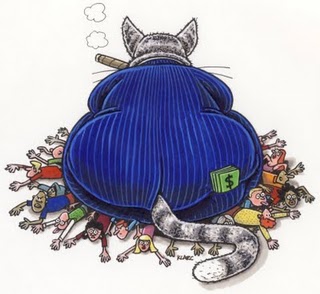 If you want a good example of politics-as-usual as well as something that is not in the interest of the public, this is it. Payday lenders are loan sharks without the kneecapping thugs. Senator Bob Corker wants them exempted from regulations aimed at protecting consumers from predatory and unfair lending practices. Senator Chris Dodd is basically going along with it. This is an egregious example of crony capitalism that enriches an industry by taking advantage of the poor and uninformed.
Senator Bob Corker, the Tennessee Republican who is playing a crucial role in bipartisan negotiations over financial regulation, pressed to remove a provision from draft legislation that would have empowered federal authorities to crack down on payday lenders, people involved in the talks said. The industry is politically influential in his home state and a significant contributor to his campaigns, records show.
This is really bad. If you have a congress critter sitting on Dodd’s committee, now is the time to write and scream. Here’s information on from the Center for Responsible Lending on just exactly how bad this particular brand of predators can get.
Twenty or so years ago, some finance companies figured out how to make loans of a few hundred dollars to people who were barely getting by. That may sound generous, but when you look deeper, the practice they developed amounts to nothing more than legal loan sharking.
The problem for the borrowers—and the payoff for the lenders—is that the terms of these loans are cleverly designed to be very difficult to meet. The borrower must keep coming back and renewing their loan because they aren’t allowed to pay it down and can’t afford to pay it off. They pay the lender another chunk of interest each time, about $50 for a $300 loan. How the debt trap works
These loans carry annual interest rates of 400%, and the industry relies for 90 percent of their revenue on borrowers who repeatedly renew or re-open their payday loans. The typical borrower ends up paying about $500 in interest for a $300 loan, and still owes the principal.
Corker has already damaged the bill that was designed to stop a repeat of the subprime lending crisis that triggered so much trouble back in 2007. Dodd is going along with everything like the lobbyist he surely will become in a short amount of time. We’ve already seen the take down of the new consumer agency that was originally created by the bill. The duties will now be given to the Fed. This is something that Fed Chair Ben Bernanke originally opposed but later accepted under duress from Treasury Secretary Timothy Geithner.
The Fed is a conservative organization that is more reactive than proactive. Under this new term, it is unlikely any one will activate regulation for this set of loans should they get any worse than they already are today. This basically ghettos the poorest of the poor (mostly the unbanked who rely heavily on checking cashing places and pay day loans) into the least controlled debt instruments. In other words, it’s going to take the most money and fees from those least able to pay for them. It perpetuates the loan trap. Most of the brick and mortar of the pay day loan industry is located in the poorest parts of cities where no bank will go any more. The industry says that it’s providing a much needed service. What’s really happening is that it’s ensuring there is no place else to go.
Under the proposal agreed to by Mr. Dodd and Mr. Corker, the new consumer agency could write rules for nonbank financial companies like payday lenders. It could enforce such rules against nonbank mortgage companies, mainly loan originators or servicers, but it would have to petition a body of regulators for authority over payday lenders and other nonbank financial companies.
Consumer advocates said that writing rules without the inherent power to enforce them would leave the agency toothless.
The consumer groups that seek to protect borrowers from the worst of abuses appear to have given up on Dodd and his committee. They’ve gone straight to the FED for help. The hope is that Bernanke can convince the committee to give the FED broader powers than just ensuring compliance with the Truth in Lending Act.
Consumer groups, however, say that enforcement is crucial to curbing abusive, deceptive or unfair practices.
On Tuesday, while Mr. Dodd and Mr. Corker continued negotiating other provisions of the regulatory overhaul — notably, the extent to which state attorneys general would be able to enforce consumer protection rules against banks — the Federal Reserve’s chairman, Ben S. Bernanke, met with National People’s Action, an activist group that wants the Fed to restrict the banks it oversees from financing payday lenders.
Mr. Bernanke, who had met with the group twice before, is trying to fend off proposals in the Senate to strip the Fed of much of its power to supervise banks. A recommitment to protection consumers is part of that strategy
It is just unbelievable to me that some of the very people who nearly brought the economy to the knees by taking on unbelievable risks, securitizing them and then passing the trash to the market will still be able to carry on like nothing ever happened. This is terrible news. The only hope now is that Barney Frank will stop the senate from changing the tougher language originally introduced by the White House and put through by the House. It certainly doesn’t look like the White House will stand up for its own bill.
Perspective
Posted: March 5, 2010 Filed under: Bailout Blues, Global Financial Crisis, The Bonus Class, The Great Recession, U.S. Economy | Tags: Financial Crisis, securitization, Subprime market, unemployment 1 Comment The WSJ has an interesting list of folks contributing to “Academics on What Caused the Financial Crisis“. You’ll find a lot of the usual suspects that we’ve talked about around here. There’s some interesting comments on the housing and subprime bubbles, the increased use of exotic financial instruments, and our old friend moral hazard. I’m going to a highlight just a few for you.
Some of the more interesting comments focused on how the housing bubble was enabled by government. Some blame low interest rates by the FED, others see that it wasn’t just a U.S. phenomenon and look for bigger reasons. Many folks see securitization and the pass-the-trash loan model as the big factors.
Dwight Jaffee, Haas School of Business, University of California at Berkeley
On the government’s role in creating the housing bubble: “I find the GSEs [government sponsored enterprises including Freddie Mac and Fannie Mae] to have been a significant factor in expanding the mortgage crisis as a result of their high volume of high-risk mortgage purchases and guarantees. Furthermore, I find that the GSE housing goals for lending to lower-income households and in lower-income regions were secondary to profits as a factor motivating the GSE investments in high-risk mortgages.
…
Christopher Mayer, Columbia Business School
On the housing bubble: “For the housing market, the picture is much more complex than it might first appear. The housing bubble was global in nature and also included commercial real estate, so simple explanations that rely solely on predominantly American institutions like subprime lending or highly structured securitizations cannot be the only factor leading to real estate market excesses. …My own research shows the important role played by declining long‐term, real interest rates in helping drive real estate prices to high levels, at least up to 2005. However, at some point, speculation by both borrowers and lenders took over, leading to excessive appreciation in many parts of the United States and the rest of the world.”
…
Pierre-Olivier Gourinchas, University of California at Berkeley:
How did subprime bust trigger a financial tsunami? “Three factors ensured that the collapse in what was a minor segment of the U.S. financial markets turned into a global financial conflagration. First, profound structural changes in the banking system, with the emergence of the ‘originate-and-distribute’ model, coupled with an increased securitization of credit instruments, led to a decline in lending standards and a general inability to re-price complex financial products when liquidity dried-up.
Randall Kroszner, University of Chicago Booth School of Business and a former Fed governor:
On reducing moral hazard: “Given the extent of interventions world-wide, issues of moral hazard will remain. The Rubicon cannot be uncrossed and financial market behavior will surely anticipate the return of the “temporary” programs and guarantees in the event of another crisis. To maintain the stability of the system and to protect taxpayers, the “too interconnected to fail” problem needs to be addressed in two ways: through improvements in the supervision and regulation framework as well as improvements in the legal and market infrastructure to make markets more robust globally.”
“Ultimately, to mitigate the potential for moral hazard, policy makers must feel that the markets are sufficiently robust that institutions can be allowed to fail with extremely low likelihood of dire consequences for the system.”
These are just a few brief excerpts from a few of the contributors. You should really go check out the full article.
In the same vein, I wanted once again to go behind the unemployment number released to day and the WSJ has a pretty good explanation of the figure that I follow closely. It is called the U-6 unemployment rate. It not only focuses on people without jobs but people that are ‘underemployed’. This rate, unlike the unemployment rate itself which is staying around 9.7%, went up last month.
The U.S. jobless rate was unchanged at 9.7% in February, following a decline the previous month, but the government’s broader measure of unemployment ticked up 0.3 percentage point to 16.8%.
The comprehensive gauge of labor underutilization, known as the “U-6″ for its data classification by the Labor Department, accounts for people who have stopped looking for work or who can’t find full-time jobs. Though the rate is still 0.6 percentage point below its high of 17.4% in October, its continuing divergence from the official number (the “U-3″ unemployment measure) indicates the job market has a long way to go before growth in the economy translates into relief for workers.
You can read more at NYT in a thread called “Is the Recovery Losing Steam?”
Again and despite what AZ Senator John Kyle says–as highlighted in Krugman’s recent op-ed “Bunning’s Universe”–most folks cannot make ends meet on unemployment benefits and must find jobs that are way beneath their job skills, their income requirements, or the lower the number of hours they wish to work. This more realistic rate accounts also for people who simply have given up on finding a job. These folks don’t even collect unemployment benefits. Just to remind you on Kyle’s priorities, here’s a good bit of prose from Krugman.
Consider, in particular, the position that Mr. Kyl has taken on a proposed bill that would extend unemployment benefits and health insurance subsidies for the jobless for the rest of the year. Republicans will block that bill, said Mr. Kyl, unless they get a “path forward fairly soon” on the estate tax.
Now, the House has already passed a bill that, by exempting the assets of couples up to $7 million, would leave 99.75 percent of estates tax-free. But that doesn’t seem to be enough for Mr. Kyl; he’s willing to hold up desperately needed aid to the unemployed on behalf of the remaining 0.25 percent. That’s a very clear statement of priorities.
You can see from various folks quoted on top (some from liberal and some from staunchly conservative b-schools), they do not place the blame for the last financial catastrophe on folks who don’t want to work and simply want to sit around collecting government money. Yet, if you look at today’s unemployment numbers, it’s just plain working folks that are not recovering from the financial global crisis. They are not getting the policy or money to deal with what the crisis did to them. Instead, the people who cause it are the one’s getting giant bonuses, boosts in stock prices, and continued government goodies.
Life isn’t necessarily fair, but does macroeconomic policy have to be so too during a Democratically led Congress and White House?
Batten down the Hatches
Posted: March 3, 2010 Filed under: Bailout Blues, Equity Markets, Global Financial Crisis, The Great Recession, U.S. Economy | Tags: bubble economies, Doomsday cycle, Elizabeth Warren, financial innovations, joseph stiglitz 1 Comment Most economists are saying what most Americans have been saying for some time. This doesn’t feeling like a recovering economy. But is it just another calm before yet another storm? I earlier reported on a new thesis called “The Doomsday Cycle” and the attention that it had been receiving in academic circles. The idea is that the Fed and other central banks have just been increasingly feeding private sector debt to grow bubble economies and that despite several downturns that have been not so severe (the dot com or tech bubble) and severe (the housing or sub prime bubble), we continue offering easy credit that’s not supporting real growth in the world economy. There is now a report coming from some of my favorite Cassandras that suggests we’ve yet to work out on the problems of the last few years and it’s likely to get worse. This would include Nobel prize winning economist Joseph Stiglitz, Public Watchdog of Bailout Funds Elizabeth Warren, and Rob Johnson of the United Nations Commission of Experts on Finance. The report argues that a down turn is coming that will be much worse than the recent one. The central cause of these continuing blow outs are those banks that continually speculate rather than lend to businesses that actually produce and do something which are being continually enabled by Federal governments everywhere.
The report warns that the country is now immersed in a “doomsday cycle” wherein banks use borrowed money to take massive risks in an attempt to pay big dividends to shareholders and big bonuses to management – and when the risks go wrong, the banks receive taxpayer bailouts from the government.
“Risk-taking at banks,” the report cautions, “will soon be larger than ever.”
Again, financial innovations are at the center of the maelstrom.
“While manufacturers have developed iPods and flat-screen televisions, the financial industry has perfected the art of offering mortgages, credit cards and check overdrafts laden with hidden terms that obscure price and risk,” Warren writes. “Good products are mixed with dangerous products, and consumers are left on their own to try to sort out which is which. The consequences can be disastrous.”
Frank Partnoy, a panelist from the University of San Diego, claims that “the balance sheets of most Wall Street banks are fiction.” Another panelist, Raj Date of the Cambridge Winter Center for Financial Institutions Policy, argues that government-backed mortgage giants Fannie Mae and Freddie Mac have become “needlessly complex and irretrievably flawed” and should be eliminated. The report also calls for greater competition among credit rating agencies and increased regulation of the derivatives market, including requiring that credit-default swaps be traded on regulated exchanges.
At the same time, we’re seeing the reform bill that was intended to stop a repeat of the 2008 global financial crisis being watered down to the point of uselessness by congress and the FIRE lobby. You can watch at Bloomberg which is livestreaming the conference here at the Roosevelt Institute. It’s called Make Markets Better. I know it’s finance and economics, but you’re better off knowing, believe me.

 peej
peej Carissa
 bostonboomer
 dakinikat
 ecocatwoman
 mablue2
 Mama Lopez
 peggysue22
 quixote
 skydancingguestblogger
 Mona (aka Wonk the Vote)



 Sky Dancing
Recent Comments