
How About a Big ol’ Game of Monopoly?
Posted: August 28, 2009 Filed under: Bailout Blues, Equity Markets, Global Financial Crisis, Surreality, The Bonus Class, U.S. Economy | Tags: banking industry, corporate welfare, externalities, K Street Lobbyists, rent seeking Comments Off on How About a Big ol’ Game of Monopoly? If we’re a ‘free market’ economy, why do we keep protecting so many businesses and promote monopoly? Well, I suppose the practical answer is that businesses who can afford to do so will rent-seek via K Street and politicians looking for donations will happily give them whatever they want. The bigger question is why do we keep politicians in office that DO this to us? Why do we put up with policy makers that continually keep corporations safe from the economic Darwinism implied by capitalism while we pay for all their negatives like externalities, restricted output, and high prices? Can we just say, for once, that the real welfare queens in the economy are the bonus class and these kinds of corporations? They suck up the public funds like a bunch of leeches at a Louisiana picnic. Today’s news just provides us this ongoing example from the banking industry. It’s from WaPo and David Cho. Go read Banks ‘Too Big to Fail’ Have Grown Even Bigger; Behemoths Born of the Bailout Reduce Consumer Choice, Tempt Corporate Moral Hazard for a really good example of market failure. It makes me want to socialize the lot of them! I mean, if we’re going to continually subsidize them and give them monopoly status, we might as well have a stake in their assets.
The crisis may be turning out very well for many of the behemoths that dominate U.S. finance. A series of federally arranged mergers safely landed troubled banks on the decks of more stable firms. And it allowed the survivors to emerge from the turmoil with strengthened market positions, giving them even greater control over consumer lending and more potential to profit.
J.P. Morgan Chase, an amalgam of some of Wall Street’s most storied institutions, now holds more than $1 of every $10 on deposit in this country. So does Bank of America, scarred by its acquisition of Merrill Lynch and partly government-owned as a result of the crisis, as does Wells Fargo, the biggest West Coast bank. Those three banks, plus government-rescued and -owned Citigroup, now issue one of every two mortgages and about two of every three credit cards, federal data show.
A year after the near-collapse of the financial system last September, the federal response has redefined how Americans get mortgages, student loans and other kinds of credit and has made a national spectacle of executive pay. But no consequence of the crisis alarms top regulators more than having banks that were already too big to fail grow even larger and more interconnected.
“It is at the top of the list of things that need to be fixed,” said Sheila C. Bair, chairman of the Federal Deposit Insurance Corp. “It fed the crisis, and it has gotten worse because of the crisis.”
I really hate going to the mail box these days. I am now banking with Capital One not by choice but by merger. I now have a trading account with J.P. Morgan, not by choice but by merger. My mortgage is miserably serviced by Wells Fargo, not by choice but by secondary market transaction. Each day, I find myself to be a customer of a behemoth bank with whom I would not choose to do business voluntarily. It takes me forever to get out of customer service automated voice response hell to try to figure out how to close my account so I can go elsewhere. An expedition to Patagonia would be easier.
“Be not afraid of greatness; some are born great, some achieve greatness, and others have greatness thrust upon them”
William Shakespeare.
“And some have greatness handed to them on a silver platter by their government”
Dakinikat.
Our National Ponzi Scheme
Posted: August 27, 2009 Filed under: Uncategorized | Tags: Congressional Budget Office, Federal Deficit, Nourilell Roubini, Ponzi scheme Comments Off on Our National Ponzi Scheme Doctor Doom, Nourielle Roubini, an economist and professor at NYU, always manages to turn an interesting phrase when making his trademark pessimistic forecasts. He’s really done it this week in Forbes.
I wrote about the Federal deficit last week and covered the major points of why we are on an unsustainable path for our taxes and spending and when that could be a problem. The Obama administration continues to revise its spending and deficit estimates upward as an act of surprise over how deep the recession has been. I’ve raised a Spock-like eyebrow over that and have been lighting candles on my alter to the wisdom beings that, hopefully, the White House will get more real. Well, nothing makes things more real than a splash of freezing water in the face while sipping the first cup of the day’s coffee. Roubini is his fully alarmed self. He basically accuses our political class of running one big Ponzi Scheme and we are the suckers.
The fiscal implications of the current policy package are particularly serious. For the time being, fiscal policy has been put at the service of survival, but the current price of survival is that net public debt is going to double as a share of GDP between 2008 and 2014. Even using the very optimistic forecasts of the Congressional Budget Office, which anticipate growth of around 4% over the next few years, the net debt burden will rise from 40% of GDP to 80%–that’s an increase in the debt stock of about $9 trillion. The interest charge alone on that increased debt will be in the region of $300 billion to $400 billion a year, which in turn may mean more borrowing to pay the interest if primary deficits are not reduced. When governments reach the point where they are borrowing to pay the interest on their borrowing they are coming dangerously close to running a sovereign Ponzi scheme.
Ponzi schemes have a way of ending unhappily. To get out of the Ponzi trap, governments will have to raise taxes, or cut spending, or monetize the debt–or most likely do some combination of all three.
Wow! If those estimates are right, just about every one with hands on the budget from the last 4 congresses to the last two Presidents should be in the jail cell next to Bernie Madoff. The information coming from the CBO is really what started ringing the death knell for health reform last spring. It should be completely obvious to any one that has followed the last stimulus package, what currently passes for ‘health care reform’, the escalation of ongoing wars, the Bush medicare pharmaceutical giveaway, bail-out bonanzas, and all those Bush tax cuts from the beginning of his term, that our fiscal policy actions need to be renamed nails in our collective coffin. We simply have to re-arrange our priorities or we will be assigned to the rubbish heap of failed empires. I can’t even image the People’s Republic (our banker) even relishes that outcome. I really, at this point, am incapable of optimism that any of this will be turned around in time. We continue to elect leaders that are either completely out of touch with reality or don’t care about it. We have VooDoo Government.
If Dick Cheney’s evil plan was to bankrupt the Federal Government, it’s working.
On Redefining Illiteracy and Innumeracy
Posted: August 26, 2009 Filed under: A My Pet Goat Moment, The Media SUCKS, Voter Ignorance | Tags: Bernie Sanders, Glenn Beck and the Becksters, Keith Olbermann, Misinformants, socialism Comments Off on On Redefining Illiteracy and Innumeracy I’ve been highly frustrated recently by the appalling level 0f uncivil discourse at town hall meetings. Here’s the latest experience for Howard Dean as reported by the Hill. Yesterday, I watched Senator John McCain’s meeting and his was booed several times for making statements that were true by definition. The hatred in the air is palpable even over a TV screen. What reasonable person could argue with something that is true by definition? It’s the most basic proof of all.
Well, we seemed to have lost our ability to present opposing viewpoints with the use of logic, data, and information. I was thinking about this on my drive across the bayous to campus this morning for several reason. First, I had a run-in with a group of Beck worshipers (yes, he’s a loser babee, but he’s not the singer). Second, I’m in my first set of lectures where I have to set up some definitions so we can move forward with the rest. That’s when I figured it out. There’s an entire misinformation industry out there making money on confusing the intellectually vulnerable on standard definitions. It’s now so bad,that you can say that’s untrue by definition or it’s a tautology and folks will tell you it’s just skewed data or your opinion.
How can you possibly reason with any one who thinks your data is bad because their basic definition is flawed? How do you debate some one who has refitted and redefined a definition to match their argument rather than some one who looks at the definition and tries to fit the argument to the definition? Well, you can’t. Especially when they actually believe that the generally excepted definition is arguable. To me, this redefines both illiteracy and innumeracy.
When we are very young toddlers, we start learning to posit definitions with the help of our elders. Every one who has seen a toddler call every four legged furry animal a doggie has seen this happen. We say, no, that’s not a doggie, that’s a kitty or a horsie or a moo cow, until the toddler can put the animal into the correct set. The correct set is the universally agreed upon definition of the term. The toddler does not argue that your definition of kitty is your opinion. We’d never be able to communicate with any one if we each had unique definitions for every word. Yet, there are those with political and personal agendas that would make it so.
This is what has happened in political discourse. The generally accepted and agreed upon definitions of socialism,  fascism, liberalism, racism, and other related terms are now malleable and debatable. Glen Beck is one example of a person that redefines and distorts these generally accepted definitions for a living. He’s the reason I beat my head against the wall whenever I have to tell person, that by definition, Barack Obama is not a socialist or a fascist. Keith Olbermann is another example. He’s the reason I beat my head against the wall whenever I have to tell a person, by definition, that Bill Clinton is not a racist. These ‘misinformants’ have completely made up their own definitions. As a result, those of us that follow the traditional, universally agreed upon definitions set up by scholars in the fields cannot have a civil discourse with any of their minions.
Here, let me show you. I’m going to borrow the Merriam Webster Dictionary of definition of Socialism. It’s short and sweet.
Main Entry: so·cial·ism
Pronunciation: \ˈsō-shə-ˌli-zəm\ Function: noun Date: 1837 1 : any of various economic and political theories advocating collective or governmental ownership and administration of the means of production and distribution of goods
2 a : a system of society or group living in which there is no private property b : a system or condition of society in which the means of production are owned and controlled by the state
3 : a stage of society in Marxist theory transitional between capitalism and communism and distinguished by unequal distribution of goods and pay according to work done
Take a good look at that definition and tell me, just once, when anything Barack Obama has said or done to date has had anything to do with advocating collective or governmental administration of the means of production and distribution of goods. He didn’t do it with Chrysler, he didn’t do it with GM, and he hasn’t done it to any financial institution that was held in momentary receivership, given TARP funds, or pushed towards bankruptcy. What he has done has been to take public funds and pour them into privately owned means of production and distribution of goods. GM is still owned by stockholders and now, very much, by its unions who have been enriched by tax payer dollars. All those financial institutions have not been nationalized but they have been given sweetheart loans. If he was a socialist he’d have jumped at the opportunity to grab their assets and he did nothing of the kind. If anything, he typifies cronyism. He is not a socialist.

I lifted this from the Black Agenda Report!!!
Also, the socialists themselves don’t claim him. I’ve been reading the very left leaning Black Agenda Report for months. They can’t stand him. The one openly socialist Senator we have, Bernie Sanders, doesn’t agree with Obama’s policies on health care or corporate bail outs or trade. Heck, even Socialist activist John Pilger thinks he’s a “clever corporate marketing creation.”
So, give then definition above and the data below it, can I get a shout out that BY definition, Barack Obama is NO socialist !
No? Are you going to give me the guilt by association argument? He knows a few socialists, therefore he is a socialist? (In that case I should be a Christian and a Republican because most of the folks I know, work with, live by and are related to are those and I’m neither.) What else can you do? Well, if you’re a Glenn Beck Acolyte you will take his misdefinition and tell me, just wait because I will eventually be proven wrong or that my data is skewed or that I really don’t know a thing about real socialism. I was even told by several Becksters that my data was skewed and my facts were wrong when I sent them to look at the CIA website containing the CIA factbook. I was told that all sites can be hacked. What do you say to people that think the CIA website can be hacked and that they manipulate their data to make Cuba look good?
Anyway. I picked this example, but I could’ve just as easily deconstructed the Bill Clinton is a racist meme which I just

One of the Media Ministers Of Misinformation
may do when I get pissed enough about that too! This is the deal. We are letting a few on air personalities turn people into illiterate and innumerate shrieking morons. It’s a problem when you’re in a democracy. I may have a captive group of students with whom I can reasonably demonstrate what socialism is and is not because that’s part of my job. But how do you reach the millions of folks that listen and watch these gasbags? They all need to be removed from whatever airwaves because they’re damaging the democracy for their own personal gain. Their corporate masters need to be boycotted and punished for profiting from the proliferation of ignorance.
Please Digg!! Tweet!! Share!! and Boycott Media Misinformants and their corporate Sponsors!!!


Add to: Facebook | Digg | Del.icio.us | Stumbleupon | Reddit | Blinklist | Twitter | Technorati | Furl | Newsvine
Feel the Bern!
Posted: August 25, 2009 Filed under: Bailout Blues, Equity Markets, Global Financial Crisis, U.S. Economy | Tags: Ben Bernanke, Federal Reserve Bank, Larry Summers Comments Off on Feel the Bern!While I stuck the announcement into the morning links, you had to know that I’d front page this announcement some time today. So you also probably knew that I breathed a quiet sigh of relief last night when I found out we were not getting La La Summers for Fed Chief. President 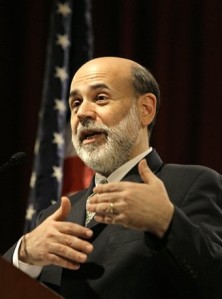 Obama has decided to re-appoint Fed Chairman Ben Bernanke to another term.
I awakened this morning to the bleating of the bloggies on this move. Of course, I have this tendency to look at folks’ credentials before I decide to take their opinions seriously. It also helps to know their political agendas and frames. Chairman Bernanke has probably had the most challenging time at that job since Paul Volcker took over the Fed helm back in the days of rampant inflation and Carter malaise. So many blogs have come to criticize Bernanke, but I’m just glad we’re not here to bury him. He may not be perfect, but he’s a damn sight better than just about everything else out there. Ben Bernanke is an economist’s economist.
Wall Street and academic economists in recent weeks showed enthusiasm for giving Mr. Bernanke a second term, and some administration insiders felt similarly even though Mr. Bernanke was appointed by — and served in the White House of — President George W. Bush. Appointing a Democrat such as Janet Yellen, president of the Federal Reserve Bank of San Francisco, or Alan Blinder, former Fed vice chairman — both former advisers to President Bill Clinton — would have been popular with many Democrats. But a move by Mr. Obama to install his own person at the Fed might have have rattled markets and unsettled the foreign investors.
Phil Izza at the WSJ has a pretty good line up of comments from both political and financial folks on the Bernanke appointment. Some of the performance the financial markets today(so far, all up) could be linked to the decision as the Fed Chair heads up the Federal Open Market Committee and sets its agenda. It is a rare FOMC that will go against the recommendations of their chair when setting monetary policy(primarily levels of interest rates, exchange rates, and bond offerings) although there is usually a healthy amount of debate and exchange or so I’ve heard since the meetings are top secret.
- I think it’s good news for the Federal Reserve. It’s good news for the country. It’s a great choice. Chairman Bernanke has done a terrific job in bringing openness to the Fed. He has been bold and creative in dealing with the financial crisis… It was not clear to most people that the crisis was going to be as broad-based, and that the excesses in the financial markets and in lending were as broadly based as they turned out to be. Even at the start, he was willing to consider all options to deal with what appeared to be more a liquidity than a solvency crisis. As it began to become more clear that it was a crisis of solvency and leverage and a classic credit crunch, he didn’t flinch in bringing enormous creativity to bear in mitigating the problem –Richard Berner, Morgan Stanley
- Having a new chairman come in at this late date would put the Fed engineered solution to both the recovery and the exit strategy at risk. The Federal Reserve made a hasty exit from easy money stimulus in the 1930s and we know how that worked out… Mistakes have been made at many regulatory institutions during this crisis, but all the Fed’s mistakes would have been made by any man according to the prudent man rule. Bernanke is a true prudent man who calls them as he sees them, and knows the ins and outs of policymaking… If he can pull off this recovery that still needs nurturing, he could well go down as one of the greatest Fed Chairmen in history. –Christopher Rupkey, an economist with Bank of Tokyo-Mitsubishi
Hillary’s Gender Agenda
Posted: August 25, 2009 Filed under: Hillary Clinton: Her Campaign for All of Us, Human Rights, Women's Rights | Tags: Angela Merkel, Betty Ford, Hillary Clinton, Indira Ghandi, Margaret Thatcher, Women in leadership roles, Women in Power 2 Comments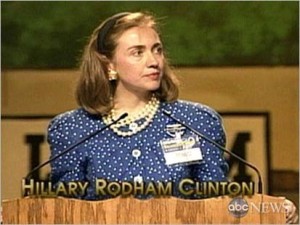 Here’s some news about Hillary Clinton’s New Gender Agenda as reported last week by the NY Times.
I have to say that Hillary really captured my admiration in 1995 when she gave that powerful speech in Beijing for the United Nations Conference. The only really feminist first lady that I can recall in my life time before Hillary Clinton was Betty Ford. Although I remember reading many many things about Eleanor Roosevelt, she died before I could truly appreciate her. All the other first ladies seemed so demure by comparison! But not Hillary Clinton!
She is our third female Secretary of State. While I appreciate Condi Rice and her brilliance, she was not always arguing positions with which I agreed so I always watched her with a raised eyebrow. I do, however, admire all three of them from Madeline Albright forward. As my Irish Grandmother taught me from her very superstitious nature, the third’s always the charm! Hillary has put women’s issues front and center and I have to say brava for that! There are so many issues facing women in the world these days that it is hard to choose one as a priority. The ones that have grabbed my heart recently are that of the plight of child brides and the girls (and young boys) trafficked for the sex trade. The one I work for is microfinancing for women’s businesses all over the world. (Shameless plug here for The Confluence Lending Team at Kiva.) Here are Hillary’s priorities.
Q: In your confirmation hearing, you said you would put women’s issues at the core of American foreign policy. But as you know, in much of the world, gender equality is not accepted as a universal human right. How do you overcome that deep-seated cultural resistance?
Clinton: You have to recognize how deep-seated it is, but also reach an understanding of how without providing more rights and responsibilities for women, many of the goals we claim to pursue in our foreign policy are either unachievable or much harder to achieve.
Democracy means nothing if half the people can’t vote, or if their vote doesn’t count, or if their literacy rate is so low that the exercise of their vote is in question. Which is why when I travel, I do events with women, I talk about women’s rights, I meet with women activists, I raise women’s concerns with the leaders I’m talking to.
I happen to believe that the transformation of women’s roles is the last great impediment to universal progress — that we have made progress on many other aspects of human nature that used to be discriminatory bars to people’s full participation. But in too many places and too many ways, the oppression of women stands as a stark reminder of how difficult it is to realize people’s full human potential.

 peej
peej Carissa
 bostonboomer
 dakinikat
 ecocatwoman
 mablue2
 Mama Lopez
 peggysue22
 quixote
 skydancingguestblogger
 Mona (aka Wonk the Vote)



 Sky Dancing
Recent Comments