
Joblessness is slowing but looks longlasting
Posted: December 4, 2009 Filed under: U.S. Economy 3 CommentsI was pouring over the jobless numbers this morning with my students. The overall numbers suggest that we’re no longer hemorrhaging jobs and that some employers maybe considering some hiring. There is one number in there that I found really disturbing. This is what I read this morning at MarketWatch which is where I always go to get short, precise updates of financial/economic data.
Still, a record 55.1% of the unemployed have lost their job permanently, a sign that the labor market is undergoing structural changes as well as a cyclical downturn.
Paul Krugman has an interesting graph up at his blog at NYTIMES as well as a warning that the move from 10.2 % 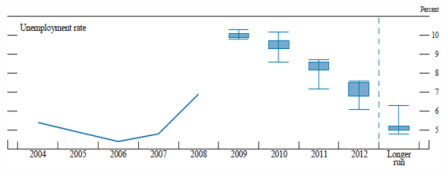 unemployment rate to 10% may cause policy makers to lose their sense of urgency. This graph is the projected unemployment being used by the FOMC. You can see that they are still expecting a rate above the NAIRU until the end of 2012. Looking at the number I found on structural unemployment, the joblessness rate may peak soon, but I doubt it will come down quite that fast.
Structural unemployment comes from the most toxic of all possible sources of joblessness. It basically means there’s a mismatch between job skills of job seekers and jobs available. Christine Romer, economic adviser to POTUS, points to the numbers as “hopeful”. (Why do I get the willies now whenever I see that word come out of the White House?) You can see the definite trend towards moderation of joblessness in the graph she’s posted there. The other good news in the numbers is that the num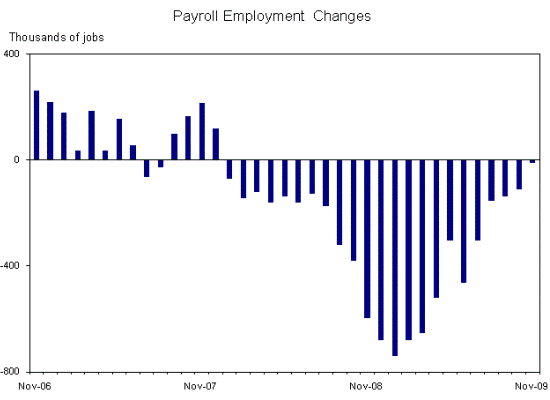 ber of temp jobs available continues to be on the rise. This is usually a precursor to permanent hires.
Additional issues that I see with the rate can be found again in the unspun numbers back at MarketWatch.
The employment participation rate fell to 65% from 65.1% as the labor force dropped by 98,000. The employment-population ratio was steady at 58.5%.
The unemployment rate fell for most major demographic groups. For whites, the rate fell to 9.3% from 9.5%. For blacks, the jobless rate dropped to 15.6% from 15.7%. For Hispanics, it fell to 12.7% from 13.1%. For men, it was 10.5%; for women, 7.9%; for teens, 26.7%.
First, we continue that Black and Hispanic Americans continue to bear the brunt of the bad job market. Both Asian and White Americans continue to have the lowest rates as well as the best rate of improvement. This is also a really bad job market for young folks. Women continue to hold onto their jobs more then men. Again, a lot of this is due to the vast difference in wages paid to women. We tend to be hired on the cheap.
The other curious piece of information is that the employment participation rate continues to go down. This could be for several reasons. Discouraged workers and long term unemployed people could be giving up. It could also signal a return to school or early retirement. This numbers deserves some exploration. I’m hoping some labor economists dig into it further.
The NY Times today emphasized a bit more of the good news in the numbers.
Still, the November jobs report was more encouraging than most forecasters had expected. Apart from the unexpectedly small number of lost jobs, there was a surge in the hiring of temporary workers and the workweek lengthened, suggesting that thousands of workers on shortened schedules got some or all of their hours restored.
Although average hourly pay for most workers rose by only one cent, to $18.74, average weekly earnings rose smartly to $622.17 from $618.09 — reflecting the increase in hours, which employers coming out of a recession often do before hiring more people.
Since I’m not a labor economist, I have to say that a lot of what I feel right now about this report comes from my gut more than anything, but I’m personally worried that we’re seeing a large number of people that will be left on the sidelines during the next upswing. I’m still not seeing any kind of emphasis on job training or re-schooling of people in some key industries that seem to be undergoing permanent downsizing. Primary among these folks are those associated with the automobile manufacturing industry but it seems that drugmakers may be putting chemists into that category also. I keep getting the feeling that the approach right now is to just send every one back to nursing school. Some how, I don’t think that’s going to be a long run solution to the problem. Perhaps green technologies will use some of these folks into new fields, but I’m not overly optimistic. I’m also pretty certain that we can’t turn them all into teacher and sales clerks at Walmart either. So, this gives me some concern. Again, I’m a financial economist not a labor economist, but I just believe that we need to get on top of this fairly quickly or we’re going to see a lot of middle aged, unemployed workers with no place to go that don’t have the luxury of going back to college.


 peej
peej Carissa
 bostonboomer
 ecocatwoman
 mablue2
 Mama Lopez
 peggysue22
 quixote
 skydancingguestblogger
 Mona (aka Wonk the Vote)



 Sky Dancing
its seems like just last week katie had an expert on that told us the recession was over its back . got qustion 4 ya DK when dose a recession end & a depression begin ????
and by the way rember that post you did about 5-31-08 the day democacy died . do you still have that . i think it was one of the best iv seen about that fatefull day
. if you still got it i love to have a copy if its ok with you??
Thank you for all you writing/insight/knowledge about all things economic. i read everything you write, rarely comment, read opinions, and think….
and think….
well
Just stopped by to wish you a Merry Hotai.
song!