
Feel the Bern!
Posted: August 25, 2009 Filed under: Bailout Blues, Equity Markets, Global Financial Crisis, U.S. Economy | Tags: Ben Bernanke, Federal Reserve Bank, Larry Summers Comments Off on Feel the Bern!While I stuck the announcement into the morning links, you had to know that I’d front page this announcement some time today. So you also probably knew that I breathed a quiet sigh of relief last night when I found out we were not getting La La Summers for Fed Chief. President 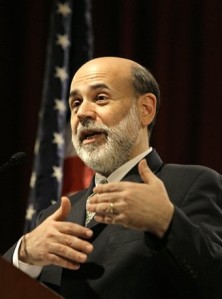 Obama has decided to re-appoint Fed Chairman Ben Bernanke to another term.
I awakened this morning to the bleating of the bloggies on this move. Of course, I have this tendency to look at folks’ credentials before I decide to take their opinions seriously. It also helps to know their political agendas and frames. Chairman Bernanke has probably had the most challenging time at that job since Paul Volcker took over the Fed helm back in the days of rampant inflation and Carter malaise. So many blogs have come to criticize Bernanke, but I’m just glad we’re not here to bury him. He may not be perfect, but he’s a damn sight better than just about everything else out there. Ben Bernanke is an economist’s economist.
Wall Street and academic economists in recent weeks showed enthusiasm for giving Mr. Bernanke a second term, and some administration insiders felt similarly even though Mr. Bernanke was appointed by — and served in the White House of — President George W. Bush. Appointing a Democrat such as Janet Yellen, president of the Federal Reserve Bank of San Francisco, or Alan Blinder, former Fed vice chairman — both former advisers to President Bill Clinton — would have been popular with many Democrats. But a move by Mr. Obama to install his own person at the Fed might have have rattled markets and unsettled the foreign investors.
Phil Izza at the WSJ has a pretty good line up of comments from both political and financial folks on the Bernanke appointment. Some of the performance the financial markets today(so far, all up) could be linked to the decision as the Fed Chair heads up the Federal Open Market Committee and sets its agenda. It is a rare FOMC that will go against the recommendations of their chair when setting monetary policy(primarily levels of interest rates, exchange rates, and bond offerings) although there is usually a healthy amount of debate and exchange or so I’ve heard since the meetings are top secret.
- I think it’s good news for the Federal Reserve. It’s good news for the country. It’s a great choice. Chairman Bernanke has done a terrific job in bringing openness to the Fed. He has been bold and creative in dealing with the financial crisis… It was not clear to most people that the crisis was going to be as broad-based, and that the excesses in the financial markets and in lending were as broadly based as they turned out to be. Even at the start, he was willing to consider all options to deal with what appeared to be more a liquidity than a solvency crisis. As it began to become more clear that it was a crisis of solvency and leverage and a classic credit crunch, he didn’t flinch in bringing enormous creativity to bear in mitigating the problem –Richard Berner, Morgan Stanley
- Having a new chairman come in at this late date would put the Fed engineered solution to both the recovery and the exit strategy at risk. The Federal Reserve made a hasty exit from easy money stimulus in the 1930s and we know how that worked out… Mistakes have been made at many regulatory institutions during this crisis, but all the Fed’s mistakes would have been made by any man according to the prudent man rule. Bernanke is a true prudent man who calls them as he sees them, and knows the ins and outs of policymaking… If he can pull off this recovery that still needs nurturing, he could well go down as one of the greatest Fed Chairmen in history. –Christopher Rupkey, an economist with Bank of Tokyo-Mitsubishi
Here’s some other interesting links around the web concerning the appointment. I’ve followed others’ takes with my own if you can hang in there long enough!
The American Prospect’s Tim Fernholz has an on-the-one-hand-on-the-other-hand kinda post.
Bernanke is “trusted” by the “markets,” in the insane parlance of our times, and this should give them some confidence going forward. (It also won’t hurt to take health-care reform out of the news cycle for a few hours or so.) And if, as Noam suggests, Bernanke’s market credibility will give him more leeway to wait on raising interest rates until recovery truly comes instead of jumping early, then that will help bring down unemployment and prevent a 1937-style second recession.
But the decision is not without downside. Bernanke’s management of the bubble economy left a lot to be desired, so whether he can manage a recovering economy without promoting bubbles and bad practices remains to be seen (his expertise is crises). And though it is comforting that the administration seems intent to remove the Fed’s consumer protection functions and place them in a new agency, since Bernanke’s greatest failure was entirely abandoning that task, the proposal to endow the Fed with more prudential regulatory authority for systemic risk will bring hard questions from Congress that might make Bernanke’s confirmation hearings iffy. There are also troubling questions about his role in the Bank of America/Merrill Lynch merger that could raise further confirmation troubles.
Ultimately, this is a good short-term pick for today, certainly, as well as the next six months or so of crisis management and the short-term reassurance of the bond markets.
Over at Calculated Risk, they are a little less sanguine.
As Fed Governor Bernanke supported the flawed policies of Alan Greenspan – he never recognized the housing bubble or the lack of oversight – and there is no question, as Fed Chairman, Bernanke was slow to understand the credit and housing problems. And I’d prefer someone with better forecasting skills.
However once Bernanke started to understand the problem, he was very effective at providing liquidity for the markets. The financial system faced both a liquidity and a solvency crisis, and it is the Fed’s role to provide appropriate liquidity. Bernanke met that challenge, and I think he is a solid choice for a 2nd term (not my first choice, but solid).
Frankly, I’m fine with the re-appointment since both his academic research and his history of having been in the middle of everything while all this was going down gives him a perspective I don’t think any one else has. Granted, he did sit on the FOMC while Greenspan was happily blowing bubbles and running a bit of a Randian experiment (which failed) with unregulated financial innovations. Greenspan was placed in the God realm by then and a youngish ivy league economist with a good publishing record might not have been highly influential at the time given the others sitting at the table also. Remember, he is never the only one sitting there with a vote and voice on monetary policy. We don’t know that he didn’t speak up because the meetings are kept secret. I know him by his research and by his commitment to Fed independence.
We also don’t know how much conflict there is between the White House Treasury Department and the Fed right now although we’ve seen Bernanke reluctantly take on some duties and argue actively for others. He’s the Fed Chair. Markets all over the world wait breathlessly for everything he says. He has to guard every public word and he’s well aware of it. I will say that one of the things he has done extremely well is introduce a lot more public information about the FOMC’s decision-making process and for that alone, he deserves some applause.
There are some incredible challenges still sitting out there. I know I sound like a broken record but those troubled assets are still out there. The Congress needs to do some serious law writing so that some one can do something with permanent with them. Again from the WSJ, we see coverage of what’s going on with the mortgage market and it is still not good.
Homeowners who fall behind on their mortgage payments have become much less likely to catch up again, a new study shows.
The report from Fitch Ratings Ltd., a credit-rating firm, focuses on a plunge in the “cure rate” for mortgages that were packaged into securities. The study excludes loans guaranteed by government-backed agencies as well as those that weren’t bundled into securities. The cure rate is the portion of delinquent loans that return to current payment status each month.
Fitch found that the cure rate for prime loans dropped to 6.6% as of July from an average of 45% for the years 2000 through 2006. For so-called Alt-A loans — a category between prime and subprime that typically involves borrowers who don’t fully document their income or assets — the cure rate has fallen to 4.3% from 30.2%. In the subprime category, the rate has declined to 5.3% from 19.4%.
“The cure rates have really collapsed,” said Roelof Slump, a managing director at Fitch.
Cure rates are extremely important because, like the label implies, it shows how resilient folks are at recovering from their lapsed payments. This numbers are downright disturbing.
Naked Capitalism outlines the continuing problem of bank failures and a new term, bank slaughter. These all come under Bernanke’s purview and we’ve got a zombie bank problem.
It is now abundantly clear, to use that Richard Nixon turn of phrase, that the big banks not only have a license to steal, but the government now undermines its risks. That plus the failure to try to engineer controlled deleverging (high leverage is systemically destablizing) guarantees that if we do not sink into Japan-style malaise, we will have an even bigger crisis in pretty short order, five year at the very outside. The failure to implement real reforms will cost us dearly, and sooner than anyone wants to believe.
Bernanke’s reappointment reminds me a lot of the Reagan re-appointment of Volcker. Reagan was closing in on running for his second term as president, the country was in the middle of a financial crisis, interest rates and unemployment were at record highs, and things looked really bleak. It was evident he wanted to replace Volcker with some one that would accommodate his agenda and re-election but it was also made clear to him that the financial markets trusted Volcker. The markets knew Volcker was responsible for lowering inflation and believed he’d do the right thing in unwinding all those troubled S&L’s and their even more troubled balance sheets. Reagan, in one of moves that showed he could be pragmatic, bowed to the wishes of the business community and re-appointed him. With the luck of the Irish, the economy improved just in time for Reagan to be able to claim morning again in America. Volcker (and President Jimmy Cater who appointed him) could probably claim responsibility for that feat but Reagan got the political credit.
So, Bernanke still will have some challenges as I don’t think we have that level of resiliency in the economy at the moment. President Obama will probably not get to claim credit for any similar  “Morning in America” because Carter almost had the budget balanced by the end of his first term and our position vis-à-vis the general debt and specifically the T bill and T bond markets which are clearly in a different status now as compared to that time period. Also, the problems in financial institutions are much more wide spread. They are impacting commercial banks which are the life blood of a capital-based economy and businesses. Thrifts don’t have those important roles as well as almost no role in monetary policy transmission.
Regulations at the time of Carter kept much of the systematic hemorrhaging in the financial institutions was limited to one distinct set. These regulations are mostly gone. Chairman Bernanke clearly needs a few really good Senators and Congressman to write Banking and Investment Regulation and law that catches up with the state of the current financial system and the current systemic problems. We don’t have the laws we need and we are in high need of experts in Congress. We had those back in the 1980s. We don’t now.
Another interesting thing, mentioned by WMCB this morning, is this lawsuit brought against the FED by Bloomberg. Bernanke has done a good job of opening up FED policy to the public without endangering either domestic or international monetary policy goals. This one will prove to be a new issue on his to-do list. Frankly, I think this move on his part has been basically to protect Citibank and at this point we might look at doing to them what we did to AT&T. But then, that’s again up to Ben and Sheila and Tim and not this little Cajun country economist.
The Federal Reserve must for the first time identify the companies in its emergency lending programs after losing a Freedom of Information Act lawsuit.
Manhattan Chief U.S. District Judge Loretta Preska ruled against the central bank yesterday, rejecting the argument that loan records aren’t covered by the law because their disclosure would harm borrowers’ competitive positions.
The Fed has refused to name the financial firms it lent to or disclose the amounts or the assets put up as collateral under 11 programs, most put in place during the deepest financial crisis since the Great Depression, saying that doing so might set off a run by depositors and unsettle shareholders. Bloomberg LP, the New York-based company majority-owned by Mayor Michael Bloomberg, sued on Nov. 7 on behalf of its Bloomberg News unit.
“The Federal Reserve has to be accountable for the decisions that it makes,” said Representative Alan Grayson, a Florida Democrat on the House Financial Services Committee, after Preska’s ruling. “It’s one thing to say that the Federal Reserve is an independent institution. It’s another thing to say that it can keep us all in the dark.”
The judge said the central bank “improperly withheld agency records” by “conducting an inadequate search” after Bloomberg News reporters filed a request under the information act. She gave the Fed five days to turn over documents it told the reporters it located, including 231 pages of reports, and said it must look for more at the Federal Reserve Bank of New York, which runs most of the loan programs.
My bottom line? I think Ben Bernanke is the strongest player on the Obama economic team at the moment. If we’re looking for folks to be replaced, I’d get rid of La La Summers and Timmy’s in the Well Again Geithner. Guess we’ll see about that.
Please Digg!!! $hare!!!! Tweet!!!!


Add to: Facebook | Digg | Del.icio.us | Stumbleupon | Reddit | Blinklist | Twitter | Technorati | Furl | Newsvine

 peej
peej Carissa
 bostonboomer
 dakinikat
 ecocatwoman
 mablue2
 Mama Lopez
 peggysue22
 quixote
 skydancingguestblogger
 Mona (aka Wonk the Vote)



 Sky Dancing
Recent Comments