
In Search of a Trough
Posted: July 31, 2009 Filed under: Global Financial Crisis, The Great Recession, U.S. Economy | Tags: BEA, GDP, job markets, jobless recovery, minimum wage, Real economic Growth, wages Comments Off on In Search of a Trough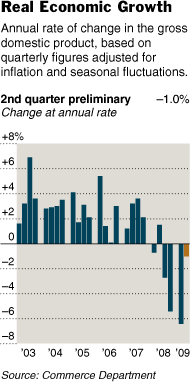 The U.S. economy still shrank in second quarter 2009 but at a much lower pace than was anticipated. That’s a pretty good indicator that the bottom or trough of The Great Recession may be near. Here’s the precise release from the Bureau of Economic Analysis (BEA).
Real gross domestic product — the output of goods and services produced by labor and property located in the United States — decreased at an annual rate of 1.0 percent in the second quarter of 2009, (that is, from the first quarter to the second), according to the “advance” estimate released by the Bureau of Economic Analysis. In the first quarter, real GDP decreased 6.4 percent.
While the many recent indicators show the recession is loosing some of its downward momentum, there are few economists ready to sing Happy Days are Here Again. The NYT’s coverage of the statistical release continues to bring up some of the same concerns we’ve discussed here before.
The economy’s long, churning decline leveled off significantly in the second quarter, as stock markets started to recover, corporate profits bounced back, housing markets stabilized and the rampant pace of job losses tapered off. Declines in business investment leveled off, and the economy was aided by big increases in government spending at the federal, state and local levels.
“We’re in a deep hole, and now we’ve got to dig ourselves out of it, which is a very difficult task,” Diane Swonk, chief economist at Mesirow Financial, said.
But consumer spending fell by 1.2 percent as Americans put more than 5 percent of their disposable income into savings. Economists are concerned that consumer spending, which makes up 70 percent of the economy, will not rebound as long as employers keep cutting jobs and trimming wages.
The last two month’s of one key leading indicator, consumer sentiment, has not shown any improvement. Indeed, the WSJ reported just last week reported that the index fell again in July. Consumers appear to be acting more cautious and pessimistic as the ranks of the unemployed swell.
Consumer attitudes darkened in July, breaking a string of improved readings that had suggested households were regaining confidence in the economy.
The Reuters/University of Michigan index of consumer sentiment, which was released Friday, sank to 66 from 70.8 in June, though it remained above the low of 55.3 recorded in November.
Richard Curtin, the survey director, noted that most consumers “believe the economic free-fall is now over,” but “see little reason to believe that the economic-stimulus package will improve their finances anytime soon.”
In July, the fewest consumers in the survey’s 60-year history reported income gains, and respondents expected their incomes to rise just 0.2% on average in the next year. Buying plans for homes, autos and big-ticket household items declined as well.
The NY times article today continues to show support among most economists that this will be a ‘jobless recovery’. Most of the fundamentals for both consumers and businesses do not appear to be on the rebound any time soon.
“We’re going from recession to recovery, but at least early on, it’s not going to feel like one,” said the chief economist at Moody’s Economy.com, Mark Zandi. “For economists, this is a seminal part in the business cycle, but for most Americans, it won’t mean much.”
That is because the job market is expected to remain dismal even after the economy resumes growing. As business picks up after a recession and companies start receiving more orders and restocking their shelves, employers will still resist hiring new full-time workers, and instead pay overtime or rely on part-time employees.
To make a dent in the 9.5 percent unemployment rate, economists say, the economy needs to grow at a 3 percent clip and add 300,000 to 400,000 jobs a month — a difficult task after so many months of a recession. Many economists expect an arduous recovery marked by high unemployment and unsteady growth.
What do you need to look for in order to feel more secure about the rest of the year? Well, first, there needs to be some indication that small and medium sized businesses are willing to hire or rehire. There was data released last week that indicating the inflation adjusted (real) purchasing power of the minimum wage was on the rise. This is a double-edged sword. While giving folks on minimum wage more money to spend, it also makes them more expensive to hire. Labor economists will undoubtedly be looking to see which effect will be stronger. Remember, the job market is always the last to recover in a recession. The longer it takes to recover, the longer we scuttle across the trough and experience a jobless recovery.
Again, some analysis from that NY Times article.
In interviews, small-business owners across the country say the ground is slowly reforming under their feet, and that business no longer seems to be careening downward. Indeed, business investment in structures like new factories and office buildings fell at a rate of 8.9 percent in the second quarter after declining by more than 40 percent in the previous three months. And investment in equipment and software, which fell 36 percent this winter, dropped a more modest 9 percent in the second quarter.
But many employers who have laid off employees or scaled back say they are not about to increase their spending or start hiring.
Next, look for any continued improvement in the housing market where much of the world’s troubles began. There appears to be some indication that market is finding a bottom, but it’s a little early to say that with confidence. The Case-Shiller Housing Price index indicates an inflection (possible turning point) which could signal a positive change. It appears that we’ve had changes in several layers of derivatives, however random variation is always possible so you need a bit more persistance to indicate a trend. But, things are looking better in the housing market.
The WSJ is looking towards another leading indicator, inventories, to see if this could be the turning point we’ve hoped for.
A couple of reports on the economy this week bolstered that case. New-home sales rose a fourth time in six months during June as buyers jumped to take advantage of fallen prices for property. Durable-goods orders fell for the month, but orders outside of transportation rose and a gauge of capital spending by businesses climbed.
Friday’s report showed inventory liquidation subtracted less from GDP in the second quarter than it did in the first quarter, 0.83 of a percentage point versus 2.36 percentage points. Economists think companies — including auto makers amid signs that the government’s cash-for-clunkers program is an early success — will have to restock soon as consumption stabilizes.
“The fact that inventories were still falling in the second quarter raises the odds that they [will] add a huge amount to GDP’s plus-column in the third quarter,” said Chris Rupkey, economist at Bank of Tokyo-Mitsubishi.
If you really want to dig into the details of the National Income Accounts, the way we keep track of economic spending and activity in the economy, you can continue reading the WSJ article. It covers the major categories and provides the percentage changes from the previous quarters for that famous equation of GDP = C + I + G + (X-M) that is the mantra of every first year macroeconomics student.
Again, these numbers were in line with expectations and positive, but remember, we’re still seeing a number of mixed signals from the household sector. It does appear that American families are still willing to spend if you give them enough incentive to do so as we’re now witnessing in the incredible popular cash for clunkers program that seems to have just run out of funding. Since it’s the American household that drives 70% of the economy, it continues to make sense to enable them to rev the economy’s engine. It continues to be about the jobs and the incomes.
Digg!!! Share!!! Tweet!!!


Add to: Facebook | Digg | Del.icio.us | Stumbleupon | Reddit | Blinklist | Twitter | Technorati | Furl | Newsvine

 peej
peej Carissa
 bostonboomer
 dakinikat
 ecocatwoman
 mablue2
 Mama Lopez
 peggysue22
 quixote
 skydancingguestblogger
 Mona (aka Wonk the Vote)



 Sky Dancing
Recent Comments