
Should Markets Respect Societal Bounds?
Posted: June 11, 2009 Filed under: Economic Develpment, Hillary Clinton: Her Campaign for All of Us, Human Rights, U.S. Economy | Tags: Dr. Michael Sandel, Economic Development, economics of public good, Elimination of poverty, Grameen Bank, Karela India, microfinance, Microlending, Muhammad Yunus, Reich Lectures 2 CommentsAs you know, I frequently rely on the British press for news and political analysis. I was delighted to find a link on Dr. Mark Thoma’s Economist’s View to the BBC’s broadcasts of the Riech Lectures for 2009. Dr. Michael Sandel, Harvard Professor of Government, delivers four lectures on the prospects of a new politics of the common good in this series. Dr Sandel argues that we need “a politics oriented less to the pursuit of individual self-interest and more to the pursuit of the common good”. I was most intrigued by the series on financial community norms (as pointed to by Dr. Thoma) and the idea that even in markets, “norms matter”.
The series is presented and chaired by Sue Lawley.
Sandel considers the expansion of markets and how we determine their moral limits. Should immigrants, for example, pay for citizenship? Should we pay schoolchildren for good test results, or even to read a book? He calls for a more robust public debate about such questions, as part of a ‘new citizenship’.
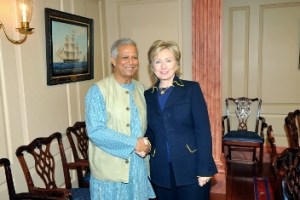
US Secretary of State Hillary Clinton receives Nobel laureate Prof Muhammad Yunus at her US State Department office in Washington DC Wednesday.
I have worked with and studied under one of the foremost authorities on Islamic Banking which are finiancial institutions developed with the idea of a “common good” so I know that in some areas of the world, this is possible. Again, in Dr. Hussan’s Bangledesh and other countries respecting Islamic law, banks do not charge interest because the Q’uran forbids usury. This is also true of the banking system used by Orthodox Jews. This is viewed as a financial system that works for the common good in lieu of exploitation of one side of the market. The banks are frequently mutually owned. Again, one of the best development vehicles in poorer countries is the microfinance banking community that developed with the inspiration from Bangledeshi Economist, Muhammad Yunus, who won the Noble Peace prize for his role in developing the idea of microcredit and the Grameen Bank. (This means of course, I have to make a shameless plug for Kiva my favorite place to invest in humanity’s future where I place money as dakinikat@aol.com). I know from this work that it is possible to create market driven systems where something other than over-the-top profits can motivate a market.
So, I’m going to return to Dr. Sandel’s exposition on what it means to have markets which value a poltics of common good. I’ve bolded the areas that I highlighted while reading the speech. (Yes, I know, old university habits die hard.)
A new politics of the common good isn’t only about finding more scrupulous politicians. It also requires a more demanding idea of what it means to be a citizen, and it requires a more robust public discourse – one that engages more directly with moral and even spiritual questions. And so in the course of these lectures, I’ll explore the prospect of a new citizenship and I’ll be asking what a more morally engaged public life might be like.
If we’re to reinvigorate public discourse, if we’re to focus on big questions that matter, questions of moral significance, one of the first subjects we need to address is the role of markets, and in particular the moral limits of markets. Which brings me to the topic of this first lecture. We’re living with the economic fallout of the financial crisis and we’re struggling to make sense of it. One way of understanding what’s happened is to see that we’re at the end of an era, an era of market triumphalism. The last three decades were a heady, reckless time of market mania and deregulation. We had the free market fundamentalism of the Reagan-Thatcher years and then we had the market friendly Neo-Liberalism of the Clinton and Blair years, which moderated but also consolidated the faith that markets are the primary mechanism for achieving the public good. Today that faith is in doubt. Market triumphalism has given way to a new market scepticism. Almost everybody agrees that we need to improve regulation, but this moment is about more than devising new regulations. It’s also a time, or so it seems to me, to rethink the role of markets in achieving the public good. There’s now a widespread sense that markets have become detached from fundamental values, that we need to reconnect markets and values. But how? Well it depends on what you think has gone wrong. Some say the problem is greed, which led to irresponsible risk taking. If this is right, the challenge is to rein in greed, to shore up values of responsibility and trust, integrity and fair dealing; to appeal, in short, to personal virtues as a remedy to market values run amuck.
Sandel goes on to call this last idea the “greed critique” and dissassembles the argument as a flawed or partial explanation of many of the recent trends in wealth and human development factors which show the ultra rich heading to the god realms while the rest of us fall farther behinds in our bills and aspirations. Here, he shows how my field of economics treats greed and self interest as equals in the sense that getting ahead as a self-actualizing experience is beneficial to not only an individual but the community at large.
From the standpoint of economics, there is no real difference between self-interest and greed. Greed is a vice in personal relations, but the whole point of markets is to turn this vice into an instrument of the public good. This is the moral alchemy that markets are said to perform. We learn this from Adam Smith who said, “It is not from the benevolence of the butcher, the brewer or the baker that we expect our dinner, but from their regard to their own self-interest”. “We address ourselves not to their humanity”, Smith said, “but to their self-love. Nobody but a beggar chooses to depend chiefly upon the benevolence of his fellow citizens”. This was Adam Smith. So it’s tempting to say that all we need to do is rein in greed and restore integrity among bankers and business executives and politicians, but this response is mainly hortatory: comforting for a time, but not really much help in rethinking the role that markets play in our societies.
Of course, it is also quite easy to do arm chair criticism of the game without proposing any alternative. I’ve noticed that in the world of political and economic discoursed in media outlets that luxury is frequently exercised. Dr. Sandler proposes an alternative.
The alternative is to re-think the reach of markets into spheres of life where they don’t belong. We need a public debate about what it means to keep markets in their place. And to have this debate, we have to think through the moral limits of markets. We need to recognise that there are some things that money can’t buy and other things that money can buy but shouldn’t.
 This is something that I’ve been adding to my lectures on development since the 1980s when I discovered the development strategy of Kerala. I remember watching a PBS series on the poltics of food and hunger. During the 80s, it was very typical for me to pass mountains and mountains of grain, piled up in small town Nebraska, while watching incredible scenes of starvation on the tv. This series attempted to rectify the two by looking at how several countries approach their market distribution of food and it related how actually, the U.S., by exporting it’s land and capital intensive agriculture system to Africa and Asia, and actually exported famine in places like the Sudan. It also highlighted the Kerala, a region of India. Kerala had decided to approach a market economy differently. It definitely approached its agriculture system as well as its food distribution chain.
Karela set up several goals for its region early in the 1960s. It decided that all folks would be within a short walking distance of schools and libraries and that it would have a strong commitment to educating all its citizens. As a result, Karela has a phenomenal literacy rate that even the United States envies. It also enjoys a high level of gender equality. The other was to establish stores that were to provide a “fair market” for certain items that the government decided should not be provided based on a pure profit motive. This included things like home heating oil, rice, and simple bicycles. Luxuries were strictly left to unrestrained market forces. These government stores would provide needed consumer goods at a ‘fair price”. Unfortunately, I have learned that in 1999, some events may have undermined these institutions and their successful public distribution systems.
So, what is the root cause of economic failures given by Sandel if greed provides a partial explanation?
Looking back over three decades of market triumphalism, the most fateful change was not an increase in the incidence of greed. It was the expansion of markets and of market values into spheres of life traditionally governed by non-market norms. We’ve seen, for example, the proliferation of for profit schools, hospitals and prisons; the outsourcing of war to private military contractors. We’ve seen the eclipse of public police forces by private security firms, especially in the US and the UK where the number of private guards is more than twice the number of public police officers. Or consider the aggressive marketing of prescription drugs to consumers in the United States. If you’ve ever seen the television commercials in America on the evening news, you could be forgiven for thinking that the greatest health crisis in the world is not malaria or river blindness or sleeping sickness, but a rampant epidemic of erectile dysfunction.
Sandel continues his talk with examples that range from the Kyoto Protocal and the possible implementation of selling the right to pollute to for profit blood banks that replace the idea of the Red Cross and Blood donations. His entire speech is worth the read. You can either listen to it or read it as I did.
This speech impacted me great because it asks a question that I’ve asked myself ever since I began to look at the so-called Karela miracle in the 1980s during the height of the Reagan/Thatcher reforms. Are there some things that are too important that that cannot and should not be left to the market? I believe this is the question that is central to our health care discussion as well as access to many things. So, I leave this question for your consideration and for your discussion.


 peej
peej Carissa
 bostonboomer
 ecocatwoman
 mablue2
 Mama Lopez
 peggysue22
 quixote
 skydancingguestblogger
 Mona (aka Wonk the Vote)



 Sky Dancing
DK I’m going to the foreign press more & more ours cant be trusted . if i ever watch them I’m usually looking for the subtext of what is really going on because i don’t & cant trust them anymore..
yup, I learned that lesson well in the first gulf war, after the lead up to the second , I always go abroad for differing views and additional facts.