
Dead Bank Walking
Posted: June 9, 2009 Filed under: Uncategorized | Tags: bad bank, joseph stiglitz, Zombie Bank 3 Comments The Treasury just gave ten big banks the okay to repay their Tarp Funds. The gang of ten includes J.P Morgan, Goldman Sachs, Morgan Stanley, American Express, Bank of New York Mellon, US Bancorp, Capital One Financial Corp, and Northern Trust. This basically gives positive identification to our zombie banks. The three most worrisome are Citibank, Wells Fargo, and Bank of America Corp essentially creating a two-tier banking system. The second tier banks had to give the Treasury their plans to raise capital, while the other banks turn back their funds.
As part of the bank bailout program, known as the Capital Purchase Program, the 10 institutions eligible to repay TARP have the right to repurchase warrants the Treasury holds at fair market value.
The 10 financial institutions already paid $1.8 billion in dividend payments to the Treasury over the last seven months, bringing the total of all dividend payments to $4.5 billion.
Proceeds from the repayments go to the Treasury’s general account, which is used to reduce Treasury’s borrowing and reduce the national debt. The funds could also be used to provide further capital to troubled financial institutions as part of the TARP program.
Other smaller banks have also returned bank bailout funds, bringing the total in returns to $70 billion.
As part of the program, J.P. Morgan is eligible to return $25 billion in TARP funds, Goldman Sachs, $10 billion, and Morgan Stanley, $10 billion.
BB& T plans to repay $3.1 billion in TARP funds it received, according to a statement from the institution Tuesday. U.S. Bancorp announced plans to buy out $6.6 billion in TARP capital, the bank reported Tuesday.
Other eligible institutions include American Express, $3.4 billion, Bank of New York Mellon, $3 billion, and State Street Bank, $2 billion.
The Zombie three have began some encouraging steps like removing a few board directors. The FDIC (Sheila Bair) is encouraging a shake up of top management. Citi plans to exchange some preferred securities for common stock. But will these steps be enough? Can we really trust so much of our economy’s lending and spending power to zombies?
I’m going to rely on Noble prize winning Joseph Stiglitz and his current-op ed piece called “American’s socialism for the Rich: Corporate Welfarism” for the answers.
With all the talk of “green shoots” of economic recovery, America’s banks are pushing back on efforts to regulate them. While politicians talk about their commitment to regulatory reform to prevent a recurrence of the crisis, this is one area where the devil really is in the details – and the banks will muster what muscle they have left to ensure that they have ample room to continue as they have in the past.
The old system worked well for the banks (if not for their shareholders), so why should they embrace change? Indeed, the efforts to rescue them devoted so little thought to the kind of post-crisis financial system we want that we will end up with a banking system that is less competitive, with the large banks that were too big too fail even larger.
It has long been recognized that those America’s banks that are too big to fail are also too big to be managed. That is one reason that the performance of several of them has been so dismal. When they fail, the government engineers a financial restructuring and provides deposit insurance, gaining a stake in their future. Officials know that if they wait too long, zombie or near zombie banks – with little or no net worth, but treated as if they were viable institutions – are likely to “gamble on resurrection.” If they take big bets and win, they walk away with the proceeds, if they fail, the government picks up the tab.
I like his characterization of “gambling on resurrection” because it is a huge gamble and much is at stake. If you 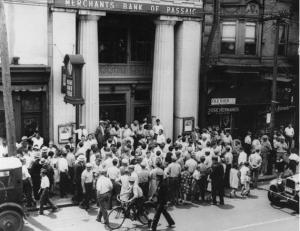 continue to read his piece, as well as anything I’ve done on the Zombie phenomenon for the last 8 months or so, you will see that history shows it’s a gamble that we will loose. Stiglitz argues that the Obama adminstration has now upped the ante even further. We now have not only institutions that are “too big too fail’ that have now achieved undeserved lower risk status because of implicit government guarantee, the Obama administration has now developed a philosophy of “too big to re-structure”. What we are witnessing is a complete upset of market rules where you reward the least efficient, the least responsible, and the least profitable with special status.
The Obama administration has, however, introduced a new concept: “too big to be financially restructured”. The administration argues that all hell would break loose if we tried to play by the usual rules with these big banks. Markets would panic. So, not only can’t we touch the bondholders, we can’t even touch the shareholders – even if most of the shares’ existing value merely reflects a bet on a government bailout.
I think this judgment is wrong. I think the Obama administration has succumbed to political pressure and scare-mongering by the big banks. As a result, the administration has confused bailing out the bankers and their shareholders with bailing out the banks.
Restructuring gives banks a chance for a new start: new potential investors (whether holders of equity or debt instruments) will have more confidence, other banks will be more willing to lend to them, and they will be more willing to lend to others. The bondholders will gain from an orderly restructuring, and if the value of the assets is truly greater than the market (and outside analysts) believe, they will eventually reap the gains.
But what is clear is that the Obama strategy’s current and future costs are very high – and so far, it has not achieved its limited objective of restarting lending. The taxpayer has had to pony up billions, and has provided billions more in guarantees – bills that are likely to come due in the future.
Rewriting the rules of the market economy – in a way that has benefited those that have caused so much pain to the entire global economy – is worse than financially costly. Most Americans view it as grossly unjust, especially after they saw the banks divert the billions intended to enable them to revive lending to payments of outsized bonuses and dividends. Tearing up the social contract is something that should not be done lightly.
I continue to argue that big finance OWNS this adminstration. It also appears to own much of Congress because after two years of financial meltdown, we STILL have yet to see one reasonable piece of legislative regulation inducing systemic change. I hate to keep repeating myself, but I will until I’m assured some one is listening. The Zombie 3 need to be broken up in an AT&T style trust busting spree. There is no research out there that supports the Obama administration paradigm. Big banks do not have economies of scale. Big Banks do not have any kind of efficiencies. The only thing they seem to have is political power and prowness. Shuffling a few players when they all were trained in league that has been show to be full of gamblers and juicers without clear and present oversight is a fools’ game!
Stiglitz refers to a new ersatz economics.
But this new form of ersatz capitalism, in which losses are socialized and profits privatized, is doomed to failure. Incentives are distorted. There is no market discipline. The too-big-to-be-restructured banks know that they can gamble with impunity – and, with the Federal Reserve making funds available at near-zero interest rates, there are ample funds to do so.
Some have called this new economic regime “socialism with American characteristics.” But socialism is concerned about ordinary individuals. By contrast, the United States has provided little help for the millions of Americans who are losing their homes. Workers who lose their jobs receive only 39 weeks of limited unemployment benefits, and are then left on their own. And, when they lose their jobs, most lose their health insurance, too.
America has expanded its corporate safety net in unprecedented ways, from commercial banks to investment banks, then to insurance, and now to automobiles, with no end in sight. In truth, this is not socialism, but an extension of long standing corporate welfarism. The rich and powerful turn to the government to help them whenever they can, while needy individuals get little social protection.
We need to break up the too-big-to-fail banks; there is no evidence that these behemoths deliver societal benefits that are commensurate with the costs they have imposed on others. And, if we don’t break them up, then we have to severely limit what they do. They can’t be allowed to do what they did in the past – gamble at others’ expenses.
Look, Dr. Stiglitz has more Wall Street cred and Ivy league decorations than any one in the White House at the moment. Can we please start taking him more seriously?


 peej
peej Carissa
 ecocatwoman
 mablue2
 Mama Lopez
 peggysue22
 quixote
 skydancingguestblogger
 Mona (aka Wonk the Vote)



 Sky Dancing
another exalent post DK .one question when is considered a depression what has to happen .
GDP has to drop 10% to be considered a depression and the unemployment rate has to rise much higher than that.
The usually prescription is government work programs to take care of unemployment. The deal is to get buying power back into the hands of families. That’s the traditional Keynesian response.
Dk thanks keep up the good work