
A Credit Derivatives Primer
Posted: May 12, 2009 Filed under: Bailout Blues, Global Financial Crisis, U.S. Economy 2 Comments While it’s short on mathiness, it’s long on financespeak. Another one of those speechie things I have given to people confused by what’s been going on in the financial markets. Don’t worry, I’ll quit posting academic things later this week! Meanwhile, don’t fall asleep!
Credit derivatives are a relatively recent financial innovation. They were first introduced in 1992 but not broadly traded until 1999 when documentation was standardized. The market for these securities is huge. Since 2000, it has increased from $900 billion to more than $45.5 trillion. This is roughly twice the size of the entire United States Equity Markets. Hedge funds are very active in this market and there is much concentration of the volume trade. Four large broker-dealers are responsible for the majority of transactions. JP Morgan Chase, Citibank and Bank of America have been the largest players. Most credit derivatives are credit default swaps (CDS). These are contractual agreements that transfer the default risk of one or more reference entities from one party to the other. It is designed to shift credit risk from one party to another. It is basically a bet on the health of a company or another set of assets like mortgages.
These instruments serve a role similar to insurance and appear to inject moral hazard into the banking community by leading to lax lending practices as witnessed by the current crises triggered by mortgage markets. Many traditional bank assets have been packaged and sold recently. This appears to be a side effect of the changing role of banks after GLBA. Credit derivatives were developed as an attempt to manage credit risk.
There is also risk stemming from problems in the market itself. Some of the biggest concerns come from the size of the notional outstanding. It is believed that the total size of credit default swap universe is about 10 times bigger than the underlying pool of cash bonds. This underlying mismatch has proved to be a problem as the market has recently become thin and less liquid. Deliverables have become an issue. This is probably one of the reasons that the government has proposed to buy “troubled assets” as part of the financial crisis rescue.
There is a clear and present danger, since the hedge funds have taken similarly losing positions and they may play a role in further destabilizing the market as they unwind these assets. This is one reason that the Fed is taking some of these assets onto their balance sheet as a strategy of their quantitative easing policy. They’d prefer to slowly unwind this market.
From My Ivory Tower
Posted: May 11, 2009 Filed under: Bailout Blues, Equity Markets, Global Financial Crisis, U.S. Economy | Tags: fiduciary responsibility, Financial Crisis, lend and hold mod 1 Comment(Note: I’m knee deep in end of the semester stuff so I thought I’d share with you my standard academic speech on the current financial meltdown.  Don’t fall asleep now!)
While the underlying causes of the current mortgage and housing crisis cannot be perfectly elucidated at the moment, there appear to both micro and macroeconomic factors at work. The macroeconomic factors can be traced to a prolonged period of excess global liquidity. The was induced by relatively low interest rates set by the Federal Reserve Bank and other central banks following the US recession in 2001 and the events of 9/11/2001. This excess liquidity went into the demand for residential investment and triggered large increases in housing prices.
The roots of microeconomic crisis can be found in industry practices by financial intermediaries including the ‘originate and distribute’ lending model. Other factors included poor regulation of Fannie Mae and Freddie Mac, major players in the residential housing markets, and the loosening of underwriting standards for loans and leverage requirements for investment banks. This encouraged banks to provide house loans to folks ill-suited for them that were securitized to meet an increasing demand. The inherent risk in these loans was mispriced. The loan origination process was especially weak as many mortgage originators were more concerned with producing volume to ensure bonuses than soundness. Agents securitizing these mortgages did not audit individual loans for soundness. Additionally, rating agency models seemed completely unable to discover underlying default risk. Prudent auditing practices were missing at all levels of the lending process.
As the demand for houses increased, prices of those homes increased which increased the number of construction companies building homes and speculation in the housing market. Many of the people that bought homes did so at inflated house prices. Given the lax lending standards, these folks did not necessarily have down payments or the credit history and income to pay for these loans as the economy slowed and interest rates began to rise. Many did not even care about the terms of the loans since they were not planning on holding them very long. Regulators missed the build-up of vulnerabilities as much of the risk was perceived to be transferred to other, unregulated securities markets. Home buying and financing became a speculative activity with many buyers that were unaware of the risk and unprepared to handle the consequences of a downturn.
At the time of the failure of Fannie and Freddie, they were leveraged at a level of 150 and poorly capitalized to handle loan losses. Since many of the loans originated at this time were packaged and sold on the secondary market, an increasing default rate brought down the value of these bonds as well as other types of derivatives created from mortgage related assets. Since it is difficult now to value these assets and there appears to be no bottom set in the market, banks are now reluctant to lend to each other in the interbank markets and prefer to maintain high liquidity to cover potential losses and deposit withdrawals. At the moment, we’re seeing governments injecting capital into banks as well as the end of investment bank as a standalone entity. While this situation should be temporary, banking laws should be changed to prevent any future occurrence.
Regulations are likely to change as the crisis winds down. Both Fannie and Freddie require a complete overhaul, something that was tried in 2000 by the Clinton Administration and then by Congress in 2003 and 2005. It is unseemly in a market economy that extraordinary profits be privatized while losses resulting from bad management and accounting practices should be turned over to the taxpayer.
Additional Regulation over the derivatives market is also likely to result. These markets have largely been ignored until the meltdown. The government should ensure that sound underwriting practices are not undermined to achieve ‘affordable’ housing—especially not by the GSEs and other organizations that carry implicit taxpayer guarantees. Encouraging old fashioned “lend and hold” banking would help this. Affordable Housing initiatives most likely require target funds and programs that ensure transparency in the origination process and place borrowers in appropriate loans. Additionally, secondary markets must be more transparent, more standardized, and more accountable. It is possible that a revision of the mark to market accounting practices will be narrowed to asset classifications that are rich with asset valuation information only. It is also possible that certain short-selling practices may see restrictions.
Past crises have also show that regulation in the U.S. is reactionary. One example is the reaction to the bank runs during the Great Depression. A further example is the thrift crises in the 1980s. Sophistication of the markets, increased options for saving and investing, and borrowing went farther than the Fed’s ability to monitor and manage bank performance. As these crises occur, regulators respond and frequently must wait until laws catch up. The current crisis is no different.
One of the most significant studies of systemic banking crises has just been produced by the IMF this fall. Laeven and Valencia (2008) identified 124 systemic banking crises over the period of 1970 to 2007. Their study evaluates crisis resolution policies put in place to contain the crisis as well as the challenge of long-run system stabilization. They have found that nonperforming loans tend to be high during the onset of a banking crisis. During a Crisis in Chile in 1986, non-performing loans peaked at 36% of total loans. These were the result of unsound banking practices such as a high level of connected loans. The authors found that the percentage of non-performing loans ran as high as 75% of the total loans in one country and averaged about 25% across country. They also found that banking crises were frequently preceded by credit booms. This was also the case in Chile where the average annual growth of private credit to GDP prior to its crisis was as high as 34.1 percent.
In the case of Turkey in 2000, the trigger of the crisis was the collapse of the interbank loan market. It especially failed in loans from large to small banks. Any bank that depended heavily on overnight funding failed. Authors pointed out that Turkey widely exhibited problems in macroeconomic factors. At the time, inflation was growing at 80 percent per annum in the 1990s. The government also ran high fiscal deficits. There was large public debt, high current account deficits and a generally weak financial system. Because of these macro vulnerabilities, the banks had exposure through holdings of government securities. There were also the micro risks of maturity and exchange rate mismatches coming from market risk. It is possible that these factors are present in the current global financial crisis. This could extend the period of crisis beyond normal expectations.
Dollar Dazed
Posted: May 9, 2009 Filed under: Global Financial Crisis, U.S. Economy | Tags: Dollars, Eurodollars, IMF, international currency, SDRs, Special Drawing Rights 2 CommentsOne of the debates coming out of the global financial crisis is the potential for the U.S. Dollar to loose its supremacy as  the safe-haven and international reserve currency of choice. The dollar has not experienced this kind of problem since the 1970s when U.S. inflation threatened the Bretton Woods agreement. The threat to the dollar’s supremacy is based on different issues this time around. The first issue is the pervasive and increasingly huge U.S. trade deficit which has contributed to huge dollar holdings in oil rich countries and China. The second issue is the widespread acceptance and credibility of the Eurodollar.
Prior to the GS 2- meeting, China called for replacement of the U.S. Dollar by Special Drawing Rights (SDR) as the international reserve currency. This would certainly diminish U.S. economic influence around the world. What is an SDR and what is the chance it will supplant the Dollar as the currency of choice in the global economy? The best place to learn about Special Drawing Rights is to go straight to the IMF website.
The SDR is an international reserve asset, created by the IMF in 1969 to supplement the existing official reserves of member countries. SDRs are allocated to member countries in proportion to their IMF quotas. The SDR also serves as the unit of account of the IMF and some other international organizations. Its value is based on a basket of key international currencies.
As you can see, SDRs have been around for some time. They were created during the inflationary period of US history to support the Bretton Woods Agreement. This agreement established a fixed exchange rate regime to help build the global economy as it was experiencing World War 2. Bretton Woods is a small town in New Hampshire and served as the meeting place for the representatives of the 44 Allied Nations. This agreement was the basis of international currency evaluation until it’s official demise in 1976 in Jamaica. The system had collapsed prior to that date so the Jamaican agreement was really just an ex poste meeting to officiate the end.
Since then, most of the world’s currencies are traded on markets and the market determines their exchange rates. This is called a flexible exchange rate regime. Not all countries have flexible exchange rates. Some countries (because of weak governments or problems with inflation) peg their currencies to a stronger currency in their geographic area. Other countries adopt the currency of their economically stronger neighbors. Some form currency unions where they share a common currency. The biggest of these unions is the Eurozone which remains a coalition of politically independent countries that rely on the Eurodollar for trade. Both the Wikki site I referenced above as well as the International Monetary Fund site have some really interesting historical backgrounds and are worth the read. I’ve read through the Wikki reference and can guarantee that information on it is correct so that I do not have to send you to a textbook or someplace more complex. (International Trade, Finance, and Macroeconomics are my primary research areas now. I’ve somewhat branched out from my first masters area which was just basically the Financial economy of the U.S. and it’s the subject of my dissertation.)
The SDR is the unit of account for the IMF and other international development funds. It’s not really a currency or a money as we tend to think of monies today. This is because it is not a claim on the IMF in the way that a dollar bill is a claim on the Federal Reserve Bank and essentially the U.S. Treasury. It is a potential claim on the set of currencies that it represents. These currencies are basically those of the IMF members and they are placed in what is known as a basket. The basket is a weighted average of all the currencies of the members. This is how SDRs are ‘created’ (also from the IMF link.) Today the basket consists of the yen, the Eurodollar, the U.S. dollar, and the U.K. pound sterling.
Don’t Quit Your Job if you can Help It!
Posted: May 8, 2009 Filed under: U.S. Economy, Uncategorized | Tags: Job Losses, Job Market, Unemployment Rate Comments Off on Don’t Quit Your Job if you can Help It!April’s employment data was released today. We now stand at an 8.9% unemployment rate which represents a 26 year high. Every one appears to be spinning away the bright side of over 539,000 lost jobs with the refrain that at least it’s not as bad as it was in January. 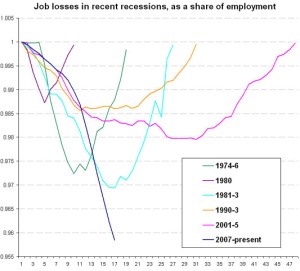 But, just because it’s marginally better, doesn’t mean the worst is over. All time series have variation and this may or may not signal the end of the worst of the worst monthly losses.
I’m still trying to figure out how people are finding glimmers of hope in this news given the historical perspective shown in this graph from the NY Times as presented by its blog Economix. This compares the current recession to previous recessions. As you can see, we’re still straight off the cliff at this point. Equally impressive is this graph from Market Watch which shows the monthly change in nonfarm payroll growth. It seems that the monthly changes may have bottomed, but it’s way too early to tell if there’s going to be any improvement. That’s when you have to examine some of the underlying factors in the market. Remember, variation in any series is to be expected so you’ll get ups and downs just from random variation. Those movements don’t necessarily indicate a trend. What do economists say about these numbers?
From Economix:
“The employment data do not yet corroborate the extent of the diminishment of the intensity of the recession suggested by other economic indicators (ISMs, consumer confidence, etc,). However, if we continue to see declines in the four-week average of jobless claims (which has fallen for four straight weeks), this may suggest smaller declines in employment later in the second quarter. Nonetheless, relating this report to the bank stress tests, the unemployment rate in April is already at the “alternative more adverse” average level assumed for the 2009…” — John Ryding, Conrad DeQuadros, RDQ Economics
“In April, more than one in four unemployed workers, 27.2 percent, had been without jobs for six months or longer, the highest rate on record since the government started calculating this statistic in 1948.” — National Employment Law Project
“The unemployment rate rose to 8.9 percent, but this is entirely due to a surge in the size of the labor force, as household employment is reported to have risen…
“[W]ith the smaller headline job loss number, many are interpreting the April employment report
as yet another sign that the economy is “stabilizing,” but the more accurate assessment is that the economy’s pace of contraction is slowing, which is not quite the same as stability and is still a long way from the economy actually improving.” – Richard F. Moody, chief economist, Forward Capital, LLC

Rightwing Canards 101
Posted: May 7, 2009 Filed under: just because, Voter Ignorance | Tags: Judge David Hamilton, Michale Tomasky, Obama judicial nominees, Right Wing Memes, seperation of church and state, the establishment clause, The Guardian 2 Comments In 2008, I decided to go from blog lurker, to thread poster, to front-pager. It has been one strange trip that has been both oddly satisfying and exasperating. I think I popped out of the womb with an opinion and a need to express it. If my first grade teacher Miss Pearl Jensen of Herbert Hoover elementary school could speak to this, she’d probably say, that child has too much to say and I just felt the need to “shake the toenails off her” all the time. She used to pick me up, shake me, and scream that at me. I assume she’d do that again if she met me today.
My mother was always being called to school about me because I was always saying something. In fourth grade, I refused to say the pledge of allegiance because I saw absolutely no use in it. I announced in fifth grade, after reading my social studies assignment on eastern religions, that I must be a Buddhist because it’s the first religion I’d read about that didn’t seem less real than ‘The Hobbit’. I’ve always been in trouble throughout my corporate work life for being ‘verbose’, ‘glib’, and ‘mouthy’. Thank goodness for academic freedom where I can now get away with it. So, I guess you shouldn’t be surprised that I would eventually find a home as a front pager some where.
Since front-paging really doesn’t come with instruction manuals, other than the usual, wow, we like the sound of how you write, knock yourself out here, I’ve had to learn by the hunt and peck method. I’ve learned which buttons attract what type of nasty comments. I usually avoid pushing those buttons because frankly, unless it’s really important, I hate doing troll duty. Some how, there’s just one button I keep pushing. It is the “I hate your source” so you must be a ______ button.
Look, I’m used to writing scholarly stuff and finance reports. I recognize that sometimes the people who drive you the craziest can some times come up with a good point and good data. Other times, the people you really want to support and put forward can come up with some stinkers. This is a blanket warning to every one who ever reads my stuff. People that you disagree with can frequently be quotable as more than just examples of wingnuts. On the other hand, some times people that you disagree with, and get quoted a lot can be very very very wrong and what they say will be printed over and over and over and over. The only thing I think is completely over the top is taking a comment out of context and creating a moonbat feeding frenzy with it.
With that statement and story, I present to you Michael Tomasky of the Guardian (last time I checked both reliably liberal and credible sources) and ” How they lie: a case study; Did an Obama judicial nominee really express a preference for Allah over Jesus? No, not by a long shot”. Tomasky basically chases down one of those right wing memes around the web, then exposes that meme as untrue by actually using (gasp) facts and showing the context. His gut told him with a title like that, it was undoubtedly one of those right wing smear jobs, but he didn’t just take it at gut or face value. He chased down the truth before he pounded out the story. In other words, he acted like a journalist who writes a blog rather than a blogger that acts out what he supposes is journalism.

 peej
peej Carissa
 bostonboomer
 dakinikat
 ecocatwoman
 mablue2
 Mama Lopez
 peggysue22
 quixote
 skydancingguestblogger
 Mona (aka Wonk the Vote)



 Sky Dancing
Recent Comments