
Women and the Great Recession
Posted: May 21, 2009 Filed under: Economic Develpment, Global Financial Crisis | Tags: Development Goals, Gender Equality, Macroeconomics and Gender equality 4 Comments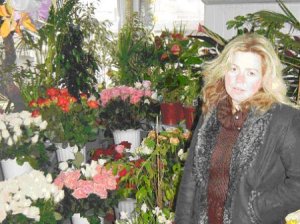
Nataliya is a single mother with two children. She runs a small business selling flowers in downtown Uzhgorod, Ukraine.
A colleague of mine sent me a link to the Levy Economics Institute of Bard College where they do a lot of research on Gender Equality and Economic Issues. The Institute’s Rania Antonopoulos has just released a very interesting study on The Current Economic and Financial Crisis:
A Gender Perspective. It is an interesting addition to a growing field that finds that “widespread economic recessions and protracted financial crises have been documented as setting back gender equality and other development goals”. Problems with development goals include food insecurity, poverty and increasing inequality.
I learned that women’s economic and social role in an economy is one of the primary indicators of when and if a country will every creep its way off the bottom of Human Development index when I began to study development economics way back in the late 70s and early 1980s. Development economics spends a lot of time on institutions these days. I do a lot of my research into the depth and effectiveness of financial institutions. There are also legal institutions (like lack of government corruption and presence of an effective justice system) that make an important difference too. But, overlying all of these institutional institutions is the society’s treatment of women. Women’s access to education, birth control, and economic-self determination are essential to a country’s overall development. This is especially true for developing nations but it holds true for industrialized ones as well.
Antonopoulos poses an interesting question for those of us interested in both eliminating poverty and achieving gender equality throughout the world. She asks “what macroeconomic conditions must prevail for gender-equality processes to take root?” and argues that women’s rights can only be achieved if economic development is “broadly shared”. I was particularly awed by her treatment of women in her study.
Hence, women in this analysis are not featured as passive recipients of gender-equality policies, but rather as full citizens participating at all levels of economic, political, and social life. As active members of the community, women have a stake in putting forward comprehensive, coherent, and consistent proposals instead of being content with a piecemeal agenda that targets the “poor” and “women.”
I like this definition of equality as ‘full participation’ in all aspects of a community although I would add that as stake holders women (and indeed GLBT and other minorities kept in an inequality gulag) not only should achieve full participation but also full rewards for that participation.
One of the most compelling arguments that she makes for Gender Awareness is that frequently women’s most important roles in the local economy are in nonpaying jobs. She argues that you really can’t take any policy into full account unless you study the impact on all of women’s contributions to the economy. That includes work that does not entail monetary compensation but is welfare-enhancing.
While the former (paid work) in the private and public sectors (under formal contracts or informal arrangement) is largely recognized, unpaid work, which includes unpaid family work contributions, subsistence production, collection of free goods from common lands and volunteer work, household maintenance, and unpaid care work for family members and communities, still remains hidden and, hence, outside policy consideration.
These contributions are still the dominant areas for women in traditional societies. It has been shown that women who
Mrs. Som Neang, age 53, is married and lives with her two children in Phnom Penh, Cambodia. She and her husband, Mr. Ban Boeun, 59, have a small business selling eggs and a variety of vegetables in a busy market.
understand health and nutrition issues as well as women who are educated and value education contribute a lot to an economy when they serve in these traditional capacities. Educated women contribute through their children who are healthier and go on to achieve better outcomes in life.
There is also impact, however, on women who work outside the homes and women are concentrated in jobs that tend to suffer greatly during bad economic times. Any time energy or food prices increase, development goals and gender equality goals suffer setbacks. Antonopolous forwards some broad areas where women tend to suffer most from any economic crisis.
“Among the emerging challenges of the current crisis, we now turn to the turbulence in the world of women’s work in four key areas: paid work (especially in textiles and agriculture); informal work; unpaid work; and fluctuations in remittances, including those from women migrant workers.”
Employment is always one of the slowest things to recovery from a macroeconomic downturn. The last set of recessions resulting from the Asian Financial crisis as well as other country-specific downturns showed that employment recovery has been even more slow than recovery from recessions earlier in the post world war 2 years. Current data is rich in information on how this impacts women’s equality goals.
Here are some of her more interesting findings.
The gendered nature of employment raises a variety of concerns surrounding vulnerability to economic shocks. The projections of the recent economic downturn forecast that the female unemployment rate will range from 6.5 to 7.4 percent, compared to 6.1 percent to 7.0 percent for men, in 2009. According to the ILO, the economic crisis is expected to increase the number of unemployed women by up to 22 million in 2009.
The concern is all the more grave due to the recent concentration in job growth for women in exports and tourism, sectors both marked by extreme procyclical fluctuations. As the gravitation of investment to export processing zones or special economic zones reinforces the movement of production down the wage scale, issues of household and community fragility come to the forefront. These have often been accompanied by privileged treatment of corporations in gaining access of land and water resources for commercial purposes (what has been described by some as land usurpation), resulting in ever-decreasing control over livelihoods. The reliance on remittances and the increased vulnerability of rural regions in the face of urbanization are key to understanding crisis response.
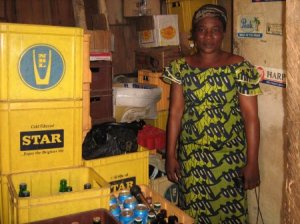
Bose Owolabi is 45 years old, married with 3 children. She comes from Mushin in Lagos State, Nigeria. Bose sells drinks.
We must also note that men and women have been found to respond differently to such shocks. Where women tend to sell and pawn productive small assets to smooth consumption, men hoard potentially valuable resources, as male goods have greater perceived value and clearer ownership (Antonopoulos and Floro 2005). As men become unemployed, women are found to expand their labor supply contributions not only in unpaid work, but also in paid work, even under conditions of extremely low remuneration. On the other hand, as men loose their ability to provide for their families, shame and despondence have devastating impacts on them, at times leading to suicide (as in the Asian crisis and the crisis of small land holdings in India), as well as destructive behavior that leads to severe decline in life expectancy (i.e., by ten years during the period of transition in the 1990s in Russia).
This is an extremely interesting study and I would suggest any one interested in gender equality, poverty reduction, and economics spend some time with it. It is very readable. I have also provided the link to the Levy Institute’s other studies. There are quite a few there and they are not highly technical so you might find them interesting reading too.
It is important to understand how this crisis could impact women differently because that impact will inevitably lead back to all of society. In most parts of the world, women still remain the primary nurturers of a country’s future citizens and this role should never be underestimated. If as Antonopolous argues, severe macroeconomic setbacks tend to hit women worse, then this of course, means that it will hit children also. We should work to ensure that cutbacks in programs that result from a recession don’t burden women and children unduly if we are truely interest in seeing gender bias disappear.
Shameless plug for KIVA.ORG (I’m Dakinikat@aol.com). The women whose pictures appear in this thread are women business owners from around the world to whom I have loaned money through microlending organization KIVA and a variety of NGOs. Microfinancing is one of the best ways to help women heads of households become independent business owners who achieve financial independence. HELP change lives!

Lidia works knitting traditional shawls for women and her husband works as a brick layer in Beni state. With both jobs the couple is able to support their family. Their house is located in the Villa Ingenio (Rió Seco) zone of El Alto city in Bolivia.


 peej
peej Carissa
 ecocatwoman
 mablue2
 peggysue22
 quixote
 skydancingguestblogger
 Mona (aka Wonk the Vote)



 Sky Dancing
I feel a need to comment but am not sure what to write. The study to which you allude offers conclusions that fall into the category of common knowledge, but has more published evidence as support. Intellectual response. The gut response is that men need to get over themselves and help with the work!
ea,
Not long ago, in a discussion with a fellow graduate student from Kenya, I suggested that the movement of women into the political realm in Rwanda was a sign of progress, with respect to getting their serious population problems under control. She said that she did not see this as progress because it was merely a case of men shifting even more work upon the backs of women. She said (something like), “The men made this mess. They should clean it up. They should not expect us to do their work for them.”
She set my mind alight. Liberation is not merely access, it is sharing the blessings and the burdens.
s
I also read in your colleague’s response a nod to historic gender roles. Depending on the point of view, in cultures in which tasks and responsibilities have been segregated based on sex, generations of females and males have engrained in them that they are supposed to do certain things and the other sex should do certain things. Any given task might not have anything to do with power or authority. Of course, this gets corrupted and more value is placed on some tasks and responsibilities than others.
ea,
Yes. In her community’s sense of the order of things, many roles are gendered.
My mother, via her father and mother of Swedish heritage, taught us (my father included) that there are no male tasks and female tasks, there are only tasks.
s