
Don’t Quit Your Job if you can Help It!
Posted: May 8, 2009 Filed under: U.S. Economy, Uncategorized | Tags: Job Losses, Job Market, Unemployment Rate Comments Off on Don’t Quit Your Job if you can Help It!April’s employment data was released today. We now stand at an 8.9% unemployment rate which represents a 26 year high. Every one appears to be spinning away the bright side of over 539,000 lost jobs with the refrain that at least it’s not as bad as it was in January. 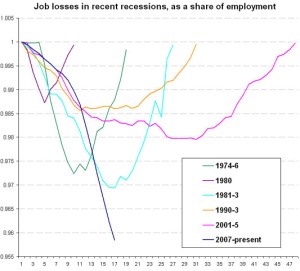 But, just because it’s marginally better, doesn’t mean the worst is over. All time series have variation and this may or may not signal the end of the worst of the worst monthly losses.
I’m still trying to figure out how people are finding glimmers of hope in this news given the historical perspective shown in this graph from the NY Times as presented by its blog Economix. This compares the current recession to previous recessions. As you can see, we’re still straight off the cliff at this point. Equally impressive is this graph from Market Watch which shows the monthly change in nonfarm payroll growth. It seems that the monthly changes may have bottomed, but it’s way too early to tell if there’s going to be any improvement. That’s when you have to examine some of the underlying factors in the market. Remember, variation in any series is to be expected so you’ll get ups and downs just from random variation. Those movements don’t necessarily indicate a trend. What do economists say about these numbers?
From Economix:
“The employment data do not yet corroborate the extent of the diminishment of the intensity of the recession suggested by other economic indicators (ISMs, consumer confidence, etc,). However, if we continue to see declines in the four-week average of jobless claims (which has fallen for four straight weeks), this may suggest smaller declines in employment later in the second quarter. Nonetheless, relating this report to the bank stress tests, the unemployment rate in April is already at the “alternative more adverse” average level assumed for the 2009…” — John Ryding, Conrad DeQuadros, RDQ Economics
“In April, more than one in four unemployed workers, 27.2 percent, had been without jobs for six months or longer, the highest rate on record since the government started calculating this statistic in 1948.” — National Employment Law Project
“The unemployment rate rose to 8.9 percent, but this is entirely due to a surge in the size of the labor force, as household employment is reported to have risen…
“[W]ith the smaller headline job loss number, many are interpreting the April employment report
as yet another sign that the economy is “stabilizing,” but the more accurate assessment is that the economy’s pace of contraction is slowing, which is not quite the same as stability and is still a long way from the economy actually improving.” – Richard F. Moody, chief economist, Forward Capital, LLC
“Soaring unemployment is depressing wage gains, up only 0.1% in Apr, putting the y/y rate down to 3.2%, a 40-month low. There’s much further to go here; seriously bad news because without wage gains people can’t deleverage unless they cut spending deeply.” – Ian Shepherdson, chief United States economist, High Frequency Economics
“With the exception of education and health care jobs, declines in the private service sector have been pervasive.” — Joshua Shapiro, chief United States economist, MFR Inc.
“[M]ost of what gains the labor market saw in April were due to the hiring of temporary workers in preparation for the 2010 Census, as government employment increased by 72,000 while the private sector shed 611,000 jobs.” — Economic Policy Institute
“[T]here were indications that industry’s headlong decline is bottoming out, as the manufacturing workweek rose for the first time since July 2008, and manufacturing overtime rose for the first time since November 2007.” — Nigel Gault, chief United States economist, IHS Global Insight
“[I]t still looks like the unemployment rate will move above 10% in coming months which will exacerbate the credit losses confronting the financial sector.” – David Greenlaw and Ted Wieseman, Morgan Stanley
“[T]he household measure of employment managed to rise for the first time in a year, up 140,000, and economists note that the household measure, although more volatile, can sometimes be better at picking up turning points in the economy. Even when the household measure of jobs is adjusted to be more like the payroll methodology (count each job a multiple job-holder has and exclude the self-employed), the data still showed a rise.” –Ian Morris, head of United States economics, HSBC
“Thanks to the economic stimulus program including innovative monetary policy, the economy could hit the bottom sometime around mid-year. The financial market has begun to stabilize and the credit flows throughout the economy are slowly improving.
“Economic contraction during the current quarter should moderate to around 3 percent compared to a decline of 6.1 percent during the first quarter.” — Sung Won Sohn, Smith School, California State University CI.
“Employment declines are gradually burning out. However, don’t be surprised to see job loss es near 500K over the next two months and a lagged rise in the unemployment rate beyond.” –Steven C. Wieting, analyst, Citi


 peej
peej Carissa
 bostonboomer
 dakinikat
 ecocatwoman
 mablue2
 Mama Lopez
 peggysue22
 quixote
 skydancingguestblogger
 Mona (aka Wonk the Vote)



 Sky Dancing
Recent Comments