
A Taxing Subject
Posted: April 17, 2009 Filed under: The Media SUCKS, U.S. Economy | Tags: taxes, Tea Party, US Taxes comparison 11 Comments
There was a table set out under a tree in front of the house, and the March Hare and the Hatter were having tea at it: a Dormouse was sitting between them, fast asleep, and the other two were using it as a cushion, resting their elbows on it, and the talking over its head. `Very uncomfortable for the Dormouse,’ thought Alice; `only, as it’s asleep, I suppose it doesn’t mind.’
The table was a large one, but the three were all crowded together at one corner of it: `No room! No room!’ they cried out when they saw Alice coming. `There’s PLENTY of room!’ said Alice indignantly, and she sat down in a large arm-chair at one end of the table.
`Have some wine,’ the March Hare said in an encouraging tone.
Alice looked all round the table, but there was nothing on it but tea. `I don’t see any wine,’ she remarked.
`There isn’t any,’ said the March Hare.
`Then it wasn’t very civil of you to offer it,’ said Alice angrily.
`It wasn’t very civil of you to sit down without being invited,’ said the March Hare.
`I didn’t know it was YOUR table,’ said Alice; `it’s laid for a great many more than three.’
`Your hair wants cutting,’ said the Hatter. He had been looking at Alice for some time with great curiosity, and this was his first speech.
`You should learn not to make personal remarks,’ Alice said with some severity; `it’s very rude.’
from Alice’s Adventures in Wonderland: A Mad Tea Party
by Lewis Carroll
I’ve taught Macroeconomics for a very long time. Tax policy of course is also part of the curriculum so I always get to spend at least a week on U.S. taxes. One of my favorite lectures is to disabuse people in the U.S. of the notion they are ‘over taxed’. You probably saw that I didn’t exactly get on the Tea Party band wagon. I’m not worried about my taxes. I am worried about the huge amount of deficit spending going on and I’m worried about the quality of government I get in return for my taxes . I’m more worried about loosing my constitutional right to privacy. I’m also worried about my tax dollars going to religious organizations and other spurious uses.
Several other economists used their blogs on Tax Day for the purpose of showing folks that the U.S. has extremely low taxes compared to the kinds of things we expect and get from the Government. I’d like to share some of that with you.
What a World …
Posted: April 16, 2009 Filed under: Uncategorized | Tags: Bush Administration and Torture, Obama administration and Torture, Torture 4 CommentsA year seems like such a short time for some many things to go upside down. Here it is. I’m just going to let this go where it may so you can see it. This is KO. ( Yes, I know, I can’t believe I’m posting him but listen to it.) This is KO saying he can’t believe POTUS basically punted on the torture thing. I have that same sick feeling I had when Ford pardoned Nixon and I was just a teenager back then. So, watch it and discuss, while I go grab a lot of booze to grok the idea of moral relativism in the 21st century as compared to the 20th century. Bottoms up my friends!
What are the Equity Markets Smoking?
Posted: April 13, 2009 Filed under: Bailout Blues, Equity Markets, U.S. Economy 2 CommentsI’m torn between relief at watching my 403(b) improve and wondering why the stock markets appear so oblivious to reality at the moment. Stock markets appear to be celebrating the loosened mark-to-market rules and only the Greater Ethos would know what else. (Perhaps Spring break and more Girls Gone Wild Videos in the offing?) During the 14 trading days prior to March 27th, the S&P 500 index jumped 21%. That would be akin to the steepest rally since 1938. At the same time, the corporate bond market saw 35 defaults. Moody’s stated that number of defaults has not been seen in single month since the Great Depression. The Economist (April 11, 2009), in the article Whistling in the Dark thinks Equity investors have been humming the Monty Python Classic.
As American companies begin the first-quarter earnings season, the news on that front is hardly encouraging either. Profits are forecast to be down by 37%, according to Bloomberg. That will be the seventh straight quarterly drop, the longest losing stretch since, yes, the Depression.
So what explains this dichotomy between share prices and fundamentals? Markets fell so far, so fast that they already reflected a lot of bad news. And prices rarely drop in a straight line. They often rebound as investors who have gone short (bet on falling prices) take profits. There were five rallies of 20% or more between 1930 and 1932, during the worst bear market in history.
 So, who is right? I’m going with the bond markets. They usually have the inside track on what is going on with the companies themselves because they are, well, bond holders. At least Equity Market Volatility is down and the markets appear ready to acknowledge bottom shortly. This is better than the recent series of financial and economic variables that look more like the trails of lemmings over precipices than randomly varying series. Still, the bond markets and most economists are somber because the real numbers still aren’t pointing to recovery despite what Bernanke and POTUS say recently about Green Shoots and Glimmers of Hope.
But David Rosenberg of Bank of America Merrill Lynch, one of the few Wall Street economists to predict the current recession, is sceptical. He points out that although the Institute of Supply Management’s index of American manufacturing has rebounded from 32.9 to 36, the latter figure is still the fourth worst in the last 27 years. Capital Economics, a consultancy, says its recovery index suggests the probability that the American recession has ended is less than 10%.
Other indicators also cast doubt on the idea of a sharp rebound. The Baltic Dry Index of freight rates is seen as a measure of global trade activity (although it is also affected by the supply of shipping). It bottomed in December, a staggering 94% below the May 2008 high. From that point, it more than trebled by early March, a sign of a rebound in activity. But it has since resumed falling and is down by around a third in the last four weeks. Nor is there any sign of a big pickup in commodity prices; the Dow Jones AIG index is above its recent low on March 2nd but is still less than half last July’s peak.
Every one has the right to live Happily Ever After …
Posted: April 12, 2009 Filed under: Human Rights | Tags: California, Gay Marriage, Gay rights, Proposition 8, Vermont 3 Comments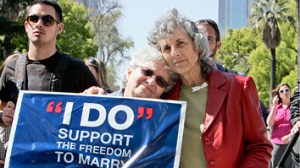 I’ve never been a big fan of marriage even though I sat in one for about 20 years. Don’t ask and I won’t tell. I’ve found it to be a major constraint. I found compromise is a virtue only to those who lack ambition and leave it at that.
However, I know I’m not the least bit in the main stream about a lot of things; mostly about any kind of religion. It takes a lot of commitment and intellectual compromise to support religions developed back before high level reading, writing, arithmetic, and science were invented. I even think that the term “DARK AGES” and “Age of Enlightenment” are pretty self-explanatory but then if there’s a god gene, it just doesn’t seem to run in my family and hasn’t for a long time.
Still, I’ve noticed a generational thing surrounding the marriage issue as well as old time religion. The older you are, the more you insist it’s one man, one woman, and it’s best for children. I just think it’s unnecessary unless you really want to give away your assets, time, and dreams to some body else who can drag you through court and take even more by the time you’re done. My kids have yet to get married and think it’s something best put off to when you’re nearly dead any way (say somewhere between 30 and 40). The kids and I think any one who wants to be able to do it should be able to get married. My parents were both pretty accepting of gay people, but their generation just can’t see gay marriage. In that way, my family appears to be pretty typical.
Living in a Black Swan World
Posted: April 8, 2009 Filed under: Bailout Blues | Tags: Black Swan, Nassim Nicholas Taleb 1 Comment I’ve been reading Nassim Nicholas Taleb’s Black Swan in between journal articles. Boston Boomer and I picked up on this book and honed in on the theory earlier this year. A Black Swan moment or event is large-impact, hard-to-predict, and rare. The event is unexpected because its outside “normal” expectations. Here’ some basic information from Wiki.
The theory was described by Nassim Nicholas Taleb in his 2007 book The Black Swan. Taleb regards many scientific discoveries as “black swans” — undirected and unpredicted. He gives the rise of the Internet, the personal computer, World War I, and the September 11, 2001 attacks as examples of Black Swan events.
The term Black Swan comes from the assumption that ‘All swans are white‘. In that context, a black swan was a metaphor for something that could not exist. The 17th Century discovery of black swans in Australia metamorphosed the term to connote that the perceived impossibility actually came to pass. Taleb notes that John Stuart Mill first used the Black Swan narrative to discuss falsification.

 peej
peej Carissa
 bostonboomer
 dakinikat
 ecocatwoman
 mablue2
 Mama Lopez
 peggysue22
 quixote
 skydancingguestblogger
 Mona (aka Wonk the Vote)



 Sky Dancing
Recent Comments