
What are the Equity Markets Smoking?
Posted: April 13, 2009 Filed under: Bailout Blues, Equity Markets, U.S. Economy 2 CommentsI’m torn between relief at watching my 403(b) improve and wondering why the stock markets appear so oblivious to reality at the moment. Stock markets appear to be celebrating the loosened mark-to-market rules and only the Greater Ethos would know what else. (Perhaps Spring break and more Girls Gone Wild Videos in the offing?) During the 14 trading days prior to March 27th, the S&P 500 index jumped 21%. That would be akin to the steepest rally since 1938. At the same time, the corporate bond market saw 35 defaults. Moody’s stated that number of defaults has not been seen in single month since the Great Depression. The Economist (April 11, 2009), in the article Whistling in the Dark thinks Equity investors have been humming the Monty Python Classic.
As American companies begin the first-quarter earnings season, the news on that front is hardly encouraging either. Profits are forecast to be down by 37%, according to Bloomberg. That will be the seventh straight quarterly drop, the longest losing stretch since, yes, the Depression.
So what explains this dichotomy between share prices and fundamentals? Markets fell so far, so fast that they already reflected a lot of bad news. And prices rarely drop in a straight line. They often rebound as investors who have gone short (bet on falling prices) take profits. There were five rallies of 20% or more between 1930 and 1932, during the worst bear market in history.
 So, who is right? I’m going with the bond markets. They usually have the inside track on what is going on with the companies themselves because they are, well, bond holders. At least Equity Market Volatility is down and the markets appear ready to acknowledge bottom shortly. This is better than the recent series of financial and economic variables that look more like the trails of lemmings over precipices than randomly varying series. Still, the bond markets and most economists are somber because the real numbers still aren’t pointing to recovery despite what Bernanke and POTUS say recently about Green Shoots and Glimmers of Hope.
But David Rosenberg of Bank of America Merrill Lynch, one of the few Wall Street economists to predict the current recession, is sceptical. He points out that although the Institute of Supply Management’s index of American manufacturing has rebounded from 32.9 to 36, the latter figure is still the fourth worst in the last 27 years. Capital Economics, a consultancy, says its recovery index suggests the probability that the American recession has ended is less than 10%.
Other indicators also cast doubt on the idea of a sharp rebound. The Baltic Dry Index of freight rates is seen as a measure of global trade activity (although it is also affected by the supply of shipping). It bottomed in December, a staggering 94% below the May 2008 high. From that point, it more than trebled by early March, a sign of a rebound in activity. But it has since resumed falling and is down by around a third in the last four weeks. Nor is there any sign of a big pickup in commodity prices; the Dow Jones AIG index is above its recent low on March 2nd but is still less than half last July’s peak.
This also worries me. We’re still creating zombie banks and the Tarp is down to its final $134 billion. This article in this weekend’s NY Times shows a big disconnect between the Obama Bailout plan and healthy banks.
The tension between the industry and the administration is rising as the government’s bailout fund is dwindling, putting the administration in a bind. It is all but certain to need to seek more money from Congress, which wants to see results from existing programs first.
The fund is down to its final $134 billion, according to Treasury officials, and is expected to face new requests for money in the coming weeks to aid tottering banks, the auto industry and possibly insurance companies.
…
The immediate concern for the administration is how to get the weaker banks to relieve their books of deteriorating mortgages and mortgage-backed securities.
Industry analysts estimate that United States banks alone have more than $1 trillion of such mortgages on their books but have recognized only a small share of the likely losses.
Economists at Goldman Sachs estimated recently that banks were valuing their mortgages at about 91 cents on the dollar, far more than investors are willing to pay for them.
This means that banks are still seeing loan losses of about 9 %. Compare that rate to the bond default rate which Moody’s is expecting will reach 14.6% by the fourth quarter and I think you’ll see that a lot of folks must be smoking those green shoots or inhaling something from those Glimmers of Hope bongs.
The good news is that a lot of executives in banks are running for smaller companies to avoid the restrictions that TARP recipients are now seeing placed on executive pay. Healthier banks are also exiting the program.
Facing a host of government restrictions — from how much they pay executives to how many foreign citizens they employ — some small banks have returned the bailout money, and some larger ones, including Goldman Sachs, Wells Fargo and Northern Trust, have said they want to do so as quickly as possible.
On Friday, Sun Bancorp of Vineland, N.J., became the sixth bank to exit the program, returning $89.3 million just three months after it received its loan.
Regulators are reluctant to approve the early repayments until banks can show that they have the capital to withstand further erosion in the economy and will not curtail their lending.
 Why is this good news? For one, it supports the idea of creative destruction. Another NY Times Article explains that the best and brightest are leaving the TARP-addicted. The brightest are leaving the failing institutions to go to smaller upstarts that will be in a position to respond to the current situation. Additionally, it will be a huge signal to the market about the well-managed banks. This was something that the Department of Treasury looked to avoid earlier because they wanted to prop up every one.
Top bankers have been leaving Goldman Sachs, Morgan Stanley, Citigroup and others in rising numbers to join banks that do not face tighter regulation, including foreign banks, or start-up companies eager to build themselves into tomorrow’s financial powerhouses. Others are leaving because of culture clashes at merging companies, like Bank of America and Merrill Lynch, and still others are simply retiring early.
This is certainly a concern for the banks losing top talent. But other financial experts believe it is the beginning of a broader and necessary reshaping of Wall Street, too long dominated by a handful of major players that helped to fuel the financial crisis. The country may be better off if the banking industry is less concentrated, they say.
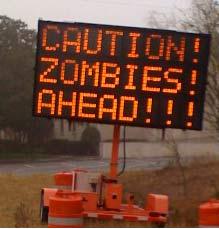
I’m hoping that market discipline will make it so costly to continue the Zombie creation that the Treasury will change strategies. As healthy firms refuse the TARP funds, the weaker ones will be exposed to the daylight. Daylight and Zombies generally are mortal enemies. This does mean, however, that the TARP funds will continue to flow to bad institutions and bad management. They may as well just put out a big ol’ sign that announces their zombie status.


 peej
peej Carissa
 ecocatwoman
 mablue2
 Mama Lopez
 peggysue22
 quixote
 skydancingguestblogger
 Mona (aka Wonk the Vote)



 Sky Dancing
I think it’s a combination of 7 trillion dollars in stimulus and guarantees being pumped into the markets along with this asinine assumption that 50% is the most the market needs to drop before the recovery can begin.
The rating agencies are still full of it. They gave ridiculously high ratings to credit default swaps and now they’re downgrading municipal bonds. Foreclosures are coming in commercial proprties now that credit lines are dried up.
I saw Paul Krugman on ABC Sunday saying that the US has about $6 trillion more in stimulus we can give before we have a problem which is only the case if the banks don’t all default which is still possible. Now we have big banks that want to give back TARP money so they can hand out huge bonuses and other banks who can’t give it back whose stock will plummet by comparison.
I saw someone tonight peg economic slowdowns to the price of oil. The more dependant countries like Germany are having an even worse drop than the US. If that were the case, we should be on the way back up with oil down to $50 a barrel. Except that we put ourselves another $3 trillion in debt and have 15 million under and unemployed Americans.
Rating agency reform is really necessary. I’m almost of the opinion it should be an SEC function but afraid to put politics into the process. It needs to be more independent and funded more broadly.