
Yes, it’s an AIG Thread. Discuss.
Posted: March 18, 2009 Filed under: Equity Markets, Global Financial Crisis, president teleprompter jesus, Team Obama, U.S. Economy | Tags: AIG bonuses, Geithner, Summers, timeline 3 CommentsThe peasantry appears ready to pick up the pitchforks and storm the castle over the AIG bonuses. So what sayeth the King’s men? What’s the word from our Regent’s best? Well, here’s the real bottom line according to the NY Times.
New York’s efforts against A.I.G. have overshadowed those of the Treasury secretary, Timothy F. Geithner, the official who is responsible for the financial bailout, along with the Federal Reserve. The White House and Treasury have been besieged by questions about why Mr. Geithner did not know sooner about the bonus payments due this month, and whether he could have done more to stop them, prompting White House officials to assert President Obama’s continued confidence in Mr. Geithner.
“He more than has the president’s complete confidence,” said Rahm Emanuel, the White House chief of staff. As angry as the president is at the news about A.I.G., which he learned Thursday, Mr. Emanuel said, “his main priority is getting the financial system stabilized, and he believes this is a big distraction in that effort.”
It appears the henchman let slip something important. It’s all a ‘big distraction’. POTUS is so angry he can tell a joke. Meanwhile, more and more comes out concerning ‘what the President knew and when he knew it.” I have to say one thing, we got the time line for this immediately after the request came at yesterday’s press conference. Gibb’s may not be the most eloquent of Press Secretaries but when he promises missing information, he does deliver.
CNN’s Wolf Blitzer and Ali Velshi are reporting that they reported on the bonuses back in January 28 so why the kerfuffle today? Also, who is going to be the Judas Goat for this one? FDL’s Jane Hamshear calls Dodd the ‘sin eater’ here and thinks the President is trying to protect Geithner. Jane puts together a time line that more aptly reflects the idea that the President had to hear about the bonuses way back when but didn’t really LISTEN until they became a problem.
Here’s Jane’s take on Dodd’s original provision (removed by Geithner and Summers) on executive pay.
Dodd’s version prohibited TARP recipients from paying out bonuses, retention awards or incentive compensation to the 25 most highly compensated employees. It also prohibited any employee of a company receiving TARP funds from making more than the President. Both provisions would have been in effect so long as a company was receiving TARP funds. Since AIG just paid out $1 million in bonuses to 73 employees, Dodd’s version limiting all employees to what the President made (roughly $500,000) would have substantially nipped that in the bud.
So, at this point we have to ask a question. Do we have a renegade Secretary of the Treasury in cahoots with the President’s personal Economics adviser or a President who probably knew what was going on and didn’t really care until the peasants made an issue of it? Now we have an issue with which congress critters of both parties can make hay. Geithner is going to testify before the House next week on March 24 and 26 according to the WSJ about the AIG bonuses. Meanwhile, AIG’s current CEO testified and plans to ask employees to return the bonuses. ( Pretty, Pretty please, give back at LEAST HALF).
AIG Chairman and Chief Executive Edward Liddy, appearing before a U.S. House subcommittee, said the company has asked employees at its financial-products division who received more than $100,000 to “step up” and return at least half the payments.
“We’ve heard the American people loudly and clearly these past few days,” Mr. Liddy said, claiming that some employees have already volunteered to give up their entire bonus.
He warned, however, that the request could backfire if the employees who received the retention bonuses decide to resign from the firm. “They will return it, but they will return it with their resignations,” Mr. Liddy said.
So after a good yammering, I mean hammering from congress, Liddy once again explains the role of the bonuses.
Mr. Liddy said that the “cold realities of competition” for customers and employees played a role in the firm’s decision to make the payments, which have spurred a public backlash given the roughly $170 billion the government has used to prop up the troubled insurer.
“Because of this, and because of certain legal obligations, AIG has recently made a set of compensation payments, some of which I find distasteful,” Mr. Liddy said.
Describing the financial-products division, Mr. Liddy called it an “internal hedge fund” that exposed the company to extreme market risk. The result, he said, was that “mistakes were made at AIG on a scale few could have ever imagined possible.”
“Those missteps have exacted a very high price, not only for AIG but for America’s taxpayers, the federal government’s finances and the economy as a whole,” said Mr. Liddy, who took over AIG as part of the government’s rescue of the firm in September.
It seems every one finds them distasteful. Even the president “coughed” and joked with “anger” after being properly motivated by his teleprompter. So once again, congress critters will draft legislation to control executive compensation at companies receiving TARP money. Barney (the congressman, not the dinosaur) wants the President as ‘de facto CEO’ of AIG to institute a lawsuit to get the funds back. But wait, they did do that during drafting of the stimulus package. Dodd edited it. Summers and Geithner removed it. What next?
Meanwhile, over at the FED they continue to try break up AIG into pieces. They also appear to be more the source of Wall Street attention that both the hearings and today’s Presidential work-avoidance trip to California. The market rallied on news of the latest from the FOMC. They’re letting loose the printing presses to ease credit. So evidently, while the peasantry revolt, the congressmen act revolting, and the President flies to give another speech and appear on Leno, the bankers are at play.
Let’s just grab some popcorn and discuss.
Happy St. Paddy’s Day
Posted: March 17, 2009 Filed under: Festivities | Tags: St. Patrick's Day Greetings 4 Comments The first time I saw Ireland was when I was a kid. Mostly I remember that it was the greenest shade of green that I’d ever seen. Ireland is one of the most beautiful countries that I have ever visited. It’s easy to see why there are plenty of stories about enchanted things because there are parts of that country that hardly seem possible without some kind of magic. This picture of the Giant’s Causeway should be proof enough.
My grandmother’s and my mother’s name was Atha and they were from the Dennis side of my family. When I had colic, my grandmother would sing me Toorah Loorah loorah and rock me in the rocker that sits in my living room. I got the green in my eyes, the red in my hair, and the ‘Irish’ in my temper from her. I also heard my share of old Irish wives’ tales like “things come in threes.” Both my grandmother and my mother were terribly superstitious and it was hard to do anything as a kid without hearing something terrible that happened to a neighbor or a cousin or an aunt that had been foolish enough to do the same thing.
Grandmother used to love to cook and Colcannon was one of my favorites.
Colcannon Ingredients:
- 3 cups finely shredded green cabbage
- 1 onion, finely chopped
- 1/4 cup water
- 6 cooked potatoes, mashed
- 1/4 cup milk
- 1/4 cup butter or margarine
- Salt and freshly ground pepper to taste
Preparation:
Place cabbage, onion, and water in a saucepan or Dutch oven and quickly bring to a boil. Reduce heat, cover, and simmer about 8 minutes until tender. Do not overcook.
Add mashed potatoes, milk, butter or margarine, salt, and pepper. Mix well, stirring often until heated through.
Colcannon is served warm as a side dish. I like it served with breaded pork chops baked with apples. That’s another Irish dish. If you really want a nice treat try it with some warm soda bread and a little clotted cream
There’s a lot of great things that have their roots in Ireland including a large number of Americans like me. I love to read some of the great Irish poets and writers and my favorite local bar is Vaughn’s. I like it because it has that ramshackle looked of an Irish pub known for great brews and conversations. (Jack Kerouac used to jump off at the tracks by my house and share a few drinks with William S. Burroughs there so while it’s now known for New Orleans Jazz, it did have a bit of a literature tradition too.) Here’s a treat from James Joyce’s Dubliners:
They walked along Nassau Street and then turned into Kildare Street. Not far from the porch of the club a harpist stood in the roadway, playing to a little ring of listeners. He plucked at the wires heedlessly, glancing quickly from time to time at the face of each new-comer and from time to time, wearily also, at the sky. His harp,m too, heedless that her coverings had fallen about her knees, seemed weary alike of the eyes of strangers and of her master’s hands. One played in the base the melody of Silent, O Moyle, while the other hand careered in the treble after each group of notes. The notes of the air sounded deep and full.
The two young men walked up the street without speaking, the mournful music following them. When they reached Stephen’s Green they crossed the road. Here the noise of trams, the lights and the crowd released them from their silence.
So, I raise a pint to you my friends and tell you to think kindly of the Irish today and be thankful for all the blessings that life has brought to you.
Just Say No to Zombie Banks!
Posted: March 16, 2009 Filed under: Uncategorized | Tags: bad bank, ben bernanke managing market expectations, financial regulation, good bank, zombie banks 6 Comments The market seems to have stabilized for awhile as Ben Bernanke has been giving speeches and making appearances every where he can. For those of you that really want to take on empirical studies in Economics (econometrics and all), this is a part of a strategy he outlined in Monetary Policy Alternatives at the Zero Bound: An Empirical Assessment. (Bernanke and Reinhardt 2001). It’s 113 pages long so be prepared to spend some time with it like I did last year. However, my guess is you can read the front parts and the back parts and skip the methodology and findings and be just as happy. It is basically the Chairman’s take on the Japanese Lost Decade and monetary policy at the time. It talks about quantitative easing which is the new approach that even the Bank of England is using now. That is when the Central Bank uses its balance sheet to buy and sale various financial assets to try to unclog lending channels. Since this is the first time the acting Chairman of the Federal Reserve Bank has ever appeared on any major news channel to have a fire side chat as in last night’s appearance on Sixty Minutes, I thought I’d point you to the motive behind the method. It’s outlined in that academic paper. Bernanke and Reinhard argue that Federal Open Market Committee (FOMC) announcements of policy and other announcements by the Fed shape market expectations and results. (Yes, I know El Presidente told us we shouldn’t care about the DJ but the FED chair still does because he knows IT MATTERS.)
Has the Federal Reserve’s policymaking body, the Federal Open Market Committee, historically exerted any influence on investors’ expectations about the future course of policy? Although members of the FOMC communicate to the public through a variety of channels, including speeches and Congressional testimonies, official communications from the Committee as an official body (ex cathedra, one might say) are confined principally to the statements that the FOMC releases with its policy decisions.
…
The FOMC has moved significantly in the direction of greater transparency over the past decade. Before 1994, no policy statements or description of the target for the federal funds rate were released after FOMC meetings. Instead, except when changes in the federal funds rate coincided with changes in the discount rate (which were announced by a press release of the Federal Reserve Board), the Committee only signaled its policy decisions to the financial markets indirectly through the Desk’s open market operations, typically on the day following the policy decision. In February 1994, the FOMC began
to release statements to note changes in its target for the federal funds rate but continued to remain silent following meetings with no policy changes. Since May 1999, however, the Committee has released a statement after every policy meeting.
The FOMC statements have evolved considerably. In their most recent form, they provide a brief description of the current state of the economy and, in some cases, some hints about the near-term outlook for policy. They also contain a formulaic description of the so-called “balance of risks” with respect to the outlook for output growth and inflation. A consecutive reading of the statements reveals continual tinkering by the Committee to improve its communications. For example, the balance-of-risks portion of the statement replaced an earlier formulation, the so-called “policy tilt”, which characterized the likely future direction of the federal funds rate. Much like the “tilt”statement, the balance of risks statement hints about the likely evolution of policy, but it does so more indirectly by focusing on the Committee’s assessment of the potential risks to its dual objectives rather than on the policy rate. The relative weights of “forward looking”and “backward-looking” characterizations of the data and of policy have also changed over time, with the Committee taking a relatively more forward-looking stance in 2003 and 2004.
Of course, investors read the statements carefully to try to divine the Committee’s views on the economy and its policy inclinations. Investors’ careful attention to the statements is prima facie evidence that what the Committee says, as well as what it does,matters for asset pricing.
I’ve highlighted that last paragraph because it is extremely important in explaining both the Chairman’s sudden interest in TV appearances and the market’s relief rally recently. Bernanke has been out there saying that the Fed will not let major banks fail, he dislikes then entire AIG thing and wants to ensure it never happens again, he’s been asking the senate committees he visits for more regulation, and he’s repeatedly said that the FED expects the recession to experience the trough later this year. We’ve not seen any meaningful discussion about the type of recovery to expect (L shaped or otherwise). We have however, seen more upbeat statements geared to appease the markets and their role in asset pricing.
March 10, 1959
Posted: March 15, 2009 Filed under: Human Rights | Tags: 50th anniverasry of Tibetan Uprising, His Holiness the Dali Lama, Tibet Comments Off on March 10, 1959 March 10, 1959 was the day that native Tibetans protested the Chinese Invasion and occupation of Tibet. By March 20, the Tibetan Capital was mostly destroyed. It was estimated that 800 shells were used to destroy Tibet’s three major monasteries. Chinese soldiers rounded up the remaining monks and nuns. They executed many. China’s response to the protest was a mass genocide of Tibetans. This genocide continues today.
By the time of the 1964 census, 300,000 Tibetans had gone “missing” in the previous five years, either secretly imprisoned, killed, or in exile.
In the days after the 1959 Uprising, the Chinese government revoked most aspects of Tibet’s autonomy, and initiated resettlement and land distribution across the country. The Dalai Lama has remained in exile ever since.
China’s central government, in a bid to dilute the Tibetan population and provide jobs for Han Chinese, initiated a “Western China Development Program” in 1978.
As many as 300,000 Han now live in Tibet, 2/3 of them in the capital city. The Tibetan population of Lhasa, in contrast, is only 100,000.
Ethnic Chinese hold the vast majority of government posts.
His Holiness, the 14th Dali Lama and a small entourage made a difficult journey across the Himalyas to seek refuge in India. They are still in exhile. Tibetan Monks, Nuns, and loyalists are still imprisoned, tortured, and murdered. The aftermath of the invasion is documented by Wikipedia.
According to the Tibetan Government in Exile and captured Chinese documents an estimated 86,000 Tibetans died in the events surrounding the 1959 uprising. The Norbulingka was struck with an estimated 800 shells, killing an unknown number of Tibetans within and camped around the palace. Lhasa’s three major monasteries- Sera, Ganden, and Drepung– were seriously damaged by shelling, with Sera and Drepung being damaged nearly beyond repair. Members of the Dalai Lama’s bodyguard remaining in Lhasa were disarmed and publicly executed, along with Tibetans found to be harboring weapons in their homes. Thousands of Tibetan monks were executed or arrested, and monasteries and temples around the
city were looted or destroyed.
In April 1959, the 19 year old 10th Panchen Lama, the second ranking spiritual leader in Tibet, residing in Shigatse, called on Tibetans to support the Chinese government. However, after a tour through Tibet, in May 1962, he met Zhou Enlai to discuss a petition he had begun writing at the end of 1961, criticizing the situation in Tibet. The petition was a 70,000 character document that dealt with the brutal suppression of the Tibetan people during and after the Chinese invasion of Tibet. In this document, he criticized the suppression that the Chinese authorities had orchestrated in retaliation for the 1959 Tibetan uprising. But in October 1962, the PRC authorities dealing with the population criticized the petition. Chairman Mao called the petition “… a poisoned arrow shot at the Party by reactionary feudal overlords.” In 1967 he was formally arrested and imprisoned. He was released in 1977 and died suddenly after a mysterious illness in 1989.
I would like to ask for you to visit the Tibetan Government in Exile’s website and to consider helping Tibetan refugees and any other efforts that might interest you.
The Economist Pans POTUS
Posted: March 14, 2009 Filed under: Global Financial Crisis, president teleprompter jesus | Tags: European criticism of US policy, G20 summit, m Obamabears, Obama Education, Obama Science, The Economist Comments Off on The Economist Pans POTUS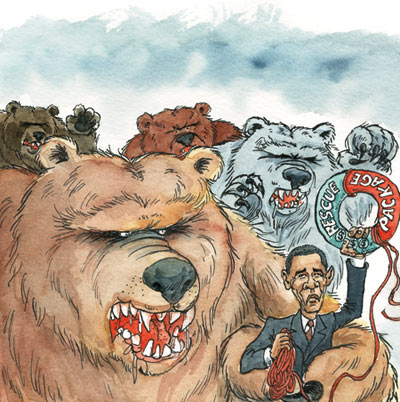 The Economist endorsed Obama for POTUS in last year’s presidential campaign. I’m going to say that up front because reading my print edition (slightly soggy from today’s rain) would have lead me to another conclusion. Each article in this week’s (March 14, 2009) United States section took a jab at something POTUS either said or did. Either the Brits are really mad at the Gordan snub last month, the koolaid has worn off overseas, or they’ve finally seen into the empty suit. All I can say is here are the links, read for yourself.
Article one was “Pursued by Obamabears“. This was an analysis subtitled “Investors fret that Obama’s crisis response is not up to task.” It also had this nifty graphic. You can read the entire thing and we’ve discussed the bear market that just recently experienced a brief relief rally. This point was the money maker for me.
Whatever the cause, the strain on the Treasury is encouraging the view that Mr Obama’s agenda is being driven by political advisers and Congressmen, both more attuned to voters’ rage than to market confidence. Chris Dodd, who faces a battle to retain his Connecticut Senate seat in 2010, inserted tough new restrictions on bankers’ pay into the fiscal stimulus package despite the administration’s objections. Since then, a series of mostly small banks have said they will return bail-out money, frustrating the plan to increase the banking system’s capital and lending capacity.
There was also an interesting quote from a former aide to Bill Clinton who was quoted as having ‘two equally depressing” hypotheses on why team Obama appears to be not ready for prime time. I also liked it. The comparisons to Carter have started already.
“Either they do not know what to do, or they do not believe they can muster the political support to do what they know needs to be done.” He advised Mr Obama to focus his attention on the crisis, or risk the loss of confidence Jimmy Carter suffered three decades ago. That would bring Obamabears out in droves.

 peej
peej Carissa
 bostonboomer
 dakinikat
 ecocatwoman
 mablue2
 Mama Lopez
 peggysue22
 quixote
 skydancingguestblogger
 Mona (aka Wonk the Vote)



 Sky Dancing
Recent Comments