
Systematic Banking Crises: Learning from the Past
Posted: February 15, 2009 Filed under: Global Financial Crisis, U.S. Economy 3 Comments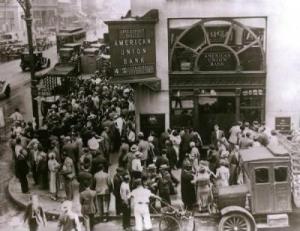 I’ve had some more questions recently about the banking situation so I’m going to try cover some of it here. People are worried that the TARP and bailout plans really won’t work and will cost a lot of money.
I covered some of this in October when the IMF came out with a working paper by Laeven and Valencia (2008 ) that looked at systemic banking crises and policy responses to them from the period 1970-2007. This was at the time the TARP was pretty new and the financial crisis was not at the center of many people’s lives.
This study is 80 pages and it uses lots of multiple regression analysis between country characteristics, banking system characteristics, and emergency measures taken by policy makers to solve these kinds of crises so be prepared to enter my world if you want to read it. It’s not as bad as it could be, but be prepared. It is beyond wonky. It’s your basic research by economists meant at shaping policy worldwide.
They even separate the ’emergency measures’ from the long-run challenge of crisis resolution. The goal in the long run is to get the credit system and legal system back to functionality as well as rebuilding balance sheets of both banks and borrowers. The short run emergency measures tend to be more focused on containing the crisis itself and stopping the contagion. That means there are two phases to the response.
The first phase, crisis resolution typically involves coordinating problems that exist between debtors and creditors and frequently resembles a bankruptcy process. A lot of this has to do with loans going bad. Two banks, for example, went into receivership this weekend. There have been a total of 13 for this year already. The FDIC and the Federal Reserve bank have procedures to handle this and are currently working on what to do for bondholders and equity owners of the bank while making sure the depositors know their deposits are safe. Restructuring will happen over the weekend so the banks can resume some kind of business over the weekend. A lot of times hasty marriages or mergers of convenience have previously been arranged with more healthy banks.
This is the typical process that goes on day in and day out. As some one who has been an active part of the Fed’s monitoring process, I can tell you, that some one looks at all banks balance sheets every day. Also, annually, Fed auditors will examine banks as well as state auditors, board of director’s auditors and even the FDIC. This process only works when there is not a systematic problem though. While the Fed usually sees a handful of these a year, 13 in about the first six weeks of the year, suggests a systemic problem.
Financial Crises, especially those that turn out to be contagious, will rapidly spread to many parts of the economy even when we don’t necessarily see vulnerabilities in banks themselves. Things that cause these kinds of problems include unsustainable macroeconomic policies (interest rates that are too low, huge government fiscal outlays, huge current account deficits, or unsustainable public debt). Emerging market countries and developing countries tend to be more vulnerable to these types of crises because they do not have very deep and wide financial institutions and frequently their laws and policy response mechanisms are quite poor. There are also some other things that can cause these types of crises like currency and maturity mismatches that tend to happen in countries with questionable currencies and exchange rate policies. Once the crisis occurs, the government must coordinate a response. The paper I’ve referenced above looks for ‘best practices’ or responses that have worked during recent crises and this includes both the emergency response as well as long-term policy changes.
So, let’s talk first about the types of responses that can be employed by Governments that face a financial crisis. Basically, the major response has to reallocate wealth towards bank and debtors and away from taxpayers. Yes, that’s what I said, it’s a reallocation of wealth. You can see right now that that sets up a very unpleasant trade-off choice. While this reallocation usually leads to a restart of ‘productive investment’ it has HUGE costs. First, taxpayer’s wealth is spent on helping banks and bankers. It is basically to help them out of what was a set of really bad decisions resulting from misallocation of capital. The economy experienced distorted incentives, the money followed it, and everything hit the fan. In our case, right here, right now, too much capital flowed into the housing market. The Fed enabled a bubble by providing extremely low interest rates. Banks, Freddie and Fannie loosened underwriting standards and came up with weird loans. They lent to every thing and every one thinking they could pass the trash on with securitization. Once demand for houses and real estate starting going up from the availability of weird loans that were backed by even weirder risk management arrangements (think swaps), all of which were poorly regulated and given very little oversight, boom! In economics and finance, we call these distortions. Distortions or bubbles don’t last because capital usually will disappear then head off in another direction. In this and many cases government actually encourages banks and firms to do stupid things through subsidies, government protections, and poor regulation. All of these things were present in the housing bubble.
If, in the case of many emerging market countries and developing countries, you have institutional weaknesses (i.e. poor legal system, currency issues, bad central banks, corruption), these can exacerbate the problem. Fortunately, for the US, we really don’t have weak institutions. But, we had huge investment distortions brought on by low interest rates, unregulated derivative markets, and lending gone wild.
So, what does history teach us? What does the current research say about policy response?
If you review much of the existing research based on looking at actual data, we find that measures like explicit guarantee of banks’ liabilities, forbearance of regulations like capital floors or other regulatory measures or pumping liquidity into their balance sheets are extremely costly. Other researchers that have studied prior crises (including the Asian Financial Crisis which has gone from something only financial economists used to talk about to a cocktail topic) have found that these particular policies DO NOT SPEED UP economic recovery. That’s right, this is what we’ve been doing with the last two adventures on the TARP and all the evidence says it costs a lot of money and really does nothing to make it go away quickly.
So let me overwhelm you with some of the basics in this study. The authors of this study identified 124 ‘systematic banking crises’ that occurred from 1970 – 2007. You can see, this is not really an unusual circumstance, which makes this all the more puzzling to me why the folks in Washington DC don’t get it. I lived through the one in the 1980s concentrated in the S&L industry. My ex-husband dealt with the one occurring in the Federal Land Banks when farms experienced problems shortly thereafter. We also have a much larger lesson in the Great Depression. So what happens when a country goes into a financial crisis? Well, we basically see the following things: an increase in loans not being paid back –banks call them nonperforming loans, banks don’t lend as much money out trying to cover the loan losses, and we start seeing stress on the country’s real economy as measured by real GDP growth. That means it turns into a recession at minimum. In some cases this turns into a twin crisis and not only impacts the country’s domestic financial system but spreads to its currency. As it heats up, it can then become a triple threat which hits at the country’s ability to service its debt and current account. A country’s debt is the amount its government spends above its tax revenues which is frequently financed by other countries and foreign investors (including sovereign wealth funds). The current account is what tracks trade and currency flows with other countries. If it’s in deficit, that means it imports a lot of stuff and has to pay for it with its currency so other countries and individuals have tons of its money.
One of the most interesting things about the IMF study is that it finds that the initial conditions in the country are important in terms of the flexibility and depth of response required by policy makers in the containment phase of the crisis. If the economy is weak, then policy makers have less of a buffer to cushion the impact of the crisis. If you think of the US, we had a huge build up of debt due to the Iraq and Afghan wars, our interest rates have already been incredibly low and we’ve had a jobless, lackluster recovery since our last recession. Also, we’ve had huge, useless tax cuts that really haven’t done much but exacerbated existing problems. This means we have fewer choices on containment and resolution policies. Also, this creates an even bigger set of problems if the market gets heebie jeebies. Because we’re already weak, market panic can cause us to go down hill quickly. This has happened also. We’re seeing deep declines in industrial production, wholesale inventories, and the housing market unlike anything we’ve seen in decades.
So, again, ’emergency liquidity support’ and ‘blanket guarantees’ are two typically used containment strategies. In this study, the authors find that liquidity support was used in 71 percent of the crises. Blanket guarantees in 29 percent. Both of these strategies were used in the fall. Remember, the Treasury did not buy the toxic assets, they used convertible warrants to inject liquidity into banks, and almost immediately we saw increased FDIC guarantees of deposits. There is also talk of guaranteeing some of the bad loans –especially those that ran through the now bankrupt Freddie and Fannie. In some of the emerging market and developing countries you see other things also. These include deposit freezes (think bank holiday). We did not get to that point because our folks know that historically, these things are very disruptive and tend to create more panic. So, the authors found that these extended guarantees tend to average about 53 months. Liquidity, injected into the system, tends to be a huge deal. Peak liquidity injections average about 28% of TOTAL DEPOSITS. I just pulled this off the FRB atlanta stat site. As of Jan 1, 2009 there was about $7338.6 billion dollars in deposits so 1/3 of that amount would amount to the average peak liquidity injection if it were required this month. Yeah, you need to pull your jaws up off the ground now.
So, let’s move to crisis resolution and what works. Stay with me, I know it’s long, but I’m getting there.
Regulatory Forbearance: This policy objective aims at gradually recovering the banking system. Usually, it entails a gradual transition towards STRICTER lending standards or as bankers refer to it “prudential requirements” . Commonly, banks are allowed to temporarily decrease their capital requirements or given time periods to comply with stricter lending and loan classifications. (This could include getting rid of subprime mortgage classifications or getting rid of loans that require no down payment or something like that depend on which politician has their say when it is dealt with in the banking committees.) Forbearance has been shown to be ineffective in terms of actually solving the problems even though its usually a key component of any policy. In the study, 86% of cases saw ‘large-scale government intervention in banks’. This included things like bank closures, nationalizations or assisted mergers. In this situation the outcomes are varied, in a lot of cases shareholders lose money and are forced to inject new capital into banks. Not only have banks seen this problem, but also non-bank financial institutions like finance companies and insurance companies. In 51% of the cases, banks were actually sold to foreign interests. (Remember, however, this sample includes a lot of third world countries.)
Special Bank Restructuring Agencies: These are set up to restructure distressed banks and were used in 48% of the crises. Asset management companies were used in 60% of the crises to deal specifically with the distressed assets (toxic assets). The authors of the IMF study found that the use of AMCs is positively correlated with peak non-performing loans and fiscal costs. There correlation statistics showed that there was a degree of ineffectiveness of AMCs. Other studies have found this also.
Recapitalization of Banks: In 32 of 42 selected crisis episodes, banks were recapitalized by the government. Again, the TARP funds were used for this purpose in the fall, rather than set up an AMC. We’re using convertible warrants but many of the crises studied used other things including cash. Recapitalization often entails writing off losses against shareholder’s equity and injecting some form of capital in different tiers or tranches. Recapitalization usually comes with strings. In Chile, they’ve used a nonperforming loans purchase programs and blocked banks from distributing dividends. They also forced banks to use profits to repurchase the loans. Mexico made banks deposit any funds from their capitalization program and their deposit insurance fund into the central bank. Mexico banks were given bonds that they could redeem once their capital adequacy rations went about 9 percent. There were several other tranches that involved convertible debt that had other conditions. There is more evidence in the paper from Turkey and Thailand. These things all resemble our current TARP.
But get this, the authors found that “on average the net recapitalization cost to the government (after deducting recovery proceeds from sales of assets amounted to 6% across crisis countries in the sample.” So, again, get your calculators out, our current GDP is
Current-dollar GDP — the market value of the nation’s output of goods and services — decreased
4.1 percent, or $148.2 billion, in the fourth quarter to a level of $14,264.6 billion. In the third quarter,
current-dollar GDP increased 3.4 percent, or $118.3 billion.
Indonesia came in with the highest costs at 37.3% of their GDP. They did find that recapitalization tends to be associated with lower GDP losses. So this study finds that ‘by replenishing banks’ capital, the supply of credit returns to normal sooner and the output losses become smaller.”
So, the IMF study does find that some ‘resolution measures’ work better than others. First, they suggest that speed of response is important. They also find that there are certain provisions in bank recapitalization programs that work better than others.
1. The program is ‘selective’ in its financial assistance to banks.
2. It specifies clear quantifiable rules that limit access to preferred stock assistance
The authors argue that Government owned asset management programs are largely ineffective because of both political and legal constraints.
Another point the authors make is that any adverse impact of the ‘stress on the real economy’ should be contained. This means things like typical monetary policy steps or fiscal policy steps. We’re terribly constrained in steps we can take with monetary policy because the interest rates are already low. The Fed is using its balance sheet (called quantitative easing as used by Japan earlier) to do what it can. This is why in this circumstance we need fiscal stimulus.
 One of the things that the authors of this study mention is the one thing that the TARP has been woefully short on. This is trying to reverse the adverse impact of the crisis on corporations and households and a targeted debt relief program and mechanism. We really haven’t seen widespread restructuring programs–especially for the poor and for small businesses– and that is perhaps why the Geithner plan announcement crashed the market last week. These programs require public funds, need to be targeted, and there must be adequate safeguards.
Currently, the debate has become how to inject the capital into the banks. Should we continue to use convertible warrants or should we do something more controversial and nationalize maybe the 14 biggest banks? To date, he majority of state investments in banks has been preferred stock rather than common shares. Convertible warrants have been attached in that if the common stocks become better deals than the preferred stock (which is safer and has bigger claims during bankruptcy proceedings), then you convert to common stock and sell on the market. We call this hybrid capital. The reason it is important at the moment is because of international banking law (called the Basel accords). Classification of capital is put into one of two tiers. Tier-one capital is common equity. This can suffer losses but still not default. It also does not require dividends and does not need to be repaid. Banks can also hold some preferred stock that sits between common and debt. Debt is like bonds or loans and requires repayment with interest. Hybrid capital suffers loses only after common equity is gone. Since we’ve been supplying hybrid capital (tier 1) this has led to some weird circumstances.
Preferred stock has benefits. It does offer the government (and its taxpayers) a bit more security. The other thing it does is reassure the banks counterparties (like bondholders or lenders) that there is some buffer between them and losses. It is not the same thing as common equity, however. It tends to raise share-price volatility because it makes common stock holders nervous. (Their earnings become diluted and their risk goes up.) This makes banks uneasy. They don’t want to lend when their stock is noisy. Believe me, bank stock has been VERY noisy recently.
The UK has recently swapped some of its preferred shares in banks that its propped up in to pure common stock to try to get the banks to lend by quieting down their stock prices. But, for all intents and purposes, ownership of commonstock is technically nationalization. Just to give you an idea, if we were to convert our $45 billion of ownership of preferred stock that we now have in Citigroup, we would have 70% of the voting capital. Voting rights is one benefit that comes with common stock ownership. (Voting rights also gives us the right to throw out the board of directors and the CEOs).
So, Germany has come up with another solution. It has issued a hybrid that bears losses along with common stock, but it gets a fixed coupon (a fixed face value with an given interest payment). This means that any losses that occur in Commerzbank (the German bank that was first to receive this type of capital injection) are recovered to the taxpayer BEFORE the common stock holder. It has also attached some strings. The first one is that all losses must be recovered before paying any dividends. This avoids nationalization but creates a higher quality capital. It should stabilize the shaky common stock price also. What remains to be studied is taxpayer support of this type of deal.
So, I hope this gives you some back ground and also shows you that there is a middle path between strict nationalization and just endless shoveling of cash to zombie banks. I know this has been about three times longer than most of my posts and threads but I really wanted to clear up questions. Hope it did!


 peej
peej Carissa
 dakinikat
 ecocatwoman
 mablue2
 Mama Lopez
 peggysue22
 quixote
 skydancingguestblogger
 Mona (aka Wonk the Vote)



 Sky Dancing
I have what might be an unrelated question. I’ve heard Steve Forbes (among others) mention changing the “mark to market” rule. I think the idea is to more accurately value assets so that the banks have a place to start from. Would this have a positive effect or any affect?
this would have a huge positive impact on the market and would help unstick the credit market to a certain degree. one of the problems we have is that there is no bottom price or accurate asset pricing going on right now so things are just lurking around a level then crashing lower on bad news or feelings, this would force the banks to reassess their assets to what they think they are essential worth, not what this dysfunctional market thinks they are worth now.
If this is the case, I can only think of 2 reasons why it wouldn’t be done. Either the administration wants to fan a crisis or the banks want to roll the dice and hope for a day when their assets will be worth enough to sell them off at one time.