
Dismal Science, Dismal Economy, Dismal Policy
Posted: February 11, 2009 Filed under: Global Financial Crisis, president teleprompter jesus, U.S. Economy, Uncategorized Comments Off on Dismal Science, Dismal Economy, Dismal Policy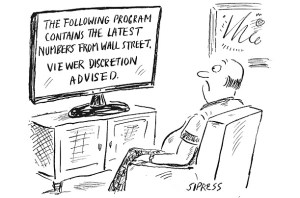 I’ve been closely following blogs of other economists this week since we’ve had so many major things come down the pipe having to do with the dismal science and the even more dismal economy. I thought I’d just highlight what’s out there at the moment. I promise, I’ll avoid all the folks that felt it necessary to blog the banker’s testimony live.
Brad DeLong of U.C. Berkely noted something of interest concerning the new TARP money. It’s not economics, but it’s juicy. I just love reading Grasping Reality with Both Hands. It has that wonky snark I find inspiring. These are his first two points from a thread entitled Brief Notes.
- Called the Geithner Plan, not the Obama Plan–distancing of the president from the proposal.
- Reinforced by Axelrod leaks to Labaton and Andrews painting Geithner as the Wall Street loving holdover–and this the person to take the blame if things go south.
I think this mean’s move over, Geithner’s joining us under the bus. After yesterday’s reports of senators and staff laughing at its presentation and the market dive, how long will the Secretary of Tax Evasion last? I’m taking bets, if any one is interested.
Economist’s view, the blog of Mark Thomas of the University of Oregon, is still talking about multipliers (nice easy explanation out there) and the primacy of fiscal spending over tax cuts under these circumstances. He also points to a the Freakonomics blog over at the NY Times where there’s a nice discussion of Gauti Eggertsson of the New York Fed arguing for more government spending. Eggertsson’s study aruges that the current risk of deflation definitely shows the need for a large dose of government spending and not taxes.
Our current problem is deficient aggregate demand. The government can raise total spending either by buying more stuff, or it can lower taxes and hope that consumers take their tax breaks to the mall. If consumers do indeed spend their full tax cuts (a big if), you might think that either approach stimulates aggregate demand in roughly equal measure.
But that’s not the whole story. Tax cuts stimulate both aggregate demand and aggregate supply. If taxes are temporarily lower, they make working today more attractive than working tomorrow, and thus increase labor supply. This boost to the nation’s productive capacity means that a tax-cut-based stimulus doesn’t do as much to narrow the gap between output and what we can produce.
Under normal circumstances, this doesn’t present a problem, because the Fed can lower interest rates to close this output gap. But right now, the Fed has set interest rates as low as they can go, and so different principles apply. Eggertsson’s concern is that a big output gap will lead inflation to fall, leading real interest rates to rise in the middle of the recession. These higher real interest rates further dampen economic activity, and with the Fed powerless to offset this, there’s the very real risk of a deflationary spiral. And so a tax-cut-based fiscal stimulus might actually backfire. In fact, Eggertsson reckons there’s a chance that tax cuts could even deepen the recession.
Catch that last sentence. I suggest in the spirit of bipartisanship, you write angry letters to the Republicans pushing for these things as well as the President that’s enabling them to do so. So this stimulus plan that just passed the senate yesterday is now the ‘democratic plan’ and the new Tarp plan is now the ‘Geithner plan’ . Any ideas if we changed the President’s Press Conference on Monday to the MSM Press Conference yet? Did Axelrove forget the mission accomplished banner behind the podium?
So, Noriel Roubini is not buying the latest TARP plan either and is calling for nationalization of the banking system. Roubini has a big old Roubini computer that spits out mounds and mounds of data. It seems the models suggest estimates of losses hiding out there in the banking system.
A year ago I predicted that losses by US financial institutions would be at least $1 trillion and possibly as high as $2 trillion. At that time the consensus such estimates as being grossly exaggerated as the naïve optimists had in mind about $200 billion of expected subprime mortgage losses. But, as I pointed out then, losses would rapidly mount well beyond subprime mortgages as the US and global economy would spin into a most severe financial crisis and an ugly recession. I then argued that we would then see rising losses on subprime, near prime and prime mortgages; commercial real estate; credit cards, auto loans, student loans; industrial and commercial loans; corporate bonds; sovereign bonds and state and local government bonds; and massive losses on all of the assets (CDOs, CLOs, ABS, and the entire alphabet of credit derivatives) that had securitized such loans. By now writedowns by US banks have already passed the $1 trillion mark (my floor estimate of losses) and now institutions such as the IMF and Goldman Sachs predict losses of over $2 trillion (close to my original expected ceiling for such losses).
But if you think that $2 trillion is already huge, our latest estimates RGE Monitor suggest that total losses on loans made by U.S. financial firms and the fall in the market value of the assets they are holding will be at their peak about $3.6 trillion. The U.S. banks and broker dealers are exposed to half of this figure, or $1.8 trillion; the rest is borne by other financial institutions in the US and abroad. The capital backing the banks assets was last fall only $1.4 trillion, leaving the U.S. banking system some $400 billion in the hole, or close to zero even after the government and private sector recapitalization of such banks. Thus, another $1.4 trillion will be needed to brink back the capital of banks to the level they had before the crisis; and such massive additional recapitalization is needed to resolve the credit crunch and restore lending to the private sector. So these figures suggests that the US banking system is effectively insolvent in the aggregate; most of the UK banking system looks insolvent too; and many other banks in continental Europe are also insolvent.
This is referred to as a systematic failure and Roubini suggests the only way to go is to nationalize the banks. I don’t want to put that debate up here at the moment, I only want you to think of the $700 billion dollars that are part of this TARP, then look at those numbers. Yes, we just made a very minor down payment if Roubini’s estimates are any where in the ball park.
I just can’t resist adding some comments from the shrill one’s blog on the issue, even though I don’t want to debate it here. On Obama’s response to the MSM press conference concerning nationalizing the banks:
But his (note: OBAMA’s) two main arguments aren’t actually very good. Yes, we have thousands of banks — but the problems are concentrated in a handful of big players. In fact, the Geithner plan, such as it is, already acknowledges this: the “stress test” is to be applied only to banks with assets over $100 billion, of which there are supposed to be around 14.
And the argument that our culture won’t stand for nationalization — well, our culture isn’t too friendly towards bank bailouts of any kind. Yet those bailouts are necessary; and even in America they may be more palatable if taxpayers at least get to throw the bums out.
Oh, and not a week goes by without the FDIC taking several smaller banks into receivership. Nationalization is actually as American as apple pie.
I’m going to close with a great list composed by Tyler Cowen at Marginal Revolution. (Cowen’s a prof of econ at George Mason). Here’s his set of ‘hypotheses’ concerning that little bank problem we have at the moment. Yet another wonky snark, gotta love it.
1. U.S. banks have been known to be insolvent for some time and everyone is simply afraid to come out and admit it.
2. The economists offer up coherent plans, but they are then bogged down by the input of competing advisers and Karl Rove-like politicos.
3. The goal of the various plans has been to confuse Congress.
4. The Republicans were just stupid and irresponsible and now the Democrats are smart but they lack experience at the rudder and they need another try to get it right.
5. The Republicans were just stupid and irresponsible and now the Democrats are just stupid and irresponsible.
6. The Obama team is brilliant and we are the silly ones who insist on imposing simple narratives on all policy actions. Good policy should be difficult to understand.
7. The Democrats made the mistake of setting an artificial deadline and by the time it came around they realized they had nothing so they put up what they had, which wasn’t much.
8. We need to re-benchmark our expectations because the world doesn’t work as well as we used to think. What we used to consider “bad policy” is, in reality, compared to the relevant alternatives, “reasonably good policy.”
9. U.S. banks are insolvent but we can muddle through if we ignore that fact and let them evolve back into solvency. What we need is a plan which lacks transparency and Geithner delivered.
10. All of the above.

 peej
peej Carissa
 bostonboomer
 dakinikat
 ecocatwoman
 mablue2
 Mama Lopez
 peggysue22
 quixote
 skydancingguestblogger
 Mona (aka Wonk the Vote)



 Sky Dancing

Recent Comments