
Speaking of Down Ticket …or is that a Downer Ticket?
Posted: October 4, 2008 Filed under: New Orleans | Tags: Dollar Bill Jefferson, New Orleans politics, Second District Race 4 CommentsSo you think the candidates at the top of the ticket look like Hobson’s choice? Let me show you what’s going on with the 2nd District of Louisiana Congressional District. That district would be $Bill Jefferson’s district and the folks trying to unseat him. I’m supposed to vote some time before 7 p.m today in the run-off. As usual, I watch the debates to try to look for clues. I remain clueless. But here’s some of the highlights so you can feel better about where EVER it is that you live.
Of course, you remember cold cash Jefferson. He’s the congressman found with all that money stashed in the refrigerator in his Georgetown house. He’s currently trying to get the case thrown out because the FBI was interfering with his Congressional duties so his indictment, he argues, is unconstitutional. (For more of his escapades you can read the Gambit link below. He and family members are quite entangled with the law at the moment.) He’s rated below all the freshmen congressman in terms of efficacy and finally, New Orleans appears ready for a change. Here’s the alternatives to Dollar Bill.
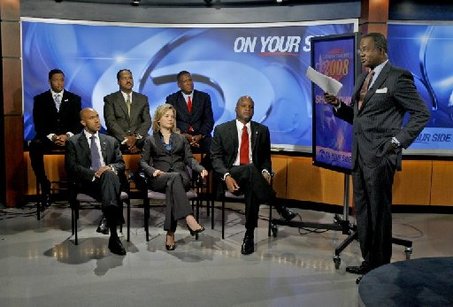
RUSTY COSTANZA / THE TIMES-PICAYUNE
The group of contenders: Kenya Smith, front left to right, Helena Moreno, andJames Carter, Cedric Richmond, back left to right, Troy Carter, and Byron Lee listen to moderator Norman Robinson during a debate at the WDSU studios for the candidates in the race for the 2nd Congressional District on Friday.
Let me just mention first, that Cedric Richmond was once a protege of $Bill Jefferson and is currently the state rep from the northeastern side of New Orleans. He endorsed Jefferson last time but is challenging him this time. He has quite a following in New Orleans East and is fairly well thought of in the legislature. Here’s some of the interesting back ground on him, however.
Step taken to suspend Richmond’s law license
Posted by The Times-Picayune October 23, 2007 4:54PM
By Gwen Filosa
Staff writerA committee of the Louisiana Attorney Disciplinary Board has recommended a one-year suspension of State Rep. Cedric Richmond’s law license as punishment for falsely claiming in 2005 that he lived in New Orleans’ District D in a failed attempt to run for the City Council.
The committee concluded that Richmond filed a sworn statement reflecting his home address in the 2005 council race “which most fitted his need at the time but which was not accurate.”
Helena Moreno quit her job as a news anchor recently to run for this position. She doesn’t need to fund raise since her family is quite wealthy and underwriting her campaign. Here’s a kicker. She’s Hispanic and is best known for being “that little white girl in the race”. Richmond and Moreno got into at the debate. She took a swipe at him for the action under consideration by the state supreme court mentioned above. His retort later?
“Would everyone up here, Miss Moreno specifically, would you be willing to submit to a random drug test?” Richmond asked, noting that many job applicants face such screening…The nasty confrontation ended with Moreno, stung by what she called Richmond’s outrageous “suggestion” that she uses drugs, marching out of WDSU-TV’s downtown New Orleans’ studios and into a nearby clinic, where she voluntarily submitted to a drug test.She quickly delivered the results — a clean reading — to The Times-Picayune.
Evidently, rumor had it that Ms. Moreno enjoys cocaine. I wouldn’t know but she vehemently agreed to take any test given. I don’t even pretend to run with the beautiful people down here so this was news to me. However, a local political talking head calls Morena Jefferson’s dream candidate … basically because she is Hispanic which puts voting by racial identity into play.
I did see the exchange on WDSU as well as read comments later. It didn’t put Richmond in the best light as far as I was concerned. I will admit that I was leaning towards him before that or Morena simply because I like supporting women candidates. The two of them appear very close to Jefferson in the polls and one or two of them may make it through tonight.
James Carter is my city councilman and just got the position two years ago. He seems to be attracting some of the endorsements Moreno hasn’t received basically because he’s really done nothing that any one can take a swing at. In other words, he has little accomplishments under his belt and has done little to offend any one as a result. He basically goes along and gets along. Did I mention James failed out of Southern University Law School and had to take the bar six times before passing it?
Next up is Bryon James who is the cousin of my state senator, Derrick Shephard. Shepard just got arrested for some domestic squabbling and is now living in his mother’s house under house arrest due to the fact he is also under indictment for money laundering and getting into fist fights with your girl friend violates your parole terms. He supposedly money laundered for a client that was sent to him by none other than $Bill Jefferson in what seemed to be a pay-off for supporting Jefferson’s run against State Senator Karen Carter (no relation to James or Troy) in 2006. Shephard also ran against Jefferson and Carter and was peeved he didn’t make the run-off. Bryon’s a city councilman from Jefferson Parish and considered a “political ally” of Shepard. Whatever that means.
The New Orleans Weekly Paper Gambit also mentions this tidbit:
“He has one other weakness: his controversial handling of the distribution of hundreds of thousands in slush-fund dollars from a Jefferson Parish landfill. Some of his own constituents have griped that he gives too much to nonprofits with which he or his allies have ties.”
Troy Carter used to be a city councilman and his turned into a perpetual candidate recently. He has a very loyal following, but unfortunately for him, they never amount to more than about 10% of the electorate. This is mostly because he’s really not known for doing anything other than providing his services for partial ownership in a business. Sit in a bar room long enough and mention his name and dozens of folks will come up with a unique story about that. No kidding. I suppose this is quite entrepreneurial of him. However, I’m not sure that’s part of the above board benefits of being a city council member.
Kenya Smith is a former aide to New Orleans Mayor Ray Nagin. He and the mayor are under some clouds at the moment for living a little too large off of the city’s credit cards. Plus, he’s an aide to Mayor Nagin. I think that just about does it for him. Mayor Nagin’sjudgement is about as solid as quicksand.
So, let me remind you, former Governor Edwin Edwards is still sitting in Federal prison. You remember him, David Duke was the candidate the Republicans ran against him that last time? Oh, speaking of Republicans, let’s not forget the little trysts of Bob Livingston and David Vitter. Republicans have such interesting sex lives for being so hyper-religious. Maybe there’s some genetic link between the two characteristics. Too bad it’s Mary’s turn to run this year, because I would really enjoy finding more about Vitter, his diaper fetish, and the hookers in Washington.
Oh, the joys of Louisiana politics. While, I have a few more hours to decide what to do, maybe you have better stories than me about your downticket candidates. I doubt it, but a girl can hope can’t she?
For more fun, follow this link. Some of the blog comments are just priceless.
Who let the Sharks Out?
Posted: October 3, 2008 Filed under: U.S. Economy | Tags: bailouts, Fannie Mae, Financial Crisis, Freddie Mac, Investment banks 4 CommentsAs the economy continues its slide towards recession, we now have a pork-laden rescue of many of the folks both responsible for the recession as well as the crisis. TARP may unfreeze the credit markets, but until we responsibly regulate the financial markets that are now shoveling troubled assets onto taxpayers and until we support the prices of their underlying assets (that would be folks’ homes), we will not solve the problem.
 I focused recently on the lax lending standards that helped to create the housing bubble (fueled also by the Fed who kept interest rates too low, too long after 2001). It was the red meat thrown into the piranha pool. Let’s talk about what the piranhas did with the red meat once they had it.
Let me mention first that we’ve nearly been here before when Long-Term Capital Management (LTCM) came close to collapse in September 1998 at the time when Russia had difficult repaying its debt. The Fed rescued the fund and showed that some guys are just “too-big-to-fail”. The Fed wanted to stop possible contagion coming from the failure from spreading to commercial banks. Studies at the time showed that losses to investment banks during this type of contagion could be huge (including one done by my Financial Intermediaries Seminar prof). They noticed that investment banks would be far more vulnerable to losses than depository institutes. This small crisis that most folks probably don’t even remember was the canary in the coal mine.
Meanwhile, the primary mortgage market was coming under the spell of the underwrite-nearly-everything mentality spurred on by Fannie and Freddie. We’ve mentioned that Fannie and Freddie also imply a government guarantee. Now, we have a situation where the Fed has shown its readiness to put the tax payer’s money behind anything it deems too big to fail. Both actions were like chumming the waters. Rising house prices were just more blood on the water. It was only time before the piranhas and sharks came to feed. They were being encouraged to ignore risk and that’s not a wise thing to do.
Five investment banks, including Goldman Sachs, approached the SEC with a proposal around 2004. They sought an exemption for their brokerage units from old depression-era regulations that limited the amount of debt they could incur. An exemption from this leverage rule would free up a heckuva lot of money to invest in some new-fangled investments: mortgage-backed securities, credit derivatives, and credit default swaps. They got permission. Enter the net capital rule that enabled the piranhas and the sharks. During the next few years, leverage ratios increased until for about every dollars worth of equity held by an investment bank, there was around $30 in debt.
Credit default swaps act like insurance. They are instruments intended to cover losses to banks and bondholders when companies fail to pay their debts. Since 2000, the market has boomed from about $900 billion to more than $45.5 trillion. This about twice the size of the entire U.S. stock market. The market for credit default swaps as well as the market for mortgage securities were left unregulated. Many folks have been worried about this market for some time.
The Comptroller of the Currency, a federal bank regulator warned that increased trade in swaps during 2007 was putting a strain on processing systems that were used to handle swaps. Swaps are essentially what brought down AIG. Back in the beginning of the year, AIG found that it had incorrectly valued some of the swaps and announced that mistake would cause the company to lose $6.3 billion more than they had estimated before.
Placing correct values on Swaps and Mortgage securities is very difficult. Big banks, insurance companies and hedge funds are among the financial institutions that trade these derivatives. CDS tend to be private agreements where buyers of the protection/insurance agrees to pay a premium to the seller over time. (Much like an insurance policy premium). The seller pays only if a particular crisis occurs. These contracts can also be bought and sold. Because the market is basically unregulated, no one quite knows when the swaps are sold and to whom they are sold. This can be a problem when the protection is required, say like when the Hurricane Katrina of asset bubbles bursts in the housing market. Just so you know, the largest players in this market are JP Morgan Chase, Citibank, and Bank of American. All WAY too big to fail, right?
Enter speculators as this market gets large. Speculators (read HEDGE FUNDS) have used these instruments to bet on a company or a bank’s failure. Funny thing is there is actually more value now out there in the derivatives than there is in the underlying assets. Remember, this is BEFORE the bubble bursts and brings the asset prices down even further. So credit default swaps are basically default insurance, although they can’t be named that. So what happens when every one needs to make a claim on their insurance and can’t exactly locate your contract and it probably resides with some one who is in worse shape than you? (Ah, let your imaginations run away with you, it’s bad.)
So, let’s get back to our Pirahanas and Sharks. They’re being encouraged to loosen up those lending standards by Fannie and Freddie AND they can buy insurance too if their bad loans go bad. How can you lose with a deal like that? It doesn’t appear that you can, does it? So what do you do? Continue underwriting loans for folks without income, folks without credit, folks that are even dead. (Yes, dead, I’m not making that up.)
I think you can see that what we have here is the perfect storm. So let me get back to what this bill doesn’t do. It DOESN’T stop the assets from continuing to go bad, at least in the housing end of things. It DOESN’T regulate any of the players in this market although the investment banks are now under the jurisdictions of bank holding companies and basically the FED. It DOESN’T deal with the leverage issue. It DOESN’T punish any one for lending bad loans even. No one is getting yelled at for encouraging this — not Fannie and Freddie, not the FED and not the SEC. Definitely not the congresscritters that enabled them either, at least not yet.
What we are witnessing is the creation of more TOO BIG TO FAIL critters AND we’re giving them more money to lend out and we have inadequate regulation. It’s time to take the chum out of the water, folks!
Why has an Army Brigade Been Assigned to Patrol “the Homeland?”
Posted: October 3, 2008 Filed under: just because Comments Off on Why has an Army Brigade Been Assigned to Patrol “the Homeland?”Today I received an e-mail from the American Freedom Campaign (AFC), an organization founded by several prominent liberals, including Naomi Wolf, author of The End of America. Among the list of official supporters of the AFC are Amnesty International and the Center for Constitutional Rights. The AFC e-mail I received alerted me to an unprecentented order by George W. Bush that for the first time in history has assigned an army combat brigade to deal with emergencies and insurrections on U.S. soil.
From Army Times:
The 3rd Infantry Division’s 1st Brigade Combat Team has spent 35 of the last 60 months in Iraq patrolling in full battle rattle, helping restore essential services and escorting supply convoys.
Now they’re training for the same mission — with a twist — at home.
Beginning Oct. 1 for 12 months, the 1st BCT will be under the day-to-day control of U.S. Army North, the Army service component of Northern Command, as an on-call federal response force for natural or manmade emergencies and disasters, including terrorist attacks…
snip
…this new mission marks the first time an active unit has been given a dedicated assignment to NorthCom, a joint command established in 2002 to provide command and control for federal homeland defense efforts and coordinate defense support of civil authorities.
After 1st BCT finishes its dwell-time mission, expectations are that another, as yet unnamed, active-duty brigade will take over and that the mission will be a permanent one.
Deep Breath Time
Posted: October 2, 2008 Filed under: Uncategorized | Tags: Racism, Suprime Mortgages 5 CommentsThere has been a recent spate of attacks on several other blogs on a post I wrote, authors writing at The Confluence, and the PUMA movement in general. Riverdaughter, who I respect and like tremendously has already given her view point. This is mine and I take full responsibility for it.
While it may be the habit of these other blogs to find their sources in the talking points of political campaigns and other blogs. It is not mine. These bloggers have not have checked any of my sources (which were indeed rooted in academic research and not either the MSM, the blogworld, or some political campaign with an agenda) nor have they learned anything about me personally and/or other PUMAs. Rather they appear to rely on caricatures.
I’m not one to drag charts and statistics in to blogs when I speak about economic issues because it tends to make folks remember their economics courses and become disinterested. When I wrote the post in question, one of my major sources was the academic work of Stan J. Liebowicz. He is a professor of economics at the University of Texas Dallas. This is his article cited once more for you. It is called Anatomy of a Train Wreck: The Mortgage Meltdown Crisis .
Read this article please. If you look at his numbers you will see, that his study and that of others cited in the article do not bear out the story of a group of poor down trodden folks being lead to their demise by greedy lenders and placed in subprime mortgages. In fact you will see that most of the problems of defaults are in the prime mortgage markets. Increased foreclosures have happened in both the subprime and prime markets with the same intensity. If you look at his figures, you’ll see that subprime loans do not perform any worse than prime loans. There is no evidence to support any claim that this problem started in subprime mortgages. Both markets were hit at the same time.
There were lax lending standards in both markets encouraged by politicans trying to appease their consitutients. Lax underwriting standards were pushed by both Freddie and Fannie. The executives were paid bonuses based on increased production and were not punished for encouraging bad lending practices. If anything, they were rewarded by congressional praise and fat bonuses. These folks also encouraged the institutions they dealt with to lower their lending standards. In fact, the Fannie May foundation continually encouraged and praised Countrywide for its ‘innovative’ underwriting practices. I quote from one of their reports.
Countrywide tends to follow the most flexible underwriting criteria permitted under GSEand FHA Guidelines. Because Fannie Mae and Freddie Mac tend to give their best lenders access to the most flexible underwriting criteria, Countrywide benefits from its status as one of the largest originators of mortgage loans and one of the largest participants in the GSE program.
When necessary–in cases where applicants have no established credit history, for example–Countrywide uses nontraditional credit, a practice now accepted by the GSEs.
At this same time (2000), Countrywide was named “Corporation of the Year” for their outstanding work in the Latino Community. If this corporation, was guility of preying on minorities with nasty subprime loans, you sure wouldn’t know it then. They were being rewarded for extending home ownership. They were considered outstanding corporate citizens.
I can cite many more examples, but rather than just paraphrase Dr. Liebowiz’s work any further or the other underlying sources he cites, go READ them. In fact, if you search the academic literature, you can read many, many examples of studies that cite lax underwriting standards as the problem not subprime mortgages. This is why Fannie and Freddie both failed! They were actively buying and packaging loans that were bound to fail if the economy worsened!
I’d also like to bring to your attention this series of interviews with top financial economists done recently. I’m using this to point to the fact that most financial economists see Fannie and Freddie and their loose underwriting guidelines as the basis of this problem rather than the subprime mortgage market.
Economists Raise Concern about Bailout Plan
This link is worth a read. Here’s one quote from that link.
The economists offered a range of explanations for the problems, but they did agree on a few things. All were concerned about the way that the government set up Freddie Mac and Fannie Mae, though they did not all agree that it should be fixed immediately as part of the bailout. Jon Berk pointed out:
Freddie Mac and Fannie Mae — all of us knew it was going to happen. You don’t have an implicit agreement where you cover their losses and don’t expect these types of problems (their large financial losses).
It is worth mentiont that the aforementioned Dr. Johnathan Berk is from Standford and the on record as an Obama supporter.
Here is another point.
In addition, most of the economists criticized the federal government for restricting mortgage lenders’ ability to require down payments and properly check credit scores, but they were not unanimous on how much of the problem could be attributable to this.
On a more personal note, I think you should know that I have lived within one mile of ACORN for about 13 years now so I have some first hand experience with them. I live in the ninth ward of New Orleans. I do not teach at a university full of happy suburban faces with rich parents. I choose to teach at schools where many students come from the same inner city neighborhood that I live in or the surrounding rural areas. I have a Freddie loan myself. My city councilman is black, my mayor is black, my congressman is black (although I’m hoping we can replace $Bill Jefferson with an hispanic woman or with another black man who is a state representative), my state representative is black, and my state senator is black. If I was a racist republican redneck, I really doubt I would have made the lifestyle choices that I’ve made. I live my convictions.
Through out this election, it has become de rigueur to throw the racist label at anything that disagrees with you. It is getting tiresome and it is densensitizing people to the true problems we still face with racism. I live in New Orleans and have seen black politicians take advantage of their constituents just as readily as I’ve seen white politicians do the same. Enriching yourself off the vulnerable is not limited to one race or one part of the country. It is also not limited to one political party. Before you start throwing that label around, I’d suggest you do your homework for a change rather than jump to conclusions without citing fact or circumstance. I’m not a Republican and I’m not using Republican talking points. I’m an economist, and I’m using academic, peer-reviewed research. If the data doesn’t fit your worldview, please don’t call my friends and me names because you have no other response up your sleeve.
Those who forget the past are condemned …
Posted: October 1, 2008 Filed under: U.S. Economy | Tags: bail out, Bail out of Fannie Mae and Freddie Mac, Fannie, Financial Crisis, HOLC 6 Comments(cross-posted at the Confluence)
I’m having difficulty digesting a lot of the news and hoopla surrounding this financial crisis. There are some things that are really worrying to me. It’s not so much the crisis itself, which I actually understand, but the responses. I am reminded of the saying that those who forget the past are condemned to repeat it. I think this basically sums up much of why I feel so desperate when I watch the response to this crisis unfold on TV. It’s time to stop the blame and start the problem-solving.
First, what really bothers me is the inability of ANY of the politicians to either REALIZE how they contributed to this or understand what lead to this. A recent post by myiq2xu mentioned a speech by Senator Obama who offhandedly referred to the period of deregulation of industries that went on during the 70s. He has been hammering his every talking point with the Republicans did this to us. Useful, I suppose when trying to get elected based on something other than your credentials, but disingenuous at the very least. I keep wondering if he JUST doesn’t know the history of deregulation or he’s purposefully lying to us.
The deregulation of the telcom industry, the airline industry and the banking industry came about during the Carter regime. When I was a fresh out of grad school economist, I worked for a bank then a Savings and Loan. The Monetary Control Act of 1980 (okay, i’m dating myself) was a response to the problem of traditional banks and thrifts hemorrhaging deposits to Money Market Accounts. The root of deregulation started with Jimmy Carter’s administration. Hasn’t any one told him this or does he just like to go on misspeaking? The fight against the deregulation against Fannie and Freddie–probably the biggest contributors to this latest moral hazard problem–was led by the Democrats also. Why can’t we just be honest about this and say that each of the parties had a hand in this and learn from the past?
Second, I lived through the S&L crises and the economy that prevailed in the early 80s. My first house loan had an interest rate of 17.67% which got discounted to a beneficent 12.67% because I worked for the thrift that gave me the loan. House loans aren’t even half that at the moment. Two other folks besides me got house loans that month from the biggest thrift in the heartland. I’d say that was a credit crunch, wouldn’t you? I also worked the money desk at that time and remember the interbank loan (Fed Funds rate) bopping between 4% and 21% on any given day. Both of these rates are a far cry from the current rates as is the unemployment rate which sat between 12 and 13% for some time. Remember, these were the morning in America years of the early 80s. We currently have a 6.1% unemployment rate.
My father lived through the great depression. At that time, the unemployment rate peaked between 25% to 29%. The foreclosures that happened during that time occurred because no one had jobs and no one had unemployment insurance. When they closed the banks, there was no FDIC so, you lost your life savings. Today, we have unemployment insurance, the FDIC, and various other types of insurance that minimize the loss you experience on your deposits –even money market funds. You may experience paper losses, but you will not loose EVERYTHING! There are safeguards against much of the worst situations experienced during the depression. I’m not sure that given today’s economy, which is sluggish and experiencing problems but is not as bad as either of these two periods, we need this rush to judgment. Why aren’t we thinking this bail-out plan through more?
 Which brings me back to today. We solved many of the problems of the previous financial crisis with government intervention. The HOLC bought up many defaulting mortgages, renegotiated them when possible, and held on to the properties, insuring they wouldn’t drive land and house prices down further. During the S&L crisis, the RTC bought out S&Ls, unwound the assets, and sold the sellable ones while holding onto the bad stuff, until the market turned around. The government can afford to hold paper losses on its books. Private industry cannot. Government can help put a bottom price on these markets. This is what it needs to do. It does not need to end the alternative minimum tax, change the taxes on corporations, or fund ACORN and La Raza.
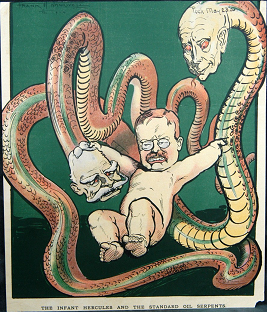
Which brings me to one more point, when do we stop turning these unprofitable behemoths into megacompanies that become too big to fail? Haven’t we learned anything in the past about this? Why are we creating more Freddies and Fannies? It is not fair to the taxpayer for the profits to be privatized, but the losses to be turned to the public. During the last 30 years, we’ve allowed mergers to create these giant companies that are behaving more and more like monopolies. This is not good for a free market system. If we are allowing them to become so big and letting them get away with extraordinary profits during good times, than making them subject to public largess if they fail, what is the difference between this and just nationalizing them altogether? Didn’t we learn these lessons during the trustbusting years of Teddy Roosevelt? Isn’t the basis of our monopoly law the Sherman Anti-trust regulations that were set up in the 19th century? Why have we forgotten the excesses of the gilded age?
Yes, it’s broken. Yes, it needs to be fixed. But can some one in Washington just pick a few history and economics textbooks so we’re not condemned to relearn the lessons of the past and do it with everyone’s tax dollars?

 peej
peej Carissa
 bostonboomer
 dakinikat
 ecocatwoman
 mablue2
 Mama Lopez
 peggysue22
 quixote
 skydancingguestblogger
 Mona (aka Wonk the Vote)



 Sky Dancing
Recent Comments